
Acetate vs Metal vs Injection Sunglasses Guide
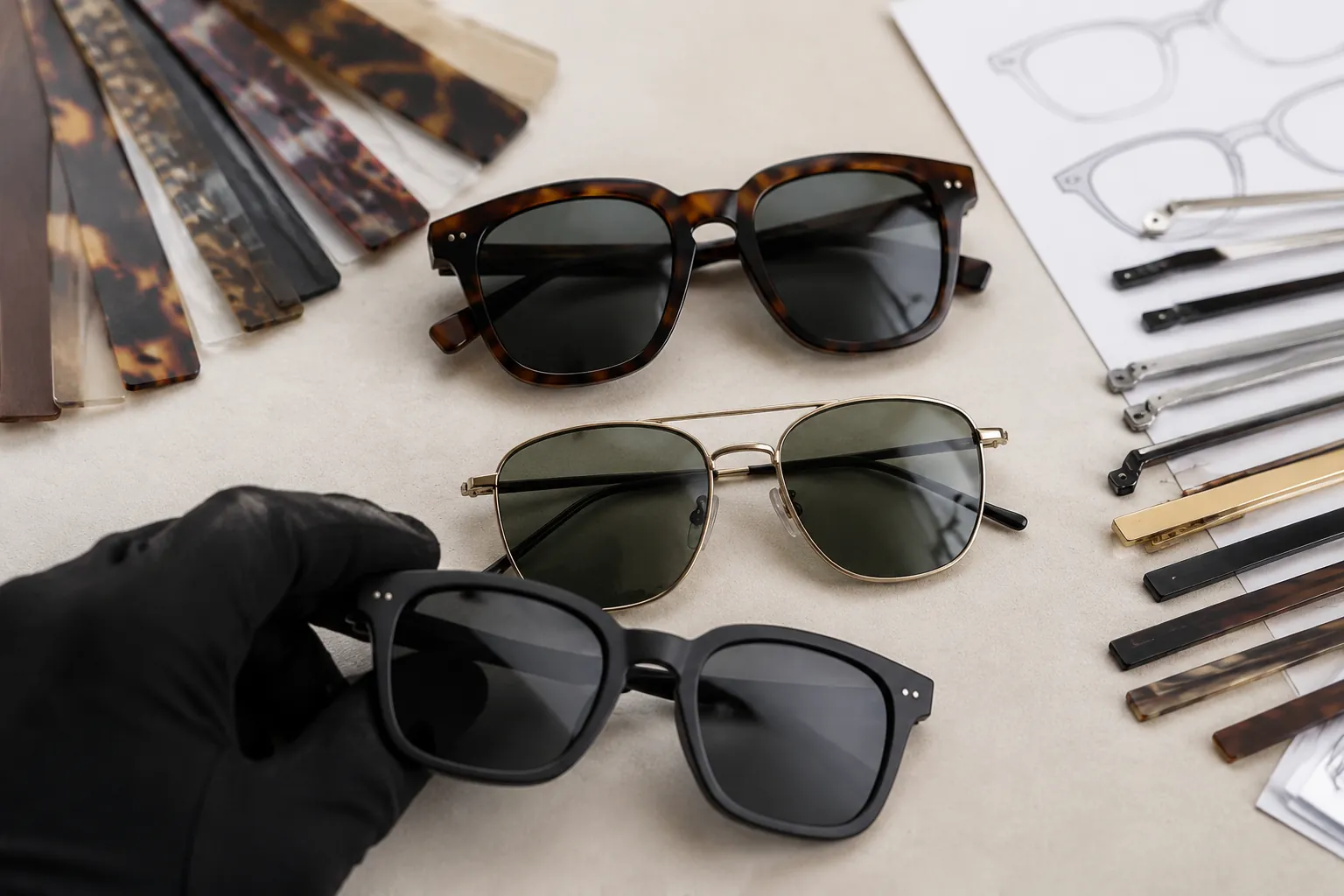
If you buy sunglasses for a brand, chain, import program, or distributor line, frame material is not just a design choice. It affects tooling cost, sample speed, landed margin, weight, finishing quality, compliance requirements, and how painful reorders will be. The right build depends on your target retail price, how many SKUs you want to carry, how much inventory risk you can absorb, and whether you need speed or a premium feel. This guide compares acetate, metal, and injection frames in practical terms so you can match construction to the business model instead of guessing from a catalog photo.
Start with the business model, not the material
Buyers often ask which frame material is better. That is the wrong first question. The better question is simple: which construction fits the channel?
A promotional program, a mid-market chain style, and a premium fashion line do not need the same tooling budget, finishing standard, or reorder strategy. They are different jobs. Treat them that way.
Three variables usually drive the decision. First is target retail price, because it sets the landed cost ceiling. Second is reorder behavior: a seasonal drop can handle more setup friction, while replenishment needs repeatability. Third is decoration complexity: a simple temple print is easier than a recessed logo, metal plaque, or multi-step color effect.
In practical terms, injection supports speed and stable unit cost, metal supports slim silhouettes and a light look, and acetate supports stronger perceived value with more depth in color and finish. Those differences come from how each frame is made, how many operations it needs, and how much labor sits between the first sample and the bulk carton.
At LumiShades in Wenzhou, the working split is straightforward. Injection is the fastest route to volume. Metal is the cleanest route to a light, sharp-looking frame. Acetate is the most premium-feeling option, but it usually asks for more handwork. If you are planning a small first order, keep the construction simple. If you are planning a repeat program, the reorder economics matter more than the first sample photo.
One caution: do not assume a supplier controls every step just because they say yes to everything. Ask whether the same specification can be held from sample to bulk to reorder. That is the real test.
Acetate: best for premium positioning and color depth
Acetate frames are cut from cellulose acetate sheet, then shaped, drilled, tumbled, polished, assembled, and adjusted. Because the material comes from layered sheet stock rather than injected resin, it can deliver richer color depth, stronger translucency, and a solid hand feel. That is why acetate still shows up in premium private-label collections and fashion-led retail programs.
The process is more labor-intensive than injection. Several steps still depend on trimming, fitting, and finishing. That is where buyers see risk. The material is not the problem. Inconsistent polishing, symmetry, or assembly is.
A sample can look strong on the bench and still drift in bulk if the finishing standard is loose. That happens more than it should.
Where acetate makes sense:
- Retail price bands that need stronger perceived value and room for margin.
- Collections with tortoise, marble, translucent, layered, or custom color stories.
- Brands that want thicker temples, a firmer feel in hand, and more visual depth under light.
The trade-offs are clear. Acetate is usually heavier than many injection builds and many wire-metal styles. It also needs careful packing because polished surfaces can scuff if cartons are loose or if the pouch and tissue spec is weak. Lock the hinge type, screw spec, lens retention standard, and packaging spec early. Do not leave them until after sampling.
Decoration options are strong, but they should fit the material. Laser engraving works well on temples and can hold detail. Pad printing and hot stamping can work for logos if abrasion performance is checked. Metal logo plates add perceived value, but only if the mounting and edge finishing are clean. Approve the decoration method together with the finishing method. Do not split them into separate decisions.
Metal: slim profile, sharper look, tighter assembly
Metal frames fit buyers who want a thinner visual profile, lower face coverage, or a classic fashion look. They are common in wire frames, rimless or semi-rimless styles, aviator shapes, and mixed-material constructions where the front is metal and the temples carry acetate or injected tips.
Production is less about cutting thick blocks and more about part accuracy and assembly control. The important measurements are bridge width, pad arm symmetry, pantoscopic angle, temple length, and hinge alignment. Small errors show fast. There is nowhere to hide them.
A crooked bridge or uneven pad height can make a stylish frame feel cheap or uncomfortable. That is the risk.
Metal is often chosen for these reasons:
- Lower visual weight on the face and a cleaner silhouette.
- Good fit for fashion classics, rimless-inspired shapes, and smart-casual assortments.
- Flexible decoration options such as laser marking, enamel fill, pad printing, and small logo plates.
The commercial reality is straightforward. Metal can look more premium than its actual build cost if the silhouette is right and the finishing is clean. But it can also become fragile if the wire diameter is too thin, the bridge is underbuilt, or the hinge torque is too low. Ask for the hinge opening feel, pad arm material, plating specification, and corrosion testing method used by the factory.
For regulated markets, finish quality and compliance documents matter. Ask whether the supplier can support CE EN ISO 12312-1, ANSI Z80.3, AS/NZS 1067, and REACH where applicable. If your program needs them, also ask whether the factory can provide FDA registration details for the manufacturing entity and the documents your compliance team requires. Get the documents before approval. Not after shipment.
Injection: fastest path to volume and repeatability
Injection frames are the workhorse for price-driven programs. The parts are molded from resin, trimmed, assembled, and decorated with fewer manual shaping steps than acetate. If you need speed, predictable unit cost, and scalable repeat orders, injection is usually the first place to look.
The real upside is tooling efficiency. Once the mold is approved, repeat production is usually more stable than hand-finished builds because the core shape comes from the tool rather than the operator. That matters for private-label buyers who want the same style on every reorder and for core carryover programs that need to hold shape and color across seasons.
Injection is typically the best fit for:
- Promotional, entry-price, and club-store programs.
- High-volume SKUs with stable demand and simple color stories.
- Collections where speed to market matters more than hand-finished depth.
There are trade-offs. Cheap injection can look cheap if the wall thickness is wrong, the surface texture is weak, or the mold layout creates sink marks or visible gates. A well-made frame usually needs balanced wall design, hinge reinforcement, and careful gate placement to avoid stress whitening and brittle break points. Ask for the mold plan, expected cavity life, gate location, and the color-matching method used for production.
Decoration can be efficient on injection frames. Pad printing, hot stamping, in-mold texture, soft-touch coating, and small metal inserts are all common. Keep the design realistic for the material. If the frame is overdecorated, it can gain weight, lose durability, or become expensive enough that injection no longer behaves like an entry-price solution.
Compare the three structures in commercial terms
Use the table below as a buying shortcut. These are practical differences, not abstract design opinions.
| Frame type | Best retail position | Tooling / setup | Typical strengths | Main risks | Buyer fit |
|---|---|---|---|---|---|
| Acetate | Premium to upper-mid | Moderate, with more handwork | Color depth, solid feel, premium perception | Heavier weight, longer finishing time, polish variation | Brands, boutiques, fashion-led programs |
| Metal | Mid to premium | Moderate, assembly-sensitive | Slim profile, clean lines, strong style range | Warp, plating defects, fragility if underbuilt | Retailers needing sharper silhouettes |
| Injection | Entry to mid | Higher upfront mold dependence | Fast production, stable repeat runs, strong volume economics | Cheap look if designed badly, mold defects, sink marks | Importers, chains, volume-driven private label |
The right choice usually shows up once you know the retail story. If the line needs a high perceived-value frame at a modest landed cost, acetate can work. If the line needs tight cost control and fast replenishment, injection usually wins. If the brand wants a lighter visual profile and balanced margin, metal sits in the middle. The material should support the retail promise. It should not fight it.
Do not stop at the front frame photo. A frame with premium-looking fronts but weak hinges, poor temple tips, or low-grade lenses can still fail at retail. A good OEM eyewear program aligns frame construction, lens quality, packaging, and compliance so the whole product lands at the intended shelf position.
Tooling, MOQ, and unit price: where the breakpoints sit
Tooling and MOQ should be discussed together. Too many buyers negotiate one without the other, then get surprised when the price only looks good because the factory assumed a larger run, a simpler decoration package, or a lighter QC standard.
The practical starting point depends on the project, but a low MOQ is useful only if the supplier can still hold the same specification. If you are testing a new shape, a smaller run can make sense. If you are planning a carryover style, the real question is where the unit cost becomes efficient enough to support the channel.
- Small pilot runs: useful for market testing, influencer drops, or first-time style approval.
- Mid-size runs: often the first level where custom packaging, printed pouches, and broader color selection begin to make sense.
- Larger runs: better for stable core shapes, repeat programs, and simplified decoration with consistent demand.
Acetate usually tolerates premium pricing better because the market accepts the look and feel. Metal pricing is driven by plating, nose pad quality, assembly labor, and reject rates on fit. Injection is where volume economics usually improve fastest, provided the mold is right and the design is not overcomplicated. If a supplier gives you one universal price for all three structures, be skeptical. That often means the quote hides something: finish quality, lens spec, compliance testing, or packing standard.
For a private-label buyer, the best request is a written quote that breaks out material, decoration, lens spec, packaging, testing, and any one-time setup items. That makes it easier to compare bids without mixing recurring cost and one-time cost.
Lead time and reorder speed are not the same thing
Sampling and bulk production should be planned separately. A sample can be fast even when a reorder is slow, and a fast first order does not guarantee a smooth replenishment program.
Injection can be the fastest path once the mold is approved because the process is highly repeatable. Reorders are straightforward if the color code, lens tint, and finishing note stay stable. Metal usually needs careful recheck on plating, pad alignment, and hinge tension before each run. Acetate can take more attention because polishing, fitting, and temple alignment are more sensitive to batch variation and handwork consistency.
Here is the practical rule:
- Choose injection if you need faster replenishment and simpler repeatability.
- Choose metal if the style is narrow, slim, or fashion-led and the volumes are moderate.
- Choose acetate if the collection needs stronger perceived value and you can accept more finishing time.
For buyers working across seasons, reorder flexibility is often more important than first-order cost. A frame that is slightly cheaper but unstable on repeat can create more damage than it saves. The best suppliers build a repeat spec file that covers color chips, hinge hardware, temple length, bridge tolerances, lens tint codes, and carton details so the second order looks like the first one.
If you are comparing factories, ask whether the same approved sample, material code, and packaging code will be carried forward to reorder. That question usually reveals how disciplined the supplier is.
How to specify the frame so the order does not drift
Good specs prevent disputes. Bad specs create same-style-different-look problems on reorder. The easiest way to lose control is to approve a loose sample and then assume the bulk will match by memory.
At minimum, lock these points before bulk:
- Frame material and exact finish.
- Temple length, bridge width, lens width, and total front width.
- Hinge type, screw requirement, and opening tension.
- Logo method: laser engraving, pad printing, hot stamping, or metal logo plate.
- Lens tint, UV protection target, and compliance market.
- Packing method, carton count, and transport test expectations.
For dimensional control, ask the supplier to confirm acceptable tolerances in writing. The exact tolerance should match the design and production method, but the point is simple: it must be specified before bulk. If you sell into the EU, ask for CE EN ISO 12312-1 support where applicable. For the U.S., ask for ANSI Z80.3 support and any required FDA registration information. Australia and New Zealand may require AS/NZS 1067. REACH matters for restricted substances. Ask what testing is done in-house and what documentation ships with the carton.
Also check whether the supplier has a documented quality system such as ISO 9001 and, if relevant to your sourcing policy, BSCI. Those are not product certifications, but they help buyers assess process control and social compliance.
A simple buying rule you can use today
If your brand is building premium image and can support a higher retail ticket, start with acetate. If the goal is a slimmer fashion silhouette with balanced margin, use metal. If you need speed, cost control, and easy replenishment, injection is usually the safest bet.
The cheapest unit price is not always the best business choice. A frame that misses your retail position will cost more in markdowns, returns, and dead stock than you save at the factory gate. Private-label buying is not just about the part. It is about channel fit, repeatability, and how much production risk you want to carry.
For overseas buyers, the useful question is this: which construction gives you the cleanest path from sample to bulk to reorder without surprises? That is the one to spec. If you want to reduce risk further, build one hero acetate style, one core metal style, and one high-volume injection style instead of forcing one material to do every job.
FAQ
Which frame material gives the best margin for private-label sunglasses? There is no universal winner. Injection usually gives the lowest unit cost at volume, acetate supports stronger perceived value, and metal often sits between them. The best margin comes from matching the material to the channel, retail price, and reorder plan, not from choosing the cheapest frame.
What MOQ should I expect for custom sunglasses? MOQ depends on the factory, material, and decoration package. Start by asking for the minimum order per design, per color, and per lens tint, because those may differ. A good buying brief should also ask when pricing improves at higher quantities so you can compare pilot runs with replenishment runs.
How fast can I get samples and bulk production? Ask the supplier to quote sample lead time and bulk lead time separately, because they are not the same. Sample speed depends on whether the style is new or based on an existing tool, while bulk speed depends on material, decoration, lens spec, and packaging. Lock the timeline in writing before approval.
Which structure is easiest to reorder without variation? Injection is usually the most repeatable once the mold and color standard are approved. Acetate and metal can also reorder well, but they rely more on finishing control, hardware consistency, and assembly checks. For any material, keep the approved sample, material code, and packaging code locked for reorder.
What compliance documents should I ask for? Ask for the documents that match your target market. Common requests include CE EN ISO 12312-1 for the EU, ANSI Z80.3 for the U.S., AS/NZS 1067 for Australia and New Zealand, and REACH for restricted substances. If your team requires it, ask whether the manufacturer has FDA registration information available, and request ISO 9001 or BSCI documentation if those are part of your sourcing policy.
Can one collection mix acetate, metal, and injection? Yes. Many buyers do this. A practical mix is acetate for hero styles, metal for slim fashion pieces, and injection for volume basics. Keep the price architecture, decoration limits, and compliance requirements clear from the start so the collection feels coherent and the factory can quote it correctly.
Have a custom sunglasses project in mind?
Send us your styles, target market and quantities and we will return a detailed quote with MOQ, lead time and a sample plan.
Get a QuoteWhy source this from Wenzhou with LumiShades
Wenzhou in Zhejiang Province is widely regarded as China’s eyewear manufacturing capital, producing a large share of the world’s sunglasses. That concentration matters to buyers: a deep local supply chain for acetate sheet, hinges, lens blanks, plating and packaging means shorter component lead times, easier color and material matching, and a workforce with decades of eyewear-specific skill. LumiShades has manufactured in this ecosystem since 2009, and our vertical integration — in-house injection molding, acetate cutting, CNC milling, lens tinting, decoration and quality control — means no part of your order is quietly subcontracted to a workshop you cannot audit.
For international buyers, that vertical control translates into accountability. When a single factory owns every step, defects are traced and fixed at source rather than bounced between vendors, and your specifications survive intact from first sample to bulk. For procurement review, buyers can request process records, approved samples, quality checkpoints and project-specific compliance files before placing a bulk order. Required testing and documentation are confirmed against the destination market and product specification rather than assumed from a generic certificate list. Explore our manufacturing capabilities and quality control process to see how this works in practice.
Frequently asked questions
Which frame material gives the best margin for private-label sunglasses? There is no universal winner. Injection usually gives the lowest unit cost at volume, acetate supports stronger perceived value, and metal often sits between them. The best margin comes from matching the material to the channel, retail price, and reorder plan, not from choosing the cheapest frame.
What MOQ should I expect for custom sunglasses? MOQ depends on the factory, material, and decoration package. Start by asking for the minimum order per design, per color, and per lens tint, because those may differ. A good buying brief should also ask when pricing improves at higher quantities so you can compare pilot runs with replenishment runs.
How fast can I get samples and bulk production? Ask the supplier to quote sample lead time and bulk lead time separately, because they are not the same. Sample speed depends on whether the style is new or based on an existing tool, while bulk speed depends on material, decoration, lens spec, and packaging. Lock the timeline in writing before approval.
Which structure is easiest to reorder without variation? Injection is usually the most repeatable once the mold and color standard are approved. Acetate and metal can also reorder well, but they rely more on finishing control, hardware consistency, and assembly checks. For any material, keep the approved sample, material code, and packaging code locked for reorder.
What compliance documents should I ask for? Ask for the documents that match your target market. Common requests include CE EN ISO 12312-1 for the EU, ANSI Z80.3 for the U.S., AS/NZS 1067 for Australia and New Zealand, and REACH for restricted substances. If your team requires it, ask whether the manufacturer has FDA registration information available, and request ISO 9001 or BSCI documentation if those are part of your sourcing policy.
Can one collection mix acetate, metal, and injection? Yes. Many buyers do this. A practical mix is acetate for hero styles, metal for slim fashion pieces, and injection for volume basics. Keep the price architecture, decoration limits, and compliance requirements clear from the start so the collection feels coherent and the factory can quote it correctly.
Ready to start?
Explore our shield & oversized sunglasses or request a quote — our sales team replies within 12 hours.
Request a Quote