
Stainless Steel vs Plated Alloy Sunglasses Frames
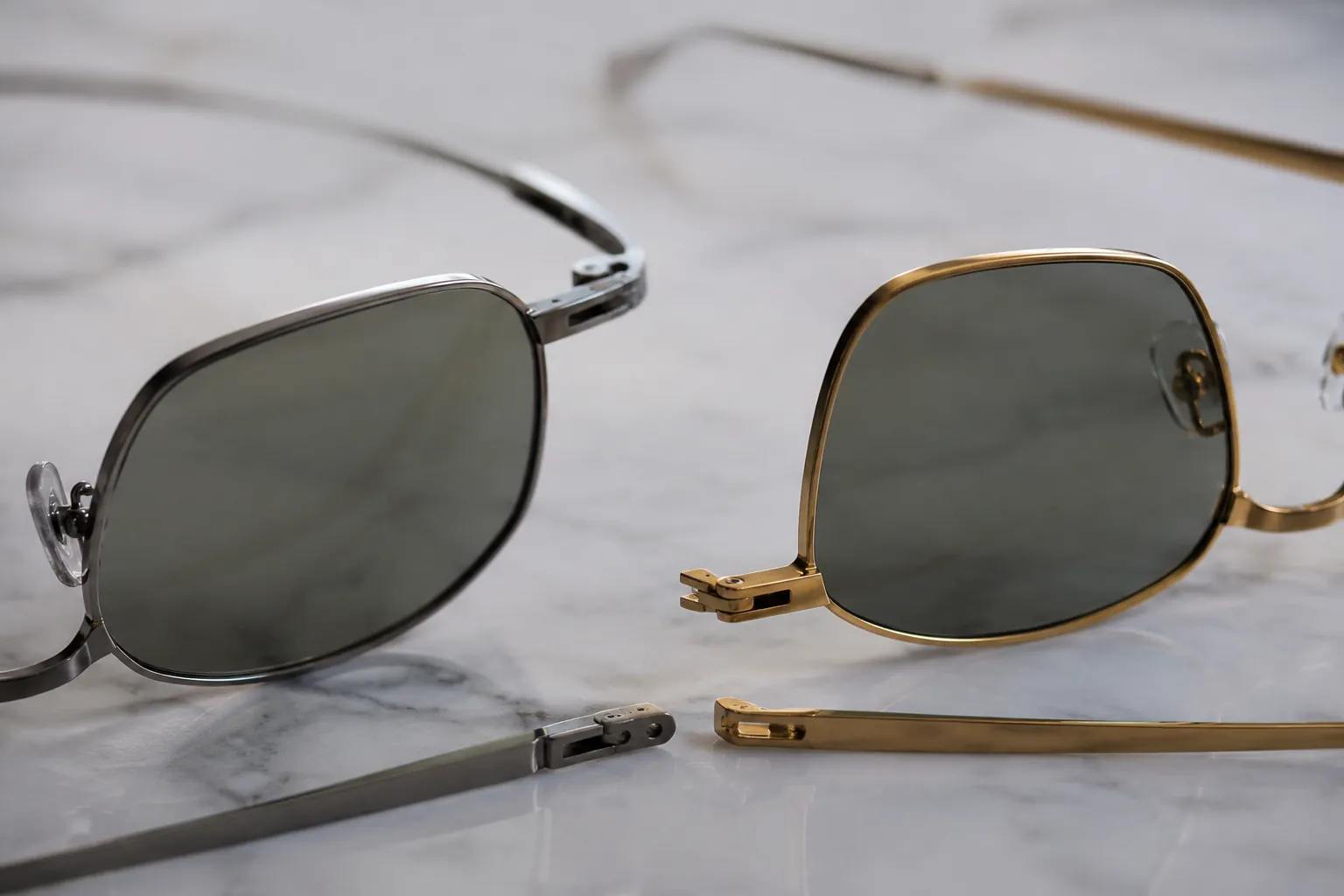
This guide is for brand owners, importers, distributors, and retail buyers choosing between stainless steel and plated alloy for custom metal sunglasses. The goal is practical: cut finish complaints, make costing easier to read, and match the frame material to your target retail price, climate, and order volume. Stainless steel is not always the right answer. Plated alloy still works when the budget is tight, the product life is short, and the design is built around that reality.
Start with the job the frame must survive
Metal sunglasses fail in a few predictable ways. Plating can dull or rub through. Sweat can attack the bridge or temple tips. Screws can loosen after repeated heating and cooling. Hinges can lose tension. Frames can bend and not return cleanly.
The right material depends on which failure would hurt your business most. If customers expect repeat wear through a full season or longer, corrosion resistance matters more than a low unit price.
Stainless steel is usually the better choice for humid markets, coastal retail, travel channels, and designs with thin temples, narrow bridges, or exposed edges. In sourcing terms, stainless gives you more margin for error. A scratch through the finish is less likely to become an immediate complaint because the base metal resists corrosion better than most plated alloys. A well-designed stainless frame can also hold alignment better when the front, bridge, and temples stay within sensible wall thicknesses.
Plated alloy, usually zinc alloy or copper-based alloy depending on construction, fits price-driven programs, fashion drops, event merchandise, and lower retail price points. It can look good at first inspection, especially on thicker decorative fronts or bold logo areas. The risk is not day-one appearance. The risk is what happens after repeated wear, heat, sweat, and friction. If the plating stack is thin, porous, or poorly sealed, weak points show up fast.
A simple rule: if the buyer expects repeat wear for a full season or longer, quote stainless steel first. If the buyer is targeting a promotional price and accepts shorter product life, plated alloy can work. Just write finish expectations into the spec. Define acceptable scratch behavior, edge wear, and color shift before production starts.
How the two materials behave in production
Stainless steel frame parts are normally stamped, cut, CNC profiled, drilled, welded or soldered, polished, and then finished by electroplating, PVD, painting, or electrophoresis depending on the look. The material is harder on tooling than alloy and needs more discipline during polishing. On thin stainless temples, over-polishing can change the profile or soften the edge. Under-polishing leaves tool marks that can show through light-colored finishes. The main control points are polishing consistency, weld cleanliness, and fixture accuracy during coating.
Plated alloy is easier to cast or stamp into thicker decorative shapes. It handles bold bridges, raised logos, and sculpted fronts well. That is why many low-cost fashion metal frames use it. The trade-off is weight, porosity risk, and finish stability. Alloy parts often need copper or nickel underlayers before the final color plating, and every layer adds another process variable. If a supplier skips or shortens pre-treatment, the defect may not appear until the product has already reached the market.
For custom projects, material choice changes more than frame cost. It affects polishing time, plating control, screw selection, nose pad fitting, salt-spray expectations, and QC sampling. A metal frame is a stack of decisions, not one line item. Even a small change in temple thickness can alter weight, fit, and how the frame behaves during plating and assembly.
- Use stainless steel for thin temples, minimalist shapes, better corrosion resistance, and retail products that should survive regular use.
- Use plated alloy for chunky decorative shapes, very aggressive price targets, and short-cycle fashion programs.
- Avoid vague specs such as "gold metal frame." State the base material, finish process, lens standard, hinge type, logo method, and approved sample reference.
For sourcing accuracy, ask the factory to confirm wall thickness, temple spring-back tolerance, and the expected finished weight. In custom programs, finished weight should always be measured, not guessed from a sketch.
Durability, corrosion, finish, and cost compared
| Decision point | Stainless steel | Plated alloy | Buyer note |
|---|---|---|---|
| Corrosion resistance | Strong base-metal resistance; scratches are less risky | Depends heavily on plating thickness and sealing | Choose stainless for humid, coastal, or sports-adjacent markets |
| Frame strength | Good for thin parts if the design avoids weak bends | Can be rigid but may deform or crack at thin sections | Do not copy a stainless design directly into alloy |
| Finish stability | Better long-term stability with proper polishing and coating | Good initial look; higher risk of color loss at edges and hinges | Ask for finish testing on the approved sample |
| Weight | Can be kept light with slim temples and bridges | Often heavier, especially in cast decorative parts | Check full finished weight, not only frame drawings |
| Target price | Higher unit cost, especially at low MOQ | Lower entry price for simple fashion programs | At different order sizes, the gap can narrow depending on finish |
| Best use case | Brand lines, retail ranges, private label programs | Promotions, seasonal colors, price-led drops | Match the material to the return policy and brand promise |
The table is only a starting point. A poor stainless frame can still fail if the weld is dirty or the coating is rushed. A well-managed alloy frame can still pass a reasonable retail inspection. The difference is the size of the safety margin. Stainless gives you more margin when the frame is scratched, sweated on, packed in a hot container, or stored for weeks before sale.
For cost planning, ask for a quote split into material, surface finishing, assembly, lens, packaging, and test charges. On a simple metal frame program, the material itself may be only part of the landed price, while polishing, plating, and rework can drive a surprising share of cost. That is why a stainless frame with clean geometry can sometimes be more economical than a complex alloy design that looks cheaper on paper but takes longer to finish well.
Finish stability: where plated alloy gets into trouble
Most complaints on plated alloy sunglasses are not dramatic. They are small and irritating: gold turns pale at the temple bend, black plating rubs off near the hinge, discoloration appears around the nose bridge, or the logo plate changes color before the lens has any problem. These issues usually start at high-contact points. The first signs often show up on the inside of the temple bend, hinge barrels, bridge underside, and any corner with a sharp edge or weld line.
The weak zones are predictable. Hinges trap sweat and sunscreen. Bridge undersides collect skin oil. Temple tips see constant friction. Sharp edges receive thinner plating because current distribution is uneven during electroplating. If the supplier does not radius the edge before plating, that edge may look fine in the showroom and fail after a few weeks of wear. A small radius can materially improve plating consistency on small metal parts.
For stainless steel, finishing still needs control, but the base metal is more forgiving. Polished stainless with electrophoresis or PVD can hold color better than a basic plated alloy finish. If your frame uses light gold, gunmetal, matte black, or rose gold, ask how the color is built: base polish, underlayer, final coating, sealing, and inspection criteria. Also ask for the coating thickness target, because a finish that is too thin may pass appearance checks but fail rub resistance.
Factory-floor rule: do not approve a metal sunglasses sample under office light only. Check edges, hinge barrels, screw holes, bridge underside, and temple bends under bright white light. Then rub the high-contact areas with a dry cloth. If color transfer appears on the first sample, bulk production will not improve by itself.
When a buyer wants darker finishes, especially matte black or dark gunmetal, ask whether the factory is using PVD, electrophoresis, painted top coat, or a basic electroplated color layer. The process choice affects abrasion resistance, repairability, and consistency across production lots. If the order is for a repeat line, keep the finish method locked rather than swapping methods to chase a small price drop.
MOQ, pricing, and when stainless becomes worth it
Low minimum orders are useful for testing colors, validating fit, or checking a new frame direction. At small quantities, stainless steel can look expensive because setup, sample handling, polishing, and finish control are spread across fewer units. The first quote is not the full story. Compare not just unit price, but also the chance of remake, damage, and complaints after delivery.
Prices improve as order quantities increase because tooling use, material buying, line setup, and QC routines become more efficient. On volume, some custom sunglasses programs can move down materially compared with small trial orders, depending on frame type, lens, decoration, packaging, and inspection requirements. That is not a promise; it is a sourcing pattern. A stainless steel metal frame with premium finish, spring hinges, polarized lenses, and custom packaging will sit above a simple frame with basic components, and it should. The added process steps cost money.
For plated alloy, the low entry price can be attractive, but buyers should include the cost of possible claims. If a distributor sells into humid countries and receives finish complaints, the apparent saving disappears quickly. If the product is a short-term promotional giveaway with a clear budget ceiling and limited wear expectations, alloy may still be the rational choice. The key is to align the material with the commercial lifespan of the product.
Use this sourcing sequence to avoid mismatched quotes:
- Set the target retail price and expected product life.
- Define the market climate: dry inland, humid, coastal, beach retail, or travel retail.
- Choose the frame material before locking the finish color.
- Ask for samples in the real finish, not a similar showroom color.
- Confirm packaging, because poor packing can scratch metal frames before they ship.
In practice, a small trial is best used to prove color, fit, and consumer response. A mid-size order is often the first level where material and process efficiencies become visible. Larger orders may justify custom tooling details, dedicated fixtures, or more controlled inspection steps.
Compliance and testing should be tied to the whole product
Material choice does not replace compliance. For sunglasses, the lens and finished product must match the destination market. Common requirements include CE EN ISO 12312-1, ANSI Z80.3, AS/NZS 1067, REACH, and FDA-related expectations. ISO 9001 and BSCI describe quality-management or social-audit systems, but they do not certify a specific pair of sunglasses. Do not ask a supplier to add compliance after production. Build the requirement into the purchase order and sample approval.
CE EN ISO 12312-1 and AS/NZS 1067 cover sunglasses performance such as light transmission and safety requirements. ANSI Z80.3 is relevant for non-prescription sunglasses in the United States. REACH matters for chemical restrictions, especially coatings, plastics, and components that contact skin. FDA registration may be relevant to the supply chain in the United States, but it is not a product certificate by itself. If the product has polarized lenses, tinted lenses, or a mirror finish, the factory should confirm the test path for the completed assembly, not just loose components.
For stainless steel versus plated alloy, REACH and nickel release concerns deserve attention. If a metal part touches skin, the finish and underlayers matter. A plated alloy frame with a nickel-containing layer may need tighter control than buyers expect. For children's or sensitive-skin markets, state the market, restricted-substance expectations, and any nickel-release limits early. Do not assume a normal finish is automatically acceptable.
Testing should be based on the finished sample: frame, lens, coating, nose pads, screws, temple tips, logo plate, and packaging. Changing any one of those after approval can affect compliance or durability. A lens change from UV400 to polarized, or a hinge change from standard to spring, can shift the final product enough that the approved sample is no longer representative.
Request the factory's internal test items as well: salt spray for corrosion risk, coating rub checks, hinge cycle checks, and dimensional inspection on the finished pair. A supplier does not need to overspecify every test, but they should show that the inspection plan matches the material and the market.
Design details that change the right material choice
A design that works in stainless steel may not work in plated alloy. Thin double bridges, narrow temples, rimless-style drilled parts, and fine logo cutouts need material strength and clean edge finishing. Stainless is usually safer. Big decorative fronts, heavy brow bars, and thick fashion temples may be cheaper in alloy, especially if the shape would waste too much stainless material or require too much polishing time.
Hinge choice is another driver. A low-cost hinge on a stainless frame is false economy. The frame may resist corrosion, but the hinge becomes the complaint point. For private label metal sunglasses, specify standard hinge, spring hinge, or flex hinge at the start. Then ask whether screws are stainless, coated steel, or another material. A hinge assembly that feels smooth in sample stage can still loosen if the screw material or torque control is wrong.
Lens pairing also matters. A stainless frame with poor lenses is a weak product. If the market expects better durability, buyers usually pair stainless frames with UV400 lenses, polarized options where needed, and compliant tint categories. If the project combines metal frames with other parts such as injection-molded nose pads, acetate temple tips, or decorative components, keep the frame, lens, and packaging aligned under one production plan instead of treating them as separate jobs.
Decoration can push the decision too. Laser engraving works cleanly on many stainless parts and can produce crisp, durable branding if the mark is placed on a flat or gently curved area. Pad printing can suit temples, but it needs adhesion testing, especially on coated surfaces. Metal logo plates on plated alloy can create extra corrosion points if the plating and adhesive are not controlled. For high-volume brand programs, keep decoration simple unless the design truly needs more complexity.
One useful design check is to compare the intended visual detail against the material's manufacturing tolerance. If the logo line is too fine, the plating may blur it. If the bridge opening is too narrow, polishing tools may not reach it cleanly. The best frame choice is often the one that lets the factory build the design with less hidden risk.
How to brief the factory before approving samples
A good inquiry is short, but it must be specific. Send the design file or reference sample, target quantity, market, lens requirement, finish color, logo method, packaging, and target price. Also say whether the order is a trial, a seasonal program, or a repeat line. Factories quote differently when they understand the life of the product. A one-off trend frame and a core private-label line should not be priced or sampled the same way.
Samples normally take 7 to 10 days when materials and finish direction are clear. Bulk production is typically 25 to 35 days after sample approval and deposit, depending on order size, finish complexity, and packaging. If a project requires custom plating colors, special hinge sourcing, or branded packaging inserts, expect the longer end of that range. Rushing plating is a bad place to save a few days. It often creates returns later.
During sample approval, check dimensions against the spec, hinge tension, temple opening, lens fit, coating consistency, logo position, nose pad comfort, and packing method. For metal frames, also check left-right balance on a flat surface. If one temple sits high, ask whether it is a sample adjustment issue or a production jig issue. A small alignment defect on sample often becomes a bigger defect in bulk if the process is not corrected.
Before bulk, freeze the approved sample and written spec together. The sample shows the hand feel and finish. The spec controls the measurable parts: material, lens standard, finish, logo, packaging, inspection level, and shipping mark. You need both. For repeat programs, keep one approved reference photo, one physical golden sample, and one locked specification sheet so the order can be repeated without interpretation drift.
Use the material that matches the business model
Stainless steel is the safer long-term choice when the product needs better corrosion resistance, sharper shape control, and a cleaner premium story. Plated alloy is still useful when the target price is tight, the design is decorative, and the product life is intentionally short. Neither material is universally better. The best result comes from matching the material to the climate, price band, decoration method, and customer expectation.
If you want to quote a stainless or plated alloy program, define the market, the target retail price, the expected wear life, the finish, and the minimum order quantity. Once those five items are clear, the right material choice becomes easier to defend, and the production risk becomes easier to control.
Have a custom sunglasses project in mind?
Send us your styles, target market and quantities and we will return a detailed quote with MOQ, lead time and a sample plan.
Get a QuoteWhy source this from Wenzhou with LumiShades
Wenzhou in Zhejiang Province is widely regarded as China’s eyewear manufacturing capital, producing a large share of the world’s sunglasses. That concentration matters to buyers: a deep local supply chain for acetate sheet, hinges, lens blanks, plating and packaging means shorter component lead times, easier color and material matching, and a workforce with decades of eyewear-specific skill. LumiShades has manufactured in this ecosystem since 2009, and our vertical integration — in-house injection molding, acetate cutting, CNC milling, lens tinting, decoration and quality control — means no part of your order is quietly subcontracted to a workshop you cannot audit.
For international buyers, that vertical control translates into accountability. When a single factory owns every step, defects are traced and fixed at source rather than bounced between vendors, and your specifications survive intact from first sample to bulk. For procurement review, buyers can request process records, approved samples, quality checkpoints and project-specific compliance files before placing a bulk order. Required testing and documentation are confirmed against the destination market and product specification rather than assumed from a generic certificate list. Explore our manufacturing capabilities and quality control process to see how this works in practice.
Frequently asked questions
Is stainless steel always better than plated alloy for sunglasses? No. Stainless steel is usually better when you need stronger corrosion resistance, thinner parts, and longer wear life. Plated alloy can be the better commercial choice for low-cost fashion or promotional frames when short-cycle use is expected and the finish spec is realistic. The right choice depends on market climate, expected wear, and target price.
What MOQ should I use to test stainless steel metal frames? Use the smallest quantity that still lets you judge fit, finish, and order handling without distorting the result. If your supplier accepts low trial quantities, use them for color and construction validation first, then compare pricing at higher volumes once the design is stable. Ask for a quote at your trial quantity and again at larger volumes so you can see how setup and finishing affect the total cost.
Can plated alloy frames pass export compliance? Yes, if the finished sunglasses meet the destination requirements and restricted-substance controls. Confirm the relevant standard before sample approval, such as CE EN ISO 12312-1 for the EU, ANSI Z80.3 for the United States, AS/NZS 1067 for Australia and New Zealand, and REACH for chemical restrictions. FDA registration may be part of the US supply chain, but it is not a product certificate by itself.
Which finish is safest for humid or coastal markets? Stainless steel with a controlled polish and a stable coating such as PVD or electrophoresis is usually safer than basic plated alloy. Ask the factory how the finish is built, how edges are treated, and how the hinge barrels, bridge underside, screw holes, and temple bends are checked. Humid and coastal markets punish weak sealing and sharp edges first.
How long should custom metal sunglasses production take? A normal sample lead time is about 7 to 10 days when the design and finish are clear. Bulk production is commonly about 25 to 35 days after sample approval and deposit, depending on order size, finish complexity, and packaging. Treat these as planning ranges, not fixed promises, and confirm the schedule in writing before you place the order.
What should I put in a purchase order for metal frames? State the base material, finish process and color, lens standard, hinge type, logo method, packaging, market compliance requirements, approved sample reference, inspection criteria, quantity, and delivery date. If the order is for a specific market, add the applicable standard or requirement, such as CE EN ISO 12312-1, ANSI Z80.3, AS/NZS 1067, REACH, or FDA-related expectations. Vague wording causes avoidable disputes.
Ready to start?
Explore our square sunglasses or request a quote — our sales team replies within 12 hours.
Request a Quote