
Hybrid Metal-Acetate Sunglasses: What to Specify
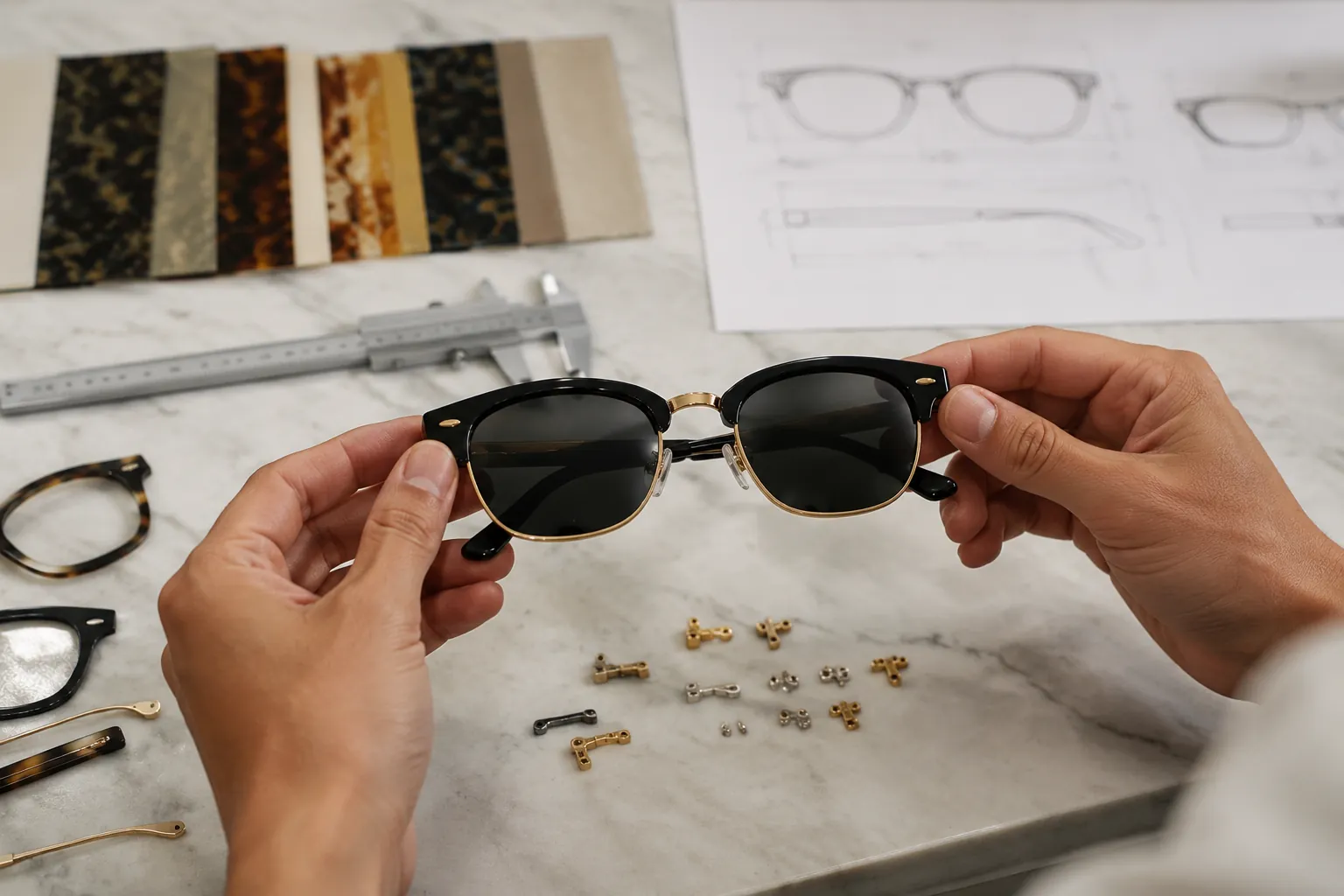
This guide is for brands, importers, distributors, and retailers buying hybrid metal-acetate sunglasses in volume. Be specific. If you do not define the hinge, temple build, finish method, lens fit, and inspection standard, you invite breakage, returns, rework, and late shipments. A clear brief also shortens sampling and helps keep cost predictable as you move from small test orders to larger runs.
Define the frame structure before you quote
Start with the frame architecture in production terms, not marketing language. A factory needs to know whether the build is a metal front with acetate temples, an acetate front with metal temples, or a mixed front with metal rim inserts. Those are different tooling paths. Different assembly steps too. They also carry different cost structures. If you only write "metal and acetate frame," the supplier will fill in the gaps, and the sample may come back with the wrong weight, wrong balance, or an unnecessary seam at the transition point.
The junction between materials is the weak spot. Metal parts usually need thinner walls, tighter bend control, and clean plating edges. Acetate needs machining allowance, thicker cross-sections, and enough polishing capacity. If the interface is not specified, the result is often a visible step between materials, loose temple fit, or stress cracking near the endpiece after repeated open-close cycles. Say exactly where the transition starts and ends. State whether the temple uses an internal wire core. State whether exposed metal is structural or decorative only.
A complete structure note should include the front material, temple material, hinge style, bridge type, nose pad type if any, and whether the frame uses an acetate sleeve over metal or metal inserts inside acetate. If the frame has a semi-rimless or mixed-rim look, define whether the lens groove is cut into metal, acetate, or both. Those details affect assembly time, lens seating, and defect risk. The more precise the architecture, the fewer assumptions a supplier can make.
A useful shorthand for the brief is: front construction, temple construction, joint type, and finish boundary. That one line can save a full revision cycle. For example, "stainless steel front, acetate temples with wire core, 5-barrel hinge, visible transition polished flush at endpiece" is far better than a mood-board description. Buyers who lock this down early usually get cleaner quotes and fewer sample surprises.
Lock the dimensions that drive fit and lens compatibility
Dimensions are not cosmetic. They control fit, balance, lens cut size, and how the frame behaves after polishing and assembly. For hybrid sunglasses, the core measurements are lens width, bridge width, temple length, front total width, lens height, and temple opening angle. A design can look strong on paper and still wear badly if the bridge is too narrow, the pantoscopic angle is off, or the temples open too aggressively. Small numbers. Big effect.
Ask the supplier to quote nominal size and tolerance separately. In eyewear sourcing, the critical dimensions should be controlled closely after final assembly, especially at the lens-seat points and face-contact areas. Temple length often needs the most attention because even a small drift changes how the frame sits behind the ear. Bridge width matters just as much. A minor change can shift pressure from comfortable to annoying on a long wear test.
Also specify the target fit condition. "Standard adult fit" is not enough unless your market is very narrow. If you sell into multiple regions, request the sample with a defined face-width target and test the same model on at least two wearers before approving the size. Hybrid frames are especially sensitive to balance because the weight distribution changes when you shift from metal to acetate. A frame that feels balanced in the hand may still slide forward on the face if the front is too heavy or the temples are too rigid.
Ask the factory to confirm whether dimensions are measured before or after final polishing and whether colorways change those numbers. This matters because thick translucent acetate, plated metal, and decorative inserts can move the finished size slightly. If you are ordering multiple colors, require dimension checks on every colorway, not just the first sample. A sample in black may fit differently from a translucent version if the finishing changes the final geometry.
| Specification | Why it matters | Typical buyer mistake |
|---|---|---|
| Lens width | Controls face coverage and lens cut size | Approving a fashionable size that is hard to source consistently |
| Bridge width | Affects nose comfort and alignment | Ignoring nose-pad style and front weight balance |
| Temple length | Controls ear fit and retention | Leaving no room for market-specific fit preference |
| Front total width | Determines overall wearability and visual proportion | Approving a sample that looks right but wears too tight |
| Temple opening angle | Impacts grip, comfort, and hinge stress | Checking it only by eye instead of on a wear test |
If you are building a private-label line, ask for a dimension sheet tied to the actual sample rather than a generic CAD file. That makes reorders easier and future production easier to compare against the approved reference.
Choose the right metal and acetate pair
Not every metal works well with every acetate. The wrong pairing can create problems that only show up after assembly or in the first month of use. Stainless steel is a common choice for hybrid sunglasses because it offers good strength, corrosion resistance, and stable finishing performance. It also handles repeated hinge cycles reasonably well. Aluminum reduces weight, which can help in oversized or fashion-led frames, but it is less forgiving in structural areas and needs careful control of wall thickness and surface finishing. Brass and alloy components are often used for decorative details or lower-cost structural parts, but they demand tighter control on plating adhesion and anti-oxidation treatment.
For acetate, ask whether the factory uses sheet, block, or preformed blanks, and what thickness remains after cutting. A typical acetate front may start at around 6 mm to 8 mm before finishing, with temples often starting around 4 mm to 6 mm depending on the design. Those numbers matter because acetate shrinks and changes visually during polishing. If the factory cuts too thin, you lose material for shaping and the part can look flat or fragile. If it is too thick, you get a bulky feel, higher weight, and more freight cost.
Hybrid frames usually work best when the heavier mass stays close to the face and the temple weight is controlled. That is not just a design preference. It affects comfort and return rate. If the metal front is too heavy, the frame slides during wear. If the acetate temples are too thick or too dense, the carton weight rises and the product feels expensive in hand without improving function. Small per-pair weight increases become real money once you ship thousands of units.
Ask for a material breakdown in the quote, not just a final unit price. The supplier should identify the metal alloy, finishing system, acetate type or grade, nominal thickness, nose pad material if used, and any reinforcement inside the temple. If the build includes a wire core, specify its gauge and whether it is centered or offset. In volume programs, consistency matters more than shaving a few cents off the first order. A stable thickness spec is worth more than a vague promise of "high quality" material.
One practical rule: if the design relies on a crisp metal-to-acetate transition, ask for a finish sample under strong light and inspect the seam by hand. Roughness, exposed glue, or a visible step at the joint usually signals weak process control, not a one-off issue.
Specify hinges, screws, and assembly limits
Many hybrid failures come from hardware, not from the visible frame materials. The hinge must match temple thickness, expected opening load, and the rigidity of the front construction. A weak hinge will loosen after repeated use. An overly stiff hinge can crack the acetate near the endpiece, distort temple alignment, or cause screws to back out during shipping vibration. In hybrid eyewear, hinge selection is structural. It is not a style detail.
Tell the factory exactly which hinge family you want: standard 3-barrel, 5-barrel, spring hinge, or custom geometry. A 5-barrel hinge often offers better stability for medium- to heavier-duty styles, while a spring hinge increases comfort and perceived value but also raises cost and assembly risk. Spring hinges can work well in premium programs, but only if torque is consistent across production and the factory has experience setting them. If not, the frame may feel too loose or too tight. That creates avoidable complaints.
Ask how screws are secured and what torque target is used in assembly. A controlled torque range is better than a vague instruction to "tighten properly." In practice, suppliers should be able to tell you whether they use thread-lock, pre-applied adhesive, or mechanical crimping, and whether they recheck after finishing. Also confirm whether hinge barrels are aligned by jig before final screw lock. Small misalignments can accumulate and show up as a temple that sits higher on one side than the other.
- Confirm hinge type before artwork approval.
- Ask for opening-cycle targets used in QC, such as 3,000 to 5,000 cycles for routine durability checks.
- Require the screw-locking method and torque control method to be listed on the spec sheet.
- Check left-right symmetry on every sample, not just the best-looking side.
- Ask whether hinge retention is rechecked after polishing and after lens insertion.
If a supplier cannot explain how it controls hinge torque, screw retention, and temple alignment, it is not ready for a volume hybrid program.
Treat finish risk as a sourcing issue
Hybrid frames fail in finish more often than in basic structure. Metal can show plating scratches, edge burn marks, color variation, dull spots, or contamination at weld and bend points. Acetate can show polishing haze, sink marks, burn-through on sharp corners, and batch-to-batch color drift. Because hybrid frames combine both materials, you need separate acceptance standards for each surface. One broad statement that the product should look "premium" is not enough.
For metal parts, specify the finishing system: polished, brushed, matte, PVD, electroplated, painted, or coated. Each has different risk points. Plating thickness and adhesion matter because thin or uneven plating can wear off at contact points after transport and retail handling. If the design uses dark gunmetal, gold, or rose-gold tones, ask for a color reference under standard light and confirm whether the finish is matched to a physical sample or a printed reference. If the supplier uses PVD, ask which substrate it is applied to and whether the coating is decorative only or also intended to improve wear resistance.
For acetate, finish quality comes from polishing stage, buffing consistency, and temperature control. A good-looking sample can still hide process weakness if the polish is not even across the batch. If you are buying clear, translucent, tortoise, or layered colors, ask for color reference under daylight-equivalent lighting and retail lighting. Those materials can look acceptable in a sample room and very different in store.
Decoration needs the same level of specificity. Laser engraving, pad printing, and metal logo plates each have different cost, durability, and defect risk. Laser engraving is clean and permanent, but contrast depends on the substrate and depth control. Pad printing is useful for small logos and multi-color graphics, but it is more vulnerable to wear if surface preparation is poor or if the print sits near a contact point. Metal logo plates create a premium look and can improve visibility, but they introduce adhesive or rivet controls, and they must not interfere with opening movement. If the logo sits near the hinge or endpiece, ask for a rub check in the sample stage so moving parts do not abrade the decoration.
State what must remain clean after assembly. If the seam between metal and acetate is visible, ask how it will be dressed, whether any glue will be removed, and how the transition is checked under magnification. Sharp transitions and residue are often what make a frame feel cheap even when the shape is good.
Match lens build and compliance to the market
Do not separate frame design from compliance. The final sunglass must pass the standards relevant to the destination market, and the lens spec is part of that equation. Keep the compliance list limited to standards and registrations that are actually supported for the product and market: CE EN ISO 12312-1, FDA registration, ANSI Z80.3, AS/NZS 1067, REACH, ISO 9001, and BSCI. Use only the claims that match the supplier's current documentation and the exact SKU you are approving.
Lens specification should cover tint level, lens category, coating, and functional type. A fashion tint is not the same as a sun-protection lens, and a mirrored lens is not the same as a polarized one. If the product will be sold as sunglasses, define the expected UV performance and whether the lens is solid tint, gradient, mirrored, polarized, or photochromic. Each choice changes process control and may affect defect rates in coating, lamination, or cutting.
For hybrid frames, lens fit deserves special attention because the frame geometry can create reflections or edge exposure if the groove depth is off. Ask the supplier to perform a lens seating check on the actual frame, not only on a CAD file. That check should confirm the lens sits evenly across the rim, that there is no rock or gap, and that the lens does not stress the rim during insertion. A lens that fits in design software can still fail in the real frame if the metal front distorts during polishing or if the acetate portion changes size after finishing.
Compliance should stay tied to the exact build. If you change lens tint, coating, frame finish, metal alloy, temple material, or nose pad material, treat that as a controlled revision. In many cases, a material or coating change means retesting. The safest sourcing practice is to freeze the approved sample and then manage future changes under a simple rule: no material swap, no finish swap, and no lens swap without buyer approval.
For cross-border programs, ask the supplier to keep the compliance file linked to the SKU and colorway rather than to the shape alone. That saves time when reorders happen months later and someone on the factory side wants to substitute a similar-looking part.
Use MOQ, pricing, and lead time logic
For hybrid sunglasses, MOQ and production timing should be planned together, not treated as separate negotiations. A low MOQ is useful for testing a new build without locking too much inventory. That is enough to check structure, fit, decoration, and packaging behavior before scaling. But the economics change quickly as the order grows. Pricing usually improves at higher quantities, so ask the supplier to quote by breakpoints rather than giving one flat number for every order size.
Use the sample order as a test of process control, not just a prototype. Sample lead time is often about 7-10 days, while bulk production is often about 25-35 days after approval. That is fast enough for seasonal collections, but only if your specification is stable and your approvals are not changing every few days. Every revision to finish, lens tint, or decoration can add time. If the design uses a custom hinge, metal logo plate, or mixed finish, sample early and identify issues before the order reaches the full production queue.
Buyers should think in terms of breakpoints. At a small test quantity, you are validating feasibility. At a moderate launch quantity, you are testing market response with a more meaningful price. At a larger replenishment quantity, the goal is stable repeatability. At high volume, the focus shifts to consistency, carton efficiency, and defect containment. The larger the order, the more expensive it becomes to discover that the temple angle is wrong or the plating tone shifts between batches.
| Order level | Typical use | Commercial note |
|---|---|---|
| 50 pairs | Prototype or market test | Lowest commitment; validates fit, finish, and assembly logic |
| 300 pairs | Small launch | First meaningful price break; good for a narrow channel test |
| 1000 pairs | Core replenishment | Better unit economics for stable designs and repeat orders |
| 5000+ pairs | Scale program | Lowest per-pair cost; quote should reflect the actual build and volume |
The key sourcing habit is simple: validate early, then scale only after the sample proves that weight, finish, and hardware all hold together.
Build QC around actual failure points
QC for hybrid sunglasses should focus on the parts that fail in the real world, not just on whether the frame looks attractive on arrival. That means hinge torque, temple symmetry, metal finish consistency, acetate polish, lens seating, logo durability, and packing protection. A frame can look excellent in a display tray and still create returns if the hinge loosens, the temple drifts, or the seam between materials catches the hand.
Ask for in-process checks at the points where defects are most likely to be introduced: metal forming or CNC work, acetate cutting, polishing, lens tinting, decoration, and final assembly. The fewer handoffs there are, the fewer chances there are for a problem to go unnoticed until shipment. It also makes correction faster if a batch drifts. The more the supplier controls internally, the easier it is to stop a problem before it becomes a shipment.
A useful pre-shipment checklist should include visual inspection under standard light, open-close testing, logo placement review, lens alignment, and a random wear-fit check on packed goods. For hybrid frames, also check that metal edges do not rub the acetate during opening and closing, that the temple tips are smooth, and that there are no glue marks near seams or hinges. If the order is going to multiple countries, ask for packaging that prevents temple rub marks and lens scratches during transit. Hybrid frames can mark each other easily if the carton partitions are weak or the parts move inside the tray.
Set the acceptance criteria in writing. A good QC brief states what counts as an acceptable scratch, what amount of color variation is tolerable, and what hinge play is not allowed. If you do not define the limit, the factory will use its own standard, and that standard may be too loose for your channel. Before approval, keep three items locked: the approved sample reference, the production tolerance limits, and the change-control rule for future reorders. That protects you when the factory has new operators or a different plating run six months later.
One blunt sourcing truth: if a supplier cannot explain how it prevents scratch transfer between metal and acetate during packing, it is not ready for a true volume program. The carton method is part of the product.
Use a buyer-ready spec sheet
The best way to buy hybrid sunglasses is to give the factory a spec sheet that removes guesswork from the start. Keep it short enough to read quickly, but complete enough to quote accurately and sample correctly. The ideal brief includes the frame structure, materials, dimensions, hinge type, finish references, lens type, decoration method, packaging, compliance target, MOQ, sample timing, and bulk timing. If you provide those details up front, the factory can quote faster and the first sample is much more likely to match production intent.
A strong buyer checklist looks like this:
- Frame architecture: front material, temple material, joint type, and visible transition point.
- Exact dimensions: lens width, bridge width, temple length, front width, and any critical angle.
- Material callouts: metal alloy, acetate grade or thickness, finishing system, and reinforcement if used.
- Hardware: hinge style, screw locking method, opening-cycle target, and torque control method.
- Lens and compliance: tint, coating, UV performance target, and destination market standard.
- Decoration: laser engraving, pad print, or metal plate, with exact placement and size.
- Commercial terms: MOQ, sample timing, bulk timing, and the next price breakpoint.
If the brief is complete, a factory can quote and sample faster, and you reduce the chance of a second or third revision cycle. That is the real savings in custom eyewear sourcing: fewer surprises, fewer delays, and fewer corrections after production has already started.
Have a custom sunglasses project in mind?
Send us your styles, target market and quantities and we will return a detailed quote with MOQ, lead time and a sample plan.
Get a QuoteWhy source this from Wenzhou with LumiShades
Wenzhou in Zhejiang Province is widely regarded as China’s eyewear manufacturing capital, producing a large share of the world’s sunglasses. That concentration matters to buyers: a deep local supply chain for acetate sheet, hinges, lens blanks, plating and packaging means shorter component lead times, easier color and material matching, and a workforce with decades of eyewear-specific skill. LumiShades has manufactured in this ecosystem since 2009, and our vertical integration — in-house injection molding, acetate cutting, CNC milling, lens tinting, decoration and quality control — means no part of your order is quietly subcontracted to a workshop you cannot audit.
For international buyers, that vertical control translates into accountability. When a single factory owns every step, defects are traced and fixed at source rather than bounced between vendors, and your specifications survive intact from first sample to bulk. For procurement review, buyers can request process records, approved samples, quality checkpoints and project-specific compliance files before placing a bulk order. Required testing and documentation are confirmed against the destination market and product specification rather than assumed from a generic certificate list. Explore our manufacturing capabilities and quality control process to see how this works in practice.
Frequently asked questions
What should I send first for a hybrid sunglasses quote? Send a dimensioned drawing or clear reference photos, plus the exact material split, hinge type, lens type, logo position, target market, and order quantity. If you can add target dimensions, finish references, and packaging needs, the quote will be much more accurate. A front photo alone usually produces only a rough estimate and often leads to a sample that needs correction.
What is the biggest failure point in metal-acetate hybrids? The material junction and the hardware around it. Loose hinges, poor temple alignment, rough seam finishing, and weak screw retention cause most complaints. Weight balance is the other common issue, especially on frames with a heavier metal front. Ask the supplier to show how it controls both the seam and the hinge before you approve production.
Can I order a small run first? Yes. Start with a small test order to validate fit, finish, and packaging before you scale. Ask the supplier for its minimum order quantity by design, then request the sample or pilot quantity that matches your launch plan. Use that first run to check wear comfort, hinge behavior, lens fit, and carton protection in real handling conditions.
How long should I plan for samples and bulk production? Plan for sample lead time and bulk lead time separately, and treat them as estimates that depend on approval speed and design complexity. As a practical starting point, ask the supplier what it needs for the first sample, then confirm the lead time for bulk after that sample is approved. Any change to finish, lens tint, decoration, or hardware can add time, so freeze the spec before you place the order.
Which compliance standards should I ask for? Ask only for the standards that match your market and the supplier's actual documentation: CE EN ISO 12312-1, FDA registration, ANSI Z80.3, AS/NZS 1067, REACH, ISO 9001, and BSCI. Do not request claims outside the supplier's real certification list. Keep the compliance file tied to the exact SKU, colorway, lens build, and frame materials you approve.
Ready to start?
Explore our wayfarer sunglasses or request a quote — our sales team replies within 12 hours.
Request a Quote