
5 Low-Light Lens Tints for High-Contrast Vision
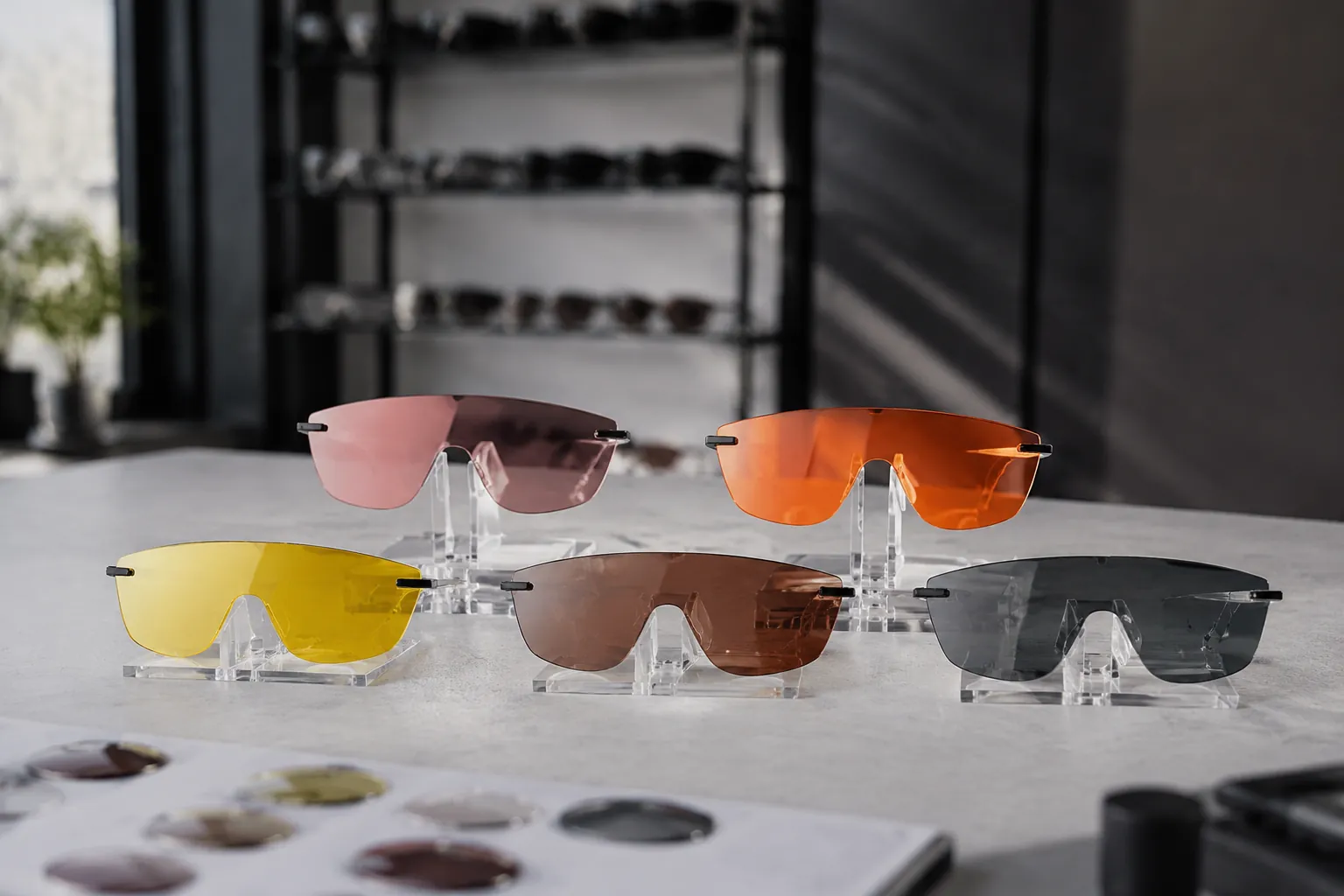
This guide is for brand owners, importers, and retailers sourcing custom sunglasses for overcast days, dusk, and heavy shade. It breaks down five lens tints that improve contrast without making the scene too dark. You get factory-side specs, MOQ and price logic at different volumes, and the compliance checks that matter when you order 50 or 5,000 pairs from a manufacturer.
Why low-light tints are not just colored lenses
Most tint guides focus on visible light transmission, or VLT, for bright sun. Low-light use is different. The goal is to filter specific wavelengths so edges read more clearly, while keeping enough light in the scene. That matters in overcast weather, dusk, fog, and deep shade.
Gray and dark brown lenses usually cut too much light for this job. They can flatten contrast and make the scene feel dimmer. The tints below are tuned filters. They are not meant to be dark.
On the factory side, these tints are usually made by immersion dyeing lens blanks, by mixing pigment into molded polycarbonate, or by adding a coating on top of a tinted base. Each route has a different cost and lead time. Tolerance matters too. For common production, a batch may sit within about ±3% VLT, with wider variation between batches. If you need tighter control, ask for it up front. Do not assume the catalog color is the final production color.
The 5 tints: specs, behavior, and use cases
All numbers below are based on production for 2.0 mm polycarbonate lenses with anti-scratch hardcoat. VLT is measured per ISO 12312-1. CRI is approximate. It is not a regulated number, but it still matters for color-critical work.
| Tint | Typical VLT | Contrast Mechanism | Best Use Case | CRI |
|---|---|---|---|---|
| Amber #1 | 65-75% | Blocks blue light (400-480 nm), enhances red-green edges | Overcast days, fog, general low-light driving | ~65 |
| Vermillion | 55-65% | Pink-orange filter; boosts red-green contrast for depth | Snowy/cloudy terrain, shooting targets, ball sports | ~70 |
| Yellow (shooting yellow) | 78-85% | Blocks blue-violet; sharpens edges, brightens flat light | Dawn/dusk, indoor range, overcast woods | ~60 |
| Copper (brown-red) | 50-60% | Broad contrast + IR absorption; reduces glare while preserving depth | Cycling in changing light, mountain biking, fishing | ~75 |
| Blue-blocker (dark amber) | 40-50% | Heavy blue cutoff; high contrast but borderline dark for twilight | Heavy overcast, wet roads, early morning driving, fog | ~55 |
Blue-blocker is the edge case. Its VLT can fall below 50%, so it fits dusk better than full night. For true night driving, use clear or pale yellow. Do not use a tint that removes too much light. That is a bad trade.
For shooters, vermillion often gives strong target separation against green backgrounds. Some supplier data shows better edge detection than standard brown at similar VLT under low illumination.
How the tint is made: dyeing, molded color, or coating
The production method affects cost, lead time, and consistency. Keep that in mind before you compare colors on price alone.
- Immersion dyeing (CR-39 or polycarbonate blanks): Lens blanks are dipped in a heated dye bath. Tooling cost is low, usually $50-$150 per color. This works well for 50-500 pairs per color. The tint can fade slightly under UV if it is not properly overcoated. Lead time is usually 7-10 days for samples and about 25 days for bulk after the dye is set. Bath temperature is commonly kept at 85°C ±2°C, and dwell time runs 12 to 25 minutes depending on target VLT.
- Molded-in color (injection molding): Pigment is mixed into the polycarbonate resin before molding. This is consistent and UV-stable, but it needs dedicated masterbatch setup and mold cleaning. Tooling and changeover costs are higher, often $200-$500 per color shift. MOQ is usually 500+ pairs per design. Bulk lead time is often 30-35 days.
- Sputtered mirror on tinted base: A thin-film mirror layer is added over a dyed base lens. It adds about $0.30-$0.80 per lens depending on the coating. This is useful for styles that need a little more glare control without changing the base tint. The mirror usually reduces VLT by 5-12%. That must be accounted for in final testing.
For most B2B orders between 50 and 5,000 pairs, immersion dyeing is the most flexible route. It is also the easiest to adjust.
Cost comparison: tint type vs. volume
Prices below are for stock frame plus lens assembly, with the tint applied by immersion dye. They do not include new frame tooling. If you need a custom frame, add roughly $1,200-$3,500 for the mold. For molded-in color, add about $0.15-$0.30 per pair.
| Order Volume (pairs) | Amber | Vermillion | Yellow | Copper | Blue-blocker |
|---|---|---|---|---|---|
| 50 | $4.80 | $4.90 | $4.70 | $5.00 | $4.85 |
| 300 | $3.20 | $3.30 | $3.10 | $3.40 | $3.25 |
| 1,000 | $2.60 | $2.70 | $2.50 | $2.80 | $2.65 |
| 5,000+ | $2.10 | $2.20 | $2.00 | $2.30 | $2.15 |
These prices include CE EN ISO 12312-1 and ANSI Z80.3 compliance documentation. FDA registration is separate and usually charged as a flat fee per model, not per pair. At 5,000+ pairs, blue-blocker is a little cheaper than copper because it uses fewer costly red pigments.
Volume changes the economics fast. At low quantities, the dye setup matters more than the raw lens cost. At higher quantities, the pigment formula and changeover time start to show up in the quote.
Compliance you must check
All five tints can be certified, but not automatically. The batch has to match the target spec. Ask for the test report for the exact tint you are buying. Not a similar one. The exact one.
- CE EN ISO 12312-1:2013/A1:2015 (Europe): Covers sunglasses and filters for general use. Lenses must meet requirements for traffic signal recognition, UV protection, and mechanical performance. All five tints can pass if the batch stays in spec. Blue-blocker gets closer to the limit if VLT drops too far, so hold the target higher if driving is the use case.
- ANSI Z80.3-2018 (USA): Focuses on sunglasses impact resistance and optical quality. Tint itself does not change impact performance. Polycarbonate usually handles this well. Optical homogeneity still matters, so ask for batch uniformity data.
- AS/NZS 1067 (Australia/New Zealand): More demanding on UV protection and optical quality. VLT must stay close to the labeled value. That means the factory needs decent control, not just a good sample.
- FDA 21 CFR 801.410 (USA): Covers impact resistance and labeling. Tint does not create a special exemption. If the product is sold for night driving, the VLT has to match the claim. Do not label a low-VLT lens as night driving eyewear.
- REACH (EU chemical regulation): Dye chemicals need to be registered. Standard factory tints are usually covered, but custom Pantone matching can introduce new chemistry. Ask for a REACH statement if you are changing the formula.
Bottom line: compliance is batch-specific. Ask before production starts, not after the shipment is packed.
Lead time planning for small vs. large orders
Lead time depends on the tint method and frame availability. Here is the typical breakdown for a custom order.
- Samples, stock frame: 7-10 days from confirmed spec. Expect 2-3 pairs for VLT checks. If the frame is also custom, add 20-25 days for mold making and first shots.
- Bulk 50-300 pairs, immersion dye, stock frame: About 25 days from purchase order and deposit. The work is mostly dye prep, tinting, assembly, QC, and packing.
- Bulk 300-1,000 pairs: Around 30 days. Molded-in color adds time for masterbatch blending and mold cleaning. With immersion dye, the bottleneck is often batch size.
- Bulk 5,000+ pairs, injection molded tint: Around 35 days. Changeovers are scheduled in batches so the line does not stall. One color across multiple frame models can save about a week.
If the tint has to match a Pantone reference, add time. Plan on another 5 days for sample-stage adjustment.
Choosing the right tint
Start with the use case. Do not start with the color name.
- Customer drives in overcast or rainy climates: Amber #1 or yellow. Keep VLT at 70% or higher for safer night visibility. Pair with AR coating if reflections are a problem. AR coating usually adds about $0.50 per lens.
- Customer shoots or plays ball sports in low light: Vermillion. It is strong on target separation against grass, leaves, and snow.
- Customer cycles in mixed light: Copper. It gives a good balance of contrast, depth, and glare reduction. Accept the lower VLT. That is part of the trade.
- Customer needs night driving or indoor use: Pale yellow or clear. Do not use blue-blocker or copper. They are too dark for that claim.
- Customer wants a signature brand color that still works daily: Low-saturation amber around 65% VLT is the safest starting point. It looks different without breaking the function.
If you need one product for both low light and bright light, ask about photochromic or gradient options. Photochromic lenses usually add $1.00-$2.50 per pair and about 10 days. Gradients add about $0.30 per pair and roughly 3 days.
What to ask your supplier before ordering
Use the quote stage to remove guesswork. Ask for the exact VLT target, the test method, the dye or resin route, the certification package, and the sample count. If you are comparing factories, ask for the same items from each one. Otherwise the quotes are not comparable.
You should also ask what happens if the batch lands outside the target. Good suppliers answer that directly. They explain whether they can re-dye, remake, or hold the batch. If they dodge the question, that is useful information.
For branded programs, ask whether the tint can be repeated across seasons. Color drift is common if the formula is not locked. A stable formula is worth more than a slightly cheaper quote.
Have a custom sunglasses project in mind?
Send us your styles, target market and quantities and we will return a detailed quote with MOQ, lead time and a sample plan.
Get a QuoteWhy source this from Wenzhou with LumiShades
Wenzhou in Zhejiang Province is widely regarded as China’s eyewear manufacturing capital, producing a large share of the world’s sunglasses. That concentration matters to buyers: a deep local supply chain for acetate sheet, hinges, lens blanks, plating and packaging means shorter component lead times, easier color and material matching, and a workforce with decades of eyewear-specific skill. LumiShades has manufactured in this ecosystem since 2009, and our vertical integration — in-house injection molding, acetate cutting, CNC milling, lens tinting, decoration and quality control — means no part of your order is quietly subcontracted to a workshop you cannot audit.
For international buyers, that vertical control translates into accountability. When a single factory owns every step, defects are traced and fixed at source rather than bounced between vendors, and your specifications survive intact from first sample to bulk. We back this with 15+ years of experience, shipments to 60+ countries, more than 5 million pairs produced per year and a 98.5% on-time delivery rate. Our certifications — CE EN ISO 12312-1, FDA registration, ANSI Z80.3, AS/NZS 1067, REACH, ISO 9001 and BSCI audit — mean the compliance documentation your market requires already exists. Explore our manufacturing capabilities and quality control process to see how this works in practice.
Frequently asked questions
Can I mix multiple low-light tints in a single bulk order of 300 pairs to test different markets? Yes, but the minimum is usually 50 pairs per tint per design. Mixing tints adds a setup fee because the dye bath or color line has to be cleaned between runs. Lead time usually stretches by 3-5 days if you order three or more tints in one lot. For example, 100 pairs each of amber, vermillion, and copper will usually cost more and take longer than one 300-pair run in a single tint.
Do these tints meet the EU standard for driving goggles or sports eyewear? Amber #1, yellow, vermillion, and copper can pass CE EN ISO 12312-1 if the batch is within spec. Blue-blocker is the risky one because its VLT can fall too low for some driving claims. Each model needs the correct filter category on the label. For sports eyewear, you may also need EN 166 testing, especially if you are selling into protective-use channels.
What if I order a custom Pantone tint instead of these five standard colors? Can you guarantee it will still be a low-light contrast tint? No. A Pantone match is mostly a color match, not an optical-performance guarantee. If you want contrast, start from one of the five base formulas and adjust the saturation or transmittance from there. That usually costs extra and needs sample rounds. REACH compliance should also be checked again if the chemistry changes.
Is there a minimum order quantity for a lens tint that requires molded-in color instead of dyeing? Yes. Molded-in color is usually only efficient at 500+ pairs per design because of purge loss and color changeover time. For 50-300 pairs, immersion dyeing is the normal route. Some factories will do molded-in color below that, but the surcharge is usually not worth it unless you need the added durability.
How do I verify that my tint batch is within ±3% VLT without buying a spectrophotometer? Ask for a QC sample from the production run. Reputable factories often provide a measured VLT report for sample pairs or a batch certificate for the lot. If you want independent verification, send a sample to a third-party lab. That is usually the cleanest option for a launch order.
Can I add a mirror coating to any of these low-light tints, and does it affect VLT? Yes. A sputtered mirror can be added to any of the five tints. It usually lowers VLT by 5-12%, depending on the coating. That means the final lens must be recertified, not assumed to be the same as the base tint. The mirror also adds cost and lead time.
Ready to start?
Explore our round sunglasses or request a quote — our sales team replies within 12 hours.
Request a Quote