
5 lens coatings for bulk sunglasses: a technical buyer's guide
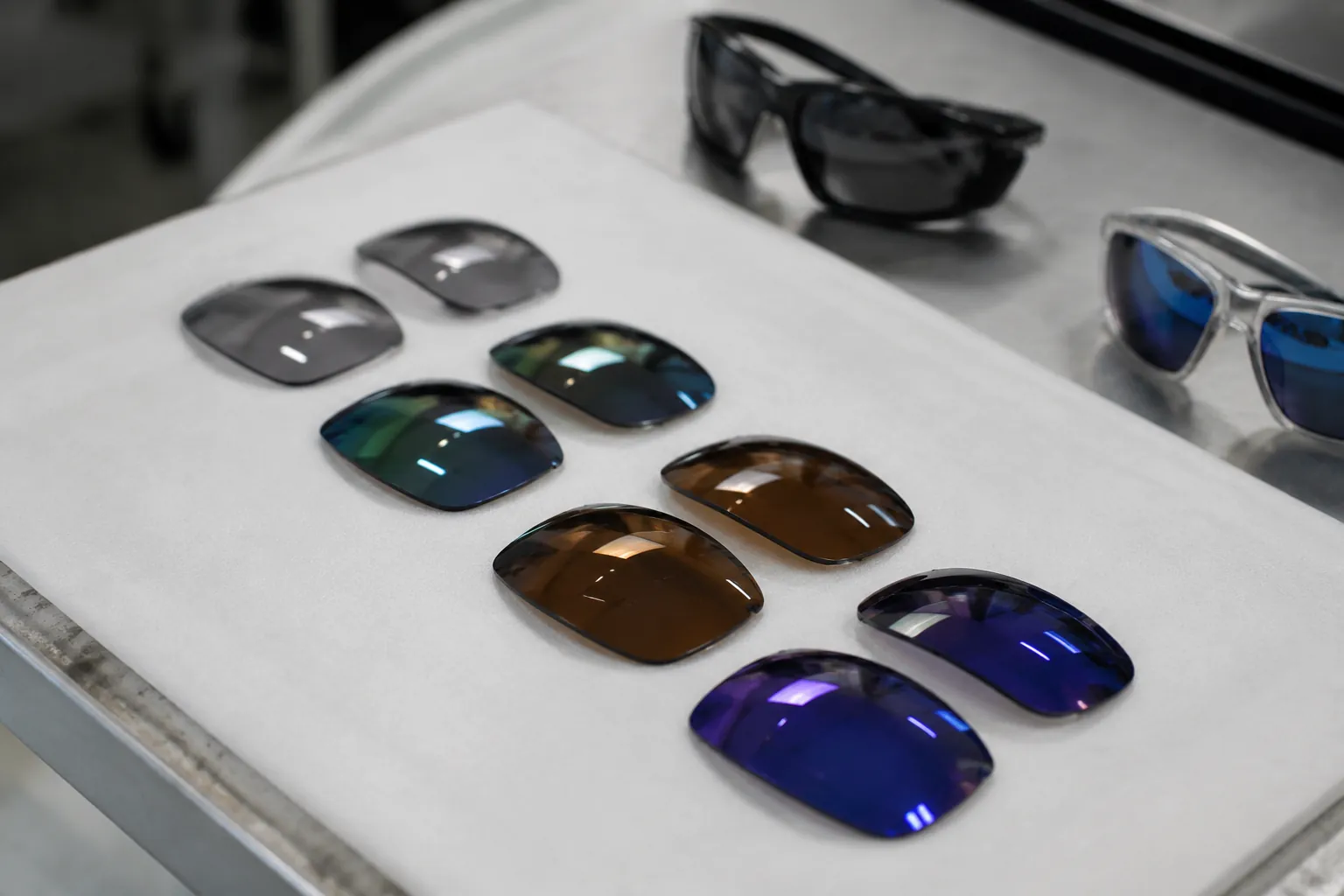
If you buy custom sunglasses at scale, lens coatings affect return rates, optical quality, and brand perception. This guide compares five common coatings - anti-scratch, anti-reflective, hydrophobic, oleophobic, and UV-blocking - by cost, process, durability, and test criteria. It is written for procurement teams and brand owners who need practical specifications for RFQs, factory audits, and sample approval. The focus is on measurable requirements: thickness, adhesion, contact angle, abrasion resistance, UV transmittance, and common failure modes.
1. Anti-scratch coating: baseline protection for handling and wear
Anti-scratch coating, often called hard coat, is the default durability layer for polycarbonate and CR-39 lenses. It adds a silica-rich surface that improves resistance to cleaning marks, shipping abrasion, and day-to-day handling. Without a hard coat, polycarbonate can show visible scratching quickly under retail use. In practice, a well-formulated hard coat raises surface durability from low to moderate, but it does not make the lens scratch-proof.
Typical application is dip coating or spin coating before edging. Standard dry thickness is 2-5 microns with a process tolerance of +/-0.5 microns. At volume, cost is usually $0.15-$0.30 per pair, with large orders trending toward the lower end. For 1,000 pairs, $0.18-$0.28 is common; for 10,000+ pairs, $0.12-$0.20 is realistic when the factory already runs the lens material and coating line in-house.
Buyer specifications should focus on the abrasion test, cure quality, and adhesion. A 500-cycle steel wool test using 0000-grade steel wool under a 500 g load is a common internal QC benchmark. For higher-use programs, require 800 cycles or a documented equivalent abrasion method. Ask the factory to state the coating cure temperature, cure time, and whether corona or plasma treatment is used before coating. On CR-39, pre-treatment materially affects adhesion; poor surface activation leads to early haze, edge lift, and patchy wear.
Buyer note: Do not accept generic claims such as 'scratch resistant.' Request the exact test method, load, cycle count, and pass/fail criterion. If the product is intended for sports, travel, or lower-supervision retail channels, hard coat should be treated as mandatory, not optional.
2. Anti-reflective coating: clarity, contrast, and lens appearance
Anti-reflective coating, or AR, reduces surface reflections and improves light transmission. It is a multilayer dielectric stack, usually 4-7 layers, tuned to suppress visible reflection across the lens surface. Good AR improves clarity in low light, reduces ghost reflections in photos, and gives the lens a cleaner appearance from the front.
A standard 6-layer AR typically reduces surface reflection from about 8% on an uncoated lens to below 0.5% per surface, with total transmission at or above 98% depending on the base lens material and tint. Premium 9-layer stacks can reach 99%+ transmission, but they raise cost and require tighter process control. Typical volume pricing is $0.40-$0.80 per pair, with 1,000-pair orders often landing near $0.60 and 10,000-pair orders near $0.45-$0.55.
AR is applied by vacuum deposition after the hard coat is fully cured. The coating chamber typically runs around 10^-5 mbar. Compatibility matters: if the hard coat is under-cured, the AR stack can delaminate later during heat exposure or cleaning. A cross-hatch adhesion test under ASTM D3359 should return at least 4B, and 5B is preferable on premium programs. Ask for a heat-humidity aging result as well, since AR failures often appear only after the lens has been exposed to moisture and thermal cycling.
Compliance note: AR is not required by CE EN ISO 12312-1 or ANSI Z80.3, but it changes the visual behavior of the lens and may support claims about clarity or glare reduction. Any marketing claim should match the actual measured transmission data. For high-wrap frames, AR becomes more valuable because oblique viewing angles increase internal reflection. On those frames, a neutral-color AR stack is usually preferred over heavily tinted cosmetic finishes.
3. Hydrophobic coating: water shedding and easier cleaning
Hydrophobic coating is a water-repellent top layer that makes droplets bead and roll off the lens. It is commonly used as the final surface treatment over AR. The main benefit is operational: less water spotting, less drag from rain, and less effort during cleaning. For outdoor, travel, and sports programs, hydrophobic coating improves user experience without changing optical prescription or tint.
Typical coating thickness is 10-20 nanometers, applied by vapor deposition at room temperature or near-room temperature depending on the factory process. Volume cost is usually $0.20-$0.50 per pair, with 1,000-pair orders around $0.35-$0.45 and 10,000-pair orders around $0.20-$0.30. The main spec is contact angle. Require at least 110 degrees for standard performance and 115-120 degrees for premium performance. Anything below 108 degrees should be treated as out of spec unless your tolerance is unusually loose.
Durability is usually described in wipe cycles, but the factory should define the cloth type, pressure, and endpoint. A useful benchmark is 5,000 microfiber wipes before the contact angle falls below 100 degrees. Hydrophobic coatings do wear down in real use, especially with repeated alcohol cleaning or abrasive cloths. For that reason, the factory should confirm whether the top coat is fluoropolymer-based and whether it is designed to sit on AR or on a separate primer layer.
Practical note: Hydrophobic coating is useful for rain, sweat, and salt exposure, but it is not a substitute for abrasion resistance. If your product is sold into cycling, hiking, or marine channels, pair hydrophobic coating with a verified hard coat and UV protection. For curved lenses, ask the factory how it verifies uniform deposition at the edge of the lens.
4. Oleophobic coating: fingerprint and skin-oil resistance
Oleophobic coating reduces adhesion from oils, fingerprints, sunscreen, and skin residue. It is chemically related to hydrophobic coating, but the surface energy is tuned for oil repellence rather than water shedding. In sunglasses programs, it matters most when the target user is likely to handle the lens often or wear the product in warm conditions where skin oils transfer easily.
Typical thickness is 5-15 nanometers, generally applied as the final top layer by vapor deposition. At volume, cost is around $0.25-$0.55 per pair, with 1,000-pair orders commonly at $0.40-$0.50 and 10,000-pair orders near $0.25-$0.35. Oil contact angle is the key measure. A usable coating should be at least 70 degrees; premium coatings are generally 80-85 degrees. The factory should state the test oil used, because results can vary depending on the fluid standard.
Oleophobic coatings make cleaning faster and reduce complaints about smears after first wear. The trade-off is wear life. These coatings are thinner and typically more fragile than hard coats, so poor curing or repeated aggressive cleaning can shorten performance. A reasonable field-life target is 3,000-5,000 wipes before measurable loss of oil repellence. If the coating sits over AR, require adhesion testing after humidity exposure, since the layer can fail by edge lift or patchy smear retention rather than obvious peeling.
Buyer consideration: If the sunglasses are aimed at fashion retail, gifting, travel, or premium everyday use, oleophobic coating is a strong add-on. For heavy outdoor use, specify it only when the cleaning benefit matters enough to justify the added process step. A combined hydrophobic/oleophobic top coat can work, but separate layers are usually easier to validate when you need stricter QC.
5. UV-blocking coating: compliance layer for sun protection
UV-blocking protection is the compliance-critical part of a sunglasses build. On polycarbonate, UV protection is usually inherent in the base material, which blocks most UV up to around 380 nm and often meets or exceeds UV400 expectations. On CR-39 and glass, UV protection normally requires a dedicated absorbing or reflective treatment. Cost is low when it is integrated into the lens process, usually $0.05-$0.10 per pair in-line and $0.15-$0.25 for standalone UV treatment.
The spec to request is UV400, meaning protection through 400 nm. A lens that only blocks to 380 nm is not enough for current buyer expectations and may fail the relevant standard depending on the product category and market. Require spectrophotometer data showing transmittance below 0.5% at 400 nm, and ask the factory to show the full curve from 280-400 nm. For certified product, the UV result should be batch-level, not a single marketing sample.
UV treatment can be built into the base material, added during tinting, or applied as a separate layer depending on the lens substrate. On CR-39, the most reliable route is a UV-absorbing monomer or an integrated coating process with validated cure control. If UV is added after AR in a poor process sequence, optical behavior can shift and the lens can show inconsistency between center and edge. For that reason, ask the factory to state the layer order and the verification method used after coating.
Compliance note: UV protection is not optional for a sunglass program sold as sun protection eyewear. For the EU, US, and Australia, request the relevant test report before production approval. For Australian programs, also confirm post-abrasion UV performance if the product is intended for higher wear exposure.
Comparison table: coating options for bulk orders
| Coating | Cost per pair (1,000+ volume) | Cost per pair (10,000+ volume) | Thickness / method | Key test / spec | Typical durability | Compliance relevance |
|---|---|---|---|---|---|---|
| Anti-scratch | $0.15-$0.30 | $0.12-$0.20 | 2-5 microns, dip or spin, +/-0.5 micron | Steel wool abrasion, 0000 grade, 500-800 cycles | 2-3 years | Wear resistance under ANSI Z80.3 |
| Anti-reflective | $0.40-$0.80 | $0.45-$0.55 | 4-9 layers, vacuum deposition at 10^-5 mbar | Transmittance >=98% at 6 layers; >=99% for premium stacks | 2-3 years | No direct requirement; supports clarity claims |
| Hydrophobic | $0.20-$0.50 | $0.20-$0.30 | 10-20 nm, vapor deposition | Water contact angle >=110 degrees | 12-18 months | No direct requirement |
| Oleophobic | $0.25-$0.55 | $0.25-$0.35 | 5-15 nm, vapor deposition | Oil contact angle >=70 degrees | 12-18 months | No direct requirement |
| UV-blocking | $0.05-$0.10 in-line; $0.15-$0.25 standalone | $0.04-$0.08 in-line | Absorbing layer, dip or built into lens material | UV400: <0.5% transmittance at 400 nm | Lifetime of lens | CE EN ISO 12312-1, ANSI Z80.3, AS/NZS 1067 |
How coatings interact: layer order, compatibility, and failure modes
Coatings have to be applied in the correct order. The common stack from lens base outward is:
- Anti-scratch hard coat on the raw lens, usually 2-5 microns
- AR stack on the cured hard coat, usually 4-9 layers
- Hydrophobic top coat on the AR surface, usually 10-20 nanometers
- Oleophobic top coat when used separately, usually 5-15 nanometers
UV protection can be built into the substrate, added during tinting, or applied before the hard coat if the process is designed for that sequence. It should not be added casually after AR without checking optical impact. In poorly controlled lines, that step can shift reflectance color, reduce uniformity, or create patchy results across the lens.
Common failure modes are delamination between hard coat and AR, patchy wetting on the top coat, and edge failure on high-wrap lenses. The problem is usually cure mismatch, contamination, or incompatible thermal expansion. Hard coats and AR layers do not react the same way to heat, moisture, or repeated cleaning. Ask for ASTM D3359 adhesion data, thermal cycling results, and humidity aging results when more than one coating layer is specified.
For high-wrap frames, base curve, edge thickness, and curing consistency matter more than on flat lenses. If the lens is curved aggressively, request edge inspection because coating thickness can vary at the perimeter and that variation can drive early wear or optical inconsistency.
Buyer checklist: what to specify in the RFQ
Use this checklist when you request bulk sunglass quotes:
- Anti-scratch: require at least a 500-cycle 0000-grade steel wool abrasion result under a 500 g load; for sports or travel use, ask for 800 cycles.
- Anti-reflective: specify a 6-layer minimum and request measured transmittance data. For premium orders, ask for 9 layers and a documented color reflection target.
- Hydrophobic / oleophobic: require water contact angle and oil contact angle reports with test method details. Set minimums at 110 degrees water and 70 degrees oil, or higher for premium programs.
- UV-blocking: require UV400 transmittance data from a calibrated spectrophotometer. Ask for the full curve from 280-400 nm, not just a pass/fail statement.
- Adhesion: ask for ASTM D3359 cross-hatch results, with 4B as the minimum and 5B preferred on premium orders.
- Sequence: confirm the layer order, cure conditions, and whether the top coat is deposited over AR or applied as a combined finish.
- Aging: request thermal cycling and humidity aging results for any order with three or more coatings.
For 1,000+ pairs, typical lead time is 25-35 days including coating and QC. For 10,000+ pairs, plan on 35-45 days because of sampling, rework, and batch verification. Coated samples are usually available in 7-10 days. Approve production only after you have tested samples yourself for adhesion, clarity, lens fit, and surface behavior.
Specification examples by use case
Different programs need different coating stacks. A low-cost promotional sunglass usually needs hard coat plus UV protection only. A retail lifestyle frame usually needs hard coat, UV400, and AR if the target price supports it. A sport or outdoor frame usually needs hard coat, UV400, hydrophobic coating, and sometimes oleophobic coating if the product will be handled often in heat or humidity.
For a premium order, a practical spec might read: polycarbonate lens, 2-5 micron hard coat, 6-layer AR, hydrophobic top coat with water contact angle >=115 degrees, UV400 compliance verified by spectrophotometer, cross-hatch adhesion 4B or better, and thermal cycling between -20 C and +60 C for 10 cycles. That spec gives the factory a clear target and gives your team measurable acceptance criteria.
For a value order, a tighter and cheaper spec might read: polycarbonate lens, hard coat only, UV400 compliance, and documented abrasion resistance at 500 cycles. That keeps the bill of materials under control while still protecting against the most common complaint: scratched lenses.
Procurement guidance: how to avoid false claims
Coating claims are easy to overstate. The factory may use the right words but skip the actual process controls. The most common issues are thin hard coats, AR stacks with poor cure, and top coats that look fine at sample stage but fail after wiping or humidity exposure. The only reliable defense is to ask for measurable data and to compare that data across samples, not just on a brochure.
Always ask for three things: the test method, the acceptance threshold, and the batch result. A statement like 'anti-scratch coated' is not enough. A useful statement looks like this: 'hard coat thickness 3.5 microns +/-0.5, 500-cycle steel wool abrasion pass, ASTM D3359 4B adhesion, UV400 pass on batch test.' That is the level of specificity procurement should require.
If the supplier cannot provide batch-level documentation, treat the coating as unverified. For private label programs, that is a supply risk, not a minor paperwork gap. The most expensive coating is the one that generates returns because the lens failed after launch.
Decision guide: which coating matters most
Start with the product use case. If the program is value-driven or high-volume promotional, prioritize anti-scratch and UV-blocking first. If the frame is premium retail or photo-forward, add AR. If the product is exposed to weather, sweat, or frequent cleaning, add hydrophobic. If fingerprints and smudges are part of the complaint pattern, add oleophobic.
In most bulk sunglass programs, the order of importance is hard coat, UV protection, AR, hydrophobic, then oleophobic. That sequence is not universal, but it is a useful default when you are balancing durability, price, and user experience. The right spec is the one your factory can repeat at scale with documented QC.
Have a custom sunglasses project in mind?
Send us your styles, target market and quantities and we will return a detailed quote with MOQ, lead time and a sample plan.
Get a QuoteWhy source this from Wenzhou with LumiShades
Wenzhou in Zhejiang Province is widely regarded as China’s eyewear manufacturing capital, producing a large share of the world’s sunglasses. That concentration matters to buyers: a deep local supply chain for acetate sheet, hinges, lens blanks, plating and packaging means shorter component lead times, easier color and material matching, and a workforce with decades of eyewear-specific skill. LumiShades has manufactured in this ecosystem since 2009, and our vertical integration — in-house injection molding, acetate cutting, CNC milling, lens tinting, decoration and quality control — means no part of your order is quietly subcontracted to a workshop you cannot audit.
For international buyers, that vertical control translates into accountability. When a single factory owns every step, defects are traced and fixed at source rather than bounced between vendors, and your specifications survive intact from first sample to bulk. We back this with 15+ years of experience, shipments to 60+ countries, more than 5 million pairs produced per year and a 98.5% on-time delivery rate. Our certifications — CE EN ISO 12312-1, FDA registration, ANSI Z80.3, AS/NZS 1067, REACH, ISO 9001 and BSCI audit — mean the compliance documentation your market requires already exists. Explore our manufacturing capabilities and quality control process to see how this works in practice.
Frequently asked questions
Which coating should I prioritize for outdoor sports sunglasses? Start with anti-scratch and UV-blocking. Add hydrophobic if rain, sweat, or spray is part of the use case. Add AR if glare or photo clarity matters. For high-wrap sports frames, specify a hard coat thickness of 4-5 microns and ask for adhesion and thermal cycling data.
Can I combine hydrophobic and oleophobic coatings into one layer? Yes. A combined top coat can reduce process steps and usually costs less than separate layers. At volume, expect about $0.40-$0.70 per pair depending on the factory and QC scope. The combined layer often gives a water contact angle around 110 degrees and an oil contact angle around 75 degrees, but separate layers usually give better durability and tighter control.
How do I verify that a coating was actually applied? Ask for batch-level test reports. For anti-scratch, request the abrasion method, cycle count, and load. For UV, request a spectrophotometer trace from 280-400 nm. For hydrophobic or oleophobic coatings, request contact angle results and test conditions. For AR, ask for adhesion data and transmittance figures.
What is the typical lead time for coated lenses? Coating usually adds 2-5 days to the standard production cycle. Samples with coatings often take 7-10 days. Bulk orders with multiple coatings usually take 25-35 days for 1,000+ pairs and 35-45 days for 10,000+ pairs, depending on rework rate and QC sampling.
Do coatings affect the fit of lenses into frames? Normally no. The layers are thin enough that they do not change the lens fit in a meaningful way. On high-wrap lenses, edge buildup can vary slightly, so the factory should check edge dimensions and insertion fit, especially on tighter acetate frames.
Which coating is most likely to cause returns? Poorly applied AR is a common source of complaints because defects are visible: haze, iridescent reflections, or peeling. That is why adhesion testing, humidity aging, and visual inspection under strong light should be part of acceptance for AR-coated lenses.
Ready to start?
Explore our round sunglasses or request a quote — our sales team replies within 12 hours.
Request a Quote