
Wire-Core Acetate Temples: When They Pay Off
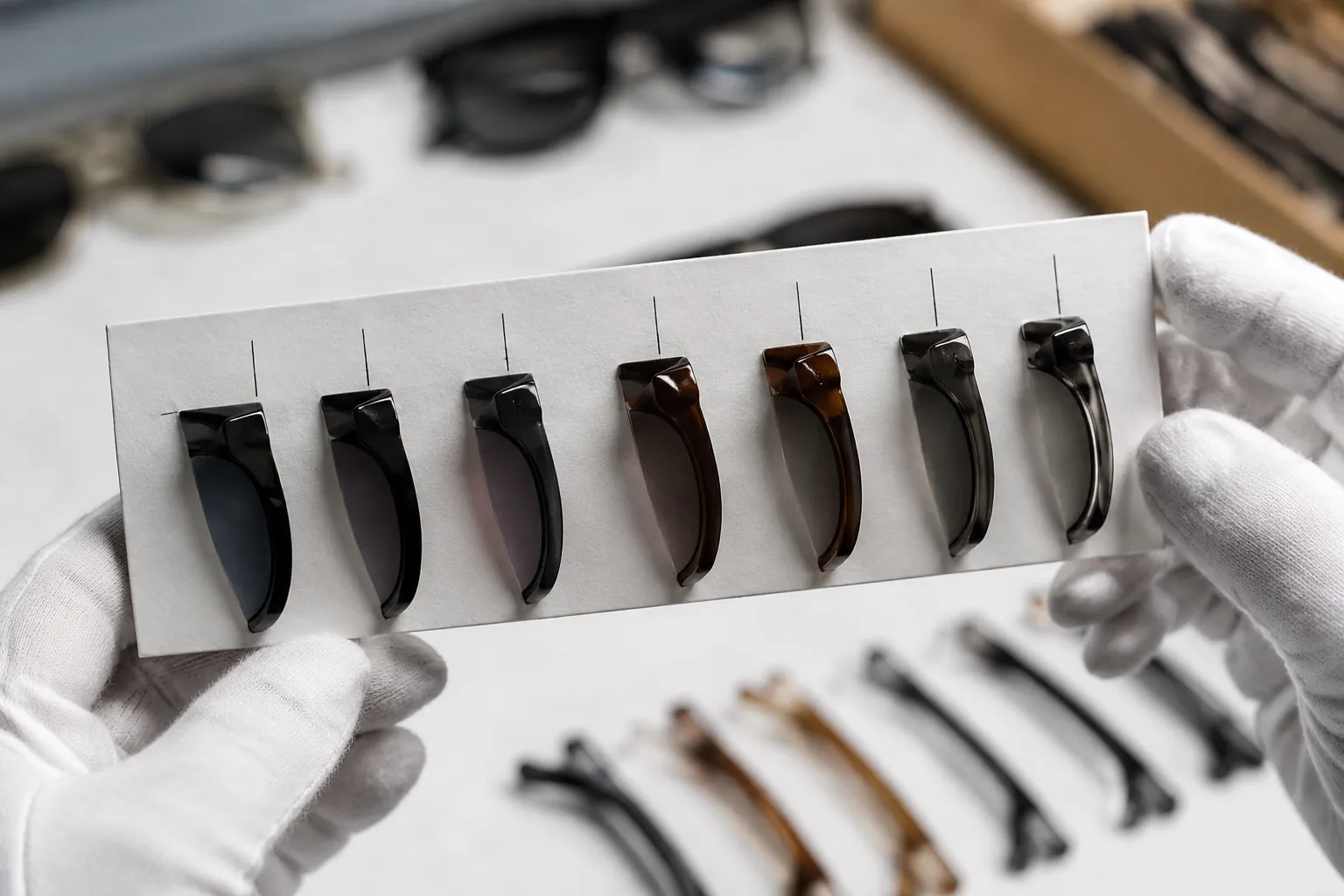
This guide is for buyers sourcing acetate sunglasses at volume and deciding whether to specify wire-core temples or keep temples solid. That choice affects post-sale fit adjustment, cosmetic risk, sample approval, process control, and unit economics across MOQ levels. Wire core can make sense in optical, fitted retail, and other service-heavy channels. In price-sensitive ecommerce, promotional, or self-serve programs, it often adds cost and production complexity without enough return.
Start with the buying question, not the feature
Many buyers treat wire core as an automatic premium upgrade. That is the wrong starting point. Ask a simpler question first: Will anyone actually adjust the temple after production?
In acetate construction, a metal core is embedded inside the temple so trained staff can make controlled adjustments. In practice, that helps most at the temple tip and along the rear section of the temple. The value does not come from the feature alone. It comes from whether the sales channel offers fitting service.
If the product is sold through optical shops, department-store counters, premium boutiques, or distributor networks that inspect and tune frames before resale, wire core can add real value. If the product is sold in sealed ecommerce units or mass retail where almost no fitting service exists, the payoff is usually low.
Wire core also changes the factory route. A solid acetate temple can be cut, shaped, polished, and assembled with fewer steps. A wire-core temple adds extra machining, core insertion, polishing control, and tighter visual checks. More handling. More chances for cosmetic rejects. That matters most on crystal, smoke, champagne, grey translucent, and other light or transparent colors where the core may show.
The right logic is not "premium equals better." It is simple: channel need plus serviceable fit equals worth specifying.
What wire core actually improves in wear
The main benefit is controlled adjustability. Solid acetate has some flexibility, but once a temple is finished its geometry is mostly fixed. A wire-core temple gives trained staff a more predictable zone to adjust without forcing the whole temple to distort.
- Fit tuning: staff can make small corrections to reduce side pressure or improve hold.
- Temple-tip shaping: the end section can be adjusted to sit more securely behind the ear.
- Symmetry correction: minor left-right variation or shipping distortion may be corrected at store level instead of becoming a complaint.
- Heavier frame support: oversized fronts, thicker laminations, and fashion shapes with more front weight may benefit more than very light entry models.
- Premium appearance: on some tortoise or semi-transparent styles, a clean and centered visible core can add to the look.
Buyers often overrate this benefit on light, straight-temple sunglasses built to aggressive price targets. In those products, fit usually depends more on overall geometry than on an internal core. Temple length, hinge alignment, front curve, bridge fit, and weight distribution often matter more.
Channel matters just as much. If nobody in the sales chain adjusts the product, the adjustability exists only on paper. That makes wire core a channel-dependent specification, not a universal upgrade.
Where buyers over-specify it and lose margin
A common mistake is adding wire core to low- or mid-price sunglasses with no real fit-service model. Then the buyer pays for extra machining, insertion, handling, and QC without a clear drop in complaints or returns.
For promotional, fast-fashion, resort, festival, and online-only programs, performance usually comes from getting the basics right:
- Temple length: it should match the target fit and frame geometry.
- Front curve and lens base: these directly affect wrap and side stability.
- Hinge alignment: poor hinge setting creates skew and discomfort that wire core does not fix.
- Total frame weight: lower and better-balanced weight often improves comfort more than added adjustability.
- Temple section shape: a well-designed solid temple can outperform a poorly designed wire-core temple.
Transparent and semi-transparent acetate create another trap. On black or dense dark tortoise, the core is easier to hide. On crystal, tea, grey translucent, or laminated clear temples, the core has to stay visually centered with enough material cover after final polish. If it sits too close to the surface, it can show through, look uneven, or become more visible after rework and polishing.
Check clear temples under strong neutral light. Not warm showroom light.
Order size matters too. On small runs, setup, handling, and reject risk are spread over fewer units, so the added cost is easier to feel. On larger repeat orders, the same spec may be easier to justify, but only if the channel uses the benefit.
A practical comparison by channel, price tier, and order size
| Buyer scenario | Wire-core value | Typical unit-cost effect | Lead-time effect | Recommendation |
|---|---|---|---|---|
| Optical retail or fitted fashion retail | High, because staff can adjust width and tip fit | Usually increases unit cost because of added machining, insertion, and QC | Often limited in bulk, but sample review is stricter | Specify wire core on heavier acetate or premium fitted styles |
| Mid-market private label through distributors | Medium, depending on whether the reseller inspects and adjusts | Moderate increase that is easier to absorb on higher-volume or higher-margin SKUs | May add review time, especially on transparent colors | Use on selected premium SKUs, skip on core commercial lines |
| Online-only sunglasses with tight target price | Low, because little post-sale fitting happens | Extra cost with limited commercial payback | Can slow approvals if temple cosmetics are sensitive | Prioritize geometry, hinge quality, and weight before adding wire core |
| Promotional or event programs | Very low | Cost increase is often hard to justify on short runs | Added complexity usually works against speed | Do not specify unless the design clearly requires it |
| Premium transparent acetate collections | Medium to high, but QC risk is also high | Added labor plus possible increase in reject or rework cost | Sampling often needs closer review | Approve polished samples carefully under strong neutral light before bulk |
The commercial logic is straightforward. If a program is chasing a low factory price, every added operation matters. Wire core moves the product away from that floor.
The best answer is rarely yes or no across the whole collection. Segment by SKU, channel, and service model.
How wire-core acetate temples are made—and where defects appear
Buyers make better decisions when they understand the process. A typical acetate-cut wire-core temple often follows this route:
- Cut temple blanks from acetate sheet.
- Machine a channel for the core.
- Form or prepare the metal core to match the temple geometry.
- Insert and secure the core according to the factory method.
- Shape, tumble, and pre-polish the temple.
- Finish-polish while controlling material cover over the core.
- Fit hinge components, assemble, and verify left-right symmetry.
The core itself is usually a narrow metal strip or formed wire suited to the temple cross-section. The key issue is not only insertion. It is position consistency. If the core drifts off-center, it may show in clear acetate or create a different bend response between left and right temples.
Common failure modes often appear late, after polishing labor has already been added:
- Wire drift: the core sits off-center, making one side look visually heavier or closer to the surface.
- Read-through after polishing: final material cover becomes too thin and the core shadows through the acetate.
- Uneven bend feel: one temple feels stiffer or responds differently during adjustment.
- Cracking near the hinge area: channel placement and local wall thickness can affect structural integrity around hinge stress points.
- Decoration conflict: foil logos, metal plates, laser marking, or pad print placement may compete with the core path or available wall thickness.
That is why transparent temples and decorated thick temples need cross-section review during development. A simple 2D drawing is rarely enough if the style uses logo plates, deep bevels, heavy polishing, or aggressive tapering near the tip.
What buyers should put in the tech pack
If you want wire core, "wire-core temple" is not a usable production spec on its own. The tech pack should define function, appearance, and QC checkpoints clearly enough that sampling does not become guesswork.
- Construction intent: state whether the core is hidden, softly visible, or intentionally decorative.
- Acetate transparency: identify black, dense tortoise, semi-transparent, crystal, gradient, or laminated construction because visibility tolerance changes by color.
- Temple dimensions: include total length plus thickness at the hinge area, mid-temple, and tip so the supplier can manage core position safely.
- Bend zone: specify where adjustment is expected so the supplier understands the functional intent.
- Symmetry standard: require left-right match in top view, side view, and open position.
- Decoration method: define whether the temple uses metal logo plates, laser engraving, foil stamping, pad printing, or no branding.
- Sample checkpoint: request a pre-production sample in final color, final polishing condition, and final decoration.
Also separate construction choice from regulatory compliance. Wire core does not replace product testing. The finished sunglass still has to meet the relevant market requirements, such as CE EN ISO 12312-1 for Europe, ANSI Z80.3 for the US market, or AS/NZS 1067 for Australia and New Zealand, along with chemical compliance such as REACH where required. Depending on the product and market route, buyers may also ask suppliers about FDA registration. Factory systems such as ISO 9001 and social audit programs such as BSCI can help with supplier evaluation, but they do not replace approval of the exact final sample.
Lead time, MOQ, and cost: what changes
Wire core does not always create long delays, but it can add friction in both sample approval and production readiness. The issue is not just one extra process step. Buyers also need to confirm cosmetic appearance, symmetry, bend feel, and compatibility with decoration on the final temple construction.
Sampling often slows down because the buyer is reviewing more than shape. On a wire-core acetate temple, the sample should also be checked for core visibility, centering, polishing consistency, and left-right balance. If the first sample shows read-through or an off-center appearance, another revision cycle may be needed.
Think about cost in three layers:
- Direct material: the metal core adds material cost, but it is usually not the main driver.
- Processing labor: channel machining, insertion, handling, and tighter polishing control create much of the increase.
- Reject risk: transparent or decoration-heavy temples may increase rework or scrap risk, which raises the real cost per accepted pair.
For small trial runs, wire core usually makes sense only when fit adjustability is central to the product or the buyer is testing a premium concept. On larger repeat orders, the decision becomes strategic: does the spec support better in-store service, stronger perceived value, or a price tier that can absorb the added cost?
That is the procurement question that matters. Not "is it nicer?" but "does it earn back its cost in this sales model?"
A simple decision framework buyers can use
If your team needs a fast answer, use this filter before approving temple construction:
- Sales channel: if retail staff, opticians, or distributors will adjust the product, wire core becomes more relevant.
- Frame weight and build: if the front is thick, laminated, or oversized, the fit benefit is more likely to matter.
- Price target: if the SKU is cost-sensitive, first test whether a solid temple already performs well enough.
- Material transparency: if the temple is clear or semi-clear, decide whether the visual QC risk is acceptable.
- Order size: small runs absorb extra process cost poorly; repeat orders are easier to justify.
- Decoration plan: if using plates, foil, laser, or print, check structure and spacing before sampling.
Specify wire-core acetate temples when there is a real adjustment use case, a channel that can use the adjustability, and a price tier that can support the extra process. Skip it when the frame is light, the product is self-serve, and margin discipline matters more than store-level tuning.
Not every acetate temple needs a wire core. Good buyers know why they are paying for it. They also know when not to.
Have a custom sunglasses project in mind?
Send us your styles, target market and quantities and we will return a detailed quote with MOQ, lead time and a sample plan.
Get a QuoteWhy source this from Wenzhou with LumiShades
Wenzhou in Zhejiang Province is widely regarded as China’s eyewear manufacturing capital, producing a large share of the world’s sunglasses. That concentration matters to buyers: a deep local supply chain for acetate sheet, hinges, lens blanks, plating and packaging means shorter component lead times, easier color and material matching, and a workforce with decades of eyewear-specific skill. LumiShades has manufactured in this ecosystem since 2009, and our vertical integration — in-house injection molding, acetate cutting, CNC milling, lens tinting, decoration and quality control — means no part of your order is quietly subcontracted to a workshop you cannot audit.
For international buyers, that vertical control translates into accountability. When a single factory owns every step, defects are traced and fixed at source rather than bounced between vendors, and your specifications survive intact from first sample to bulk. We back this with 15+ years of experience, shipments to 60+ countries, more than 5 million pairs produced per year and a 98.5% on-time delivery rate. Our certifications — CE EN ISO 12312-1, FDA registration, ANSI Z80.3, AS/NZS 1067, REACH, ISO 9001 and BSCI audit — mean the compliance documentation your market requires already exists. Explore our manufacturing capabilities and quality control process to see how this works in practice.
Frequently asked questions
Does wire core automatically make acetate sunglasses higher quality? No. Wire core adds adjustability, not automatic quality. A well-made solid acetate temple with correct geometry, stable hinge alignment, and clean finishing can perform better than a poorly executed wire-core temple. Judge the sample by fit consistency, symmetry, cosmetic appearance, and ease of adjustment in the intended channel—not by the presence of a core alone.
Is wire core worth adding on entry-price private label sunglasses? Usually not, especially for ecommerce, promotional, fast-fashion, or other low-service programs where almost no fitting adjustment happens after sale. Before adding wire core, ask the supplier for a solid-temple sample and compare four basics: hinge alignment, temple length, frame balance, and comfort on wear. If the solid version already meets the target fit and price, wire core may add cost without enough return.
What should I check on a pre-production sample with transparent acetate temples? Check the finished temples under strong neutral light and at multiple angles. Confirm that the core looks centered, does not read through the acetate, and does not create visible imbalance between left and right sides. Compare bend feel on both temples, inspect the hinge area for weak-looking wall thickness, and verify that logo plates, foil, laser, or pad print placement does not interfere with the core path. Approve only a final-polish, final-color, final-decoration sample—not an unfinished development piece.
Does wire core affect compliance testing for sunglasses? Indirectly at most. Wire core is a construction detail, not a substitute for compliance. The finished sunglass still needs to meet the requirements that apply to the target market, such as CE EN ISO 12312-1, ANSI Z80.3, or AS/NZS 1067, plus chemical compliance such as REACH where required. If your market route calls for it, also confirm supplier status on FDA registration. The practical step is to tie compliance review to the exact final sample, color, lens, and bill of materials that will go into production.
Will adding wire core change MOQ or lead time? Not always, but it often changes the economics and the approval workload. A supplier may keep the same MOQ, yet the real cost per accepted pair can rise because of extra processing and tighter cosmetic control. Lead time may also stretch if transparent colors, laminations, or decoration create another sample revision. Ask the supplier two separate questions: first, whether MOQ changes; second, whether wire core adds extra sampling or approval time for the specific color and decoration you selected.
Ready to start?
Explore our aviator sunglasses or request a quote — our sales team replies within 12 hours.
Request a Quote