
Stock vs Custom Sunglasses Tooling: Cost, MOQ, Lead Time
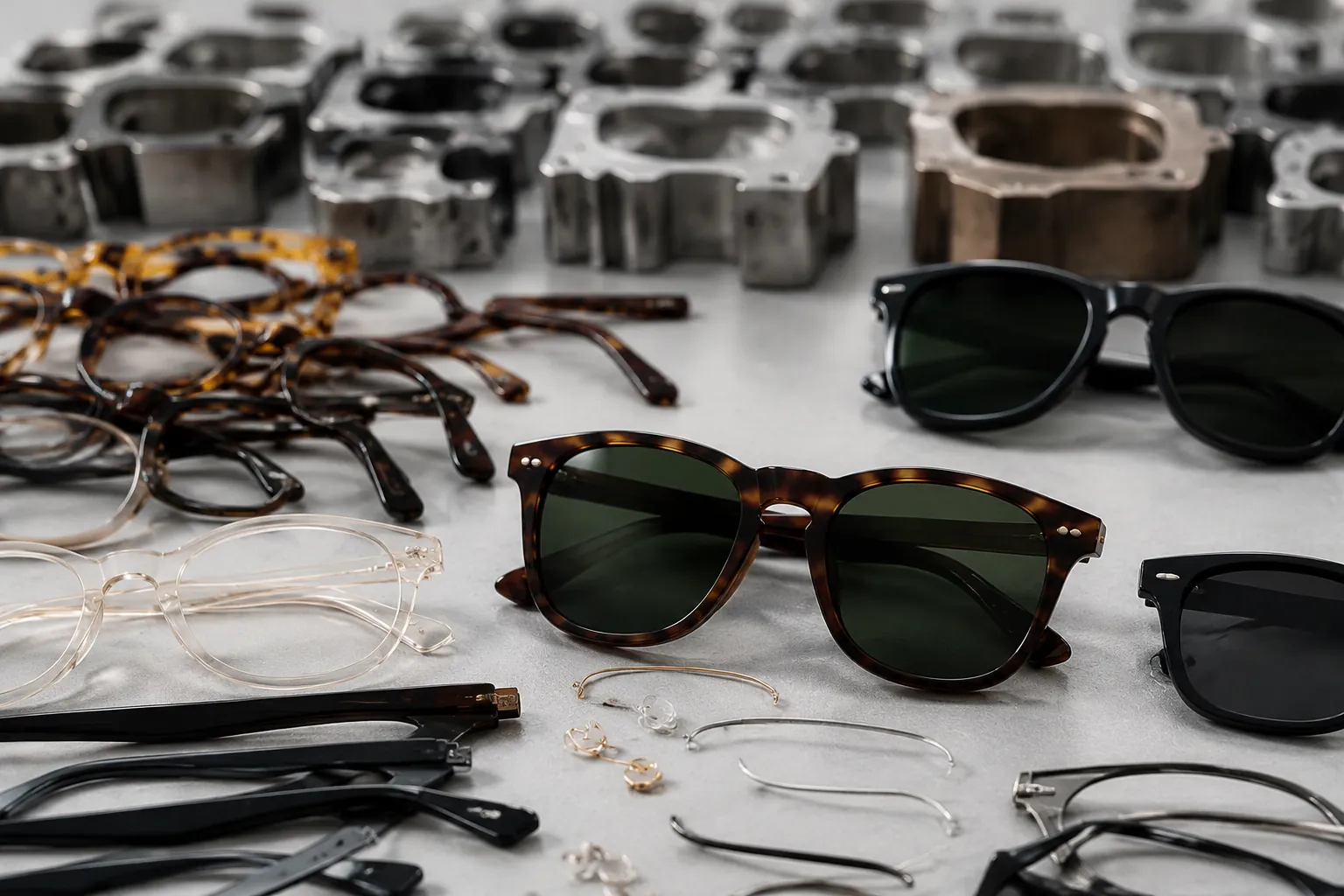
This guide is for brand owners, importers, distributors, and retailers deciding how far to customize a sunglasses line. On paper, the choice looks simple: start from an existing frame platform or pay for new tooling. On the factory floor, it is not. The wrong call can stretch development, raise unit cost, and create avoidable fit, manufacturability, or compliance problems. This framework focuses on what actually changes in Wenzhou: MOQ logic, sampling and bulk timing, tolerances, material behavior, decoration limits, and the point where a "small adjustment" stops being a stock modification and becomes real engineering.
Start with the business case, not the sketch
Many buyers start with the look: a flatter brow, a thicker temple, a sharper lens shape, or a lower bridge. That is normal. It is also the wrong first step if launch timing, target margin, and forecast are already tight.
Start with a harder question: What level of structural change can this program support?
Stock frame programs begin with an existing platform. The molds, dimensions, hinge location, lens groove geometry, and assembly steps are already set. You can usually change color, lens tint, logo treatment, packaging, and some trim details without changing the core engineering.
Custom tooling is different. It usually means new CAD, new molds or CNC programs for the front and temples, revised fixtures, fit validation, and at least one correction round before bulk production settles down.
For most importers, the decision comes down to four commercial questions:
- Launch window: If the selling season is close, a stock platform is usually the only realistic option.
- Expected volume per style: A test order and a multi-season carryover style do not justify the same development spend.
- Gross margin target: Tooling and development cost must be recoverable through planned volume and selling price.
- Distinctiveness requirement: If the frame silhouette itself is core to the brand, stock may be too limiting. If the brand story can come through color, lens, trim, and packaging, stock may be enough.
At factory level, the real question is simple: does your request stay inside the existing engineering envelope?
A logo print is cosmetic. A change to eye size, hinge position, front curve, or bridge thickness is not. Once those variables move, the job is no longer decoration. It is product engineering.
A decision table buyers can actually use
| Factor | Stock frame with modifications | Fully custom tooling |
|---|---|---|
| Typical MOQ | Often more suitable for lower-volume testing because existing tooling is already in place | Usually easier to justify when the style is expected to repeat and absorb development cost |
| Sample lead time | Usually shorter because geometry is already proven and changes are mainly cosmetic | Usually longer because CAD review, prototype making, and revision rounds are required |
| Bulk lead time | Generally more predictable once sample and packaging are approved | Usually less predictable on a first run because tooling validation and pilot corrections may be needed |
| Upfront development cost | Lower; usually limited to sampling, artwork setup, and packaging development | Higher; mold charges, fixtures, engineering time, and prototype iteration must be amortized |
| Design freedom | Moderate; limited by existing front curve, groove, hinge placement, and temple geometry | High; architecture, dimensions, material thickness, and detailing can be built around the brief |
| Production risk | Lower; fit and manufacturability are already established on the base platform | Higher; warpage, lens seating, hinge alignment, opening force, and comfort may need correction |
| Best use case | Retail tests, seasonal drops, price-sensitive private label, urgent launches | Core carryover styles, signature shapes, higher-margin collections, longer product life |
The logic is plain. If demand is still uncertain, avoid paying for engineering work that an existing platform has already solved. If the style is expected to repeat and the shape itself supports brand recognition and pricing power, custom tooling becomes easier to defend.
What you can change on a stock platform without breaking the schedule
"Stock frame" does not mean slapping a logo on a generic SKU. There is real room to customize if you stay within fixed geometry. The safest changes are the ones that do not affect lens groove dimensions, hinge axis, front curvature, or major section thickness.
Common lower-risk stock modifications include:
- Frame color and finish: black, crystal, olive, smoke, tortoise effects, matte, or high-gloss polishing depending on the material route
- Lens options: solid tint, gradient, smoke, brown, green, mirror finishes, and polarized upgrades where the target price allows
- Branding methods: pad print, lens print, laser engraving on the temple, hot stamping, foil logo, or applied metal logo plate
- Packaging: microfiber pouch, EVA case, gift box, barcode label, hangtag, care card, and outer carton marks
- Trim details: contrast temple tips, standard rivet options, simple metal accents, and standard hinge substitutions where the base design allows
Schedules usually slip when buyers ask for structural edits while expecting stock timing. That does not hold.
Requests that often push a program toward custom development include:
- Eye size changes: even a small change can alter lens cutting requirements, groove fit, and frame balance
- Bridge redesign: changing bridge shape or thickness affects comfort, strength, and tooling feasibility
- Front curve change: altering wrap changes lens behavior, fit, and appearance
- Hinge relocation: a small positional change can affect opening force, temple spread, and visual proportion
- Temple cross-section changes: thinning or reshaping temples can affect stiffness, twist resistance, and cosmetic consistency
A useful rule: if the requested change affects dimensions, wall thickness, assembly force, or lens retention, treat it as an engineering change. Not a simple stock tweak.
Material route matters more than many buyers expect
Two sunglasses can look similar in a render and behave very differently in production. Material choice drives that.
Injection sunglasses are efficient when a proven platform already exists and are often the easiest route for lower-risk private label development. But geometry changes are less forgiving than many buyers expect. Thick-to-thin transitions can cool unevenly, which raises the risk of sink, warpage, or visible stress near hinge areas. Cosmetic expectations need to match the material, finish, and target price point.
Acetate sunglasses usually deliver a stronger premium impression, richer pattern depth, and better tactile value. They also allow more visual flexibility through sheet selection and CNC shaping. But they are slower and more labor-intensive to produce. Cutting, tumbling, polishing, bending, lens fitting, and alignment all add time and labor cost.
Typical factory realities buyers should account for:
- Injection tolerance logic: dimensional consistency can be good on established molds, but cosmetic issues such as gate marks, flow lines, or sink still need style-by-style review
- Acetate yield logic: patterned sheets do not produce identical visual distribution, so left-right matching may reduce usable yield
- Metal decoration behavior: inset logo plates and rivets can improve perceived value, but they also add drilling, fitting, and pull-test checkpoints
- Polarized lens upgrades: they can strengthen retail positioning, but they add cost and require control of optical performance and lamination quality
Set the material route before you finalize the line sheet. If you do not, the visual brief can drift away from the commercial brief fast.
What full custom tooling really adds
Custom tooling is not just a mold charge on a quotation. It is a development chain with cost, time, and failure points.
- Technical briefing: front width, eye size, bridge, temple length, target fit, base curve direction, logo location, and material must be defined clearly. A sketch without dimensions is not enough.
- CAD and engineering review: the concept must be turned into a frame that can actually be molded or machined, assembled, glazed, and worn comfortably.
- Tool and fixture build: molds, inserts, cutting paths, polishing fixtures, and branding recesses are prepared from the approved geometry.
- First prototype round: a sample may look right but still fail in hinge feel, temple pressure, lens seating, spread, or fit balance.
- Correction round: section changes, angle adjustments, or groove refinement are often needed before a pilot run.
- Pilot and validation: early production exposes issues such as color variation, polishing inconsistency, dimensional drift, or slow assembly steps.
Small geometry changes can create outsized manufacturing problems. A thicker brow line may trigger visible sink in molded parts. A thinner bridge may look cleaner in CAD but perform poorly in assembly or wear. A sharper temple taper may improve the silhouette but reduce stiffness.
That is why custom development usually makes sense only when the style is expected to generate repeat orders. If the style is a short test with uncertain reorder, the amortization logic is weak. If it is likely to become a carryover model, the economics are stronger.
Lead time reality: where days are actually won or lost
Buyers often compare quoted production days and stop there. That misses the real delay points.
For stock platforms, the sequence is short: select the frame, confirm material and color, choose the lens specification, approve logo artwork, confirm packaging, sign off the pre-production sample, and move to mass production. Since the geometry is already established, the main risks are usually artwork approval, packaging approval, and slow buyer response.
Custom programs are different. Every unresolved decision becomes a stop point. Common delay drivers include:
- Incomplete tech packs: missing measurements or unclear construction notes force repeated clarification
- Fit ambiguity: standard fit, lower bridge fit, temple spread, and wrap direction should be defined at the start
- Color indecision: tortoise and translucent finishes often need physical approval because screen references are not reliable enough
- Late logo revision: changing from print to an inset plate or recess can affect tooling or fixture preparation
- Lens specification changes: switching to polarization, mirror, or a different lens category can affect cost, testing, and labeling workflow
A better planning method is to work backward from the delivery date: customs clearance, freight mode, production, sample approval, development, and internal sign-off. Do that honestly and the answer often gets clearer. For near-term launches, stock platforms are usually the only credible route.
Compliance should shape the sourcing path early
For sunglasses, compliance is not a last-step paperwork exercise. It should affect product decisions from the start.
Export buyers commonly work against requirements such as CE EN ISO 12312-1, ANSI Z80.3, AS/NZS 1067, FDA registration, and REACH, alongside factory system or social compliance expectations such as ISO 9001 and BSCI. The right path depends on the sales market, importer obligations, and product claims.
Why this matters to the stock-versus-custom decision:
- Proven combinations reduce risk: a stock frame paired with an established lens construction is generally easier to document and validate than a newly engineered combination
- Custom curves need checking: changing base curve, lens thickness, tint density, or mirror treatment can affect optical performance and labeling category
- Decorative materials matter: paints, coatings, plastics, adhesives, and metal trims may require supporting declarations for regulated markets
- Label workflows differ: the US, EU, and Australia/New Zealand markets can require different markings, warnings, or documentation sets
For first-time importers, the safest move is often to reduce variables on the first regulated program. Start with a proven frame platform. Set the lens and packaging marks early. Keep the engineering stable.
Buyer scenarios and a final checklist before you commit
Three common sourcing scenarios make the choice easier:
| Buyer scenario | Best path | Why |
|---|---|---|
| Retail chain testing a summer capsule in multiple colors with uncertain reorder | Stock frame modification | Lower risk, faster sampling, and less cash tied up in development |
| Independent brand building a signature carryover style for multiple seasons | Fully custom tooling | The frame shape itself supports price positioning, recognition, and repeat margin |
| Distributor needing private label supply for several countries | Stock platform with compliance-led lens selection | Proven manufacturability and a simpler rollout across multiple SKUs and markets |
| Fashion label with strong visual direction but no eyewear sales history | Start stock, then migrate to custom on reorder | Better cash control while validating fit, shape family, and price acceptance |
Before approving development, use this checklist:
- Write the sales case: clarify whether this is a one-season test, a retailer program, or a long-life core model.
- Set realistic volume: base the decision on likely first order and probable reorder, not optimistic internal forecasts.
- Define non-negotiables: lock lens category, polarization requirement, destination market, branding method, frame material, and retail band early.
- Separate visual from structural edits: color and logo changes are not the same as curve, hinge position, or section-thickness changes.
- Check timing backward: include sample approval, packaging sign-off, freight booking, customs, and delivery to warehouse or store.
- Ask for price ladders: compare several order quantities so you can see whether the unit economics support stock or custom development.
- Confirm compliance early: align product specification, labeling, and documentation before development goes too far.
If the forecast is uncertain, the launch is near-term, and the look can be achieved through lens, color, and branding, stock is usually the safer choice. If the model has long-term volume potential, room for development cost, and a shape that cannot be achieved credibly on existing platforms, custom tooling becomes defensible.
Simple test. Pick the route that protects margin, timing, and product reliability.
Have a custom sunglasses project in mind?
Send us your styles, target market and quantities and we will return a detailed quote with MOQ, lead time and a sample plan.
Get a QuoteWhy source this from Wenzhou with LumiShades
Wenzhou in Zhejiang Province is widely regarded as China’s eyewear manufacturing capital, producing a large share of the world’s sunglasses. That concentration matters to buyers: a deep local supply chain for acetate sheet, hinges, lens blanks, plating and packaging means shorter component lead times, easier color and material matching, and a workforce with decades of eyewear-specific skill. LumiShades has manufactured in this ecosystem since 2009, and our vertical integration — in-house injection molding, acetate cutting, CNC milling, lens tinting, decoration and quality control — means no part of your order is quietly subcontracted to a workshop you cannot audit.
For international buyers, that vertical control translates into accountability. When a single factory owns every step, defects are traced and fixed at source rather than bounced between vendors, and your specifications survive intact from first sample to bulk. We back this with 15+ years of experience, shipments to 60+ countries, more than 5 million pairs produced per year and a 98.5% on-time delivery rate. Our certifications — CE EN ISO 12312-1, FDA registration, ANSI Z80.3, AS/NZS 1067, REACH, ISO 9001 and BSCI audit — mean the compliance documentation your market requires already exists. Explore our manufacturing capabilities and quality control process to see how this works in practice.
Frequently asked questions
At what order volume does custom tooling usually start to make sense? There is no fixed volume threshold. Tooling cost, material, complexity, and target margin vary by project. The real test is whether you have credible repeat demand for the same frame shape. If the first order is mainly a market test, stock is usually safer because it avoids tying up cash before fit and sell-through are proven. Custom tooling makes more sense when three conditions are true: the style is expected to repeat, the silhouette cannot be achieved through stock modification, and the lifetime volume can absorb development cost without pushing margin below target. Ask the factory for a full breakdown of tooling, sample charges, and unit pricing at several quantities, then calculate landed cost across expected total volume, not just the first PO.
Can I create a distinctive private label result without building new molds? Yes, if the base silhouette already fits your brand direction. Buyers often create strong private label results through frame color, acetate pattern choice, lens tint, mirror or polarized upgrades, temple branding, metal logo application, and branded packaging. The best way to judge this is to review several stock platforms close to your target shape and separate cosmetic differences from structural ones. If the changes you care about are mostly cosmetic, stock can usually deliver a credible result faster and with less risk. If your brand depends on a unique front shape, bridge architecture, or temple profile, stock customization will be less convincing.
What changes usually force a move from stock modification to custom tooling? Changes that affect geometry, strength, or lens retention usually push the project into custom territory. Common examples include changes to eye size, bridge shape or thickness, front curve, hinge position, temple cross-section, and lens groove design. These are not simple styling edits. They affect how the frame is molded or machined, how lenses are fitted, and how the product behaves in assembly and wear. A practical step is to send the factory a marked drawing and ask them to split your requests into two groups: cosmetic changes that can stay on the stock platform and structural changes that need engineering review. That makes the development path clearer before sampling starts.
How should MOQ influence the decision? Treat MOQ as a risk-control issue, not just a price issue. Lower-volume tests usually favor stock platforms because existing tooling lets the factory accept smaller commitments with less setup risk. Custom development makes more sense when you are confident enough to support repeat orders and spread upfront cost over larger total volume. Do not look only at the headline MOQ. Ask for the minimum order by color, by lens option, and by packaging type, because those details affect whether the program is workable. Also compare the full cash requirement: sampling, tooling, packaging development, testing, and the first production deposit.
Does compliance differ between stock and custom sunglasses? The legal requirements apply to both, but the development risk is different. A stock frame with a known frame-lens combination is generally easier to validate because fewer variables are changing at once. A custom frame adds more unknowns, especially if you are also changing lens curve, lens construction, coatings, or decorative materials. Start by defining the destination market, then confirm with the supplier which standards and documents apply to that exact specification, including lens category, markings, packaging information, and material declarations. Do this before approving final samples, not after bulk production is booked.
Ready to start?
Explore our wayfarer sunglasses or request a quote — our sales team replies within 12 hours.
Request a Quote