
Rubber-Coated Sunglasses: Use Cases, Risks, and QC
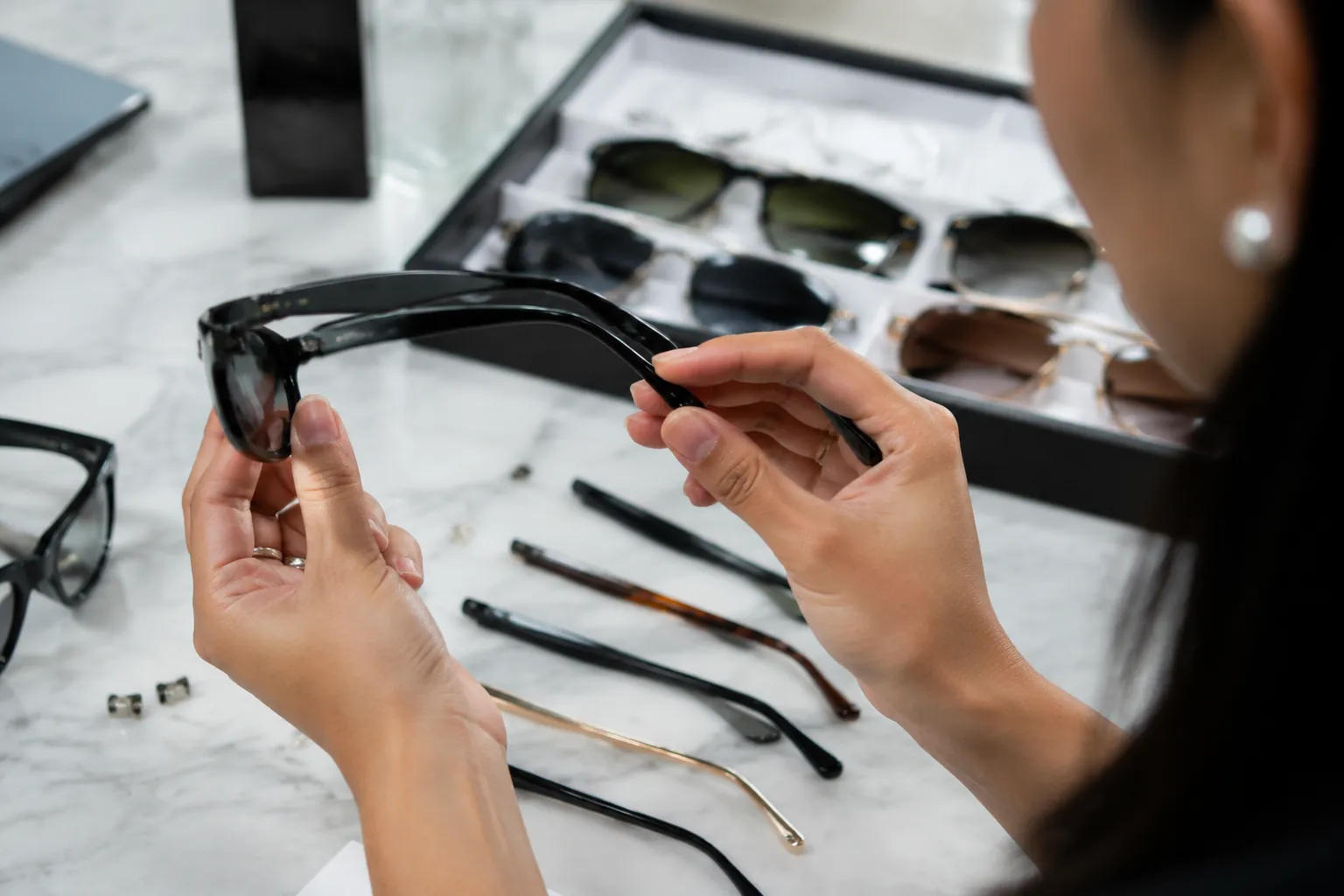
This guide is for brand owners, importers, distributors, and retail buyers sourcing custom sunglasses in volume. Rubber-coated and soft-touch finishes can improve grip and shelf appeal. They also add process risk that may not show up in an initial sample. The real question is simple: does the finish still perform after packing, wiping, try-ons, shelf handling, and repeat production across multiple purchase orders? If you are approving custom eyewear at low MOQ, scaling to larger runs, or trying to protect reorder consistency, you need to know where this finish helps and where it creates avoidable warranty risk.
Start with the job of the finish
Buyers often treat a rubber-coated finish as a style choice. It is not just that. In production, it affects grip, fingerprint visibility, rub marks, cleaning behavior, logo compatibility, and lot-to-lot consistency.
On sunglasses, rubber-coated can describe different constructions. One option is a soft-touch paint or coating applied over an injected or otherwise finished frame after molding and surface prep. Another is a structural material choice, such as a co-injected TPE grip section or a separate rubber-like component used only at temple tips or nose-contact points. These options do not carry the same performance risk or QC burden.
A full soft-touch topcoat creates the strongest first-touch effect. It also adds more variables: surface prep, coating thickness, cure conditions, handling marks, and adhesion at edges and hinge transitions. A partial grip-zone approach reduces that exposure because the most visible cosmetic areas stay uncoated.
For active-use frames, controlled grip areas can improve wear performance. For fashion sunglasses that need a clean, easy-to-wipe surface, frequent bag storage, or heavy display handling, a full rubber-coated surface may be the wrong choice. Start with use case. Not mood-board language.
Use it when grip matters more than cosmetics
Rubber-feel finishes make sense only when there is a clear functional or merchandising benefit. If the value is mostly visual, the finish has to justify the extra process risk.
- Sports and outdoor styles: Wrap shapes and injected constructions may benefit from better grip during wear and handling.
- Matte lifestyle programs: Soft-touch surfaces can help distinguish a private-label range from standard glossy or molded-matte stock.
- Small-range market testing: A buyer can test one or two rubberized SKUs before extending the finish across a broader collection.
- Grip-zone strategy: Temple tips, inner temples, or nose-contact sections often carry lower cosmetic risk than coating the entire front and both temples.
Sampling discipline matters. Ask for direct comparisons on the same frame shape: standard molded matte, painted soft-touch, and partial rubberized treatment. Many buyers approve a single soft-touch sample because it feels premium in hand. That is not enough. Compare it with lower-risk finishes that may deliver most of the effect with fewer complaint points.
Material matters too. Injected frames often accept controlled coatings more predictably than acetate. Acetate surface prep can be more sensitive to polishing residue, and edge wear becomes more visible once the top layer starts to break. On acetate sunglasses, a rubber-feel finish usually suits limited fashion capsules better than long-running replenishment lines.
Avoid it when consistency is the priority
Full rubber-coated finishes create more variables than molded matte textures, polished acetate, or standard paint systems. A factory may manage those variables on one run. Keeping them stable across repeat orders is harder.
Common failure modes include gloss variation between lots, tacky feel after storage, polished shiny areas at temple edges, fingerprint retention, color inconsistency on darker soft-touch surfaces, and thin coating on corners or transitions. These issues may not appear during final inspection if the product is newly finished. They often show up later, after carton pressure, repeated wiping, or store handling.
That makes the finish riskier for programs with strict return rules. Marketplace sellers, optical chains, department-store private label, and travel-retail operators usually care more about complaint rate, display durability, and reorder match than about a velvety first touch.
Avoid full rubber-coated finishes in these situations:
- Reorder-heavy core programs where appearance and touch need to stay close across multiple bulk runs.
- Kids or value lines where the retail structure leaves little room for coating-related returns or extra sorting.
- Gloss-led fashion styles where polish, color depth, and easy wipeability are stronger selling points.
- High-contact retail displays where many customers handle the same frame every week.
If the commercial model depends on low complaint rates and simple replenishment, molded matte texture built into the tool is usually safer. It may feel less premium on day one. It is usually easier to maintain and easier to match on the next purchase order.
Compare the options before you spec the frame
Not all soft-feel solutions behave the same in production or in use. Buyers should compare them as separate engineering choices, not under one broad label such as rubber finish.
| Option | Typical Use | Main Benefit | Main Risk | MOQ / Cost / Lead-Time Logic |
|---|---|---|---|---|
| Standard molded matte texture | Injected frames, value and repeat programs | Stable appearance, easy wipe-clean surface, stronger reorder consistency | Less premium hand feel than a soft-touch coating | Usually the lowest-risk choice because it avoids a separate finishing step |
| Soft-touch paint or coating | Fashion and lifestyle frames | Velvety touch and stronger first impression | Rub marks, tackiness, edge wear, lot variation | Often suitable for small trial runs, but adds finishing cost, inspection time, and process risk |
| Rubberized touch zones only | Temple tips, inner temples, nose areas | Grip where needed without exposing the full frame | Visible transitions, bond-line issues, or local adhesion defects | Usually easier to control than a full coating if the design is planned correctly |
| Co-injected TPE components | Performance eyewear and active-use programs | Durable grip with less cosmetic rub-off risk on the main frame surface | Higher tooling complexity and tighter material coordination | More likely to make sense when volume can support additional tooling complexity |
This comparison matters because MOQ changes the answer. At lower volumes, a coating route may be a practical way to test a trend without changing tooling. At higher volumes, it is often worth reviewing whether molded texture or co-injected grip components can replace a full soft-touch topcoat. In many cases, process stability matters more than the convenience of a post-finish coating.
What changes in cost, MOQ, lead time, and decoration
Rubber-coated work is not a minor paint upcharge. It can affect labor, reject risk, cure time, inspection time, and sometimes packing method. Ask suppliers to separate those cost drivers on the quote.
Compared with a plain molded or standard painted frame, a rubber-coated variant usually costs more because it adds post-molding finishing steps and more late-stage cosmetic risk. The exact surcharge depends on frame material, finish system, color, logo method, packing standard, and the supplier's process capability. Do not rely on a generic price claim. Ask for a split quote showing base frame cost, finish surcharge, decoration cost, and any packing adjustment.
Typical process impact looks like this:
- Sampling: Timing depends on whether the base frame already exists and whether the factory is using an established coating system.
- Bulk production: Soft-touch jobs may need more time for curing, appearance checks, and re-sorting than standard matte production.
- Late-stage reject risk: A coated frame can fail after lens fitting, logo application, or final assembly, making defects more expensive than an early molding defect.
- Packing precautions: Interleaving bags, tissue, or cleaner inner trays may be needed to reduce surface marking in transit.
Decoration sequencing matters. Pad printing may lose edge sharpness on some soft-touch surfaces if the ink system is not matched. Laser marking can work on certain coated surfaces, but on others it exposes a weak base-color contrast. Metal logo plates usually perform better when the recess and adhesive system are planned before coating. Buyers should confirm whether decoration happens before or after the soft-touch layer because that affects both appearance and adhesion.
The factory controls that matter most
Rubber-feel finishes usually fail for ordinary reasons, not exotic ones: poor substrate cleaning, residual mold-release contamination, excessive build on edges, inconsistent spray conditions, under-cure before assembly, or rough handling between finishing and packing. Buyers do not need a confidential process sheet. They do need evidence that the process is controlled and repeatable.
The checkpoint list should include:
- Substrate inspection: The base frame should be clean, dry, and stable before coating. Surface residue is a known adhesion risk.
- Film control: Coating should be applied evenly, with attention to hinge shoulders, bridge corners, and temple tips where thin spots often show first.
- Adhesion test: Cross-hatch tape testing or an equivalent internal method should be completed on approved samples before bulk sign-off.
- Rub test: Dry and slightly damp cloth rubbing on high-contact points should be part of pre-shipment QC, not just an informal sample-room check.
- Master sample retention: Each colorway should have an approved master sample for gloss, touch, and color comparison during production and reorder review.
Inspection criteria should also be written down. Buyers should ask what defect level is allowed for pinholes, gloss marks, edge thinning, dust nibs, logo distortion, and touch inconsistency. Without a written standard, a supplier may pass units that are technically assembled but commercially weak. For soft-touch programs, assembly handling matters almost as much as the coating itself. Fully cured parts should not be loosely stacked or rubbed against each other before packing if the finish is easy to mark.
Compliance applies to the full product
Finish discussions can distract buyers from the larger issue: the sunglasses still need to meet destination-market requirements as a complete product. A coating does not replace lens performance, labeling, or chemical compliance obligations.
The relevant list may include CE EN ISO 12312-1, ANSI Z80.3, AS/NZS 1067, REACH, FDA registration, ISO 9001, and BSCI, but these terms need to be used correctly. EN ISO 12312-1, ANSI Z80.3, and AS/NZS 1067 relate to sunglass performance and labeling in their respective markets. REACH relates to chemical substance control. ISO 9001 and BSCI are management and social-compliance frameworks, not substitutes for product testing. FDA registration may appear in supplier or importer documentation for the U.S. market, but it does not replace product-level compliance evidence for sunglasses.
For rubber-coated styles, the practical question is whether the finish chemistry changes the material declaration or requires updated supporting documents. A lens can stay the same while a revised frame coating creates a new chemical-compliance issue. Ask one direct question before bulk approval: if the finish supplier, formula, or color changes after sample approval, do any declarations or restricted-substance documents need to be updated for the final product?
A buying framework for first orders and reorders
If you are deciding whether to approve a rubber-coated style, use a simple commercial filter before issuing the purchase order.
- Define the sales role: Is this an active-use frame, a fashion capsule, or a core replenishment SKU?
- Choose the lowest-risk finish that does the job: Molded matte first, partial grip second, full soft-touch coating last.
- Approve against abuse: Ask for wipe, rub, packing, and logo checks on the sample rather than approving by appearance alone.
- Control the color plan: Dark neutrals are often easier to standardize than pale soft-touch shades that show unevenness quickly.
- Lock the bulk standard: Keep one sealed approval sample and one open handling sample for factory comparison.
- Plan reorders early: Retain batch references, coating specifications, and approved color masters from the first successful run.
For first orders, a limited test quantity is often the safest approach. It gives the buyer real market feedback before the finish is applied across a full collection. If the style succeeds and moves into larger repeat orders, review whether the same customer experience can be achieved with a more stable solution such as molded texture or localized TPE grip.
The decision line is straightforward. Use rubber-coated finishes where hand feel and grip clearly support the product concept. Avoid them where consistency, low claim rates, and repeatability matter more than the first impression in hand.
Have a custom sunglasses project in mind?
Send us your styles, target market and quantities and we will return a detailed quote with MOQ, lead time and a sample plan.
Get a QuoteWhy source this from Wenzhou with LumiShades
Wenzhou in Zhejiang Province is widely regarded as China’s eyewear manufacturing capital, producing a large share of the world’s sunglasses. That concentration matters to buyers: a deep local supply chain for acetate sheet, hinges, lens blanks, plating and packaging means shorter component lead times, easier color and material matching, and a workforce with decades of eyewear-specific skill. LumiShades has manufactured in this ecosystem since 2009, and our vertical integration — in-house injection molding, acetate cutting, CNC milling, lens tinting, decoration and quality control — means no part of your order is quietly subcontracted to a workshop you cannot audit.
For international buyers, that vertical control translates into accountability. When a single factory owns every step, defects are traced and fixed at source rather than bounced between vendors, and your specifications survive intact from first sample to bulk. We back this with 15+ years of experience, shipments to 60+ countries, more than 5 million pairs produced per year and a 98.5% on-time delivery rate. Our certifications — CE EN ISO 12312-1, FDA registration, ANSI Z80.3, AS/NZS 1067, REACH, ISO 9001 and BSCI audit — mean the compliance documentation your market requires already exists. Explore our manufacturing capabilities and quality control process to see how this works in practice.
Frequently asked questions
Does a rubber-coated frame usually scratch more easily than a standard matte frame? In many cases, yes. A soft-touch topcoat is more likely than a molded matte texture to show rub-polished shiny areas, edge wear, or handling marks over time. Before approval, ask the supplier to compare a coated sample and an uncoated matte control after dry wiping, slightly damp wiping, and repeated handling at the bridge, temple edges, and hinge areas.
Is rubber coating a good idea for acetate sunglasses? Usually only for selected fashion programs, not as a default choice. Acetate already offers strong color depth and polish, and a rubber-feel topcoat can reduce that visual advantage while adding more sensitivity around surface prep, adhesion, and edge wear. If you want the look, request side-by-side samples in plain acetate, matte acetate, and coated acetate before committing bulk volume.
How should I test a sample before approving bulk production? Do more than a visual review. Ask for at least one control sample in the same frame shape with no soft-touch coating. Then check dry wiping, slightly damp wiping, repeated rubbing on high-contact points, corner coverage, hinge-area coverage, logo compatibility, and any surface marking after packing simulation. Also ask the supplier to confirm the internal adhesion test method used on the approved sample and whether the same standard will apply to bulk production.
Will a rubber-coated finish affect certification or compliance documents? It can affect material-related documentation even if the lens specification stays the same. If the finish chemistry, supplier, formula, or color changes, ask whether REACH-related declarations or other restricted-substance documents need to be refreshed. Keep the question specific: request confirmation in writing for the exact finished SKU, not only for the base frame or the lens.
What is the safest way to use this finish on a commercial program? Use it selectively. The lowest-risk approach is usually to limit the finish to grip zones or to a small number of trial SKUs rather than applying it across the whole collection. For the purchase order, define the approved master sample, rub and wipe checks, packing method, and acceptable cosmetic standard in writing so the supplier is measuring bulk output against the same reference you approved.
Ready to start?
Explore our square sunglasses or request a quote — our sales team replies within 12 hours.
Request a Quote