
VLT and Tint Specs for Sunglasses Buyers
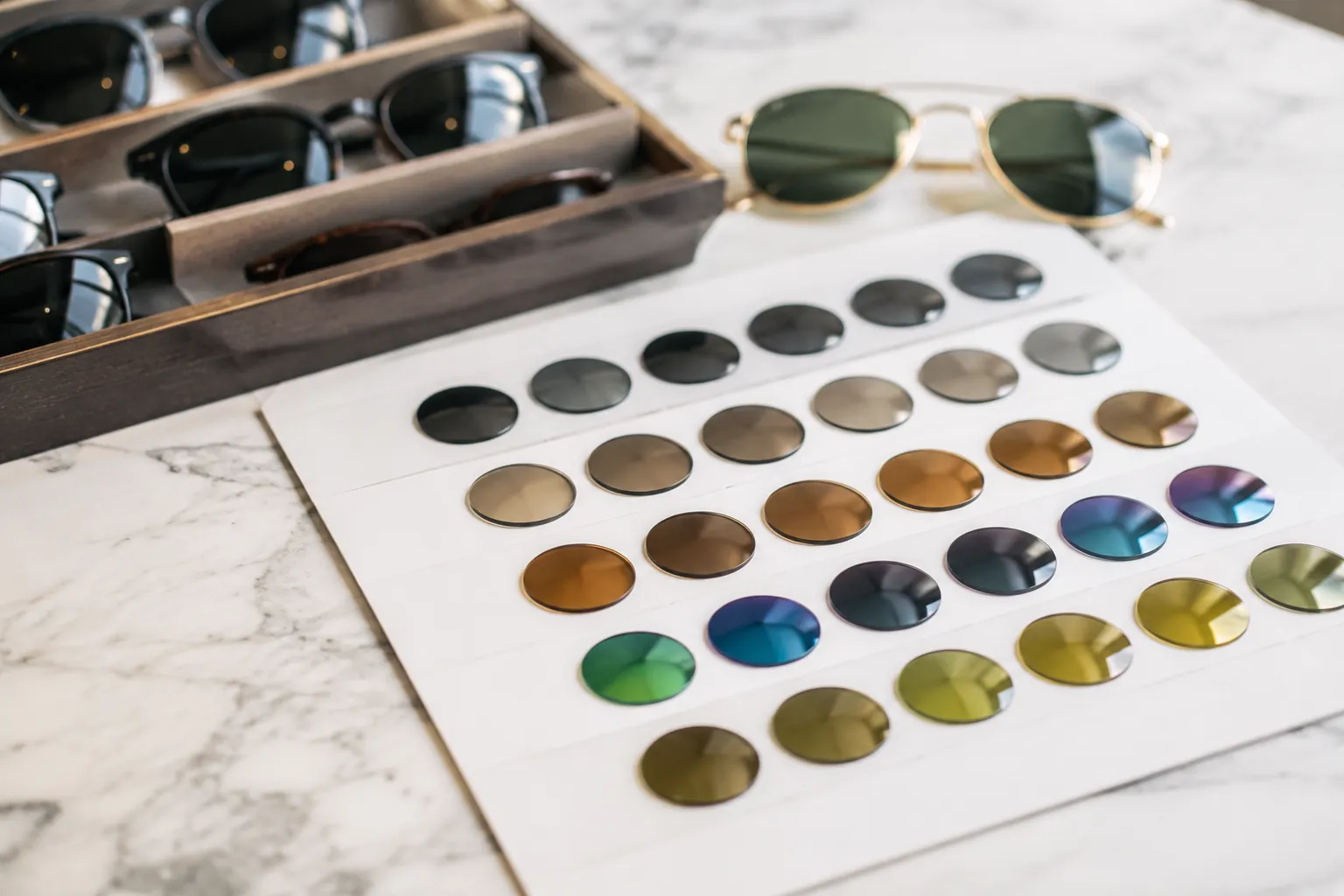
This guide is for overseas brands, importers, distributors, promotional buyers, and retail chains ordering custom sunglasses in volume. It shows how to specify visible light transmission, tint density, lens color, material, coatings, decoration, compliance market, and inspection tolerance. Do not rely on vague notes like "dark smoke" or "summer brown." Those words start conversations. They do not control production. Clear specs reduce sample rounds, tighten shade control, improve purchase orders, and cut disputes when bulk sunglasses arrive.
Why VLT Belongs on Every Sunglasses RFQ
Visible light transmission, usually written as VLT, is the percentage of visible light that passes through a sunglass lens. A lens with 12% VLT transmits about 12% of visible light. The rest is reduced by the lens material, tint, polarizing film, mirror coating, or other treatment. For buyers, VLT turns a subjective lens color into a production target.
Many RFQs still describe lenses as "black," "smoke," "tea," or "medium brown." These names help with appearance. They are not enough for repeatable manufacturing. One supplier may read "smoke" as a dark category 3 lens. Another may produce a lighter fashion tint. Both samples may look fine indoors. Outdoors, they can perform very differently.
A stronger RFQ states lens material, thickness if known, tint type, target VLT, tolerance, UV requirement, polarization, mirror coating, destination market, applicable standard, and inspection method. For example: "PC lens, 2.0 mm center thickness, solid grey, VLT 12% ±3%, UV400, non-polarized, no mirror, CE EN ISO 12312-1 category 3, measured after final coating." That gives sampling, production, and QC the same target.
Measure VLT on the finished lens condition that will ship. If a lens is tinted first and later receives mirror coating, hard coating, or another treatment that affects transmission, check final VLT after that process. If buyer and supplier measure at different stages, they may argue over the same lens.
How VLT Ranges Guide Buying Decisions
Do not choose VLT by fashion preference alone. VLT affects wearer comfort, product claims, category labeling, driving suitability, product photography, and sales channel expectations. A very dark lens may suit a beach range but feel too heavy for city use. A light pink or blue lens may work for festival fashion. That does not make it strong sun protection.
| Approx. VLT Range | Typical Lens Look | Common Buyer Use | Spec Sheet Caution |
|---|---|---|---|
| 8% to 18% | Dark grey, dark brown, G15, dark green | Beach, resort, high-sun retail, sport-inspired frames | Often used for strong sunlight products; confirm filter category, driving suitability, and local labeling requirements. |
| 18% to 30% | Medium smoke, brown, amber, green | Mainstream lifestyle sunglasses, city collections, general retail | A common commercial range for everyday sunwear; still verify UV protection and the applicable standard. |
| 30% to 50% | Light smoke, gradient lower zone, colored fashion tint | Fashion frames, boutique lines, indoor-outdoor styling | Useful for appearance-led products, but avoid overstating sun protection claims. |
| 50% to 80% | Very light pink, yellow, blue, lavender, clear fashion tint | Festival, promotional, optical-fashion, low-light style eyewear | UV400 and VLT are separate; specify both, and do not imply strong glare reduction unless testing supports it. |
Lower VLT means a darker lens. It does not automatically mean a safer or better lens. UV protection is measured separately from visible light transmission. A light lens can block ultraviolet radiation if the material or coating is specified and verified. A dark lens without proper UV control is risky. It reduces visible brightness, but tint alone does not prove UV protection.
Material Behavior: PC, TAC, Nylon, and CR39
Lens material changes tint response, shade stability, performance, and price. Buyers often tell a factory to "make it darker." That sounds simple. It is not. The adjustment depends on dye absorption, lens thickness, coating compatibility, polarization structure, heat exposure, and production sequence.
Polycarbonate, or PC, is widely used for custom sunglasses because it is light, impact resistant, and suitable for many molded sunglass programs. Tint results can vary by material grade, coating, thickness, and process control. For bulk production, ±3% VLT is often more realistic than an extremely narrow tolerance the process cannot hold.
TAC is common for polarized sunglass lenses because it is made as a laminated structure with a polarizing film. Final VLT depends on the film, adhesive layers, lens color, surface treatments, and mirror coating if used. Do not assume a non-polarized PC smoke lens and a polarized TAC smoke lens will transmit the same amount of light.
Nylon lenses are used in some performance and premium programs because they can offer good optical properties, flexibility, and chemical resistance, depending on grade and construction. CR39 is valued for optical clarity in many eyewear applications, but it is heavier than PC and behaves differently in impact testing. Choose material against use, selling market, performance needs, and test standard.
Gradient lenses need defined measurement points, not one average number. Example: top zone 15% ±4% VLT, middle zone recorded for reference, bottom zone 55% ±6% VLT. Mirror lenses need final VLT measured after mirror coating. Silver, blue, gold, red, and other mirror finishes can reduce transmission and shift perceived color.
What the Lens Room Controls
A professional tint process is not just visual matching. It creates a repeatable recipe for development samples, pilot runs, bulk production, and reorders. The process starts with the buyer's target VLT, approved appearance reference, frame type, lens material, coating plan, and destination market.
A practical development flow looks like this:
- Buyer confirms target VLT, lens material, color reference, polarization, mirror requirement, destination market, and applicable standard.
- Factory confirms lens blank, sheet, or finished-lens structure, including thickness and coating compatibility.
- Lab prepares tint trials with recorded dye ratio, bath temperature, immersion time, and rinsing or cooling steps where applicable.
- Trial lenses are measured with a visible light transmission meter instead of judged only by eye.
- Buyer approves a physical sample, and the factory retains a master sample for production comparison.
- Bulk lenses are checked by batch before assembly and rechecked after coating, edging, or other processes that may affect final appearance or transmission.
For a solid grey PC lens, the tint room may adjust immersion time or dye concentration to reach the target. For light fashion tints, a small VLT change can look obvious. Use both meter readings and side-by-side visual approval under consistent lighting.
Inspection must say where the reading is taken. For a solid lens, the center point is often enough. For a gradient lens, use top, middle, and lower points. For shield lenses, oversized shapes, or high-wrap frames, review edge uniformity. Curved or cut areas can make tint and coating density look different.
Writing a Spec Sheet Production Can Follow
A useful tint spec sheet is short, numeric, and tied to inspection. It should not read like a catalog description or mood board. The lens room needs measurable targets. The merchandiser needs approved references. The QC inspector needs pass-fail rules.
Include these fields for each lens SKU:
- Lens material: PC, TAC polarized, nylon, CR39, or another agreed material.
- Lens thickness: for example 1.8 mm, 2.0 mm, or 2.2 mm center thickness, if relevant to the frame design and test requirement.
- Lens type: solid tint, gradient tint, polarized, photochromic, mirror coated, flash mirror, or clear UV lens.
- Target VLT: one number with tolerance, such as 14% ±3%, or separate measurement points for gradient lenses.
- Color reference: sealed approved sample, internal master code, or Pantone reference for appearance discussion only.
- UV requirement: UV400 or the required UV result under the applicable destination-market standard.
- Compliance market: CE EN ISO 12312-1, ANSI Z80.3, AS/NZS 1067, REACH, FDA registration context, or other buyer requirement.
- Inspection method: meter position, sample size, tolerance, lighting condition, retained master comparison, and measurement stage.
A production-ready example: "Style LS-2407, injection PC frame, PC lens, 2.0 mm center thickness, solid G15 green, VLT 15% ±3%, UV400, non-polarized, no mirror, CE EN ISO 12312-1 and ANSI Z80.3, REACH-compliant materials, measured after final coating and before final packing."
Do not rely on Pantone alone for transparent lenses. Pantone can help define frame plastic, logo printing, temple decoration, pouch color, and packaging. It does not define light transmission. For lens performance, the approved physical sample and measured VLT matter more than a printed color chip.
Compliance, MOQ, Price, and Lead Time
Match compliance to the selling market, not only to the design brief. European buyers commonly specify CE EN ISO 12312-1 for sunglasses. US buyers often reference ANSI Z80.3 and FDA registration context. Australia and New Zealand programs may require AS/NZS 1067. REACH can apply to restricted substances in materials, coatings, and packaging. ISO 9001 and BSCI relate to management systems and social compliance. They do not replace product performance testing.
VLT links directly to filter category under sunglass standards such as CE EN ISO 12312-1. Very dark lenses may need extra attention to driving suitability and user information. Light lenses may not support strong sunlight claims. If one SKU ships to several markets, confirm the strictest testing, marking, warning, and user-instruction requirements before artwork, hangtags, or retail packaging are printed.
MOQ and price depend on customization level, material choice, test requirements, decoration process, packaging, and whether existing components can be used. A stock frame color, standard lens color, and simple logo print usually carry a different MOQ and cost than custom molds, special acetate, polarized mirror lenses, metal trim, custom packaging, and third-party lab testing.
Lead time follows process complexity. Sampling slows down when VLT targets are unclear, standards are missing, lens material is unavailable, artwork is incomplete, or packaging decisions come late. Bulk production can be delayed by new tooling, acetate color development, custom metal parts, polarized mirror construction, special coatings, or external testing. The fastest orders are the clearest orders.
Decoration Methods and Tint Coordination
Lens specifications and decoration specifications should be separate. They still affect each other in planning. A temple logo, metal badge, printed pattern, or lens engraving can change the production sequence and QC checkpoints. Approve decoration late, and final packing can slip even if the lens tint is correct.
Common decoration methods include laser engraving, pad printing, hot stamping, metal logo plates, injected logo details, custom temple inserts, and printed packaging. Laser engraving can work for subtle branding on temples or selected lens areas. Lens engraving needs care. It must not interfere with the wearer's field of view, product markings, or compliance information. Pad printing is efficient for logos and small color details, but ink adhesion must match the frame material and surface coating.
Metal logo plates and custom hinges can raise perceived retail value, but they add tooling, positioning checks, and possible schedule risk. For acetate sunglasses, CNC milling, lamination, hand polishing, and hinge installation affect timing. For injection frames, mold condition, color masterbatch, surface finish, and logo process are often major cost and quality drivers.
The best purchase orders separate lens performance from decoration artwork. Lens performance should list VLT, UV, polarization, coating, material, and standard. Decoration should list logo file, size, position, color, process, tolerance, and approved sample. Keep the files clean. Then QC can identify the defect type instead of mixing shade issues with branding issues.
Common Spec Mistakes That Cause Delays
Most tint disputes are preventable. They often start before production, when the buyer's document leaves too much open to interpretation. The factory may still produce an attractive sample. Repeatability is the problem if no one agreed on the measurable target.
- Using only color names: "smoke," "tea," "blue grey," and "black" are appearance words, not production specifications.
- Ignoring lens material: PC, TAC, nylon, and CR39 do not tint, coat, price, or inspect in the same way.
- Approving photos only: phone screens, camera exposure, studio lighting, and background color distort perceived lens darkness.
- Forgetting mirror impact: mirror coating can change final VLT, color appearance, and edge uniformity.
- Mixing markets: Europe, the US, and Australia/New Zealand may need different markings, claims, warnings, and test reports.
- No retained master sample: without an approved physical reference, repeat orders depend on memory instead of measurement and comparison.
- Burying lens details in artwork notes: decoration instructions should not replace lens performance specifications.
Use one simple rule: if it affects the wearer's eyes, write it down. Lens darkness, UV protection, polarization efficiency, optical quality, category, coating, and final VLT belong in the spec sheet. Decoration details such as laser logo, pad print, or metal logo plate belong in a separate artwork and branding section.
Buyer note: Ask the supplier to record the VLT of the approved sample, the first bulk batch, and each repeat order batch. Keep those readings with the sealed sample and purchase order. Future disputes should be checked against data, not memory.
Have a custom sunglasses project in mind?
Send us your styles, target market and quantities and we will return a detailed quote with MOQ, lead time and a sample plan.
Get a QuoteWhy source this from Wenzhou with LumiShades
Wenzhou in Zhejiang Province is widely regarded as China’s eyewear manufacturing capital, producing a large share of the world’s sunglasses. That concentration matters to buyers: a deep local supply chain for acetate sheet, hinges, lens blanks, plating and packaging means shorter component lead times, easier color and material matching, and a workforce with decades of eyewear-specific skill. LumiShades has manufactured in this ecosystem since 2009, and our vertical integration — in-house injection molding, acetate cutting, CNC milling, lens tinting, decoration and quality control — means no part of your order is quietly subcontracted to a workshop you cannot audit.
For international buyers, that vertical control translates into accountability. When a single factory owns every step, defects are traced and fixed at source rather than bounced between vendors, and your specifications survive intact from first sample to bulk. We back this with 15+ years of experience, shipments to 60+ countries, more than 5 million pairs produced per year and a 98.5% on-time delivery rate. Our certifications — CE EN ISO 12312-1, FDA registration, ANSI Z80.3, AS/NZS 1067, REACH, ISO 9001 and BSCI audit — mean the compliance documentation your market requires already exists. Explore our manufacturing capabilities and quality control process to see how this works in practice.
Frequently asked questions
What VLT should I choose for general lifestyle sunglasses? Start with the intended use and destination standard, then choose the filter category and VLT target. For many lifestyle sunglasses, category 2 or category 3 under the applicable standard is common. Confirm the exact VLT against CE EN ISO 12312-1, ANSI Z80.3, AS/NZS 1067, or the buyer's market requirement. Put the chosen VLT and tolerance on the RFQ instead of asking only for "medium smoke" or "dark brown."
Is UV400 the same as a low VLT lens? No. VLT measures visible light transmission. UV400 refers to ultraviolet blocking up to 400 nm. A light lens can be UV400 if the material or coating provides the required UV protection. A dark lens still needs UV performance verified. On the spec sheet, list both target VLT and UV requirement, then confirm them by test report or supplier inspection records.
How tight should my VLT tolerance be for bulk orders? Use a tolerance the material and process can realistically hold. For many solid tinted PC or TAC sunglass lenses, ±3% VLT is a practical starting point, but the supplier should confirm it during sampling. Gradient, mirror, very light fashion tints, photochromic lenses, and highly curved lenses may need separate measurement points, wider tolerances, or extra visual approval criteria.
Can I approve lens color from photos? Use photos only for early screening. Final approval should be based on a physical sample, recorded VLT, and a retained master sample. Screens, camera exposure, lighting, and background color all change perceived tint. For important orders, ask the supplier to measure the approved sample and include that reading in the purchase order or technical file.
What should I put on the purchase order for compliance? State the destination market, applicable standard, lens category or intended category, target VLT, UV requirement, polarization status, coating type, and any required markings or warnings. Examples include CE EN ISO 12312-1 for Europe, ANSI Z80.3 and FDA registration context for the US, AS/NZS 1067 for Australia and New Zealand, and REACH for restricted substances where applicable. Do not treat ISO 9001 or BSCI as substitutes for product testing.
Does polarization change the VLT specification? It can. Polarized lenses, often made with TAC laminated structures, include a polarizing film and other layers that affect final transmission. Specify whether the lens is polarized, state the final target VLT, and measure after the complete lens construction and coating are finished. Do not assume a polarized smoke lens will match the VLT of a non-polarized smoke lens.
Ready to start?
Explore our round sunglasses or request a quote — our sales team replies within 12 hours.
Request a Quote