
Impact-Resistant Sunglass Lenses: B2B Spec Guide
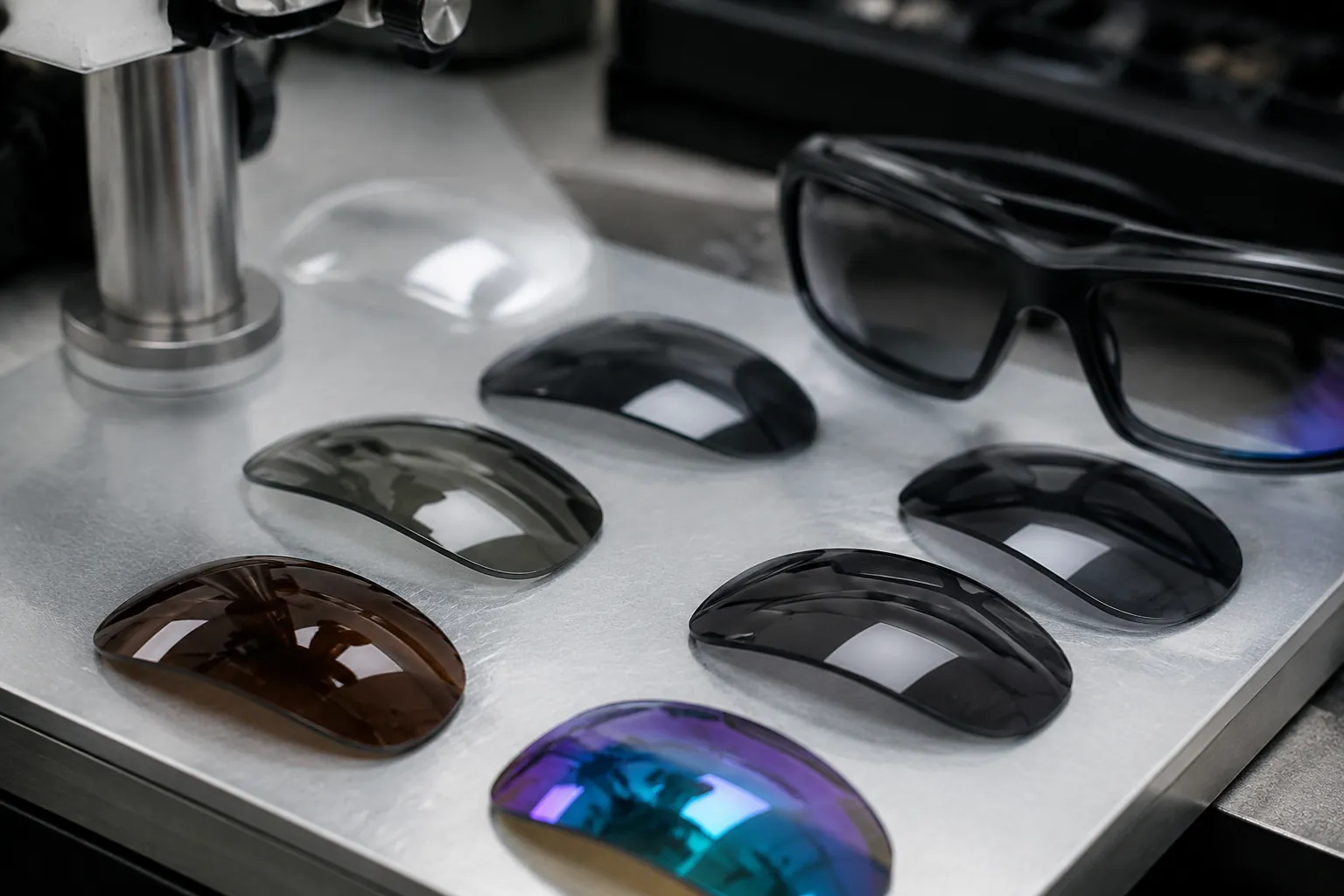
This guide is for brand owners, importers, distributors, and retail buyers ordering custom sunglasses in volume. It explains how to specify impact-resistant sunglass lenses for real production: material, thickness, edge design, frame fit, coatings, testing, packaging, and QC evidence. The aim is simple. Fewer cracked lenses. Fewer avoidable returns. Stronger compliance files. Sunglasses that fit the retail, promotional, or private-label channel they are built for.
Impact resistance belongs to the finished product
Impact resistance is not a sticker claim. It depends on the whole eyewear system. A lens blank may perform well before cutting, tinting, mirror coating, drilling, or assembly. It can still become weak if the edge is rough, the frame groove is too tight, or the base curve does not match the frame.
Buyers should separate four questions. What lens material is being used? What minimum thickness is specified? Which standard applies to the finished eyewear? How will the assembled product be checked before shipment?
For non-prescription sunglasses, the right references depend on the sales market. Common requirements include CE EN ISO 12312-1 for the European Union, ANSI Z80.3 for the United States, AS/NZS 1067 for Australia and New Zealand, REACH for restricted substances where applicable, FDA registration for relevant U.S. eyewear import files, ISO 9001 for quality management systems, and BSCI for social compliance auditing. Name the exact requirement in the purchase order. Do not rely on vague wording such as "international standard."
There is also a hard line between fashion sunglasses and occupational safety eyewear. ANSI Z80.3 sunglasses are not industrial safety glasses. If the eyewear must be used for worksite protection, say that at RFQ stage. Lens thickness, frame retention, markings, side coverage, and testing may all change. For most retail and promotional sunglasses, the target is durable daily-use eyewear that meets the sunglass standard for the sales market and survives normal handling, shipping, display, and wear.
Lens materials behave differently in production
Material choice drives much of the impact-resistance discussion. It also affects optical feel, weight, scratch resistance, tint consistency, polarization, coating adhesion, and cost. A festival giveaway, a children's sunglass program, and a polarized retail line should not default to the same lens construction.
| Lens material | Typical thickness range | Impact behavior | Best use | Buyer caution |
|---|---|---|---|---|
| Polycarbonate | 1.5-2.0 mm common for many sunglasses | Very tough, light, and resistant to cracking under normal sunglass use | Children's styles, sports-inspired frames, rough promotional use, durable retail lines | Usually needs a hard coating because the raw surface scratches more easily than some alternatives |
| TAC polarized | 0.74-1.1 mm common laminated structures | Suitable for normal sunglass use when lamination, cutting, and edge quality are controlled | Fishing, driving, outdoor private label, retail polarized programs | Poor lamination or edge sealing can cause haze, delamination, splitting, or edge defects |
| CR-39 | 1.6-2.0 mm common | Good optical quality, generally lower impact resistance than polycarbonate | Fashion sunglasses where optical clarity and tint depth matter | Not the first choice for children's frames, rimless styles, or rough handling |
| Acrylic | 1.5-2.0 mm common | Lower-cost material that can be more brittle under stress | Novelty, short-life giveaways, very price-sensitive orders | Can crack near sharp corners, drill holes, tight grooves, or stressed frame areas |
| Nylon | 1.5-2.2 mm common depending on curve | Flexible and tough when specified and processed correctly | Curved performance styles, one-piece shields, fashion sport looks | Requires tighter control of base curve, optics, coating adhesion, and fit |
If a buyer only asks for "impact-resistant lenses," suppliers may quote different products that are not comparable. Be specific. For a durable non-polarized retail sunglass, polycarbonate is often a practical default. For polarized products, TAC is common, but the finished lens still needs checks after cutting and assembly. A material name is not a QC plan.
Write the standard into the purchase order
Standards language belongs in the purchase order, not only in an email or chat thread. The PO should identify the sales market, lens category or visible light transmission target, UV claim, material, coating, packaging claim, and required documents before shipment. This reduces disputes after goods are already made.
A clear specification might read: "Finished non-prescription sunglasses to comply with CE EN ISO 12312-1, category 3 smoke polycarbonate lenses, UV400 claim supported by test evidence, REACH documentation required where applicable for frame and lens materials, hard coating required, pre-production sample approval before bulk production."
For U.S. distribution, add ANSI Z80.3 and U.S.-specific labeling requirements. For Australia and New Zealand, add AS/NZS 1067. Do not request every global standard unless the product will ship to those markets. Extra testing adds cost and time.
- State the sales market: EU, U.S., Australia/New Zealand, or multi-market.
- State lens material: polycarbonate, TAC polarized, CR-39, acrylic, or nylon.
- State lens category or VLT range, such as category 3 for strong sunlight.
- State UV claim, such as UV400 or 100% UVA/UVB where supported by evidence.
- State special lens features: polarized, mirror, gradient, photochromic, solid tint, or shield lens.
- State whether testing applies to lens blanks, cut lenses, or finished sunglasses.
- State required evidence: approved sample, test report, inspection photos, AQL report, and packaging sample.
Finished-product testing matters because assembly can change performance. A good blank can be weakened by a rough bevel, overheated fitting, tight rim, shallow groove, drilled decoration near the edge, or a base-curve mismatch between lens and frame.
Thickness, geometry, and fit control breakage
Lens material alone does not protect the program. Thickness, edge shape, frame groove, and base curve often decide whether a lens cracks, rattles, or pops out.
A 1.0 mm lens in a large square frame behaves differently from a 1.8 mm lens in a smaller oval frame. Sharp lens corners concentrate stress. Very thin edges reduce retention. A flat lens forced into a curved frame may sit under constant tension and fail after heat exposure during storage, shipping, display, or use.
For many non-prescription sunglasses, ask the supplier to confirm center thickness, edge thickness, base curve, lens bevel, and groove fit during sampling. As a practical working range, many durable sunglass programs use about 1.5-2.0 mm polycarbonate lenses. Oversized frames, rimless designs, shield lenses, and children's eyewear need closer review. Do not reduce edge thickness only to save cost if the frame has a large eye size or angular corners.
In injection-molded frames, groove consistency is critical. Flash, shrinkage, or uneven groove depth can pinch the lens. In acetate frames, cutting, beveling, heating, and hand assembly all affect retention. In metal, rimless, and semi-rimless designs, screw tension, drilled holes, exposed edges, and bridge geometry create concentrated stress.
Approve a physical sample, not only front-view photos. Open and close the temples. Press lightly around the lens edge. Check for lens rattle. Inspect under side light. Look for whitening, chips, stress marks, edge gaps, and uneven seating. For rimless and semi-rimless styles, discuss impact expectations separately because drilled holes and exposed edges raise risk. If the design must survive sport-style use, use tougher material, conservative hole placement, and a thicker lens where the design allows.
Coatings, tinting, and decoration add risk
Impact-focused buyers often miss surface durability and process risk. Polycarbonate is tough, but without a hard coat it can scratch quickly in retail use. Mirror coatings improve shelf appeal but may show abrasion, fingerprints, pinholes, or color drift if the coating stack and handling process are weak. TAC polarized lenses depend on stable lamination, clean cutting, and proper edge control. Gradient tinting must look smooth without heat stress, color bands, or uneven visible light transmission.
A useful specification combines mechanical and cosmetic requirements. For example: "Hard-coated polycarbonate lens, UV400, category 3 smoke tint, no visible coating pinholes at agreed inspection distance, no edge chips after cutting, no lens movement after assembly, approved mirror color master required for production."
For mirror colors, ask the supplier to keep a signed color master and agree on acceptable shade variation between lots. Blue mirror, silver mirror, red mirror, and other reflective finishes can shift visibly between coating batches. Small shifts may be acceptable. Surprise shifts are not.
Decoration also affects durability. Common options include laser engraving, pad printing, metal logo plates, temple logos, lens logos, and branded packaging. A temple pad print is usually lower risk. A metal logo plate can require frame changes that affect lens seating. A lens logo may look premium, but placement must avoid the central viewing zone and should not damage the coating. Laser marking directly on a lens needs careful review. Many buyers are better served by temple or frame marking.
For retail programs, request rub checks on printed logos, cleaning-cloth checks on coated lenses, and inspection of mirror surfaces after packing trials. For promotional goods, be honest about expected product life. A low-cost giveaway can still be compliant for its intended market, but it should not claim premium coating durability unless the construction and test evidence support the claim.
MOQ, price, and lead time follow the spec
Low MOQ and low unit price pull the specification in opposite directions. Small runs are useful for market tests, events, influencer drops, and small brand launches. Unit cost is usually higher because material purchasing, color setup, artwork handling, sampling, and packing preparation are spread across fewer pairs.
As quantity increases, decoration, packaging, material purchasing, and production planning usually become more efficient. Still, price cannot be judged by quantity alone. Frame type, lens material, lens thickness, polarization, mirror coating, hard coating, decoration method, retail packaging, inspection level, and third-party testing all affect the quote. A TAC polarized lens, custom mirror, acetate frame, retail box, or extra lab test can change cost quickly.
Sampling often takes about 7-10 days after artwork, material, logo position, and lens color are confirmed. Confirm this for each project. Bulk production commonly takes about 25-35 days after sample approval and deposit for standard custom programs. New molds, custom frame colors, special mirror lenses, photochromic lenses, third-party lab testing, complex packaging, or failed first samples can add time. Build in at least one sample correction round.
The wrong way to reduce price is to quietly switch from polycarbonate to acrylic, reduce lens thickness, remove hard coating, simplify packaging without a scratch trial, or loosen inspection while keeping the same claim. The better method is to request a costed option list: base construction, upgraded lens, upgraded coating, retail packaging, third-party testing, and a lower-cost promotional version. Then the buyer can choose the trade-offs that fit the sales channel.
QC should catch weak lenses before shipment
Impact-related QC is not only a lab issue. Many failures are visible during production before formal testing. A sound inspection plan starts with incoming lens material, continues through tinting, coating, cutting, decoration, and assembly, and finishes with packed-carton review. Match the inspection scope to the product risk and the claims printed on packaging or sales listings.
Ask for written checks covering lens material confirmation, UV test, visible light transmission or lens category where required, polarization if applicable, surface defects, mirror color comparison, edge chips, lens fit and retention, hinge function, temple alignment, logo placement, packing method, and carton suitability for shipping. For higher-risk programs, add finished-product impact testing against the stated market standard.
Define visual standards before production. "No scratches" is too vague unless inspection distance, lighting, defect size, and acceptance criteria are agreed. A common commercial approach is inspection at normal viewing distance under good light, with critical defects rejected and minor defects judged by AQL. Lens defects in the central viewing zone should be treated more strictly than small edge marks hidden by the frame.
For orders with retail packaging, inspect the product after it has been packed, shaken, and reopened. Scratches often happen during packing, not production.
Buyer rule: if a claim is printed on packaging, hang tags, website listings, or retail cartons, the finished product should be able to support that claim with suitable documentation. Packaging language is evidence a retailer, customs authority, or regulator may ask about.
Use a specific RFQ, not a vague quality request
The best RFQs are specific enough for the supplier to quote, sample, and inspect. Do not ask for "high quality impact-resistant sunglasses" and expect a controlled result. Send a construction brief with the frame, lens, coating, standard, decoration, packing, and evidence requirements.
A strong RFQ can include frame type, such as injection plastic, acetate, metal, or mixed material; lens material, such as 1.8 mm polycarbonate or TAC polarized; UV400 claim; lens category or VLT target; tint color; mirror or gradient requirement; logo method; packaging type; sales market; required standards; sample deadline; target order quantity; and inspection evidence. If the order may scale from a trial run to larger production, ask for tiered pricing so the design does not need to be rebuilt later.
For children's sunglasses, sports-inspired styles, and rough promotional use, protect lens material and thickness before cutting cost elsewhere. For fashion color stories or short campaigns, appearance may deserve more budget than heavy-duty performance. Both choices can be valid. The mistake is letting price pressure choose the construction without documenting what changed.
Before bulk approval, review physical samples, not only digital renders. Confirm lens seating, edge quality, coating appearance, logo position, packaging fit, and compliance documents. If a sample fails, correct it before production. Losing time at sampling is usually cheaper than receiving a bulk order with cracked lenses, poor retention, or unsupported claims.
Have a custom sunglasses project in mind?
Send us your styles, target market and quantities and we will return a detailed quote with MOQ, lead time and a sample plan.
Get a QuoteWhy source this from Wenzhou with LumiShades
Wenzhou in Zhejiang Province is widely regarded as China’s eyewear manufacturing capital, producing a large share of the world’s sunglasses. That concentration matters to buyers: a deep local supply chain for acetate sheet, hinges, lens blanks, plating and packaging means shorter component lead times, easier color and material matching, and a workforce with decades of eyewear-specific skill. LumiShades has manufactured in this ecosystem since 2009, and our vertical integration — in-house injection molding, acetate cutting, CNC milling, lens tinting, decoration and quality control — means no part of your order is quietly subcontracted to a workshop you cannot audit.
For international buyers, that vertical control translates into accountability. When a single factory owns every step, defects are traced and fixed at source rather than bounced between vendors, and your specifications survive intact from first sample to bulk. We back this with 15+ years of experience, shipments to 60+ countries, more than 5 million pairs produced per year and a 98.5% on-time delivery rate. Our certifications — CE EN ISO 12312-1, FDA registration, ANSI Z80.3, AS/NZS 1067, REACH, ISO 9001 and BSCI audit — mean the compliance documentation your market requires already exists. Explore our manufacturing capabilities and quality control process to see how this works in practice.
Frequently asked questions
Should I specify polycarbonate for all impact-resistant sunglasses? Not automatically. Polycarbonate is often the strongest practical choice when impact resistance is the priority, especially for children's sunglasses, sports-inspired styles, and rough-use promotional eyewear. TAC polarized may be better when polarization is the main selling point. CR-39 may suit some fashion programs where optical clarity and tint appearance matter more. State the sales channel, use case, lens material, thickness, and finished-product test requirement in the RFQ.
Is ANSI Z80.3 the same as a safety eyewear standard? No. ANSI Z80.3 applies to non-prescription sunglasses. It is not an occupational safety eyewear standard. If the product must protect users in worksite or industrial conditions, tell the supplier at RFQ stage and request the correct safety-eyewear specification. Safety eyewear may require different lens thickness, frame coverage, side protection, markings, retention performance, and test evidence.
What lens thickness should I request? There is no single correct thickness for every style. As a practical starting point, many durable sunglass programs use about 1.5-2.0 mm polycarbonate lenses. The final specification should be checked against frame size, lens shape, base curve, groove depth, and sales-market standard. Oversized frames, sharp corners, rimless designs, shield lenses, children's eyewear, and sport-style products need closer review of both center thickness and edge thickness.
What should I ask for before approving bulk production? Ask for physical samples, not only photos. Confirm lens material, thickness, UV claim, lens category or VLT, coating appearance, tint or mirror master, polarization if applicable, lens fit and retention, edge quality, logo placement, packaging fit, and required compliance documents for the sales market. If the product carries a claim on the package or listing, ask for evidence that supports the finished product, not only the raw lens blank.
Can low-MOQ custom sunglasses still use impact-resistant lenses? Yes, but the specification must be realistic. A small custom order can use polycarbonate or suitable TAC lenses, but the unit price is usually higher because setup, material purchasing, decoration, sampling, and packing are spread across fewer units. For low-MOQ programs, protect the main risk items first: lens material, lens thickness, UV claim, frame fit, and packaging that prevents scratches during transport.
How long should I allow for sampling and bulk orders? For many standard custom sunglass projects, sampling may take about 7-10 days after artwork, lens color, logo position, and materials are confirmed. Bulk production often takes about 25-35 days after sample approval and deposit. Confirm timing project by project, and add buffer for new molds, special coatings, custom colors, photochromic lenses, third-party testing, complex packaging, or sample corrections.
What is the biggest cause of lens breakage after material choice? Poor fit between the lens and frame is one of the most common causes. Tight grooves, sharp lens corners, rough drill holes, thin edges, base-curve mismatch, and heat stress can make an otherwise suitable material fail early. Approve assembled eyewear, check lens retention and edge quality, and require the supplier to correct stress marks, rattling, uneven seating, or visible edge chips before bulk production.
Ready to start?
Explore our aviator sunglasses or request a quote — our sales team replies within 12 hours.
Request a Quote