
How to Verify UV400 Lenses for Custom Sunglasses
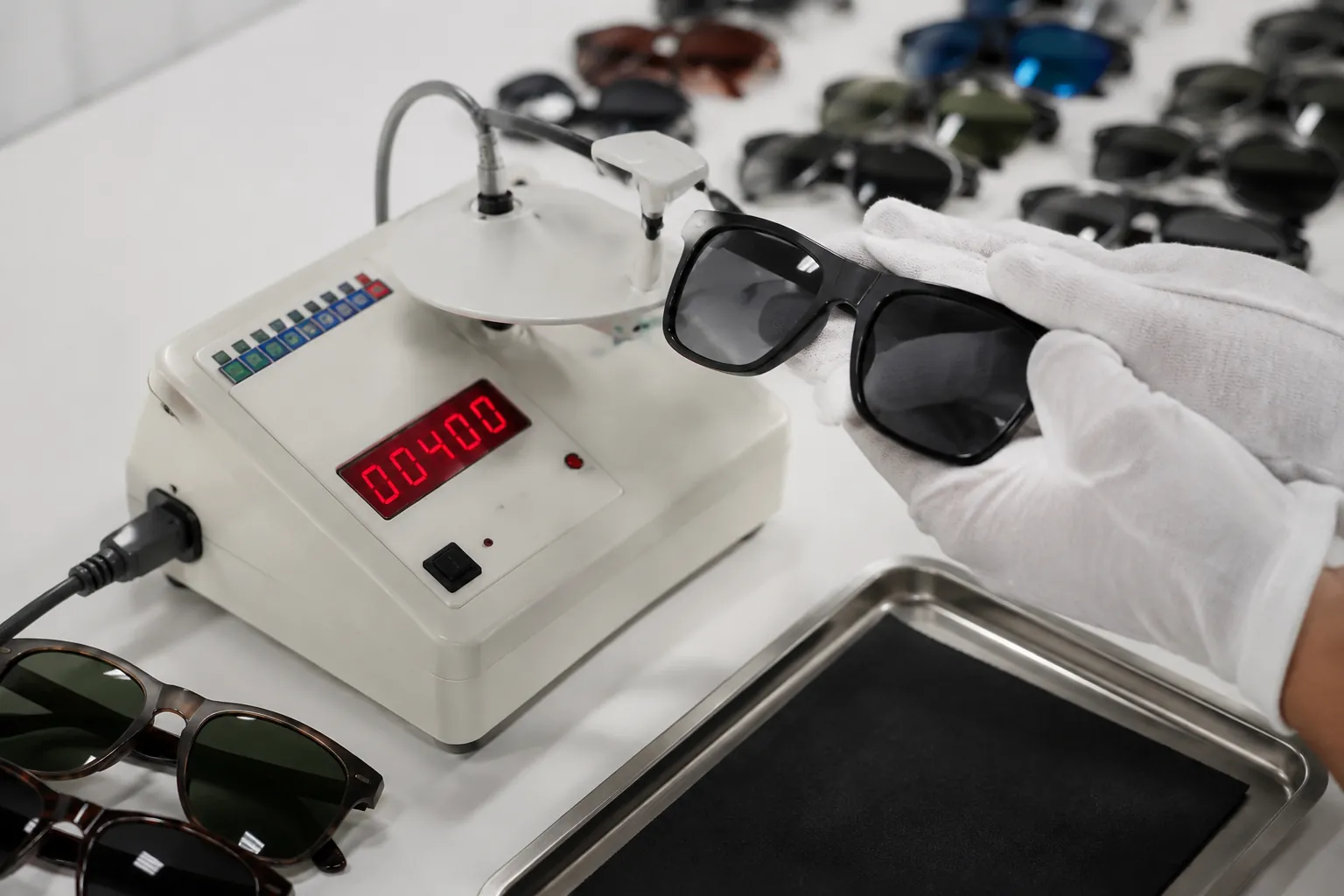
This guide is for brand owners, importers, and distributors buying custom sunglasses in volume. UV400 is useful only when the lens material, tint, coating stack, and test paperwork support the same claim. A dark lens can look premium and still fail a buyer review if the finished product was never tested. Do not rely on appearance. Use this checklist to reduce rejects, avoid compliance gaps, and choose a lens specification that fits your market.
What UV400 Actually Covers
UV400 means the lens is intended to block ultraviolet radiation up to 400 nanometers, including UVA and UVB. For buyers, it is a UV-transmission claim. It is not a promise about lens darkness, polarization, scratch resistance, or overall product compliance.
A lens can be nearly clear and still meet UV400. A lens can also be very dark and still fail if the material, dye package, or coating system does not provide enough UV protection. Darkness is not proof.
For custom sunglasses, the key question is whether the finished lens still meets the claim after tinting, polishing, mirror coating, printing, lamination, edge finishing, and assembly. That matters because a supplier may test a base lens once, then change the process later without retesting the final build.
Ask for evidence on the same lens family, same colorway, and same finishing stack you plan to order. Visible-light transmission and UV performance should also be written as separate specifications in the tech pack. One controls how dark the lens looks. The other controls ultraviolet protection.
Proof to Ask For
Ask for a spectral transmittance report, not just a generic certificate. The report should identify the sample, test method, laboratory, and wavelength range measured. For UV claims, it should show results across the UV region and clearly support the UV400 statement.
If a document only says "pass" without sample identification or method details, it is weak evidence. It may help in a sales conversation. It is not enough for a serious volume order.
For production orders, request evidence from the finished lens, not only the raw material. Test after tinting, hard coating, anti-reflective treatment, mirror application, printing, or polarization lamination. These steps can change the final optical result. A clean report on a base sheet does not automatically prove the finished lens is compliant.
Put simple traceability requirements in the purchase order: sample code, batch number, lens color, coating stack, and artwork or decoration revision if decoration is involved. If the factory cannot match the report to the exact lens family you are buying, the report has limited value.
Rule of thumb: if the UV claim cannot survive the final process step, it is not a reliable specification.
For larger programs, ask for a pre-production sample report and a finished-lot report. Compare the approved sample against the shipped batch. Also ask whether the factory has an internal quality system such as ISO 9001 and whether social compliance documents, such as BSCI where applicable, are current. These do not replace product testing, but they help show whether the factory controls its process.
Lens Materials and Trade-offs
Lens material affects compliance stability, optical feel, durability, and cost. Some materials tint more evenly. Some handle impact better. Some hold polarization or coating layers more consistently. The right choice depends on price, use case, and the strictness of your target market.
| Lens material | Typical UV400 behavior | Strengths | Weak points | Best fit |
|---|---|---|---|---|
| Polycarbonate | Usually provides strong UV protection through the base resin when correctly manufactured | High impact resistance, light weight, common for safety-oriented eyewear | Needs good scratch protection; poor molding or heat control can create stress marks or haze | Sport, kids, travel, higher breakage-risk programs |
| TAC | Common in polarized lenses and generally stable when lamination is controlled | Good optical clarity, lightweight, widely used for fashion polarized sunglasses | Heat sensitivity during lamination and finishing; process discipline matters | Fashion polarizers, everyday retail, mid-market custom lines |
| CR-39 | Can meet UV400 with proper absorbers or coatings, but the finished lens should be validated | Good clarity, easy tinting, familiar classic eyewear feel | Heavier than polycarbonate and less impact resistant | Style-led lines, classic silhouettes, higher optical preference |
Polycarbonate is usually the better choice when impact resistance is a priority, especially for active consumers or younger users. TAC is practical when you want polarized lenses with a good balance of weight, price, and clarity. CR-39 still works well when the brief values classic optics, rich tinting, and visual comfort more than impact performance.
In all three cases, confirm how the UV claim is achieved. Some lenses rely on the base resin. Some use absorptive additives. Others depend on surface coatings. If the supplier cannot explain the stack clearly, the result may depend on one fragile process step instead of a repeatable specification.
Tint Darkness Is Not UV Protection
This is one of the most common mistakes in custom sunglass buying. A darker tint reduces visible light. It does not automatically improve UV blocking. UV protection depends on the lens material, absorptive additives, coatings, and finished construction.
A very dark lens with poor UV filtration is still a poor product. It may be worse than a lighter lens because the wearer assumes it is protective.
Set two separate targets in the tech pack: visible-light transmission and UV performance. For example, you might specify a dark fashion tint for a beach collection and a lighter tint for a lifestyle or driving-style lens while still requiring UV400 compliance. Those are different choices. One affects style and comfort. The other addresses ultraviolet protection.
Also define acceptable tint variation. A well-run factory should keep color consistent from lot to lot and from left lens to right lens within the agreed visual standard. For volume orders, ask for a master reference sample and a written color acceptance standard. Large tint swings usually point to weak process control.
Brown, amber, grey, and smoke are all common choices depending on the market and intended look. The exact shade matters less than whether the supplier can keep it consistent while maintaining the UV claim.
Coatings, Color, and Lot Control
Finishing steps create much of the hidden risk in a UV400 lens program. Mirror coatings can create uneven coverage or edge failure. Hard coats can behave differently if curing is inconsistent. Printing near the lens edge can hide defects. Polarization lamination can distort if heat, pressure, or adhesive cure is poorly controlled.
Every added step adds risk: haze, peel, delamination, color shift, or UV drift. Build the control plan around that reality.
A supplier should record dye bath temperature, immersion time, lens lot number, coating lot, and line or shift reference. They should keep an approved master sample and a retained production sample from each run. If a problem appears later, those records help isolate whether it came from tint, coating, material, or assembly.
Good process control is measurable. Ask whether the factory checks center thickness, edge finish, haze, and visual clarity after finishing. Ask whether it rechecks UV performance after the final step. If lenses are tinted on one day and mounted into frames later, the buyer should still be able to trace both operations.
Look for a supplier that can link the final lens to the production batch and the approved sample. That traceability matters more than a broad marketing claim because it shows what actually shipped.
Compliance Documents by Market
Different markets require different documents. Ask for the right set before placing volume. A UV report alone is not enough if you also need market access documents, chemical compliance, or performance evidence for a retailer onboarding file.
Think of the document stack as four questions: does the lens perform, is it chemically acceptable, is it supported by the right market standard, and can the shipment be traced back to the approved sample?
- CE EN ISO 12312-1: the core sunglasses performance standard commonly requested for the EU.
- ANSI Z80.3: a common US eyewear performance reference used by importers and retailers.
- AS/NZS 1067: the sunglasses standard used in Australia and New Zealand.
- REACH: chemical restriction compliance for substances of concern in the EU supply chain.
- FDA registration: useful for market-entry paperwork, but not a substitute for product testing.
- ISO 9001: an indicator that the factory uses a documented quality management system.
- BSCI: a social compliance framework sometimes requested by buyers and retailers.
Scope is the important detail. A factory may have a valid report for one lens family, one coating stack, or one frame shape, but not for your exact custom colorway. A new tint, different mirror finish, changed lens thickness, or new print application can alter the final product.
If any of those variables change, the safe approach is to retest or at least recheck the finished lens before production release. Ask whether the supplier can provide the test report, declaration paperwork, and retained sample information together. That package is much stronger than a single certificate.
Decoration and Customization Details
Decoration often makes custom sunglasses harder to control. Pad printing, laser marking, hot stamping, foil decoration, and painted accents may look simple on a mockup. In production, they bring tolerances, adhesion risk, color variation, and durability questions.
For lenses, the safer approach is usually to keep decoration on non-optical surfaces or frame components unless the application is designed and tested for the lens surface. Decoration too close to the optical zone can interfere with inspection or performance claims.
For frames, common decoration methods include silk printing on acetate, logo embossing, hot stamping on temples, metal inlays, laser engraving on steel or titanium, and UV printing on TR90 or injection-molded frames. Each method has a tolerance window. Pad printing may suit small logos and fine lines. Laser engraving is better for permanent marking on metal components.
If the logo must survive abrasion, sweat, and repeated cleaning, test the same decoration method on the actual production part. A sample card is not enough.
For retail launches, ask for placement tolerances. A practical spec might require logo position within 1 to 2 mm of the approved artwork location and color matching within an agreed visual standard under D65 lighting. This prevents disputes later, especially when multiple factories or regions are involved.
For lens-level decoration such as gradient tint, mirror fade, or printed branding, confirm whether the process affects the UV test area. If it does, test the finished lens after decoration.
Buyer Checklist Before You Issue the PO
Lock the specification in writing before you approve the order. Do not let the factory interpret your intent after production begins. Define the lens material, target visible-light transmission, UV400 requirement, coating stack, decoration method, acceptable color range, and target market standard in the purchase order or tech pack.
If the supplier quotes several quantities, ask how the same specification affects unit cost at each tier. Price changes with volume because setup, trial loss, and packaging are spread across more units.
Use the sample process to reduce risk. Request an initial sample, review the color and UV file, then approve a pre-production sample before releasing volume. If the program includes mirror coating, multi-step printing, or custom polarized lenses, allow extra time for rework and final inspection.
- Confirm the target market standard and request the matching test report.
- Match lens material to impact risk, tint style, and price target.
- Ask for sample code, lot traceability, and post-finishing UV evidence.
- Set acceptable tint variation and inspect first production against that target.
- Check the compliance file before shipment, not after customs asks for it.
Price logic matters too. Lower quantities usually carry higher setup cost per unit because tooling, dye bath preparation, and inspection time are spread thin. Higher volumes are more efficient if the color and coating stack are stable.
Ask whether the quoted price includes packaging, standard polybags or pouches, carton labels, and final QC. Hidden add-ons appear when this detail is not discussed upfront.
If the supplier can answer these points clearly, you are likely dealing with a controlled lens program. If not, expect rework, delays, or compliance gaps after the order is already moving.
Have a custom sunglasses project in mind?
Send us your styles, target market and quantities and we will return a detailed quote with MOQ, lead time and a sample plan.
Get a QuoteWhy source this from Wenzhou with LumiShades
Wenzhou in Zhejiang Province is widely regarded as China’s eyewear manufacturing capital, producing a large share of the world’s sunglasses. That concentration matters to buyers: a deep local supply chain for acetate sheet, hinges, lens blanks, plating and packaging means shorter component lead times, easier color and material matching, and a workforce with decades of eyewear-specific skill. LumiShades has manufactured in this ecosystem since 2009, and our vertical integration — in-house injection molding, acetate cutting, CNC milling, lens tinting, decoration and quality control — means no part of your order is quietly subcontracted to a workshop you cannot audit.
For international buyers, that vertical control translates into accountability. When a single factory owns every step, defects are traced and fixed at source rather than bounced between vendors, and your specifications survive intact from first sample to bulk. We back this with 15+ years of experience, shipments to 60+ countries, more than 5 million pairs produced per year and a 98.5% on-time delivery rate. Our certifications — CE EN ISO 12312-1, FDA registration, ANSI Z80.3, AS/NZS 1067, REACH, ISO 9001 and BSCI audit — mean the compliance documentation your market requires already exists. Explore our manufacturing capabilities and quality control process to see how this works in practice.
Frequently asked questions
Is UV400 enough for compliance by itself? No. UV400 is a lens-performance claim, not a full compliance package. Buyers still need the relevant market standard, such as CE EN ISO 12312-1, ANSI Z80.3, or AS/NZS 1067 where applicable, plus traceable sample and lot evidence for the finished product.
Does a darker lens block more UV? Not necessarily. Darkness changes visible-light transmission, but UV protection depends on the lens material, absorptive additives, coatings, and finished construction. A dark lens can still fail if the UV filter is weak or the final process changed the lens stack.
Which lens material is safest for high-volume custom sunglasses? Polycarbonate is usually the strongest choice when impact resistance matters most. TAC is common for polarized fashion sunglasses, and CR-39 is useful when optical clarity and classic tint behavior matter more than impact resistance. The safest choice depends on use case, market, and compliance target.
What paperwork should I request from the factory? Ask for the UV test report, the relevant market standard file, REACH where needed, and a sample or lot code that matches the report. Also ask whether the factory can provide ISO 9001 documentation or BSCI information if your customer or retailer requires it. For larger programs, request pre-production and finished-lot evidence.
Can a supplier reuse an old UV400 report for a new colorway? Only if the lens stack is truly unchanged and the report clearly covers the same finished product. A new tint, coating, lamination step, thickness change, or base material can alter performance, so the safer move is to retest the finished lens or get fresh evidence on the new build.
Ready to start?
Explore our cat-eye sunglasses or request a quote — our sales team replies within 12 hours.
Request a Quote