
TR90 vs PC vs Nylon for Sunglass Frames
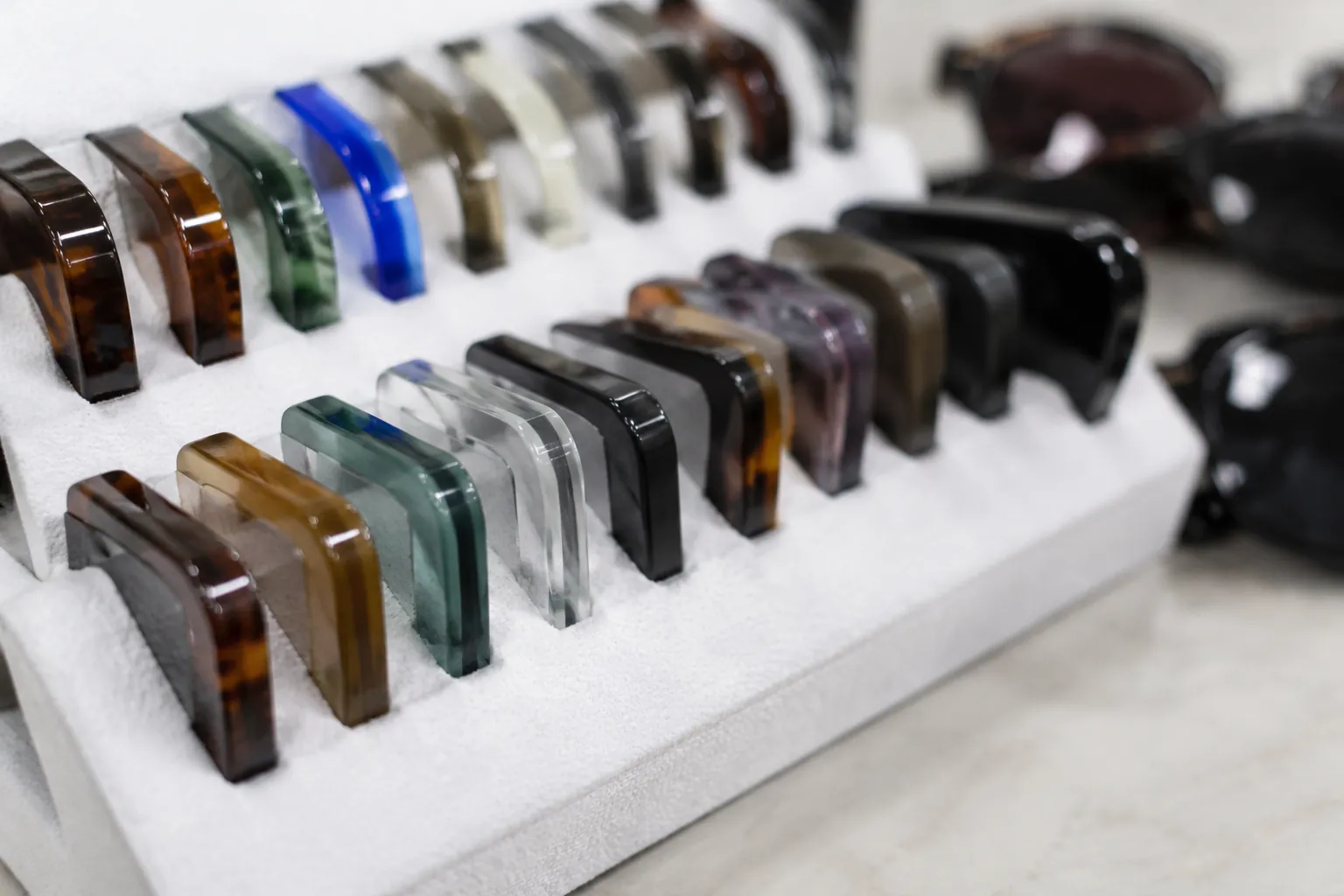
This guide is for buyers sourcing injection-molded sunglasses at commercial volume and choosing the frame resin that fits target cost, wear performance, and retail position. TR90, polycarbonate (PC), and nylon can all work. They do not behave the same in molding, hinge retention, lens insertion, finishing, or field use. A development sample may look fine and still fail later in hot weather, repeated temple cycling, or bulk production if the resin does not match the geometry and use case. The goal is simple: match resin choice to the product brief, design thickness, finish plan, MOQ, and compliance requirements before tooling and bulk scheduling lock in cost and risk.
Start with the product brief, not the resin name
Buyers often ask for TR90, PC, or nylon too early. Start with the retail tier, landed-cost range, wearer profile, use conditions, and finish requirement. Then choose the resin that supports those constraints.
For injection-molded sunglasses, frame material affects visible traits such as weight, flex feel, and finish. It also affects less visible but more expensive issues: molding stability, hinge retention, lens-groove consistency, assembly force, and repeatability from sample to bulk.
A useful buying rule is straightforward. PC often suits price-sensitive fashion and promotional programs. TR90 usually fits lightweight everyday frames. Nylon is often the better choice for sport or performance products where repeated flex, wrap geometry, and toughness matter more than the lowest frame cost.
- Choose PC when price pressure is high, the design is fashion-led, and the program needs a simple injection material for painted or solid-color frames.
- Choose TR90 when low weight, comfort, and a more flexible feel matter for daily-wear or mid-market private-label programs.
- Choose nylon when the frame will face harder use, including sport, higher wrap, or repeated movement and flex.
- Do not specify by buzzword alone; specify target frame feel, hinge construction, finish method, use case, and compliance market together with the resin.
In real sourcing, material choice affects more than the molded front. It can change drying control, mold correction, surface finishing, logo application, hardware installation, and final QC criteria. That is why experienced buyers compare resin options against the same design during development instead of assuming a polymer name guarantees performance.
Head-to-head: performance, cost, and positioning
The table below is a commercial planning tool, not a lab data sheet. It links material behavior to decisions buyers need to make before sample approval and bulk release.
| Material | Typical market position | Frame feel | Relative flex & fatigue behavior | Processing notes | Relative frame cost | Best use cases |
|---|---|---|---|---|---|---|
| PC | Entry to lower-mid | Usually a firmer feel in comparable designs | Good impact resistance, but lower elastic recovery than TR90; thin hinge zones may show visible stress under aggressive geometry | Widely used in injection molding; supports many color and paint options; design around hinge blocks and screw bosses must stay realistic | Lowest of the three in many programs | Fashion sunglasses, tourist retail, promotional orders, price-sensitive chain programs |
| TR90 | Mid-market | Often lighter and more flexible in daily-wear designs | Good flexibility and comfort; spring-back during fitting and angle setting needs control | Requires disciplined molding and post-mold handling; coating and finish results depend on process control and surface preparation | Usually above PC | Lifestyle sunglasses, travel styles, optical-sun hybrids, all-day wear programs |
| Nylon | Mid to upper-mid sport/performance | Can be light with a technical feel, depending on grade and design | Strong toughness and good fatigue resistance for active use | Moisture control is important in processing; wrapped fronts and technical shapes usually require tighter mold and process control | Usually above PC and often above TR90 | Sport sunglasses, wrap frames, cycling, fishing, outdoor, technical eyewear |
Think about unit economics by production stage, not by universal numbers. A 50-pair MOQ may work for development or market testing, but it is rarely the most efficient quantity for stable unit cost. At several hundred pairs per style, line setup and material use usually improve. At higher volumes, the cost gap between PC, TR90, and nylon matters more because even a small per-unit difference can change margin, test budget, and claim exposure across the order.
Do not compare resin price alone. Compare the full specification stack: frame resin, lens material, coating, hinge type, logo method, packaging, and testing scope. A cheaper resin can become the expensive option if it causes more tool corrections, lower cosmetic yield, or higher field returns.
What changes on the factory floor
Changing resin changes the process window. That is the practical issue.
- Drying and material preparation: Nylon is generally more moisture-sensitive before molding and usually needs tighter drying control than PC. Poor preparation can cause cosmetic instability and dimensional drift. TR90 and PC also need controlled handling, but buyers should ask how prep standards differ by resin.
- Tool shrinkage and fit correction: Different resins shrink differently during molding and cooling. That can change front curvature, temple alignment, lens-groove fit, bridge dimensions, and hinge-seat position. Small shifts can create real assembly and fit problems.
- Wall-thickness control: Very thin sections near hinge blocks, screw bosses, or lens-groove transitions raise structural risk regardless of resin. Do not use material choice to excuse weak geometry.
- Gate marks and flow behavior: Gate location affects cosmetic yield, especially on glossy fronts, higher-wrap shapes, or thin visible edges. Review visible surfaces carefully during sampling, not only after paint or decoration.
- Assembly settings: Screw torque, hinge insertion force, and lens mounting force must match the resin and the design. Over-tightening may not fail immediately, but it can increase the chance of cracking, loosening, or distortion later.
This is where supplier capability shows. If molding, lens processing, decoration, and final fitting are split across several parties, it gets harder to isolate whether a defect comes from resin prep, finish compatibility, or assembly stress. A controlled, documented workflow reduces that risk.
Where buyers get surprised: failure modes by material
The best material decision often comes from knowing how each resin fails in real use, not how it is pitched in a sales meeting.
PC failure pattern: PC is widely used and can perform well if the geometry is realistic. Problems usually appear when designs push very thin temples, sharp hinge transitions, large decorative cutouts, or weak reinforcement around hardware. Common field complaints include visible stress at hinge areas, cracking around screw bosses, or front distortion after tight lens insertion.
TR90 failure pattern: TR90 usually performs well for flexibility and comfort, but flexibility does not fix poor engineering. If hardware retention is weak or hinge geometry is under-designed, stress can build in the assembly zone. Spring-back can also affect fitting consistency if post-mold setting is rushed or inconsistent.
Nylon failure pattern: Nylon is tough. It is not automatically the best cosmetic choice. If drying and process discipline are weak, surface consistency can suffer. If the brief calls for a very glossy fashion finish, buyers should confirm that the target look is realistic for the nylon grade and finishing route.
- For hot climates: review hinge zones, temple roots, and lens-groove geometry carefully, whatever the resin.
- For wrap frames: nylon is often a strong candidate because the geometry and lens stress are usually more demanding.
- For low-cost fashion: PC is often sufficient if wall thickness, reinforcement, and finish expectations are realistic.
- For all-day comfort positioning: TR90 is often easier to justify because wearers can usually feel the difference in flexibility and weight.
- For premium claims: use nylon when the use case truly benefits from its performance characteristics, not because it sounds more technical.
Cost, MOQ, and lead-time logic buyers should use
Material choice affects quoted price, but total specification usually matters more. Frame resin, lens material, UV category, polarized or mirror treatment, hinge type, logo decoration, packaging, barcode labeling, and compliance testing can all change final cost and schedule.
A sound sourcing method is to quote one frame design in more than one resin before the program is frozen. That gives buyers a direct comparison of cost, feel, finish, and assembly behavior instead of assumptions based on past projects.
| Order stage | Typical timing or quantity | What happens in production | Buyer implication |
|---|---|---|---|
| Prototype / pre-production sample | Varies by supplier and tooling status | Color matching, logo trial, fit review, and initial material comparison | Best stage to compare flex feel, hinge function, lens fit, and finish before bulk commitment |
| Small MOQ run | Often used for pilot orders or market tests | Higher setup burden relative to quantity | Useful for validation or seeding, but unit cost is usually less efficient |
| Commercial run | Several hundred to low-thousand-unit range, depending on supplier | Better line planning, more stable material use, and steadier assembly flow | Often a practical range for importers balancing inventory risk and cost control |
| Volume run | High-volume production | Greater leverage on process efficiency and purchasing consistency | Material choice has a larger total margin impact as order size increases |
| Bulk lead time | Depends on tooling readiness, approvals, and component availability | Production scheduling, decoration, lens processing, packing, and final QC are coordinated | Late artwork, color changes, packaging revisions, or fit corrections are common sources of delay |
If you supply chain retail or seasonal programs, do not approve the sample and then reopen the resin decision. That is a common mistake. Changing from PC to TR90 or nylon after approval can require new fit checks, tool correction, finish revalidation, and another sample round. Lock the material during development, not after PO release.
Decoration, finish, and compliance details that affect sourcing risk
Many buyers focus on frame resin and miss the finishing system attached to it. That is where cosmetic yield and documentation risk often show up.
Common decoration methods include pad printing, laser engraving, silk-screen printing, hot stamping, and metal logo plates. PC often supports painted and glossy fashion finishes well. TR90 can support a lightweight product story but may need tighter process control for some coatings. Nylon often suits matte, textured, or sport-driven finishes, though high-gloss targets may need extra development work.
Ask production questions, not marketing questions:
- What pretreatment is used before painting or printing on this resin?
- What adhesion checks are performed after decoration and after heat exposure?
- Which logo method is most stable at your planned order quantity?
- Will the coating, ink, adhesive, or logo plate affect compliance documents for the destination market?
Compliance is separate from the raw resin family. TR90, PC, and nylon are material categories; market requirements apply to the finished sunglasses and their components. Depending on the destination market and product type, buyers may need documentation or testing aligned with CE EN ISO 12312-1, ANSI Z80.3, AS/NZS 1067, and REACH. If the product enters the U.S. market, buyers may also need to confirm whether FDA registration or related importer obligations apply to their business model and product classification. Factory-level credentials such as ISO 9001 and BSCI can support supplier evaluation, but they do not replace product-level compliance testing.
Which material fits which product brief
If you need one rule, make resin choice match the selling story, expected wear conditions, and design geometry the customer will actually use.
Choose PC for trend-driven sunglasses, tourist retail, promotional programs, and chain business that needs acceptable style at a sharp opening price. Keep geometry realistic and validate the hinge area carefully before bulk.
Choose TR90 for brands selling comfort, low weight, travel, and daily wear. It is often the strongest middle option for private-label buyers who want an upgrade from basic commodity injection frames without moving fully into a technical sport build.
Choose nylon for cycling, running, fishing, outdoor, and wrap programs where repeated flex, higher lens stress, and active use are central to the brief. If the frame will face movement, heat, or repeated handling, nylon deserves direct comparison during development.
Blunt rule: do not specify nylon just to sound premium. Use it when the geometry, wear conditions, and product claim require it.
One efficient commercial strategy is to develop a single silhouette in two versions: a price-point PC version and an upgraded TR90 or nylon version. That creates a clearer price ladder while keeping the same design language and simpler merchandising.
A practical sample-approval checklist
Before approving an injection-frame sunglass sample, ask for checks that expose material risk early, not after bulk production starts.
- Confirm target market and compliance path before finalizing the sample, including whether testing is planned to CE EN ISO 12312-1, ANSI Z80.3, or AS/NZS 1067, and whether REACH documentation is required.
- Match resin to use case, not to competitor wording alone. Write the intended use into the sample approval record.
- Check actual frame weight and feel against the intended retail positioning and wearer expectation.
- Measure key fit points such as overall width, temple symmetry, hinge alignment, and lens-groove consistency; dimensional drift is easier to correct before bulk.
- Cycle the temples repeatedly to check screw stability, hinge retention, and stress concentration near the hinge block.
- Inspect lens insertion fit for front distortion, edge stress, or visible gaps after mounting.
- Review decoration and finish method on the exact resin and color, and ask what adhesion or heat checks have been completed.
- Ask how pricing, process stability, and reject risk change with volume at your intended order quantity.
- Freeze color, logo, packaging, and approved sample standard early to reduce avoidable delay during bulk scheduling.
Good buyers do not approve on appearance alone. They approve on repeatability, assembly stability, documentation, and whether the sample still makes commercial sense at real order volumes.
Have a custom sunglasses project in mind?
Send us your styles, target market and quantities and we will return a detailed quote with MOQ, lead time and a sample plan.
Get a QuoteWhy source this from Wenzhou with LumiShades
Wenzhou in Zhejiang Province is widely regarded as China’s eyewear manufacturing capital, producing a large share of the world’s sunglasses. That concentration matters to buyers: a deep local supply chain for acetate sheet, hinges, lens blanks, plating and packaging means shorter component lead times, easier color and material matching, and a workforce with decades of eyewear-specific skill. LumiShades has manufactured in this ecosystem since 2009, and our vertical integration — in-house injection molding, acetate cutting, CNC milling, lens tinting, decoration and quality control — means no part of your order is quietly subcontracted to a workshop you cannot audit.
For international buyers, that vertical control translates into accountability. When a single factory owns every step, defects are traced and fixed at source rather than bounced between vendors, and your specifications survive intact from first sample to bulk. We back this with 15+ years of experience, shipments to 60+ countries, more than 5 million pairs produced per year and a 98.5% on-time delivery rate. Our certifications — CE EN ISO 12312-1, FDA registration, ANSI Z80.3, AS/NZS 1067, REACH, ISO 9001 and BSCI audit — mean the compliance documentation your market requires already exists. Explore our manufacturing capabilities and quality control process to see how this works in practice.
Frequently asked questions
Which material is best for a first private-label sunglass order? For most first private-label programs, start with the product brief and price target rather than a fixed material preference. If the line is mid-market and the selling story is comfort and daily wear, TR90 is often a practical starting point. If the program is strongly price-driven, PC is often the lower-risk commercial choice. Choose nylon first only when the product is clearly sport-focused, uses wrap geometry, or must handle tougher wear. Ask the factory to quote the same design in at least two resin options so you can compare sample feel, finish, tooling risk, and total cost before locking the program.
Is TR90 always better than PC? No. TR90 is not a universal upgrade. It is often lighter and more flexible, but PC may be the better choice for entry-price fashion sunglasses, straightforward painted finishes, and programs where cost control matters most. The right choice depends on frame geometry, hinge construction, finish requirement, retail tier, and expected wear conditions. Ask the supplier to explain what changes in tooling tolerance, lens fit, and assembly settings if the same design is molded in both materials.
Does nylon justify the higher cost? Often yes, if the product brief involves active use, higher wrap, repeated flex, or tougher handling. In those cases, the added cost may be justified because the material better suits the geometry and use case. It is less likely to be justified for basic fashion sunglasses where the customer will not notice a meaningful performance difference. To decide properly, compare nylon against TR90 or PC on the same frame design and review not only unit price but also cosmetic finish, lens insertion behavior, and likely claim risk.
Can I change from PC to TR90 after sample approval without delay? Assume no. A resin change after sample approval usually creates delay and extra review work. It can affect shrinkage, lens-groove fit, temple angle, hinge performance, finish response, and sample dimensions. In practice, the supplier may need to adjust tooling, assembly settings, or finishing steps and issue a new approval sample. The safer process is to compare material options during development, record the approved resin on the sample sign-off, and treat any later material change as a new technical approval step.
What should I ask a factory to prove before placing bulk production? Ask for five things in writing: the final frame material specification, the approved bulk-standard sample, the intended compliance path for your market, the confirmed decoration and finishing method, and the realistic lead time for your quantity. Then ask for supporting details: what testing or documentation will be provided for CE EN ISO 12312-1, ANSI Z80.3, AS/NZS 1067, or REACH if relevant; whether any coatings, inks, adhesives, or metal trims affect compliance paperwork; whether the factory holds ISO 9001 or BSCI; and what known risk points remain at the hinge, lens groove, or logo area. Place bulk only after those points are documented against the exact approved sample.
Ready to start?
Explore our round sunglasses or request a quote — our sales team replies within 12 hours.
Request a Quote