
TR90 Sunglasses Bulk Sourcing Guide
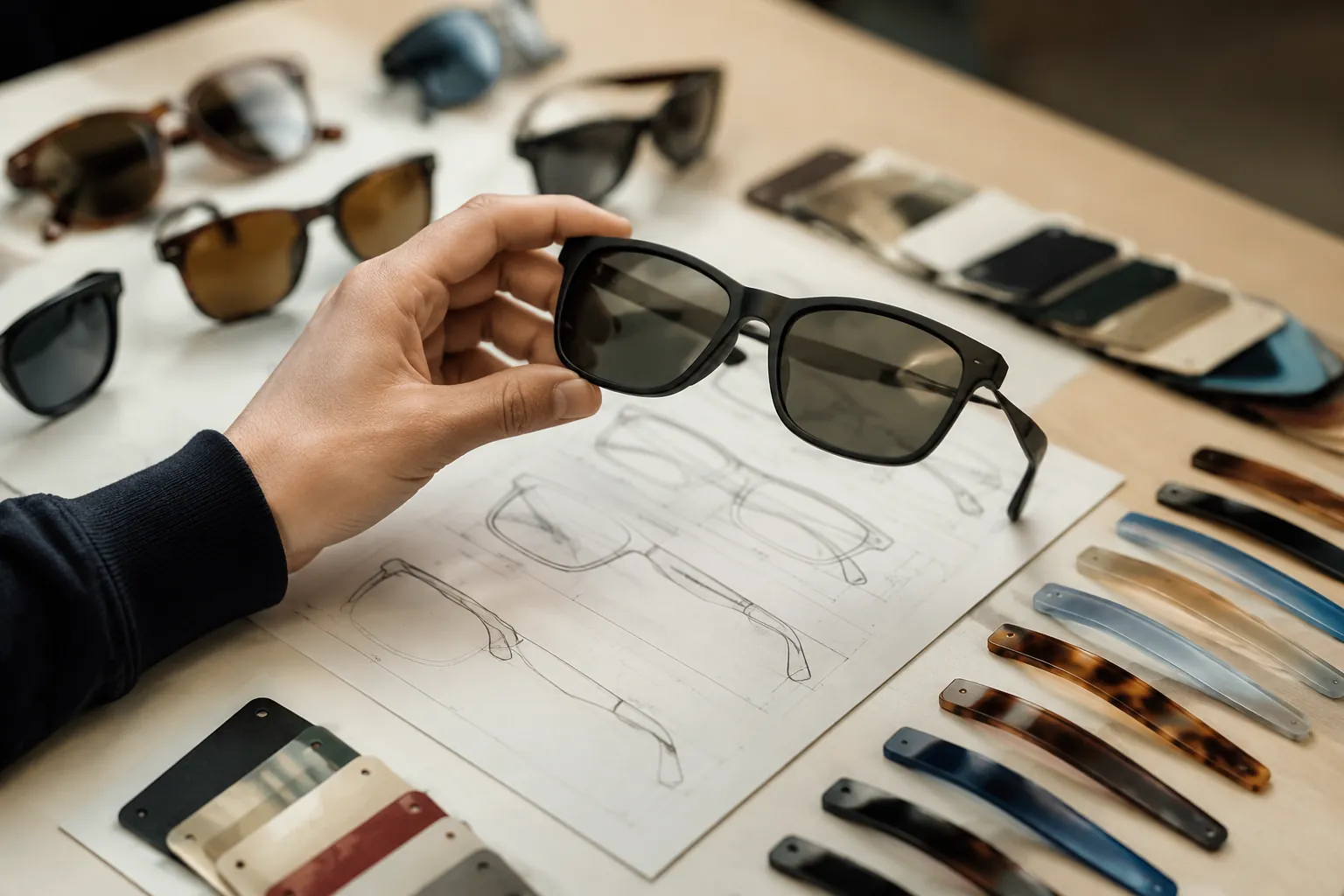
This guide is for brand owners, importers, distributors, and retail buyers sourcing TR90 sunglasses in volume. TR90 is a strong choice when a program needs low weight, flex, comfort, and repeatable injection production. It is the wrong choice if the buyer expects acetate-like depth, a dense luxury feel, or large decoration on highly curved temples. Do not buy on the material name alone. Mold design, hinge choice, lens groove control, logo placement, MOQ, and compliance files all shape the final cost and the sell-through risk. Used well, TR90 is a practical platform for travel, sport lifestyle, kids, value retail, and private label replenishment programs.
What TR90 Actually Buys You
TR90 is a lightweight thermoplastic used for sunglasses frames where comfort, flex recovery, and impact resistance matter more than a glossy luxury surface. Finished frame weight is design-specific. Lens size, temple shape, hinge type, and wall thickness all change the result. Treat any quoted weight as a sample measurement, not a universal material promise.
The value is not that TR90 bends. The value is commercial. A well-designed TR90 frame can reduce breakage complaints, fit a wider face range, and support repeatable injection production. Compared with rigid low-cost plastics, it usually recovers better after normal bending. Compared with acetate, it is usually lighter and faster to mold, but it has less visual depth and less polishing potential.
TR90 still needs proper engineering. Thin bridges, rims, or temples can twist after cooling or feel weak on the face. Thick walls can kill the weight advantage and create sink marks. There is no safe shortcut here. Wall thickness must match the lens size, hinge load, and frame geometry, then be checked during sampling and tooling review.
For bulk programs, TR90 works best when the buyer wants a practical product with predictable production and controlled landed cost. In-house injection molding helps because the factory can respond faster to flash, uneven cooling, front bowing, or hinge fit problems. Small process changes can affect warp, gloss, lens groove fit, and hinge alignment. That is why the sample stage matters.
Where TR90 Fits and Where It Does Not
TR90 is not a universal upgrade. It solves weight, comfort, and flex problems. It does not automatically create a premium hand feel. Buyers should decide early whether the collection should feel light and functional or dense and fashion-led. That decision affects the frame drawing, mold cost, logo method, packaging level, and target retail price.
| Frame option | Main strength | Main trade-off | Best use case |
|---|---|---|---|
| TR90 | Light weight, flexible recovery, impact-friendly | Less surface depth than acetate; decoration is limited on flex zones | Travel, sport lifestyle, kids, value retail, replenishment programs |
| Acetate | Rich color depth, polished premium look, thicker styling | Heavier, slower cutting and tumbling process, more manual finishing | Fashion collections, boutique retail, higher ASP programs |
| Metal | Thin profile, crisp details, adjustable nose pads | Higher part count, plating control required, less forgiving fit | Office lifestyle, aviator styles, fashion basics |
| PC or generic plastic | Low entry cost and fast molding | Stiffer feel, lower flex recovery, more breakage risk | Short-life promo items and very price-sensitive programs |
If your buyer expects glossy acetate depth, TR90 can disappoint. The material is not the issue. The positioning is. Sell it as light, practical, and comfortable. Do not pretend it is acetate.
For distributors, TR90 can reduce damage during handling and improve fit across broad customer groups. For retailers, it works when the program needs repeat colors, seasonal lens options, and controlled cost. For premium fashion brands, it can still work, but the design language should emphasize thinness, comfort, and technical performance.
Production Process and Material Behavior
A TR90 project starts with mold design, not decoration. The mold controls wall thickness, bridge stability, hinge zone strength, temple flex, lens groove depth, and the amount of post-processing required. In-house injection molding helps because the factory can adjust faster when trial parts show flash, cooling issues, front bowing, or poor hinge fit.
The normal production sequence is:
- Confirm 2D or 3D drawings, frame width, bridge, temple length, lens base curve, and hinge type.
- Review mold structure, gate location, cooling channel design, ejection points, and expected shrinkage.
- Run trial shots and check front flatness, temple balance, lens groove fit, and surface consistency.
- Lock frame color, lens tint, logo placement, packaging, and inspection standard.
- Move into bulk injection, trimming, lens cutting or fitting, decoration, assembly, QC, and carton packing.
TR90 is sensitive to drying, temperature, injection pressure, and cooling control. Moisture can damage the surface. Excessive heat can create stress or color drift. Uneven cooling can pull the frame out of shape. Aggressive ejection can leave marks or distortion. Gate placement matters too. A poor gate can leave a visible scar, cause uneven flow, or pull the front after cooling.
Approve a sample made from production tooling or final trial tooling. Not a hand-polished show piece. A one-off sample can hide real production behavior. The approval sample should use the final hinge, lens thickness, lens tint, logo method, and packing method if the buyer wants the price and lead time to remain valid.
Tolerances, Fit Risk, and QC Points
TR90 can hold good dimensional consistency, but only when the mold, material condition, and cooling are controlled. Flexibility can hide small issues at first inspection. Later, those issues show up as uneven temple pressure, crooked alignment, or lens rattle. Fit checks matter more than appearance approval alone.
For most commercial sunglasses orders, buyers should discuss practical inspection limits instead of asking for unrealistic precision. Common working targets may include frame width within about ±1.0 mm, temple length within about ±1.0 mm, lens groove consistency within about ±0.2 mm, and visible front rocking kept below an agreed limit on a flat surface. These are not universal guarantees. They depend on design and tooling. The key is to write the standard before bulk production starts.
- Temple symmetry: left and right temples should open evenly and sit without forced spreading.
- Front flatness: the frame front should not rock noticeably on a flat inspection surface.
- Hinge alignment: screw, pin, or spring-hinge placement must stay consistent across cavities.
- Lens groove fit: loose grooves cause lens movement; tight grooves can crack lenses during insertion.
- Bridge and rim shrinkage: uneven cooling can pull the bridge inward or lift one front corner.
- Surface defects: flash, sink marks, flow lines, whitening, and gate scars should be defined in the QC limit sample.
One bad cavity can create the same defect again and again across a lot. For larger orders, ask how the factory checks first articles, in-process parts, and final carton samples. In-house QC helps because many TR90 problems become obvious only after lens installation, hinge assembly, and temple opening tests.
Branding and Decoration That Work
TR90 supports private label branding, but not every surface is safe for decoration. Flat, stable temple areas print better than curved, thin, or flexing zones. Plan the logo before the mold is finalized. A small flat pad, recessed logo area, or metal plate pocket may need to be built into the temple.
Common decoration methods include laser engraving, pad printing, hot stamping, and metal logo plates. Laser engraving is durable and clean, but contrast depends on frame color and surface texture. It works best for simple logos, model codes, and subtle private label marks. Pad printing supports color logos and small text, but it should stay away from high-rub areas near the ear bend or hinge edge. Hot stamping can add a metallic effect, but it needs a stable surface and controlled pressure. Metal plates give stronger brand presence, but they add cost, weight, and assembly steps.
As a practical rule, temple logos around 20 to 35 mm wide are easier to control than oversized graphics, especially on curved temples. Fine text below about 1 mm stroke width can fill, blur, or lose clarity depending on the process. For color pad printing, provide Pantone references and approve a decorated sample before bulk production.
Branding is tied to MOQ. A simple order with one frame color, one lens tint, and one logo process can run at a lower quantity. Multiple temple logos, mixed colors, custom lens marks, and retail packaging raise the real economic MOQ. Each variation adds setup time, artwork control, and QC risk.
MOQ, Price Tiers, and Cost Logic
The MOQ starts at 50 pairs per design, but buyers should treat this as a sampling, validation, or small-launch floor. It is not the most efficient commercial quantity. Unit cost improves at 300, 1000, and 5000+ pairs because setup time, color changes, decoration setup, inspection, and packing labor spread across more units.
| Order level | Typical buyer use | Cost behavior | Commercial note |
|---|---|---|---|
| 50 pairs/design | Fit test, small launch, sales sample run | Highest unit cost because setup is not diluted | Good for validation, weak for margin |
| 300 pairs | First retail or distributor order | Noticeable drop as molding and decoration setup spread better | Useful for testing two or three colorways |
| 1000 pairs | Core private label program | Stronger economies of scale and better packing efficiency | More room for upgraded lenses, logo work, or packaging |
| 5000+ pairs | High-volume replenishment | Best cost position, with volume pricing dependent on final specifications | Requires strict spec lock and stable forecasting |
At low MOQ, the buyer pays for flexibility. Machine setup, color matching, decoration fixtures, logo plates, QC setup, and carton preparation still take time whether the order is 50 pairs or 5000 pairs. At higher volume, the price can drop sharply, but only if the specification stays stable. Changing lens tint, hinge type, logo method, pouch, barcode, or carton mark midstream can erase the savings.
Compare quotes carefully. A frame-only quote is not the same as finished sunglasses with UV lenses, decoration, assembly, polybag, pouch, barcode, inner box, and export carton. Ask whether tooling, logo molds, print plates, sample freight, test reports, and packaging artwork are included or charged separately.
Lead Times, Sampling, and Compliance
For custom TR90 sunglasses, a normal sample cycle is about 7 to 10 days when the design uses existing tooling or only minor adjustments. New tooling, special hinges, unusual lens shapes, or custom temple geometry can extend development. Bulk production is typically 25 to 35 days after sample approval, deposit, artwork confirmation, and material lock. The clock does not truly start while lens color, logo position, packaging, or compliance claims are still changing.
A practical schedule has three gates. First, sample development confirms fit, mold suitability, lens shape, and decoration position. Second, pre-production locks frame color, lens tint, UV claim, packaging, barcode, carton mark, and QC criteria. Third, bulk production covers injection, trimming, lens processing, decoration, assembly, inspection, packing, and shipment booking.
Overseas buyers should separate factory lead time from door-to-door lead time. Customs clearance, holiday congestion, sea freight schedules, and destination inspection can add days or weeks. Build schedule buffer around Chinese New Year, peak freight periods, and retailer delivery windows.
Compliance depends on the destination market and product claim. Use only the files that apply to the order: CE EN ISO 12312-1, ANSI Z80.3, AS/NZS 1067, REACH, FDA registration, ISO 9001, and BSCI. Do not assume one file covers every shipment. A Europe-bound style, a U.S. retail style, and an Australia/New Zealand order may require different documentation, lens performance confirmation, labeling, and test references.
How to Order Without Burning Margin
The safest first TR90 order is simple. Choose one frame color, one lens tint, one logo method, and one packaging format before asking for final pricing. This keeps the quote clean and makes the sample useful for scale-up. A first run with three lens colors, two logos, and multiple packs usually creates more approval delays than sales value.
For a private label launch, buy in stages. Start with 50 pairs per design for fit checks, photography, sales presentations, or controlled market feedback. Move to 300 pairs if the shape works and sell-through is real. Shift to 1000+ pairs once customer comments, return rates, and lens claims are stable. Use 5000+ pairs only when the frame is proven and the spec is locked.
Send a complete brief. Include target market, retail price, frame dimensions, lens category or VLT target, UV claim, logo artwork, packaging requirement, barcode rules, carton marks, and required compliance files. A clear brief prevents hidden costs later.
Buy TR90 for what it is: light, flexible, practical, and economical at scale. Choose acetate if the customer is paying for polish, depth, and a heavier luxury feel. Choose metal if the design needs thin lines, adjustable nose pads, or a sharper fashion profile. For travel, sport lifestyle, kids, and value retail, TR90 remains one of the most practical bulk sourcing choices.
Have a custom sunglasses project in mind?
Send us your styles, target market and quantities and we will return a detailed quote with MOQ, lead time and a sample plan.
Get a QuoteWhy source this from Wenzhou with LumiShades
Wenzhou in Zhejiang Province is widely regarded as China’s eyewear manufacturing capital, producing a large share of the world’s sunglasses. That concentration matters to buyers: a deep local supply chain for acetate sheet, hinges, lens blanks, plating and packaging means shorter component lead times, easier color and material matching, and a workforce with decades of eyewear-specific skill. LumiShades has manufactured in this ecosystem since 2009, and our vertical integration — in-house injection molding, acetate cutting, CNC milling, lens tinting, decoration and quality control — means no part of your order is quietly subcontracted to a workshop you cannot audit.
For international buyers, that vertical control translates into accountability. When a single factory owns every step, defects are traced and fixed at source rather than bounced between vendors, and your specifications survive intact from first sample to bulk. For procurement review, buyers can request process records, approved samples, quality checkpoints and project-specific compliance files before placing a bulk order. Required testing and documentation are confirmed against the destination market and product specification rather than assumed from a generic certificate list. Explore our manufacturing capabilities and quality control process to see how this works in practice.
Frequently asked questions
What is the main advantage of TR90 sunglasses for bulk buyers? TR90 combines low weight, flexible recovery, and good comfort with repeatable injection production. For buyers, that can mean fewer breakage complaints, easier wear across more face shapes, and a practical cost structure for travel, sport lifestyle, kids, and value retail programs.
Can TR90 frames support custom logos? Yes. Laser engraving, pad printing, hot stamping, and metal logo plates are common options. The most reliable placements are flat or lightly curved temple areas. Before ordering, ask the supplier which method fits your frame color, texture, durability target, and decoration area.
What is the MOQ for custom TR90 sunglasses? The MOQ starts at 50 pairs per design. Use that level for sampling, validation, or a very small launch. For commercial buying, ask for separate quotes at 300, 1000, and 5000+ pairs so you can compare unit cost against expected sell-through.
How long do samples and bulk production take? A sample run is usually 7 to 10 days when tooling already exists or only minor adjustments are needed. Bulk production is typically 25 to 35 days after sample approval, deposit, artwork confirmation, material lock, and packaging confirmation. If any of those items changes, recheck the schedule.
Which tolerances matter most on TR90 sunglasses? Focus on the dimensions that affect fit and function: frame width, temple length, hinge alignment, front flatness, and lens groove fit. Ask the supplier to state its working tolerance targets in writing and confirm how those targets are checked during first article, in-process, and final inspection.
Which certifications are relevant for TR90 sunglasses exports? Use only the certifications and registrations that apply to the destination market and product claim. Common files include CE EN ISO 12312-1, ANSI Z80.3, AS/NZS 1067, REACH, FDA registration, ISO 9001, and BSCI. Ask for the exact test report or registration reference before placing the order.
When should I choose acetate instead of TR90? Choose acetate when the buyer expects richer color depth, a more polished premium look, and a heavier hand feel. Choose TR90 when comfort, weight, flexibility, and practical bulk production matter more than visual depth.
Ready to start?
Explore our wayfarer sunglasses or request a quote — our sales team replies within 12 hours.
Request a Quote