
Low-MOQ Custom Sunglasses: What Needs New Molds
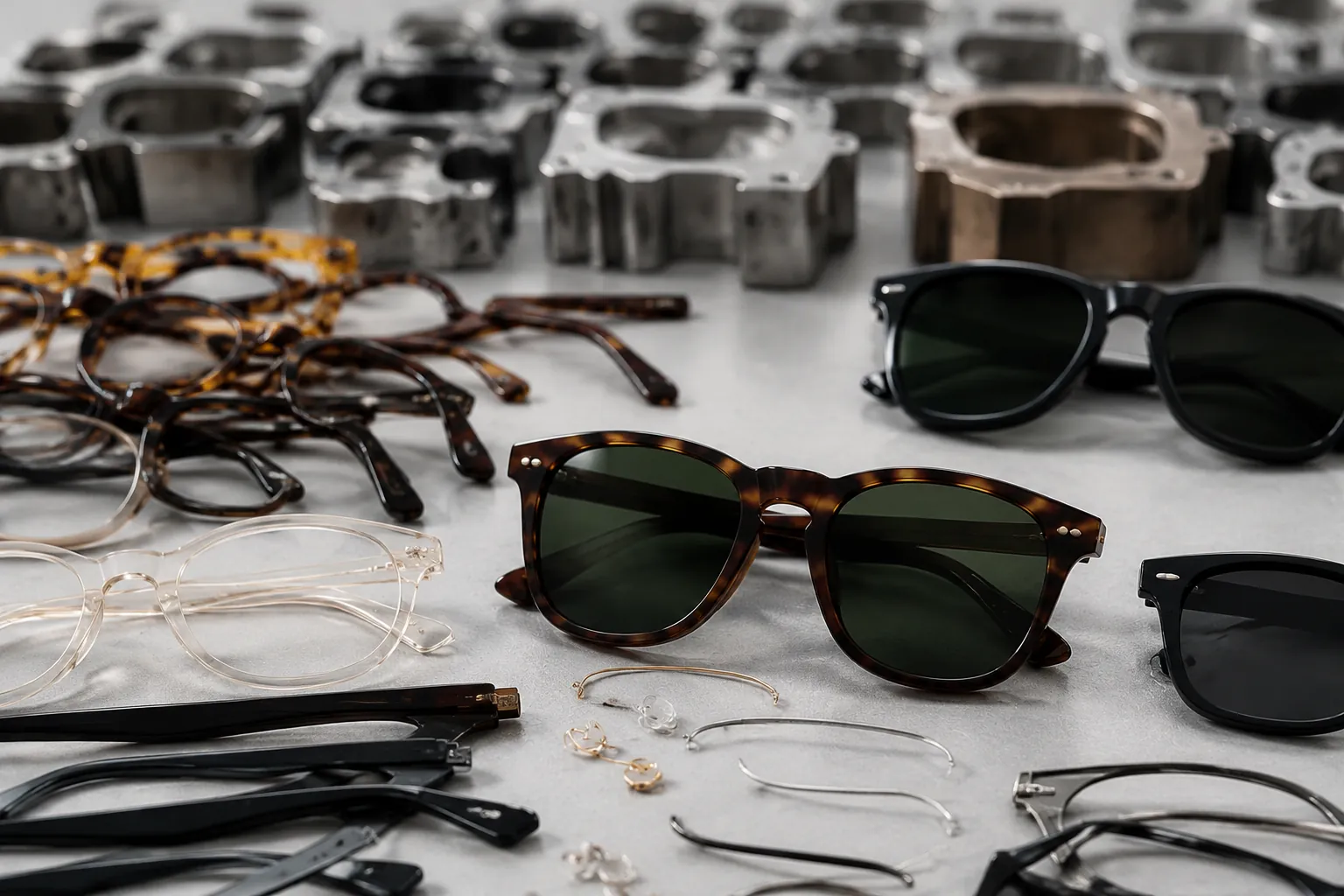
This guide is for brand owners, importers, distributors, and retailers who want custom sunglasses without paying for unnecessary tooling. Know what can change on an existing mold and what cannot. That difference affects margin, lead time, and MOQ. It also decides whether your first order stays simple or turns into a redesign. LumiShades works with injection molding, acetate cutting, CNC milling, lens tinting, decoration, assembly, and QC in Wenzhou.
What a mold actually controls
On a sunglass frame, the mold controls the fixed geometry: front curve, eye size, bridge position, rim thickness, hinge pocket, temple insertion angle, and the draft angle needed for clean ejection. If a requested change alters those fixed dimensions, it is not a simple variation. It is a new tool or a recut.
That matters because tolerance is not the same everywhere. Fit-critical areas such as hinge seats, lens grooves, and bridge alignment usually need tighter control than decorative surfaces. A small change can affect lens fit, temple balance, or how the frame sits on the face. Small move. Big effect.
For low MOQ, the best path is usually to leave the core tooling alone and change the variables around it. Color, lens tint, logo placement, hinge decoration, temple tips, and packaging often fit that model. Changes to eye size, bridge width, wrap angle, or silhouette usually do not.
So the first sourcing question is simple: does the request change geometry, lens cut, or fit? If yes, expect engineering input before quoting. If no, the job can often stay within a lower MOQ and a shorter sample cycle.
Features you can usually change without recutting
These are the first changes buyers should ask for if they want to keep tooling cost under control. If the base frame already exists and the components are available, they usually fit the normal sample and bulk workflow.
- Frame color: solid resin color, translucent tint, frosted finish, matte finish, gloss finish, or rubberized coating if the line already supports it.
- Lens color and treatment: grey, brown, green, amber, smoke, mirror, gradient, polarized, or fashion tint, provided the lens base curve and cut size stay the same.
- Logo application: laser engraving, pad printing, hot stamping, metal logo plates, or small embossed marks on flat or lightly curved areas.
- Temple decoration: printing, embossing, end-tip color changes, inserted logo plaques, or minor surface texturing.
- Hardware appearance: shiny, gunmetal, matte black, brushed silver, or plated hinge finishes when the hinge structure itself is unchanged.
- Packaging: pouch material, box print, inserts, barcodes, instruction leaflets, and master carton marking.
These changes usually do not require a new parting line or cavity profile. They are handled through resin selection, decoration setup, coating, or post-processing. The real cost is often in setup, minimums for printing or plating, and the labor needed to switch between variants.
A useful rule: if the request can be approved with a color chip, print proof, plated sample, or packaging mockup, it is probably a decoration choice, not a tooling choice. That is the kind of change that supports low MOQ.
Changes that usually force new tooling
Some requests sound small to a buyer but are major in the factory. If the frame, lens opening, or structural support has to move, the supplier will usually need new tooling or a recut. A mold is a fixed cavity with fixed release behavior. It is not a flexible template.
| Change request | Tooling impact | Typical buyer consequence | Best move |
|---|---|---|---|
| Eye size change | High | New front geometry, new lens cut data, new fit balance | Use a similar existing style first |
| Bridge width change | High | Affects comfort, fit, and lens positioning | Recut only after style validation |
| Temple length or bend angle | Medium to high | May require new temple tooling or a revised metal core | Adjust after fit samples |
| Lens shape change | High | New cutting pattern and frame opening | Match an existing frame family |
| Material swap from PC to acetate | High | Different process route, different tooling, different finish behavior | Choose a material family first |
At a low MOQ such as 50 pairs per design, these are the changes to avoid unless the style has already been validated. The more you alter the frame skeleton, the more you raise tooling cost and extend launch time. A frame family may allow a small adjustment in a non-critical area. Once the request affects lens fit, bridge ergonomics, or hinge alignment, the job becomes engineering work.
The best practice is blunt: ask the supplier to classify every request as tooling-neutral, tooling-sensitive, or tooling-triggering before the quote is final. That cuts surprise charges and sample-stage confusion.
How finish changes are handled in production
Finish is where many low-MOQ projects work. A frame can look very different without changing the mold. In injection molding, color comes from resin selection, masterbatch, process temperature, and surface texture. In acetate, the look comes from sheet stock, cutting orientation, tumbling, polishing, and coating. On CNC-milled parts, the visible finish depends on the machining path, sanding, polishing, and topcoat.
Material choice matters too. Injection-molded TR90 or PC frames are usually lighter and faster to produce. They support straightforward color changes, but they can show flow marks or gloss variation if process control is weak. Acetate usually gives a richer look and deeper translucent color, but it needs more polishing time and tighter control over dust, heat, and edge finishing.
There are limits. Deep matte textures, heavy rubber coatings, or fine logo engraving need enough draft angle and surface area to release cleanly. If the existing mold has weak draft, the factory may still try the change, but the result can show drag marks or softened edges. That is a tooling limit, not a style preference.
For buyers, the rule is simple: ask for a finish sample before a shape sample if the goal is to check color, coating, or logo execution. A color chip, plated hinge sample, or pad-print proof says more than a sketch. And if the work stays inside the existing tooling family, sample turnaround is often faster.
Component swaps that are cheap, and the ones that are not
Not every part carries the same cost or risk. Some parts can change without affecting frame geometry. Others affect fit, stability, or the whole build.
- Easy swaps: lens tint, polarized or non-polarized lens, nose pad color, temple tip color, screw finish, logo plate style, pouch, and outer box.
- Moderate swaps: hinge style within the same mounting pattern, acetate temple insert, metal core decoration, spring-hinge upgrade if the frame was designed for it.
- Hard swaps: metal-to-plastic conversion, rimless to full-rim conversion, new bridge architecture, major temple geometry changes, or a different lens base curve.
Buyers often want the same mold but a more premium feel. That works if premium means better finish, better decoration, improved lens treatment, or better packaging. It does not work if premium requires a structurally different frame. A spring hinge only works if the temple and hinge pocket were designed for it. Otherwise it is a redesign.
A good sourcing team checks the part stack before the purchase order. If the frame needs a different lens cut, hinge point, temple insert, or screw specification, treat it as a design revision, not a cosmetic revision.
MOQ, price breaks, and what drives the number
LumiShades' MOQ starts at 50 pairs per design. That works for a niche style, a seasonal colorway, or a small retailer program. As volume rises, fixed setup costs spread better, so unit price usually improves.
- 50 pairs: best for validation, highest unit cost, and limited room for complex packaging or multiple finish options.
- 300 pairs: better for small chain or distributor orders, with more room for custom print and box work.
- 1,000 pairs: a common point where setup costs spread more effectively and pricing becomes more competitive.
- 5,000+ pairs: suitable for larger programs where a simple frame family can become significantly more cost-efficient depending on material, lens specification, coating, and decoration.
The main cost drivers are material grade, lens type, plating finish, number of print steps, labor time, QC depth, and how many setup changes the line absorbs. A frame with one logo plate and a standard lens tint is simpler than a frame with mirror lenses, multiple print passes, and custom carton inserts. Every extra step adds process risk, labor, or a component minimum.
If the goal is the lowest cost, keep the base frame family stable and change only color, lens tint, and logo method where possible. That makes the process repeatable and helps the supplier forecast whether the order can stay within the target MOQ without special charges for color matching or packaging.
Compliance cannot be treated as decoration
Custom does not mean informal. For overseas B2B buyers, compliance paperwork matters as much as the visual sample. LumiShades works with recognized standards and documentation: CE EN ISO 12312-1, FDA registration, ANSI Z80.3, AS/NZS 1067, REACH, ISO 9001, and BSCI.
The buyer still has to match the product to the market. A frame and lens package for Europe should be checked against CE EN ISO 12312-1. A U.S. program should account for FDA registration and, where applicable, ANSI Z80.3. Buyers in Australia and New Zealand often use AS/NZS 1067 as the product reference. REACH affects restricted substances in plastics, coatings, inks, and metal decoration systems.
When a custom feature changes the build, compliance may need to be reviewed again. A lens tint change can affect transmittance. A metal plate can raise material questions. A coating change can affect the restricted-substance profile. So confirm whether the requested change affects the existing test file or declaration before mass production starts.
For importers, compliance should be reviewed with the quote. Otherwise the price looks fine, but the product cannot clear the target market without extra testing or document updates. That is an expensive surprise.
A clean buyer workflow for low-MOQ custom work
The fastest projects are the ones with tight instructions. The slowest projects are vague, revised three times, and then rushed. A clear workflow reduces cost and mistakes:
- Start with an existing frame family that already fits your target market and price band.
- Lock the change list: color, lens tint, logo method, packaging, and any hardware finish.
- Ask the factory to flag any request that changes the mold, not just the decoration.
- Approve a sample with measurements, finish, logo placement, and lens appearance before bulk production.
- Confirm compliance documents for the target market before deposit and production release.
That is how procurement teams control lead time. Sample timing is usually fastest when the work stays inside the current tooling family and the accessories are standard. Bulk timing is usually shortest when the design is clear, the decoration plan is fixed, and components are available. If the project needs a new mold, allow time for design confirmation, tooling, first-article review, and adjustment rounds.
The shortest path to a good first order is not to ask for everything at once. It is to ask for the right things in the right order, with the mold decision made early. That keeps low-MOQ custom sunglasses profitable instead of expensive.
Have a custom sunglasses project in mind?
Send us your styles, target market and quantities and we will return a detailed quote with MOQ, lead time and a sample plan.
Get a QuoteWhy source this from Wenzhou with LumiShades
Wenzhou in Zhejiang Province is widely regarded as China’s eyewear manufacturing capital, producing a large share of the world’s sunglasses. That concentration matters to buyers: a deep local supply chain for acetate sheet, hinges, lens blanks, plating and packaging means shorter component lead times, easier color and material matching, and a workforce with decades of eyewear-specific skill. LumiShades has manufactured in this ecosystem since 2009, and our vertical integration — in-house injection molding, acetate cutting, CNC milling, lens tinting, decoration and quality control — means no part of your order is quietly subcontracted to a workshop you cannot audit.
For international buyers, that vertical control translates into accountability. When a single factory owns every step, defects are traced and fixed at source rather than bounced between vendors, and your specifications survive intact from first sample to bulk. For procurement review, buyers can request process records, approved samples, quality checkpoints and project-specific compliance files before placing a bulk order. Required testing and documentation are confirmed against the destination market and product specification rather than assumed from a generic certificate list. Explore our manufacturing capabilities and quality control process to see how this works in practice.
Frequently asked questions
Which sunglasses changes usually do not need a new mold? Color, lens tint, logo method, small temple decoration, hinge finish, and packaging often do not need a new mold if the frame geometry stays the same and the parting line does not change. Before approval, ask the supplier to confirm that the request does not change lens fit, bridge width, hinge position, or temple angle.
What changes usually force new tooling? Eye size, bridge width, temple geometry, lens shape, and material family changes usually require new tooling, a new cavity, or a redesign of the lens cut and fit points. If you are unsure, ask for a tooling-impact review before sample approval so the quote and timeline stay accurate.
Can I order 50 pairs with a custom logo and color? Yes, if the base frame already exists and the customization stays on the decoration or finish side. To keep the order at low MOQ, use an existing frame family, choose a standard lens cut, and confirm that the logo method does not require structural changes.
How fast can samples and bulk move? If the order stays within the existing tooling family and the components are ready, sampling can often move fast and bulk production can follow a standard factory schedule. Ask the supplier to confirm sample lead time, bulk lead time, and whether any step depends on new tooling or outside component sourcing before you place the order.
What compliance should I ask for on custom sunglasses? Match the target market and ask for the applicable documentation: CE EN ISO 12312-1 for Europe, FDA registration and, where applicable, ANSI Z80.3 for the U.S., AS/NZS 1067 for Australia and New Zealand, and REACH for restricted substances. Also confirm whether any requested change to the lens, coating, or metal decoration affects the existing test file or declaration.
Ready to start?
Explore our aviator sunglasses or request a quote — our sales team replies within 12 hours.
Request a Quote