
TR90 vs PC vs Nylon for Sports Sunglasses
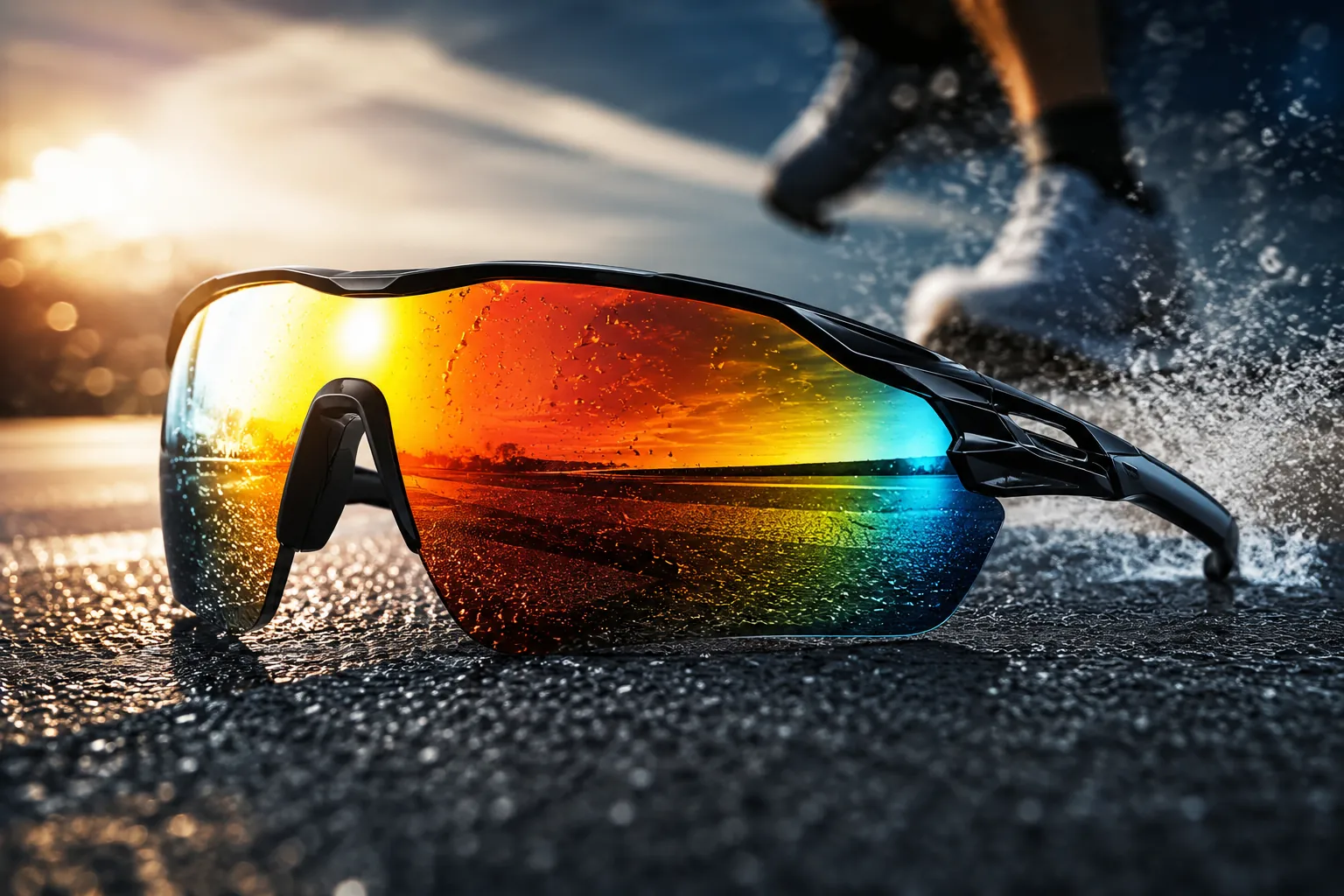
This guide is for brand owners, importers, distributors, and retail buyers developing sports or outdoor eyewear. The point is not to crown one plastic as best. The point is to match frame material to frame geometry, finish target, price band, and use conditions before sampling starts. TR90, PC, and nylon can all work in sports eyewear, but they behave differently in flex, stiffness, shrinkage, surface appearance, lens-fit stability, and production control. Buyers who define the brief first usually make better sampling decisions and avoid preventable production and after-sales problems.
Start with the use case, not the resin name
Many buyers start by asking for TR90, PC, or nylon as if the resin name alone decides quality. That is the wrong starting point. In sports eyewear, the better sequence is simple: define the product brief first, then choose the material.
Start with the sport category, frame wrap, lens type, fit target, finish standard, retail channel, and target price. Then ask the supplier which material fits that brief and why.
A low-wrap running sunglass for mass retail does not need the same material behavior as a deep-wrap fishing frame with a large shield lens and rubber touch points. A cycling frame with tighter lens-groove demands needs something different from a fashion-sport hybrid sold in resort stores. Material choice affects spring-back, hinge durability, lens insertion stress, decoration options, and how stable the frame stays after assembly and shipment.
Most sourcing mistakes start the same way: a buyer forces a cheap rigid plastic into a geometry that needs more flex recovery, or specifies a more technical resin without enough budget or process control to support it. Then the usual problems show up. Front warp. Lens stress. Whitening near high-bend areas. Uneven surface quality under store lighting.
- Define the geometry first: front curve, lens depth, bridge shape, and temple profile determine whether the frame needs more flexibility or more rigidity.
- Set the comfort target: assess overall wear comfort, not just the weight listed on paper.
- Specify the finish standard: matte textures can hide some molding marks, but they also expose weak tool texture control.
- Match the material to the sales channel: value retail accepts different trade-offs than specialty cycling, fishing, or tactical dealers.
If a supplier cannot explain the material choice in terms of geometry control, assembly tolerance, and likely failure points, the development process is already weak.
What TR90, PC, and nylon actually do
These materials overlap, but they are not interchangeable.
TR90 is widely used for lightweight active frames because it balances low weight, flexibility, and wearer comfort. PC, or polycarbonate, is common in price-sensitive programs where impact resistance and relative rigidity matter. Nylon is often chosen for more technical sports frames that need stronger fatigue resistance under repeated outdoor use.
| Material | Density / Feel | Flex Behavior | Production Notes | Typical Product Fit |
|---|---|---|---|---|
| TR90 | Light feel in many sport-frame builds | Good spring-back and comfortable flex in well-designed frames | Needs controlled molding and color management; widely used for active eyewear | Running, cycling, golf, outdoor lifestyle, broad sports collections |
| PC | Usually feels more rigid than TR90 in comparable shapes | Stiffer feel; less forgiving under repeated bending in aggressive geometries | Often suited to cost-driven programs; stress whitening can appear in high-strain areas | Promotional sport, entry-price retail, private-label chain programs |
| Nylon | Technical performance feel | Strong fatigue resistance when processed correctly | Drying and molding control are especially important; usually carries higher process complexity | Fishing, cycling, mountain sport, tactical-style active frames |
In sourcing terms, TR90 is often the safest middle-ground choice. PC is often the value option if the shape is conservative and the finish standard is simple. Nylon is often the better technical choice when the brief includes larger wraps, harder use, or performance-channel expectations.
Also keep frame material separate from lens material. Polycarbonate lenses are commonly paired with TR90 or nylon frames. That is normal.
Flex, durability, and where frames fail
Sports frames do not usually fail at random. They fail in familiar places: loose hinges, cracked temple roots, bridge distortion, inconsistent lens grooves, lens stress marks, or surface wear from sweat, sunscreen, salt, and handling. Material choice shifts the risk. It does not remove it.
TR90 usually performs well where repeated flex is part of normal use. In a properly engineered frame, it tends to recover better after bending than more rigid low-cost plastics. That helps during try-on, fitting, and routine opening and closing. But it is not magic. Poor wall transitions, weak hinge-pocket design, or uneven molding stress can still cause twist, cracking, or slow shape drift.
PC has a stiffer hand feel, which can help in conservative shapes where lens retention depends more on front rigidity than on flex recovery. The trade-off is lower tolerance for repeated hard spreading of the temples or aggressive lens insertion in wrapped fronts. In those cases, whitening near the bridge or hinge area is a known risk.
Nylon is often favored for tougher field use, especially where repeated flex, vibration, and temperature change are part of the brief. That makes it attractive for cycling, fishing, marine, and tactical-style products. But the advantage depends on process discipline. Poor drying or unstable molding conditions can create dimensional variation that complicates assembly and lens fit.
- Review the hinge area: ask how the design supports the screw, hinge pocket, and temple-root transition.
- Check lens groove consistency: variation here directly affects insertion stress and retention.
- Measure assembled alignment: visible temple offset or front twist should be found before decoration and packing.
- Inspect after repeated opening and closing: whitening, distortion, and hinge loosening may not appear at first glance.
Ask for assembled samples, not just loose frame fronts. That is where many real problems finally show up.
Weight, finish, and decoration detail
Weight matters in sports eyewear. It is not the whole story.
A lighter frame is not automatically more comfortable if balance, nose contact, and temple pressure are poor. Buyers should judge total wearing comfort together with material behavior.
TR90 is often selected because it supports a light, flexible feel in many sport-frame builds. Nylon can also perform well in technical frames, especially where larger wraps and long wear time are part of the brief. PC can still work commercially, but in more premium-feel sport programs it often needs tighter design control to avoid a heavier or stiffer impression.
Finish quality is where many programs slip. Matte black may look simple on a brief, but a consistent matte finish still depends on tool texture, molding stability, and trimming quality. Gloss finishes make flow lines, gate marks, and parting lines easier to spot. TR90 and nylon can both produce strong technical-looking finishes, but texture selection should be locked early. PC can also look good in simple finishes, though lower-cost programs often show molding marks faster once the cosmetic standard rises.
Decoration also has to match the material and surface texture. A pad-printed logo on a textured temple may wear faster under sweat-heavy use. Laser marking may be cleaner for technical styles. Metal logo inserts can raise perceived value, but they add assembly steps and should earn their place.
| Feature | TR90 | PC | Nylon |
|---|---|---|---|
| Best finish style | Sport matte, technical matte | Simple matte or gloss on value-oriented builds | Technical matte, performance textures |
| Logo options | Pad print, laser, metal insert | Pad print, hot stamp where suitable, laser depending on finish | Laser, pad print, metal insert on suitable designs |
| Risk to watch | Color consistency on custom shades | Whitening and visible molding marks | Process variation affecting surface consistency |
If a program uses several decoration steps, confirm whether molding, finishing, printing, engraving, and logo assembly are handled in-house or subcontracted. That affects revision speed and quality control.
Cost, MOQ, and the real commercial trade-off
Material choice changes more than resin cost. It also affects molding stability, reject rate, trimming difficulty, assembly speed, and lens-fitting yield. A cheaper resin can still produce a more expensive finished frame if it creates more warp, more visible stress marks, or more alignment correction in assembly.
| Program Level | Typical Buyer Goal | Material Tendency | Commercial Logic |
|---|---|---|---|
| 50 pairs per design | Market test, influencer seeding, sample sell-in | PC or simplified TR90 | Keep geometry conservative; avoid unnecessary complexity during early validation |
| 300 pairs per design | Small launch run | TR90 becomes more practical | Better comfort and lower field-risk may justify the added material and process cost |
| 1000 pairs per design | Core seasonal line | TR90 or nylon depending on sport use | More stable process control matters more as order volume rises |
| 5000+ pairs per design | Scalable volume program | All three can work | Unit price may improve, but lens spec, decoration, and packing still drive real delivered cost |
MOQ and lead time vary by factory, mold status, decoration complexity, and whether parts are standard or fully custom. Some OEM suppliers support low trial quantities. Others need much higher commitments for custom colors, logos, or tooling. Confirm MOQ by frame, by color, and by total order. Do not rely on one headline number.
Lead time needs the same discipline. Sample timing depends on whether the frame uses an existing mold, whether the logo method is simple, and whether the finish needs special texture work. Bulk timing depends on approved color, lens specification, packaging, and the supplier's real capacity. Nylon and higher-wrap sport geometries often need more tuning than simple PC programs.
Do not force nylon into a budget retail brief if the customer will not pay for the benefit. Do not force PC into a technical sports frame if returns will erase the savings. Margin depends on repeatability and failure risk as much as ex-factory price.
Why production control matters as much as material
Two factories can quote the same resin and deliver very different sports frames. Sports eyewear is sensitive to the full production path: resin preparation, injection settings, cooling control, de-gating, trimming, hinge fitting, lens insertion, alignment, and final inspection. A clean sample proves very little if the factory cannot repeat it in bulk.
A typical injection-molded sport frame goes through resin drying where required, injection molding, cooling, de-gating, trimming, surface finishing or decoration, hinge fitting, lens fitting, alignment, cleaning, and final inspection. Small changes anywhere in that chain can affect final performance. Uneven cooling can distort wrap. Groove variation can raise insertion force. Weak trimming control can hurt both cosmetics and fit.
Buyers should ask what the factory actually measures during pilot and bulk production. Useful checkpoints include front width consistency, lens groove integrity, temple symmetry, hinge insertion quality, and post-assembly alignment. On sport frames, those checks matter more because wrap and lens tension make small dimensional drift much easier to see.
- Ask for side-by-side material samples: the same shape in TR90, PC, and nylon shows practical differences better than a sales pitch.
- Check the frame after lens insertion: an empty front may look acceptable but distort once assembled.
- Review QC timing: problems should be caught before decoration and packing, not after.
- Confirm process ownership: in-house molding and QC can shorten feedback loops during development.
For technical sports styles, process control is often as important as the material itself.
Compliance, channel fit, and a practical selection framework
Frame material does not create compliance on its own. The finished sunglass has to meet the destination market's requirements as a complete product, including lens, assembled frame, labeling, and supporting documents where required. Confirm those requirements before approving both frame material and lens specification.
Common references in export eyewear programs include CE EN ISO 12312-1, ANSI Z80.3, AS/NZS 1067, REACH, FDA registration, ISO 9001, and BSCI. Ask which ones apply to the exact product you are buying. Then ask for documents that match the actual style, not a generic file.
Channel expectations also shape material choice. Entry sporting-goods retail may accept a simpler PC frame if finish, testing, and price are aligned. Specialty cycling, fishing, and outdoor dealers usually expect lighter feel, more reliable fit retention, cleaner technical finishing, and better repeated-use durability. That often pushes the brief toward TR90 or nylon.
The selection framework is simple. Use PC for value-driven programs with moderate shape complexity and controlled cosmetic expectations. Use TR90 for broader sports lines where low weight, comfort, and flex recovery matter most. Use nylon for more technical products where larger wraps, repeated stress, and tougher field use justify higher process control and cost.
Before placing an order, ask for five things: assembled sample approval, hinge construction detail, lens retention confirmation on the actual wrap, finish approval under normal lighting, and compliance documents matched to the destination market. Then confirm the commercial basics in writing: MOQ by style and color, sample timeline, bulk lead time, packaging specification, and approval standards for color and logo placement.
Blunt advice: if a supplier cannot explain why your frame should be TR90, PC, or nylon in terms of geometry, assembly, and failure risk, the recommendation is not technical enough to trust.
Have a custom sunglasses project in mind?
Send us your styles, target market and quantities and we will return a detailed quote with MOQ, lead time and a sample plan.
Get a QuoteWhy source this from Wenzhou with LumiShades
Wenzhou in Zhejiang Province is widely regarded as China’s eyewear manufacturing capital, producing a large share of the world’s sunglasses. That concentration matters to buyers: a deep local supply chain for acetate sheet, hinges, lens blanks, plating and packaging means shorter component lead times, easier color and material matching, and a workforce with decades of eyewear-specific skill. LumiShades has manufactured in this ecosystem since 2009, and our vertical integration — in-house injection molding, acetate cutting, CNC milling, lens tinting, decoration and quality control — means no part of your order is quietly subcontracted to a workshop you cannot audit.
For international buyers, that vertical control translates into accountability. When a single factory owns every step, defects are traced and fixed at source rather than bounced between vendors, and your specifications survive intact from first sample to bulk. We back this with 15+ years of experience, shipments to 60+ countries, more than 5 million pairs produced per year and a 98.5% on-time delivery rate. Our certifications — CE EN ISO 12312-1, FDA registration, ANSI Z80.3, AS/NZS 1067, REACH, ISO 9001 and BSCI audit — mean the compliance documentation your market requires already exists. Explore our manufacturing capabilities and quality control process to see how this works in practice.
Frequently asked questions
Which material is usually best for wraparound sports sunglasses? For wraparound sports sunglasses, TR90 and nylon are usually the first materials to review because both are common in active frames that need flex recovery and stable performance under repeated wear. TR90 is often the broader commercial choice because it balances lightweight comfort and easier scaling across multiple sport styles. Nylon is often the stronger option when the frame is more technical, the wrap is more aggressive, or the product is aimed at tougher outdoor use. The right way to decide is to compare assembled samples in the target wrap and check lens retention, front stability after lens insertion, temple recovery, and surface quality.
Is PC always the cheapest option for sports frames? No. PC may be cheaper at the resin or build level, but not always in finished delivered cost. If the frame shows whitening, needs more alignment correction, or creates more assembly difficulty, those extra costs can erase the resin savings. Compare total cost, including molding stability, assembly efficiency, reject risk, and likely return exposure. The practical test is simple: evaluate PC on a realistic geometry, then inspect assembled samples for stress marks, hinge-area behavior, and consistency after repeated opening and closing.
Can I use the same mold design for TR90, PC, and nylon? Sometimes for early comparison, but not automatically for production. TR90, PC, and nylon do not behave the same in molding, shrinkage, stiffness, or lens-fit response. A frame shape that works in one material may need changes to groove dimensions, wall transitions, or local structure before it performs correctly in another. If you want to compare materials, ask the factory whether the same mold can be used for short-run evaluation and what changes would be required before mass production. Do not assume one approved sample means all three materials are production-ready in the same tool.
What should I ask for during sampling? Ask for assembled samples, not just bare frame fronts. At minimum, review total wearing feel, front alignment, temple symmetry, hinge stability, lens insertion stress, lens retention, finish consistency under normal light, logo quality, and frame behavior after repeated opening and closing. If the product is a wrap style, ask the factory to confirm the sample was checked after final lens fitting, because some distortions appear only in the assembled state. If possible, compare the same design in more than one material and request written notes on the factory's recommended changes before bulk production.
How do MOQ and lead time usually work on custom programs? MOQ and lead time depend on tooling status, decoration method, color complexity, and whether the project uses an existing mold or a fully custom one. Some factories support small trial quantities, while others require higher minimums for custom colors, logos, or packaging. Confirm MOQ by design, by color, and by total order quantity. For lead time, ask for separate timing for sample preparation, sample revision, pre-production approval, and bulk production. Also ask what can extend the schedule, such as custom texture work, metal logo parts, outsourced decoration, or added compliance testing.
Ready to start?
Explore our square sunglasses or request a quote — our sales team replies within 12 hours.
Request a Quote