
Lens Colors by Channel, Climate, and Demand
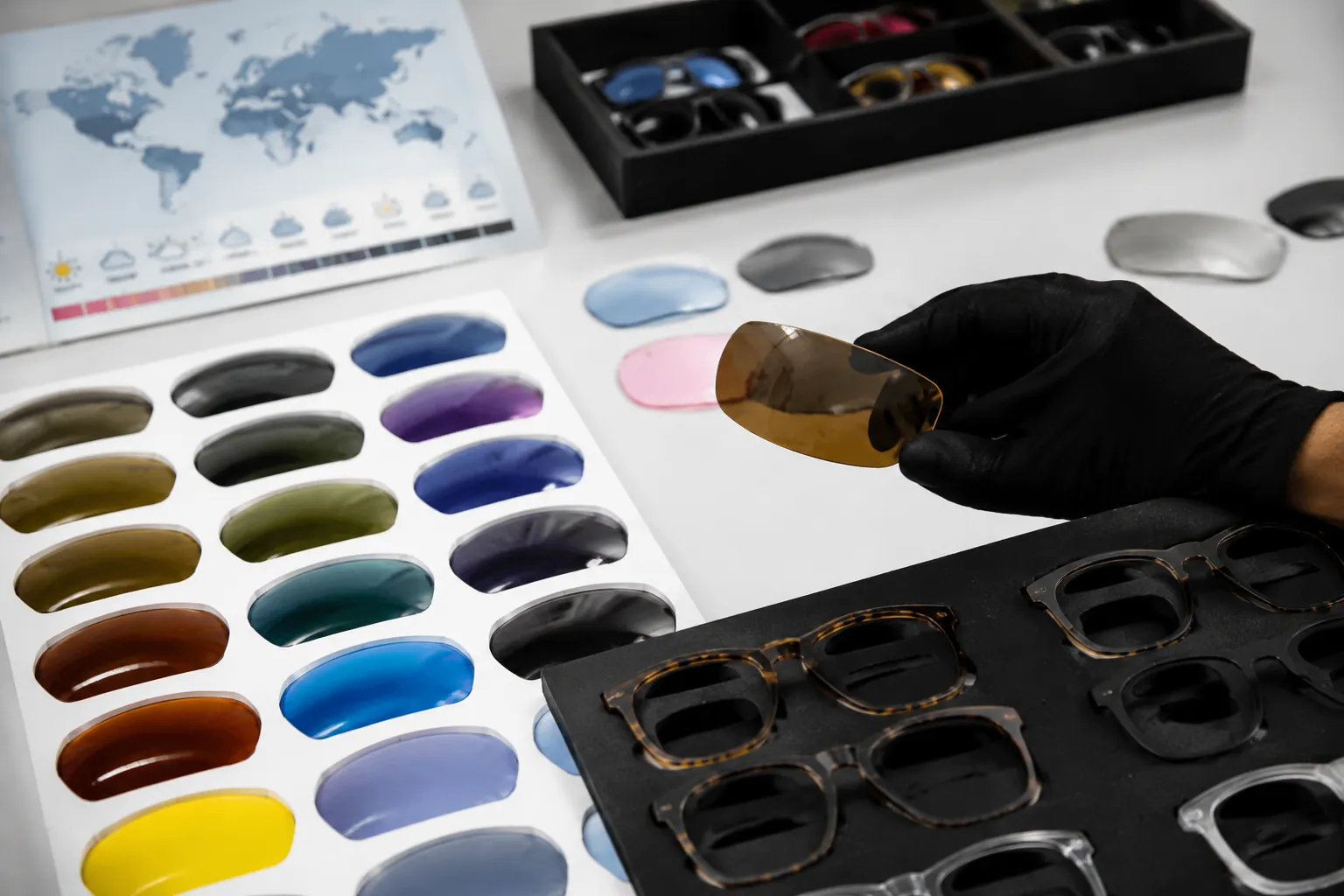
This guide is for overseas brands, importers, distributors, and retailers choosing lens colors before placing custom sunglasses orders. The goal is practical: cut slow-moving SKUs, build cleaner assortments by channel, and match lens color to real weather and use conditions. It also explains what a Wenzhou eyewear factory can control in tinting, coating, sampling, documentation, and repeat production.
Start With Channel, Not Taste
Lens color is not just a style choice. It changes how the sunglasses feel in wear, how they look on the shelf, and whether the buyer thinks they fit local weather. A black frame with smoke gray lenses can work in a petrol station rack, a beach kiosk, and a corporate promo box. A rose gradient lens may sell in fashion retail, but it is a weak fit for fishing, driving, or mountain use unless the lens category and performance support the claim.
For volume buying, start with the retail channel. Beach stores need glare comfort, clear color reading, and strong shelf impact. Fashion boutiques may accept lighter gradients if the product is mainly a style item. Sports and outdoor retailers care more about contrast, filter category, polarization where relevant, and repeatability. Promo buyers usually want a lens that passes the required sunglass standard, looks acceptable on many face shapes, and stays inside budget.
Split the lens decision into three parts: channel, weather, and target price. Do that first. It prevents a common mistake: approving a beautiful sample that does not fit the sales environment. MOQ, price breaks, and production lead time should always be confirmed from the current quotation. They change with frame material, lens type, decoration, packaging, and inspection requirements.
Quick Lens Map by Retail Channel
The table below is a practical starting point for first sampling. It is not a substitute for local market testing, lens category confirmation, or compliance review. Frame material, retail price, and display lighting still affect the final choice.
| Retail channel | Safer lens colors | Use with caution | Why it matters |
|---|---|---|---|
| Beach and resort | Gray, brown, green, blue mirror over a compliant base lens | Very pale fashion tints | Strong sun and water glare usually require comfort first. Mirror coatings can improve shelf visibility, but the base lens still needs the correct filter category. |
| Fashion retail | Brown gradient, smoke gradient, amber, rose, light green | Heavy red or purple tints without verified optical quality | Color needs to match the frame story and store lighting. Distortion, uneven tint, and poor left-right matching are easy to spot during try-on. |
| Sports and outdoor | Gray, brown, copper, green, polarized options where useful | Blue fashion tint without glare control | Contrast, traffic signal recognition, filter category, and stable tint repeatability matter more than novelty. |
| Promo and events | Smoke gray, brown, black gradient, neutral green | Complex multi-layer mirror unless budget and QC allow | Large quantity orders need low defect risk, stable color, and clear documentation for the destination market. |
| Travel retail | Gray, brown, green, gray gradient, silver mirror over gray | Very niche seasonal colors | Mixed buyers and mixed weather conditions favor neutral lenses with broad appeal. |
Do not approve too many lens colors at once. Start with two core colors and one channel-specific accent. A beach line might use gray, brown, and blue mirror over gray. A fashion line might use smoke gradient, brown gradient, and one seasonal tint. Keep it tight. That makes inventory easier to read, improves reorder discipline, and gives better sell-through data.
Weather Changes the Lens Brief
Weather demand is often more useful than country name when writing a lens brief. A cloudy coastal market and a dry high-glare market may need different lens mixes even if both sell sunglasses year-round. The factory brief should describe expected use conditions, not only Pantone references or mood images.
- Strong sun and water glare: use gray or brown base lenses, often with polarization or mirror coating when the price point supports it. Gray keeps color perception more neutral. Brown can improve perceived contrast.
- Mixed cloud and sun: green, amber, and brown gradient lenses can feel less harsh than very dark smoke lenses, but visible light transmission still needs checking.
- Driving-heavy retail: gray, brown, and green are safer starting points because they generally preserve color recognition better than novelty tints. Do not market a lens for driving unless the applicable standard and labeling support it.
- Low winter sun: amber and copper can improve perceived contrast, but final filter category, transmission, and suitability for the destination market must be verified.
- Festival and fashion use: rose, yellow, and pale blue can work as style lenses. Treat them carefully if they are sold as protective sunglasses, because category and labeling still apply.
Do not judge darkness from photos alone. Ask for physical samples, visible light transmission data where available, and the required filter category or labeling information for the target market. Check samples outdoors and under likely retail lighting. A lens that looks rich under a factory light box may look flat in a shop window or too pale under beach sun.
What the Factory Can Control
In production, lens color is controlled by lens material, tint process, coating stack, cutting, assembly, and inspection. For PC and TAC lenses, common routes include solid tinting, dip tinting, gradient tinting, mirror coating, and polarized lamination. Acetate, TR, metal, or injection frames do not change the lens itself, but frame color can strongly change how the lens appears on a shelf.
For gradient lenses, transition height is a key approval point. If the dark area sits too low, the wearer may feel the lens is dirty or visually heavy. If it sits too high, the style effect is weak. On bulk orders, confirm the gradient position on the approved sample and define acceptable left-right matching. For mirror lenses, inspect coating uniformity, edge consistency, scratches, pinholes, and color shift between left and right lenses.
A practical development flow is simple: approve the base lens color first, then mirror or gradient effect, then frame pairing, then decoration. Decoration may include laser engraving, pad printing, hot stamping, metal logo parts, or custom packaging. Do not judge a blue mirror lens before the frame color is fixed. A transparent champagne frame and a matte black frame can make the same lens look like two different SKUs.
Compliance Checks Buyers Should Ask For
Lens color cannot be separated from compliance. A fashion tint still needs to meet the destination market requirement if it is sold as sunglasses. Relevant documents may include CE EN ISO 12312-1 for Europe, ANSI Z80.3 for the United States, AS/NZS 1067 for Australia and New Zealand, REACH for restricted substances, FDA registration for U.S. eyewear import handling, and factory-level documents such as ISO 9001 or BSCI where buyers require them. Always ask for current, supplier-specific documents and confirm the product scope.
For Europe, CE EN ISO 12312-1 covers non-prescription sunglasses, including filter categories and user information. For the United States, ANSI Z80.3 is commonly referenced for non-prescription sunglasses, while FDA registration relates to medical device establishment or import handling and should not be confused with product performance testing. For Australia and New Zealand, AS/NZS 1067 applies to sunglasses and fashion spectacles. REACH is relevant to restricted substances in materials, coatings, inks, and surface treatments.
- Confirm the destination market before approving the sample.
- Ask the supplier which standard, filter category, marking, and user information apply.
- Keep the approved sample, test report, declaration or certificate, artwork, and production batch reference together.
- Do not change lens color, darkness, polarization, or mirror coating after testing without checking whether retesting or documentation updates are needed.
The point is blunt: a pale pink lens may be fine for a style-led SKU, but if its transmission, category, or labeling does not meet the target market requirement, it can become a customs, retailer, or recall problem. Solve that before bulk production.
MOQ and Cost Logic by Lens Choice
Lens color usually affects cost less than buyers expect, but lens construction can affect cost a lot. The bigger cost drivers are frame material, mold or tooling work, polarized lens structure, mirror coating complexity, decoration method, packaging, testing, inspection level, and order quantity. A simple smoke gray PC lens and a multi-layer mirrored polarized TAC lens are not the same cost case.
Use the supplier quotation to separate validation quantity from production quantity. A small run is useful for channel testing, sales samples, influencer kits, or buyer presentations, but it will not show the best unit cost. Larger quantities usually improve cost efficiency because setup, material loss, color matching, decoration setup, and packing preparation are spread across more units.
For price planning, group lens choices by risk. Core colors such as smoke gray, brown, green, and common gradients are usually easier to repeat and reorder. Seasonal tints, special mirrors, and unusual color combinations should be tested in smaller quantities until sell-through is proven. If the channel needs many colors, separate core colors from seasonal colors in the purchase plan.
Ask the factory to quote each lens option clearly: base lens material, tint, polarization, mirror coating, filter category target, logo method, packaging, sample lead time, bulk lead time, and MOQ. This makes cost changes traceable. It also prevents confusion when a sample is approved with one lens construction but the bulk quotation is based on another.
QC Points That Catch Problems Early
Good lens color control is not only visual. Inspection should cover color consistency, visible defects, transmission or category checks where required, coating quality, lens fit, frame stress, and surface scratches. The approved sample should be treated as the color master, but the QC checklist should also include measurable or clearly defined checks.
For a serious bulk order, inspect left-right color matching, mirror coating uniformity, gradient height, lens edge chipping, logo position, hinge tension, frame warpage, and packing condition. For polarized lenses, check axis consistency and signs of delamination. For tinted PC lenses, check for stress marks near the lens groove after assembly. For gradient and mirror lenses, inspect under consistent lighting because defects can be hidden under casual factory light.
Factory-floor rule: if lens color is only checked at final packing, it is too late. Check after tinting or coating, after cutting, and again after assembly.
Buyers should request retained production samples from the approved bulk run. If a reorder is placed later, the retained sample helps compare color, coating, lens thickness, logo placement, and packaging. This matters most for brown, green, gradient, and mirror lenses, where small shifts are visible when products sit together.
Build a Lean Assortment by Channel
A clean assortment usually beats a wide one. For a beach buyer, three lens directions may be enough: gray for neutral daily use, brown for warmer contrast, and blue mirror over a compliant base lens for display impact. For fashion retail, smoke gradient and brown gradient can serve as base choices, with one seasonal tint added after review. For sports and outdoor, stay close to gray, brown, copper, green, and polarized options where glare reduction is part of the product value. For promo, smoke gray or brown lenses are usually easier to approve, pack, and reorder.
Frame and lens pairing should be decided together. Transparent frames can make light lenses look cheaper if the tint is not controlled well. Matte black frames can carry most dark lenses. Tortoise frames often pair well with brown, green, and amber. Metal frames often look better with gray, green, or gradient lenses, especially for travel retail and classic styling.
Before placing volume, ask for a small sample set by channel: one core neutral, one functional color, and one visual hook. Test them in the real sales context if possible. A lens that wins in a showroom may not win on a beach rack at noon. The job is not to choose the prettiest lens. The job is to choose the lens color that sells through, meets the required standard, and can be repeated cleanly in production.
Have a custom sunglasses project in mind?
Send us your styles, target market and quantities and we will return a detailed quote with MOQ, lead time and a sample plan.
Get a QuoteWhy source this from Wenzhou with LumiShades
Wenzhou in Zhejiang Province is widely regarded as China’s eyewear manufacturing capital, producing a large share of the world’s sunglasses. That concentration matters to buyers: a deep local supply chain for acetate sheet, hinges, lens blanks, plating and packaging means shorter component lead times, easier color and material matching, and a workforce with decades of eyewear-specific skill. LumiShades has manufactured in this ecosystem since 2009, and our vertical integration — in-house injection molding, acetate cutting, CNC milling, lens tinting, decoration and quality control — means no part of your order is quietly subcontracted to a workshop you cannot audit.
For international buyers, that vertical control translates into accountability. When a single factory owns every step, defects are traced and fixed at source rather than bounced between vendors, and your specifications survive intact from first sample to bulk. We back this with 15+ years of experience, shipments to 60+ countries, more than 5 million pairs produced per year and a 98.5% on-time delivery rate. Our certifications — CE EN ISO 12312-1, FDA registration, ANSI Z80.3, AS/NZS 1067, REACH, ISO 9001 and BSCI audit — mean the compliance documentation your market requires already exists. Explore our manufacturing capabilities and quality control process to see how this works in practice.
Frequently asked questions
Which lens color is safest for a first private label sunglasses order? Smoke gray is usually the lowest-risk first choice because it works across beach, travel, promo, and general retail channels and keeps color perception relatively neutral. Brown is a strong second core color if your market prefers warmer contrast. Before bulk production, confirm the lens material, filter category, visible light transmission, and required labeling for the destination market.
Should I use polarized lenses for all retail channels? No. Polarized lenses are useful for glare-heavy products such as beach, fishing, boating, driving-oriented, and outdoor sunglasses, but they add cost and may not be needed for low-price promo or fashion-only SKUs. Use polarization when glare reduction is part of the product promise, then confirm axis consistency, delamination resistance, category marking, and any display-screen limitations you need to disclose.
Can I approve lens color from photos? Use photos only for early screening. Final approval should be based on physical samples checked outdoors, under expected store lighting, and against the approved frame color. Ask the supplier to record the lens material, tint process, mirror or polarization details, visible light transmission where available, filter category, and approved sample reference so the bulk order can be matched.
What is a sensible MOQ for testing several lens colors? Use the smallest supplier-approved quantity for seasonal or unproven colors, and reserve larger quantities for proven core colors such as smoke gray, brown, green, or common gradients. Ask for the MOQ by exact design, because frame color, lens color, logo method, packaging, and tooling can all affect the minimum. Do not spread a first order across too many colors unless you have a clear sell-through test plan.
Do different lens colors need different compliance checks? Yes. Changing tint, darkness, polarization, or mirror coating can change visible light transmission, filter category, labeling, and sometimes the need for retesting. Before bulk production, confirm the destination market and request the applicable documents, such as CE EN ISO 12312-1, ANSI Z80.3, AS/NZS 1067, REACH information, FDA registration where relevant, and any buyer-required ISO 9001 or BSCI factory documents.
How long should I allow for samples and bulk production? Ask the factory to confirm the current sample and bulk lead time in writing for your exact specification. Lead time depends on lens material, tint or mirror process, polarization, frame material, decoration, packaging, testing, approval speed, and order quantity. For planning, do not release retail launch dates until the approved sample, compliance route, packaging artwork, and production schedule are all confirmed.
Ready to start?
Explore our square sunglasses or request a quote — our sales team replies within 12 hours.
Request a Quote