
Hard Coating vs Anti-Scratch Claims for Bulk Eyewear
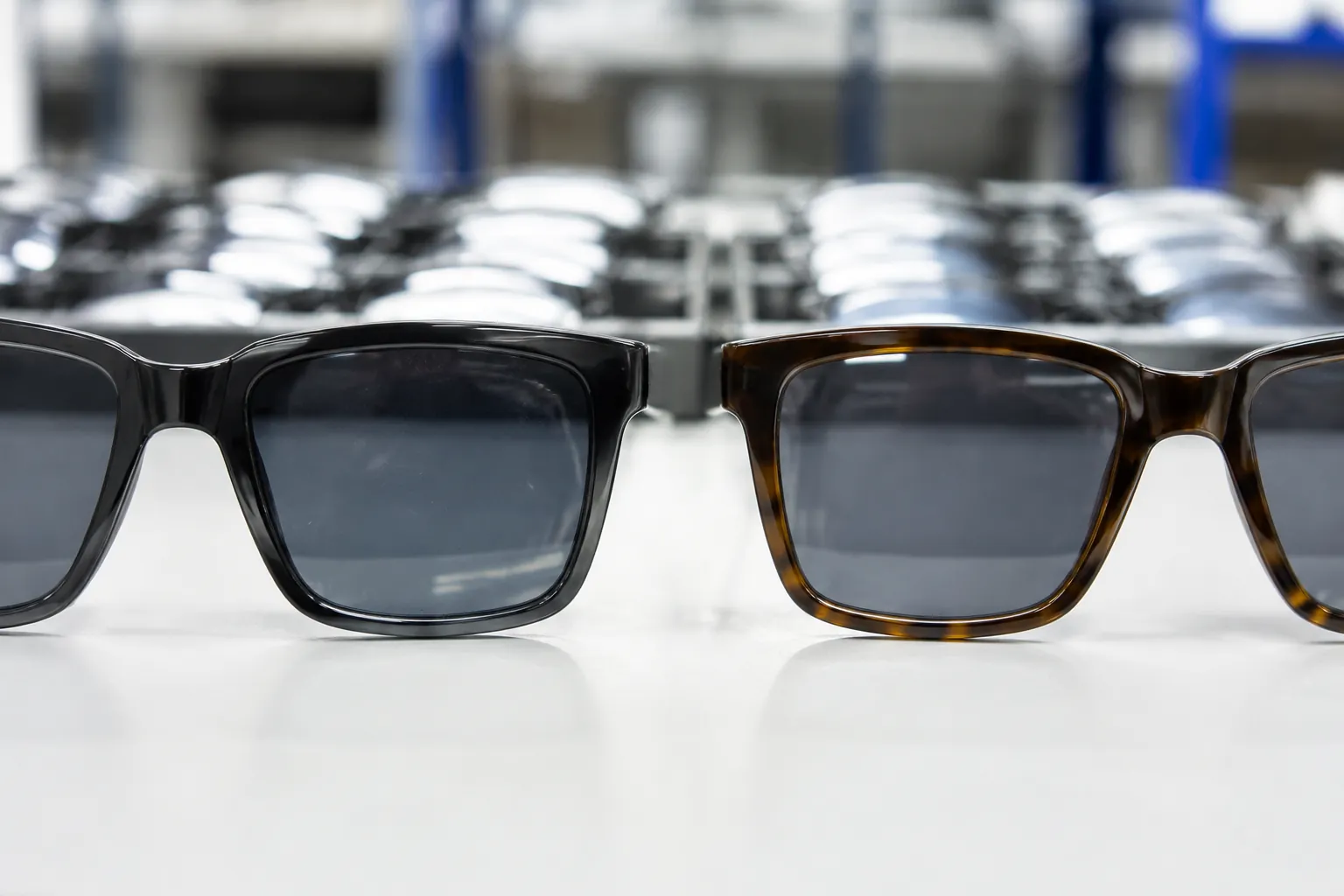
If you buy sunglasses in volume, "anti-scratch" is not a complete spec. It is a claim, and suppliers use it loosely. This guide is for brands, importers, distributors, and retailers that need to compare coatings, price the trade-offs, and write an order sheet a factory can actually follow. The point is simple: fewer complaints, fewer surprises, and less money wasted on vague promises.
What buyers usually mean by anti-scratch
Most buyers use "anti-scratch" to mean a lens surface that holds up better to everyday wiping and handling than an untreated lens. That is still too vague for an OEM order. In production terms, what you usually need is a hard coat: a thin surface layer that improves abrasion resistance, slows micro-marring, and reduces cosmetic wear from dust, cloth wiping, shipping rub, and routine handling. It does not make a lens scratch-proof. Nothing does.
Material choice comes first. The substrate decides how much the coating has to do. Polycarbonate has strong impact performance but a softer surface, so it usually benefits from a hard coat when the product will be cleaned often or packed tightly. CR-39 is generally harder on the surface than untreated polycarbonate and can offer good optical clarity, but it can still mark if the coating is weak or the packaging allows lens-to-lens friction. TAC and nylon are also used in sunglass lenses. They still depend on coating quality, curing control, and handling discipline.
"Anti-scratch" only becomes useful when it is tied to a substrate, a coating system, and a verification method. A buyer should be able to answer three questions: what is the base lens, what coating is applied, and what test or inspection method is used to judge abrasion resistance? If those three points are missing, the claim is marketing language, not a procurement spec.
The same lens can behave differently after tinting, edging, handling, and packing. A small coating defect at the edge may not show on a sample, but it can turn into edge peel or visible wear after carton pressure or temperature changes. That is why experienced buyers look at process control, not label language.
Hard coating vs scratch resistance claims
Factories often mix three different ideas: surface hardness, scratch resistance, and abrasion resistance. Buyers should not treat them as the same thing. Surface hardness describes the coating itself. Scratch resistance is the lens' ability to avoid visible marks from real-world contact. Abrasion resistance is usually the most useful commercial measure because it reflects repeated wiping, bag friction, and transit wear.
For buying decisions, the details matter. A UV-cured hard coat may be enough for low-cost fashion frames. A multi-layer system with a hard coat plus a top coat is often better for retail programs where end users clean lenses more often. Coating thickness is usually very thin, so uneven application can cause haze, cloudy patches, poor edge coverage, or weak adhesion even when the lens looks fine right after coating.
| Spec | What it means | What to ask the factory | Common risk |
|---|---|---|---|
| Hard coating | Added surface layer to improve abrasion resistance | Coating chemistry, application method, cure conditions, thickness range, and adhesion check | Thin coat, uneven cure, poor edge coverage, haze |
| Anti-scratch claim | Marketing statement, not a fixed technical standard | Which abrasion or scratch test supports the claim, and what the pass/fail rule is | No test basis, no repeatability, no clear liability if complaints rise |
| Scratch-resistant lens | Lens that resists visible wear under defined conditions | Which standard or internal method is used, how many cycles, what load, and what failure threshold | Buyer assumes more protection than the supplier can prove |
| Hard coat + top coat | Base durability layer plus a surface finishing layer | Stack order, top-coat function, cleaning performance target, and compatibility with the substrate | Better surface feel but poor adhesion if layers are incompatible |
In a well-run line, coating defects usually come from four places: dust on the lens before coating, inconsistent cure conditions, poor edge adhesion, or packing that creates rub after inspection. If the factory cannot explain where defects come from, that is a warning sign. The process may not be controlled tightly enough for bulk orders.
The specs that matter first
Buyers should rank durability specs in this order: substrate, coating system, optical quality, adhesion, and packaging. That sequence saves money because it starts with the biggest performance driver. Too many orders begin with color and finish, then discover the lens fails in abrasion, haze, or shipping rub. That is backwards.
Once the coating is chosen, the same lens still has to meet the target tint, clarity, and appearance after curing and packing. So the spec needs numbers or limits wherever possible. If the lens thickness target is a standard fashion lens, define a realistic production tolerance instead of assuming every supplier uses the same one. For visible defects, define what is acceptable. A pinhole in the coating, a small edge chip, and a slight haze band are not the same thing.
- Substrate: polycarbonate, CR-39, TAC, nylon, or another lens material. This determines impact behavior, optical stability, and surface hardness.
- Coating type: standard hard coat, hydrophobic top coat, anti-reflective layer, mirror layer, or a combined stack. Each layer changes cost and lead time.
- Adhesion: a coating that scratches easily is a problem, but one that peels at the edge after flex or heat is worse.
- Optical stability: tint consistency, haze, distortion, and birefringence after curing and trimming.
- Packing method: interleaf paper, protective film, tray spacing, carton fill, and compression resistance.
Decoration methods can also affect lens quality indirectly. Pad printing, laser marking, hot stamping, or metallic transfer on nearby parts can create dust, solvent vapor, or handling marks if the line is not segregated. Ask whether lens coating happens before or after nearby decoration steps, and whether the line uses dedicated racks, filtered curing space, or lint-free transfer trays. If you are buying private-label sunglasses, write down what acceptable means: no visible peel, no whitening at the edge, no lens-to-lens rub marks after transit simulation, and no distortion that affects fit or appearance. Clear language prevents most disputes.
What to ask a factory to prove
A serious buyer should not ask only, "Is it anti-scratch?" Ask for process evidence. The answer should include the lens material, the coating stack, the application route, the curing conditions, and the inspection method. If the supplier cannot explain those in plain language, they may not control the process well enough for repeatable bulk production.
For better comparisons, ask for numbers where the factory actually measures them. A supplier should be able to tell you the coating process used for the order, the cure conditions they follow, and the inspection point where dust, fisheyes, edge lift, and tint mismatch are removed. If they use an internal abrasion check, ask for the tool, cycle count, load, and rejection rule. If they rely on a third-party standard, ask for the exact standard version and the test report.
- Ask for the lens material and coating stack used on your order.
- Ask how the coating is applied and cured, including the process window they control.
- Ask which inspection point catches dust, fisheyes, edge lift, coating pinholes, and tint mismatch.
- Ask for sample failure photos from past rejects, if available, including edge peel and wipe haze.
- Ask for the abrasion or scratch test used internally, plus the pass/fail rule.
- Ask how lenses are packed to prevent lens-to-lens friction in transit.
For buyers working with an OEM supplier such as LumiShades, it helps to map lens tinting, decoration, and QC to a controlled process instead of guessing after shipment. That matters when you are comparing small development runs with full production orders. A sample can look clean after inspection and still fail if the packout changes or the factory changes curing conditions between lots.
If you want tighter control, ask for the sample approval reference, the production lot numbering format, and the rework rule for any lens with coating disturbance. Those three items make claims easier to settle later.
How coating choice affects cost and lead time
Coating is not free. Weak coating often costs more later through complaints, repacks, write-offs, and rejected stock. The right spec depends on where the product will sell, how it will be cleaned, and what retail price point you need to hit. For low-price promotional sunglasses, a basic hard coat may be enough. For higher-volume retail programs, buyers often need tighter abrasion control, better packing discipline, and a more consistent cure process.
Cost also moves with order size. Small sample or development runs usually absorb more engineering time, setup, and inspection effort per pair than larger production orders. In OEM programs, pricing usually improves at higher volumes because setup, tint matching, and QC effort are spread across more units. Lead time works the same way. Sample approval and production scheduling move faster when materials are ready and the specification is frozen. Bulk production depends on capacity and coating complexity.
| Option | Typical use | Durability trade-off | Buyer impact |
|---|---|---|---|
| Basic hard coat | Entry-level fashion and promo orders | Good general resistance, limited abuse tolerance | Lowest cost, but higher complaint risk if packaging is weak |
| Hard coat + top coat | Retail programs and repeated handling | Better wipe resistance and smoother surface feel | Higher unit cost, but easier to position as a premium spec |
| Hard coat on polycarbonate with stricter QC | Sport or safety-adjacent styles | Better impact performance, but the surface still needs careful handling | Useful where ANSI Z80.3 or other durability expectations matter |
| Premium stack with tighter packout | Export orders with low return tolerance | Better cosmetic stability in transit and retail handling | Higher cost and more process control, but fewer post-shipment disputes |
For OEM orders at LumiShades, the practical point is simple: MOQ, pricing, and lead time all move with the same choices: coating system, lens material, decoration steps, and packing spec. If your target cost is tight, finalize the coating requirement before sample approval, not after the first quote.
Compliance is not durability
Buyers sometimes assume certification covers scratch resistance. It does not. Compliance and durability are related, but they are different checks. A lens can pass a safety or market-access standard and still scratch too easily for your channel. Keep the technical spec and the compliance pack separate in your purchase order.
For market access, ask the supplier to align with the applicable standard for the destination market. Keep the list to relevant items only: CE EN ISO 12312-1, ANSI Z80.3, AS/NZS 1067, REACH, FDA registration, ISO 9001, and BSCI. Use them where they matter. CE EN ISO 12312-1 and AS/NZS 1067 support sunglass market access in their respective regions. ANSI Z80.3 is relevant for U.S. sunglass expectations. REACH matters for restricted substances. FDA registration is part of the U.S. supply-chain conversation, but it is not a performance test. ISO 9001 and BSCI speak to management systems and social compliance, not lens abrasion performance.
None of those documents should be used as proof that the lens coating is abrasion-proof. If a factory implies that a compliance document replaces a durability test, push back. The right approach is to pair compliance documents with a real coating spec, a packout spec, and a visible quality acceptance standard. That matters for branded orders, where one bad shipment can damage the perception of the whole line.
An order sheet that prevents arguments later
The cleanest way to buy lenses is to write the spec like a production problem, not a sales promise. Put the coating, material, test, and packing requirements in the PO or tech pack. Then the factory has something measurable to follow, and you have a clear basis for rejection if the result drifts.
A good order sheet should include not only the lens type, but also the acceptable variation. If the lens tint target has a defined range, state that range in the purchase document. If the coating must survive wiping without visible whitening, define the wipe condition or inspection method. If the edge can show minor polishing marks but no lift, define that difference in writing. The more specific the sheet, the fewer arguments later.
- Lens material and thickness
- Coating type and finish level
- Approved sample reference code
- Scratch or abrasion test method, if used
- Edge condition, haze limit, and visual defect limits
- Packing method for inner box, tray, and outer carton
- Required compliance documents by market
For example, if you are buying a polarized style with tinted lenses, say whether the lens must survive normal cleaning without whitening, whether edge wear is acceptable, and whether lens surfaces must remain free of visible rub marks after transit. Also specify whether the lenses will be inserted before or after frame finishing, because handling sequence changes the risk of micro-marring. Keep it short. Keep it clear. That is what gets followed.
What to verify before you place volume
Before you move from sample to bulk, check the same lens under three conditions: dry wipe, wet wipe, and packed-shipment handling. Many coating failures only appear after the lens has been rubbed repeatedly, exposed to cleaning fluid, or held under pressure in a carton. That is why a pretty sample can still produce complaints later.
Use a final checklist that matches how the product will actually be sold. For a retail-ready order, inspect random bulk samples under bright side light for edge lift, haze, drag marks, and coating discontinuity. For online or export programs, confirm carton compression resistance, interleaf quality, and how many layers of lenses sit in each tray. If the pack is too tight, you may see rub marks even when the lens coating itself is acceptable.
Use this final checklist:
- Confirm the approved sample matches production coating and tint.
- Inspect random bulk samples for edge lift, haze, and wipe marks.
- Check carton compression and interleaf protection.
- Confirm the factory can repeat the same result on the next PO.
- Keep the coating spec in writing, not in a chat thread.
Bottom line: buyers should specify the lens substrate, coating system, and proof method first. "Anti-scratch" only means something after those three are defined.
If you buy through a factory like LumiShades, which runs injection molding, acetate cutting, CNC milling, lens tinting, decoration, and QC in-house, you can align lens durability with the actual production line instead of hoping a label survives transit. That is where fewer returns come from: material choice, cure control, and packout discipline. Not nicer words.
Have a custom sunglasses project in mind?
Send us your styles, target market and quantities and we will return a detailed quote with MOQ, lead time and a sample plan.
Get a QuoteWhy source this from Wenzhou with LumiShades
Wenzhou in Zhejiang Province is widely regarded as China’s eyewear manufacturing capital, producing a large share of the world’s sunglasses. That concentration matters to buyers: a deep local supply chain for acetate sheet, hinges, lens blanks, plating and packaging means shorter component lead times, easier color and material matching, and a workforce with decades of eyewear-specific skill. LumiShades has manufactured in this ecosystem since 2009, and our vertical integration — in-house injection molding, acetate cutting, CNC milling, lens tinting, decoration and quality control — means no part of your order is quietly subcontracted to a workshop you cannot audit.
For international buyers, that vertical control translates into accountability. When a single factory owns every step, defects are traced and fixed at source rather than bounced between vendors, and your specifications survive intact from first sample to bulk. We back this with 15+ years of experience, shipments to 60+ countries, more than 5 million pairs produced per year and a 98.5% on-time delivery rate. Our certifications — CE EN ISO 12312-1, FDA registration, ANSI Z80.3, AS/NZS 1067, REACH, ISO 9001 and BSCI audit — mean the compliance documentation your market requires already exists. Explore our manufacturing capabilities and quality control process to see how this works in practice.
Frequently asked questions
Is hard coating enough for polycarbonate sunglass lenses? Often yes for general use, but only if the coating, curing process, and packing are controlled. The real question is not whether a hard coat exists. It is whether the supplier can prove consistent adhesion, edge coverage, and transit protection on the exact lens and packout you are ordering.
What should I ask for instead of an anti-scratch promise? Ask for the lens material, coating type, cure conditions, internal test method, and packing specification. Also ask for the approved sample reference and the defect limits used at production inspection. If a supplier cannot name those items, the claim is too vague to buy against.
Does CE EN ISO 12312-1 mean the lens will not scratch? No. CE EN ISO 12312-1 is a safety and market-access standard for sunglasses, not a scratch-resistance guarantee. The same is true of ANSI Z80.3 and AS/NZS 1067. Those documents help with compliance, but they do not replace a coating durability spec or abrasion test.
How can I compare coating claims from two suppliers? Put both suppliers on the same basis: same substrate, same coating stack description, same test method, same inspection criteria, and same packing requirement. If one supplier gives you a real method and pass/fail rule while the other gives only a marketing claim, the first one is easier to verify and manage.
What is the best way to reduce coating complaints in bulk? Approve one exact sample, freeze the coating and packing specification in writing, and confirm that the factory can reproduce the same result on production units. Most complaints come from process drift, carton rub, or weak edge protection, so the fastest risk reduction is to control the substrate, coating, and packout together.
Ready to start?
Explore our rimless sunglasses or request a quote — our sales team replies within 12 hours.
Request a Quote