
Choose Lens Transmission by Sales Channel
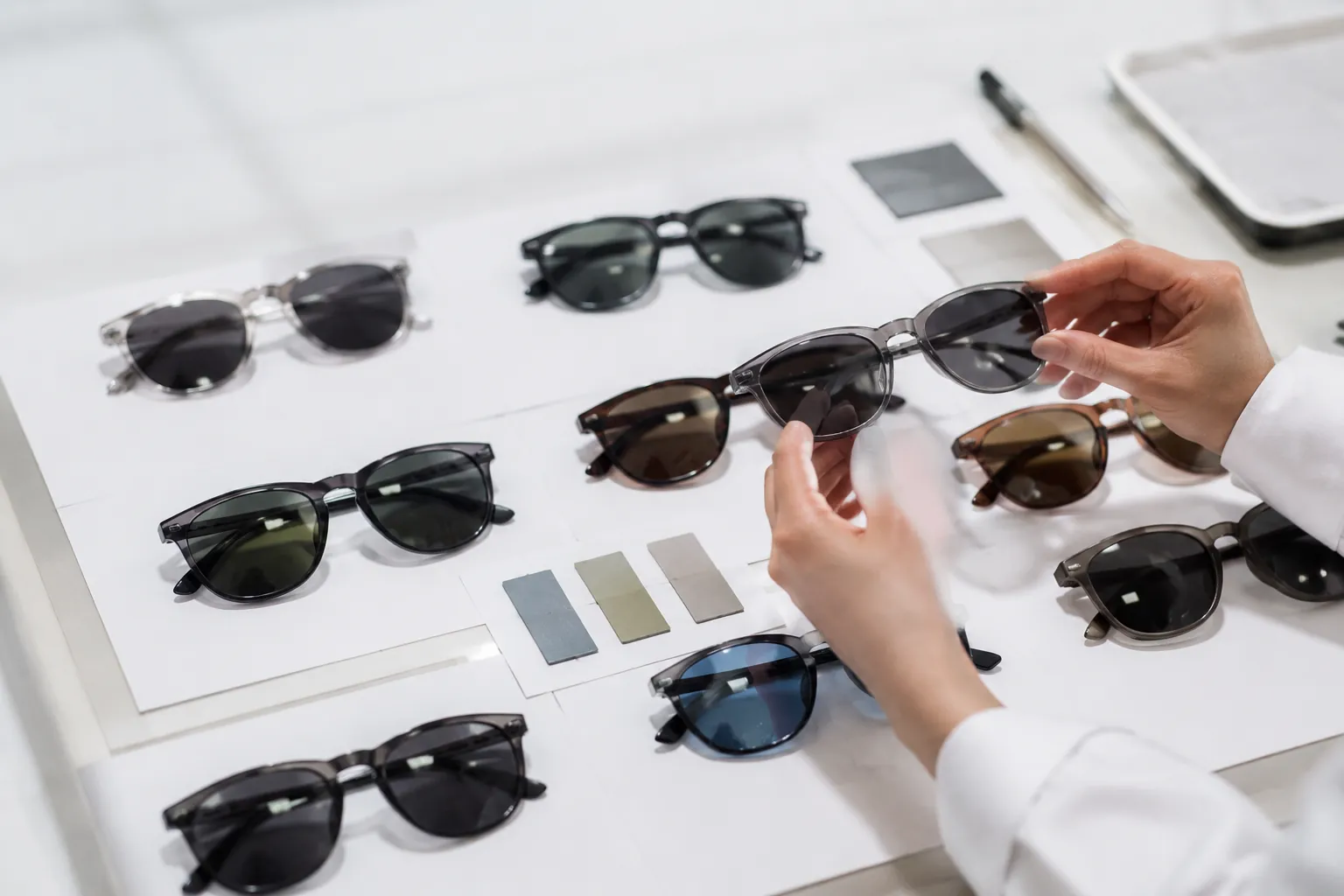
For brands, importers, distributors, and retailers, lens transmission is not a cosmetic detail. It affects sell-through, returns, and whether a SKU fits the channel it was bought for. If you buy sunglasses in volume, you need a practical way to match visible light transmission (VLT) and tint darkness to retail, promo, travel, and sport programs. The goal is fewer mismatched SKUs, clearer merchandising, and fewer complaints about glare, darkness, or poor indoor-outdoor use.
Why lens transmission matters by channel
Lens transmission determines how much visible light passes through the lens. That affects comfort, perceived quality, and channel fit. A lens can look premium in a showroom and still fail in use if it is too dark for indoor traffic, too light for beach use, or too harsh for mixed-light travel. Buyers are not choosing a tint name. They are choosing a use case.
For OEM programs, the same frame platform can usually carry different lens tints, coatings, and decorations by channel. That keeps tooling stable and makes it easier to test demand before a deeper run. Simple is better. The spec should be written around measured performance, not a color label.
Production details matter. VLT changes with base material, dye concentration, tint time, coating stack, and any mirror layer on top. Polycarbonate does not behave exactly like CR-39 or nylon. Two lenses can both be called smoke and still land at different transmission levels if the process changes.
Start with a target transmission band. Not a color name. Dark gray is not a spec. A written VLT target, plus an agreed sample reference, keeps production and merchandising aligned.
Practical VLT bands buyers can use
There is no single universal VLT that fits every market. The bands below are useful starting points for buying decisions. They reflect use, not marketing language. Tight bands reduce surprises. Wider bands allow more style variation.
| Channel | Typical VLT band | Buyer intent | Main risk |
|---|---|---|---|
| Retail fashion | 15% to 40% | Style with usable glare reduction | Too dark for indoor transitions |
| Promo / corporate gifts | 30% to 60% | Broad acceptance and lower return risk | Looks weak if tint is too light |
| Travel / leisure | 10% to 30% | Comfort in mixed outdoor conditions | Over-dark tint for shaded environments |
| Sport / performance | 8% to 20% | Strong glare control and clear outdoor use | Can feel too aggressive for casual buyers |
These are buying bands, not legal rules. Final compliance still depends on the destination market and the full sunglass specification, including lens category, labeling, and test route. CE EN ISO 12312-1, ANSI Z80.3, and AS/NZS 1067 each set different expectations for optical performance, impact resistance, labeling, and documentation. One approval does not carry over automatically.
Define the allowable variation in writing before production starts. If you are buying a simple fashion tint, a wider window may be fine. If you are building a tightly merchandised retail line or a sport program with repeatable glare behavior, you need a narrower window and an approval sample made from the exact frame, exact lens, and exact finish.
Lighter lenses usually work better for promo, travel, and urban retail because they stay wearable across indoor-outdoor transitions. Darker lenses make sense for beach, driving, and performance use where glare reduction matters more than all-day versatility. The answer depends on where the product sits, who wears it, and how often it will be used outside.
Retail: sell style, keep the tint wearable
Retail buyers need a lens that looks strong on shelf and still feels wearable after purchase. Most consumers try sunglasses under store lighting, not in full sun. That changes everything. If the tint is too dark, the product may look premium in display but create complaints once customers wear it outdoors, in a mall, or in a car.
For general fashion retail, a VLT around 20% to 35% is a dependable starting point. It gives visible tint without making the lens feel too dark indoors. For boutiques or lifestyle chains, a slightly lighter lens can widen acceptance. Gradient tints also work well. They keep a clear style signal and leave more visibility in the lower portion of the lens.
- Use medium smoke, brown, or green tints for broad retail acceptance.
- Choose gradient lenses when the buyer wants a fashion-forward look with less visual harshness.
- Keep mirror effects moderate if the target customer is buying for everyday wear rather than a statement piece.
- Ask for consistent tint density across the batch; visible variation is obvious on shelf.
- Approve samples under both store lighting and outdoor daylight before locking the spec.
For retail programs, consistency matters more than maximum darkness. Even small batch variation can create a mismatched rack, especially across black, tortoise, clear, and translucent frames. On clear frames, lens color often looks stronger than expected because the frame does not visually absorb light. On dark frames, the same lens can look softer. Pre-production samples should always be checked in the actual frame color, not only as isolated lens chips.
Before committing to bulk, confirm sample approval, production lead time, and packing standards with the supplier. Seasonal launches need room for one revision cycle. If the first sample misses the brief, you need time to fix it.
Promo: reduce risk, keep the SKU easy to wear
Promo programs fail when sunglasses are too dark, too fragile, or too narrow in appeal for a mixed audience. These orders often go to people who may wear the product at a trade show, in a car, at an outdoor event, or not at all. The lens has to feel acceptable fast. No learning curve.
For promo, lighter to medium tints with VLT around 35% to 60% are usually safer. They feel less severe, fit more face-to-face situations, and reduce the chance that the product gets dismissed as too dark for indoor use. Often the goal is not the best-looking sunglass. It is the one most likely to be worn, kept, and remembered.
Keep the spec simple. One frame, one lens tint, one logo method. Laser engraving, pad printing, hot stamping, or a small metal logo plate can all work, but every added feature raises the chance of delay or variation. Promo buyers usually care more about logo visibility, packaging consistency, and on-time delivery than optical complexity.
Validate wearability and decoration on a sample before scaling. If the item repeats annually, the savings come from standardizing the lens color, nose fit, and decoration zone so the same setup can run again with minimal adjustment. Simple SKUs usually beat clever ones.
For cost control, ask the supplier to explain where the unit price changes and what drives them. If the supplier cannot describe the cost structure clearly, the quote is not ready for an informed buying decision.
Travel: balance glare control and all-day comfort
Travel buyers sit between fashion and sport. The lens needs to work in airports, sidewalks, car rides, water glare, shaded streets, and changing weather. Too dark gets annoying fast. Too light feels weak and may not reduce discomfort enough. The best travel product usually works without drawing attention to itself.
For travel programs, VLT around 10% to 30% is the practical band. Gray lenses are the most neutral and preserve natural color perception. Brown and amber improve contrast, especially in variable light, and often work well for road travel and outdoor leisure. If your customer uses sunglasses across multiple environments, choose for comfort and visual stability, not trend color.
| Lens type | Best use | Buyer trade-off |
|---|---|---|
| Gray | Neutral color perception | Less contrast boost than brown |
| Brown / amber | Road and variable-light travel | Warmer color cast |
| Light mirror over smoke | Style plus glare reduction | Can be too fashion-led for some buyers |
| Gradient smoke | City travel and casual use | Less overhead glare protection than full tint |
Polarization can help in glare-heavy travel assortments, especially near water, pavement, and sunlit roads. But use it carefully. Some users dislike the effect on screens, dashboards, and other reflective surfaces. If a buyer expects heavy phone use, navigation visibility, or display use indoors, a non-polarized or lighter polarized spec may be safer than a very dark polarized lens.
Travel assortments work better when the lens decision is tied to use case rather than trend language. City travel should stay lighter. Beach or road travel can go darker. Lock that decision before frame color and decoration are finalized. Those downstream choices can make a lens look more or less intense than expected.
Sport: performance first, but do not over-darken
Sport buyers usually want strong glare reduction, but the wrong dark tint can hurt visibility in mixed conditions. Golf, cycling, running, fishing, sailing, and general outdoor training do not all need the same VLT. Treating all of them as one sport SKU is a common mistake.
For bright outdoor sport, VLT around 8% to 20% is common. Lower VLT helps in strong sun and open environments, but if the lens is too dark, athletes lose detail in shade, tree cover, tunnels, or late-day light. That is why many sport programs use a family of tints rather than one aggressive dark lens. A darker base lens may also be paired with a lighter mirror or contrast-enhancing coating if the brand wants performance without visual heaviness.
- Define the sport first: road cycling, golf, water, running, or general outdoor use.
- Select the VLT band based on brightness and environment variability.
- Check whether polarization is helpful or a problem for the use case.
- Verify fit, lens curvature, and wrap angle before locking the tint.
Sport buyers should also pay attention to repeatability. A lens tint that looks fine in a sample but shifts batch to batch will damage confidence quickly, especially if the customer notices a darker or lighter replacement pair. Ask for the supplier's acceptable production tolerance, not just the target VLT. A good program defines the sample reference, the allowed variance, and the QC checkpoint used before packing.
Decoration needs more restraint in performance eyewear. Pad printing, silicone logos, laser marking, or a small transfer can work, but the mark must survive abrasion, sweat, cleaning, and heat. In many sport programs, finish matters as much as tint. A scratch-resistant coating or lens hardcoat can change how the product holds up in the field.
Compliance and production details buyers should not skip
Buying by channel does not replace compliance. It just helps you choose the right starting specification. For exports, the exact test route depends on the destination market and product claim. Relevant items here include CE EN ISO 12312-1, ANSI Z80.3, AS/NZS 1067, REACH, FDA registration, ISO 9001, and BSCI. Not every program needs every item, but every program needs the right one.
Do not overstate what a sample proves. A good-looking sample is not the same as a compliant production lot. The sequence should be straightforward: confirm the target market, choose the tint band, sample the lens in the actual frame, verify labeling and markings, then run bulk with controlled QC checkpoints. If the product has a mirror coat, print, or etched logo, include it in the approval sample. Decoration changes appearance. Sometimes it affects handling or finish quality too.
Lens materials behave differently during production. Polycarbonate is common for impact resistance and lightweight performance, but it can show different surface behavior from CR-39 or nylon. CR-39 can offer strong clarity in some fashion lines, but the material stack and coating compatibility still need checking. Bath temperature, tint time, coating thickness, and post-polish quality all affect the final result. If a supplier changes substrate or polishing steps mid-run, VLT and color perception can drift enough to create complaints.
Batch control matters as much as formulation. A good production plan should specify the measured target VLT, the tolerance range, the visual master sample, and the condition under which the sample was approved. Ask for the tint target in writing, not just smoke or dark gray. If the supplier can also provide pre-shipment spot checks and a pack-out QC record, you have a clearer audit trail if the customer reports a mismatch later.
Decoration and tinting interact. A dark print on a dark lens can look muddy; a mirrored lens can hide a logo at certain angles; a clear frame can make the lens seem more intense. Approvals should test the whole product as sold, not each part in isolation.
How to build a cleaner SKU plan
The easiest way to avoid dead inventory is to build around channel logic, not a random color chart. Start with the end user, then choose the tint. A retail lens can be more fashionable. A promo lens should be easy to wear. A travel lens needs to handle mixed light. A sport lens should be set by the environment, not style alone.
For most buyers, the best move is a tight matrix that stays manageable across purchase cycles. The goal is not maximum variety. It is repeatable sell-through with controlled complexity. A clean structure also makes forecasting and packaging simpler, because the same frame can be sold with different lens specs without forcing a new mold or a new trim package every time.
- One frame platform.
- Two to three lens tints per channel.
- One decoration method per channel.
- One compliance path per destination market.
- One approval sample per finished SKU, not per component.
This keeps MOQ under control and makes pricing easier to model. It also helps when comparing supplier quotes, because the same frame with a different lens or finish should be treated as a separate finished good, not a loose mix of parts. At larger volumes, process control matters more than experimentation. A small tint drift becomes expensive across a full shipment.
If you are sourcing from an OEM hub, ask for lens VLT targets in writing, along with the acceptable deviation, sample timing, and production lead time. For a buyer, that one document prevents a lot of argument later. It also makes supplier comparisons easier, because dark smoke means very little unless it is tied to a measured band and a real approval sample.
Build the assortment from the channel backward. The better the fit between transmission, decoration, and usage, the less likely you are to carry slow-moving stock or hear complaints about how the sunglasses look and feel in the real world.
Have a custom sunglasses project in mind?
Send us your styles, target market and quantities and we will return a detailed quote with MOQ, lead time and a sample plan.
Get a QuoteWhy source this from Wenzhou with LumiShades
Wenzhou in Zhejiang Province is widely regarded as China’s eyewear manufacturing capital, producing a large share of the world’s sunglasses. That concentration matters to buyers: a deep local supply chain for acetate sheet, hinges, lens blanks, plating and packaging means shorter component lead times, easier color and material matching, and a workforce with decades of eyewear-specific skill. LumiShades has manufactured in this ecosystem since 2009, and our vertical integration — in-house injection molding, acetate cutting, CNC milling, lens tinting, decoration and quality control — means no part of your order is quietly subcontracted to a workshop you cannot audit.
For international buyers, that vertical control translates into accountability. When a single factory owns every step, defects are traced and fixed at source rather than bounced between vendors, and your specifications survive intact from first sample to bulk. We back this with 15+ years of experience, shipments to 60+ countries, more than 5 million pairs produced per year and a 98.5% on-time delivery rate. Our certifications — CE EN ISO 12312-1, FDA registration, ANSI Z80.3, AS/NZS 1067, REACH, ISO 9001 and BSCI audit — mean the compliance documentation your market requires already exists. Explore our manufacturing capabilities and quality control process to see how this works in practice.
Frequently asked questions
What VLT should I choose for a retail fashion sunglass line? Start around 20% to 35% VLT for general fashion retail. That range usually balances shelf appeal and wearability, especially when the product is tried on indoors before being worn outside. Ask the supplier to confirm the exact sample and the allowed variation in writing before you approve bulk.
Are promo sunglasses better with darker or lighter lenses? Usually lighter to medium lenses. Around 35% to 60% VLT is safer because the product feels easier to wear across a mixed audience and is less likely to be rejected as too dark. Keep the spec simple so decoration, packaging, and delivery are easier to control.
Do I need different tints for travel and sport? Yes. Travel often works best at 10% to 30% VLT, while sport may need 8% to 20% depending on brightness, wrap angle, and how variable the environment is. If the user will move between shade, sun, and screens, choose the tint based on the main use case, not the most aggressive option.
Can one certification cover all export markets? No. CE EN ISO 12312-1, ANSI Z80.3, AS/NZS 1067, REACH, FDA registration, ISO 9001, and BSCI each serve different purposes. Match the required documents to the destination market and product claim, and do not assume a sample approved for one market is automatically acceptable in another.
How should I test a new lens tint before ordering volume? Approve the exact frame and lens combination, check it under the target market lighting, confirm the VLT target and tolerance in writing, and verify the decoration and packing condition before bulk. If the product will be sold in more than one channel, test it in the channel where the weakest fit is most likely to show up.
Ready to start?
Explore our square sunglasses or request a quote — our sales team replies within 12 hours.
Request a Quote