
Photochromic vs Standard Polarized SKU Guide
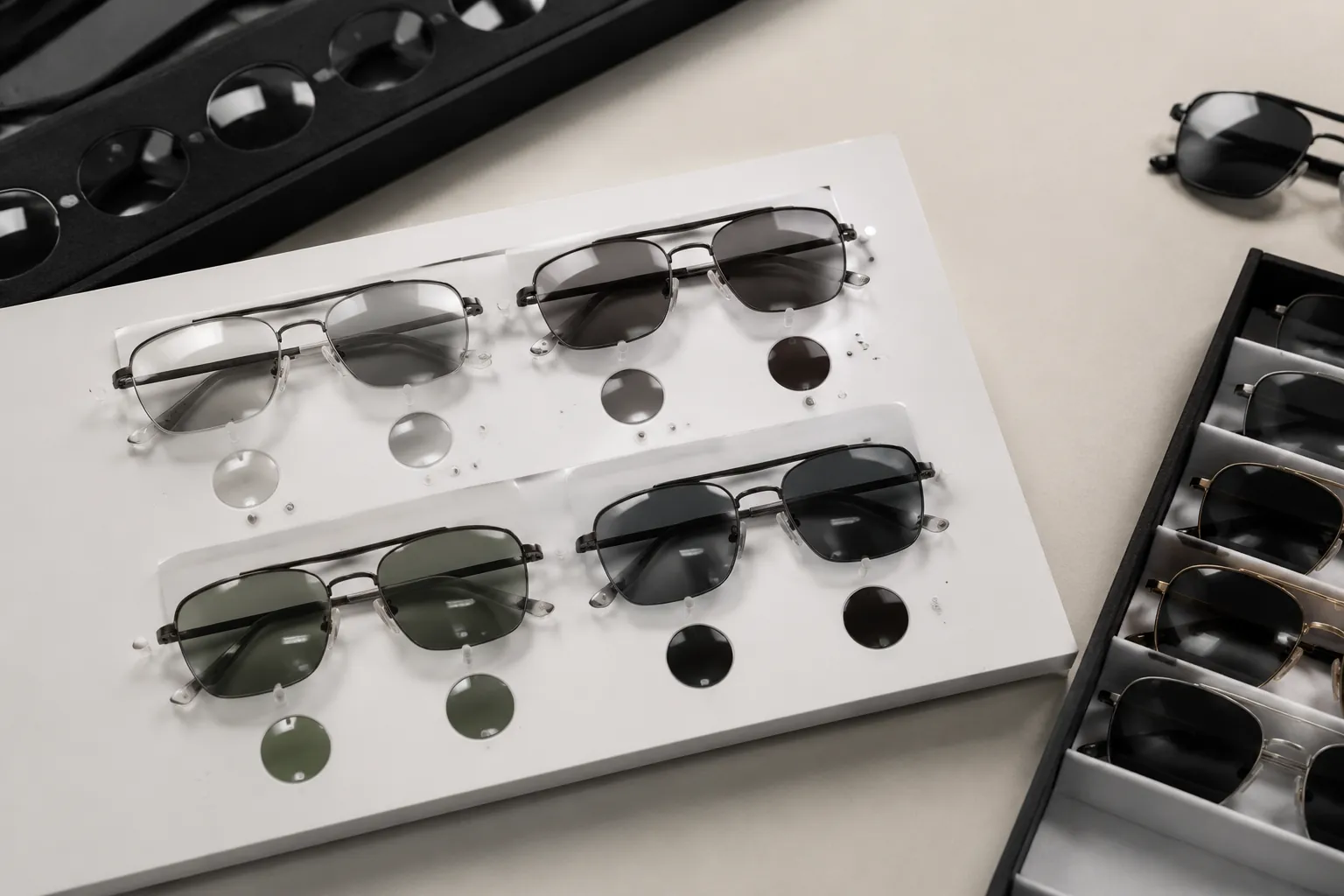
If you buy sunglasses for brands, importers, distributors, or retail chains, this is a SKU decision, not a lens debate. Photochromic polarized and standard polarized both sell, but they do not sell the same way in every market. Pick the wrong mix and inventory stalls. Pick the right mix and you reduce returns, match climate and channel demand, and protect margin.
What each lens does
Standard polarized lenses reduce glare from flat, bright surfaces such as water, roads, glass, and metal. A polarizing film blocks horizontal light waves, which is why anglers, drivers, and outdoor shoppers notice the effect fast. The tint stays fixed. That consistency is useful. It is easier to photograph, easier to explain, and easier to reorder.
Photochromic polarized lenses do two jobs at once. They reduce glare and darken with UV exposure. In lower UV, they stay lighter. In stronger UV, they darken more. The change depends mainly on UV, not visible light. So activation is weaker behind car windshields and slower in colder conditions. That is normal. It is not a defect. But it does matter, because buyers often expect a bigger indoor-to-car change than the lens can deliver.
The commercial difference is often bigger than the optical one. Standard polarized is usually the cleaner SKU for first orders, private-label tests, and price-sensitive channels. Photochromic polarized can support a higher ticket, but only if the use case is clear. If the claim is vague, sell-through slows. If the claim is specific, the SKU can work well in commuter, travel, and lifestyle assortments.
The right question is simple: which lens fits the channel's buying behavior, UV environment, and price point? Start there. It saves cash later.
Where standard polarized wins
Standard polarized wins in channels that need a simple reason to buy. Fishing shops, marine programs, driving accessory sets, fuel station retail, airport stores, and value e-commerce all reward short explanations. The shopper gets one message: less glare. That is enough.
It also fits hot, stable climates where customers do not want the lens to change. In those regions, photochromic behavior can feel like extra complexity without extra value. A fixed tint often performs better in product photos, comparison charts, and sales conversations because it looks exactly like the buyer expects. Predictable sells.
Use cases matter too. A driver wants glare reduction. A fisherman wants contrast over water. A beach shopper wants a clean, obvious benefit. Standard polarized fits all three.
- Best for direct-use cases such as driving, fishing, boating, and beach wear.
- Best when buyers want a simple retail story and short training time.
- Best for repeatable color runs where tint consistency matters across replenishment.
- Best for channels with impulse purchases and limited comparison time.
At the sourcing level, standard polarized is easier to control. The lens stack is simpler. Activation is not a variable. Approved samples are easier to match across batches. If you are testing a new market, that lowers risk. In practice, standard polarized is often the safer first run.
Where photochromic polarized wins
Photochromic polarized is strongest in channels where shoppers move between indoor and outdoor conditions during the day. That includes commuter assortments, travel retail, premium lifestyle stores, optical-style programs, and general retail in markets with mixed weather. The value is convenience. One pair covers more situations.
That said, the product has to be described accurately. The lens darkens based on UV exposure, and the speed of change depends on temperature, UV intensity, and lens formula. In plain terms, it can activate more slowly in cold weather. It may also look weak behind some vehicle glass. If the base tint is too dark, the lens can feel dull indoors. If the swing is too small, customers may think the technology is not working.
Buyers should lock down a few details before bulk production: base tint uniformity, activation range, return-to-clear time, and lot-to-lot consistency. The approved master sample has to stay close to production. Put the tolerance in writing for each colorway and lens build. Do not leave it loose.
Lumishades handles lens tinting, decoration, and final QC in-house, which helps reduce drift between sample approval and bulk output. That matters because photochromic programs often fail at handoff points. The frame is approved. The lens is approved. The assembled pair no longer matches the original target. In-house control helps keep the tint target, coating run, and final inspection aligned before shipment.
Climate, channel, and use case matrix
Buy the lens for the channel, not the brochure. Climate matters, but so do basket size, price sensitivity, and how much time the shopper has to compare options. A resort kiosk, a highway convenience store, and a commuter-focused optical program will not react the same way.
| Market / channel | Standard polarized | Photochromic polarized | What usually happens |
|---|---|---|---|
| Hot, sunny retail markets | Strong fit | Moderate fit | Standard polarized often moves faster because the use case is immediate and the tint stays predictable. |
| Mixed weather / commuter markets | Good fit | Strong fit | Photochromic polarized can win when shoppers move between indoor and outdoor environments often. |
| Fishing / boating / driving specialists | Strong fit | Moderate fit | Standard polarized is easier to explain, easier to demo, and usually easier to reorder. |
| Optical-style lifestyle assortments | Moderate fit | Strong fit | Photochromic polarized supports a higher perceived value if claims and display materials are controlled. |
| Value e-commerce | Strong fit | Weak to moderate fit | Standard polarized is easier to position on price and review sentiment. |
Cold climates need extra care. Winter sunlight still carries UV, but low temperatures slow the darkening response. That creates a perception problem. The customer may think the lens is defective when it is only reacting more slowly. If your audience is indoor workers, rideshare drivers, or urban commuters, photochromic polarized needs more education than standard polarized. If your audience is outdoors all day, the fixed tint usually wins.
Use case matters at the shelf too. A fishing buyer wants glare suppression over water. A commuter buyer wants convenience across conditions. A fashion retailer wants a premium technical story. Match the SKU to the actual day the customer lives, not the nicest label on the hangtag.
Cost, MOQ, and margin logic
The cost difference is not just the lens blank. It also includes coating control, yield loss, and the amount of explanation the SKU needs at sell-in. Standard polarized usually has the cleaner landed cost because the process is simpler. Photochromic polarized adds raw material cost and tighter process control, so the retail price has to leave room for that complexity.
With Lumishades, MOQ starts at 50 pairs per design. That works for a new color, frame shape, or channel test. At 300 pairs, you can read real sell-through. At 1,000 pairs and above, the factory can usually improve material usage, assembly flow, and packaging efficiency. Pricing depends on frame type, lens spec, decoration load, packaging, and order volume, so quote it per program. Do not treat it as a universal rate.
Bulk lead time is typically 25-35 days after sample approval, while samples are usually 7-10 days. Faster runs are possible for repeat orders or simple builds, but buyers should still plan around approval gates. For seasonal launches, standard polarized is often the easier first run because the acceptance criteria are simpler. Photochromic polarized usually needs one more sample review so the buyer can judge darkness level, activation speed, and color balance in real conditions.
- Start with 50 pairs per design when the market is unknown.
- Use 300 pairs to test real sell-through in one channel or region.
- Move to 1,000+ only after return rate, review quality, and reorder signals are stable.
- Reserve 5,000+ pairs for proven SKUs with repeat demand and clear replenishment logic.
Margin planning should include more than ex-factory price. Add freight, packaging protection, inspection time, and the cost of claims support. A cheaper lens that creates returns can be worse than a more expensive lens that sells cleanly. The goal is not the lowest unit cost. The goal is the best gross margin after returns and markdowns.
Manufacturing details that affect consistency
Lens type matters. Process control matters more. A polarized lens that looks right on the first batch and drifts on the second batch is not a sales issue. It is a process issue. The factory has to control tint bath timing, film alignment, lamination stability, edge finish, and final shade matching against an approved master. If any of those variables moves too far, the SKU starts to look inconsistent even if the spec sheet says it passes.
For polarized lenses, the main risks are optical axis alignment, lamination quality, and surface uniformity. If the polarization film is misaligned, glare reduction becomes uneven. If the tint is too strong or too weak, the lens can miss the expected visible light transmission target. For photochromic polarized, the extra risk is activation drift across lots. Buyers should ask how the factory validates response time and darkened state from batch to batch.
Lumishades runs injection molding, acetate cutting, CNC milling, lens tinting, decoration, and QC in-house. That reduces handoff errors between frame finishing and lens insertion. It also makes it easier to hold critical dimensions such as bridge alignment, temple symmetry, and groove fit. Ask suppliers to confirm the basics before approval.
- Master sample approval before bulk production.
- Reference light transmission targets by colorway and lens type.
- Assembly tolerances for temple alignment and lens seating.
- Packaging that prevents lens scuffing, rubbing, or warping in transit.
- Photo and video approval of the first article, not just a written spec.
Decoration also matters more than many buyers expect. Laser logos, hot stamping, pad printing, foil marks, and laser-etched lens marks each behave differently on different materials. On acetate, hot stamping can look premium, but pressure and temperature must be controlled to avoid edge distortion. On injected frames, pad printing is common and efficient, but ink adhesion needs testing to survive abrasion and cleaning. Laser etching is precise, but the mark can look too subtle on dark tints if the contrast is not planned. The sample should show the exact decoration method under the exact lighting the customer will see.
Small components affect perceived quality too. A weak microfiber cloth, a sleeve that scratches the lens, or a temple that sits slightly off-center can make a good lens feel cheap. That is why in-house QC is not optional in a technical SKU program. It keeps the approved product aligned from sample to shipment.
Compliance and claim control by market
Do not market the lens before you know the target market's compliance lane. The real certifications and standards a buyer may need to verify are CE EN ISO 12312-1, ANSI Z80.3, AS/NZS 1067, REACH, FDA registration, ISO 9001, and BSCI. Do not claim anything else unless the paperwork is actually in hand. Teams still get burned by reusing one generic spec sheet across multiple regions.
For Europe, CE EN ISO 12312-1 and REACH are the main references for sunglass and material compliance. For the United States, buyers usually care about FDA registration and ANSI Z80.3 performance expectations. Australia and New Zealand commonly require AS/NZS 1067. If you sell in more than one market, split the technical file by region and keep the claim language separate. A clean compliance file is easier to defend than a broad one.
Be careful with performance claims. "Photochromic" describes the lens behavior. It is not a free pass to imply medical, therapeutic, or universal UV claims beyond the supporting test data. If a retailer wants a statement about darkening speed, visible light transmission, or UV response, tie it to the approved sample and the relevant test report. Keep the file clean.
Market-specific labeling also helps sales teams avoid confusion. One market may want a simple consumer-facing claim. Another may require more conservative wording and a narrower technical description. If the product is sold through multiple channels, review the claim stack at the same time as the artwork, carton, and hangtag.
How to split the SKU mix
The right mix depends on where you sell. There is no universal ratio. There is a practical way to start and adjust. Use the channel, price band, and wearing context to guide the first order. Then let sell-through, return rate, and reorder velocity tell you what should change.
| Channel profile | Starting mix suggestion | Why | Risk if you overbuy |
|---|---|---|---|
| Outdoor specialist / fishing | 70% standard / 30% photochromic | Standard polarized is the core performer; photochromic is the upsell. | Too much photochromic can slow turns. |
| General retail / lifestyle | 50% standard / 50% photochromic | Mixed shopper intent supports both functions. | Too much of either can miss local preference. |
| Value e-commerce | 80% standard / 20% photochromic | Standard polarized usually wins on price clarity and review performance. | Photochromic can create expectation complaints if not explained. |
| Premium optical / commuter | 40% standard / 60% photochromic | Convenience and all-day wear support the premium SKU. | Standard may look too plain if the channel wants differentiation. |
A practical launch plan is narrow in style but wide enough to test behavior. One frame shape can carry two lens types and two key colorways. Then the retailer can compare return rates and review language before scaling. The goal is not more SKUs. The goal is the right first replenishment decision.
Start with the buyer's real shopping context, then work backward. If the customer is standing in a store on a sunny day, a standard polarized message is often enough. If the customer is comparing options for a one-pair commute-and-travel solution, photochromic polarized earns its premium. Match intent. Nothing else matters as much.
Have a custom sunglasses project in mind?
Send us your styles, target market and quantities and we will return a detailed quote with MOQ, lead time and a sample plan.
Get a QuoteWhy source this from Wenzhou with LumiShades
Wenzhou in Zhejiang Province is widely regarded as China’s eyewear manufacturing capital, producing a large share of the world’s sunglasses. That concentration matters to buyers: a deep local supply chain for acetate sheet, hinges, lens blanks, plating and packaging means shorter component lead times, easier color and material matching, and a workforce with decades of eyewear-specific skill. LumiShades has manufactured in this ecosystem since 2009, and our vertical integration — in-house injection molding, acetate cutting, CNC milling, lens tinting, decoration and quality control — means no part of your order is quietly subcontracted to a workshop you cannot audit.
For international buyers, that vertical control translates into accountability. When a single factory owns every step, defects are traced and fixed at source rather than bounced between vendors, and your specifications survive intact from first sample to bulk. We back this with 15+ years of experience, shipments to 60+ countries, more than 5 million pairs produced per year and a 98.5% on-time delivery rate. Our certifications — CE EN ISO 12312-1, FDA registration, ANSI Z80.3, AS/NZS 1067, REACH, ISO 9001 and BSCI audit — mean the compliance documentation your market requires already exists. Explore our manufacturing capabilities and quality control process to see how this works in practice.
Frequently asked questions
Is photochromic polarized always better than standard polarized? No. Photochromic polarized is better when the wearer moves between indoor and outdoor conditions often and understands that activation depends on UV exposure. Standard polarized usually wins on simplicity, price clarity, and faster sell-through in direct-use channels such as fishing, boating, and driving.
Does photochromic activate well behind car windshields? Not always. Many windshields block much of the UV that activates photochromic lenses, so darkening can be weaker or slower in a car. If you plan to sell it for driving, ask for tested performance data and avoid claims that go beyond what the sample shows.
What MOQ should I start with for a new SKU? A practical test order is 50 pairs per design if the market is unknown. If the first sell-through is promising, move to 300 pairs before committing to 1,000+.
What compliance documents should I ask for? Match the market and ask for the supporting documents that apply to the destination country. Common references include CE EN ISO 12312-1 and REACH for Europe, FDA registration and ANSI Z80.3 for the U.S., and AS/NZS 1067 for Australia/New Zealand.
How long do samples and bulk orders usually take? Samples are usually 7-10 days, and bulk production is typically 25-35 days after sample approval. Confirm the schedule in writing because frame material, lens specification, decoration, and packaging can change the timeline.
Ready to start?
Explore our cat-eye sunglasses or request a quote — our sales team replies within 12 hours.
Request a Quote