
Polarized Lens Tint Strategy by Climate and Channel
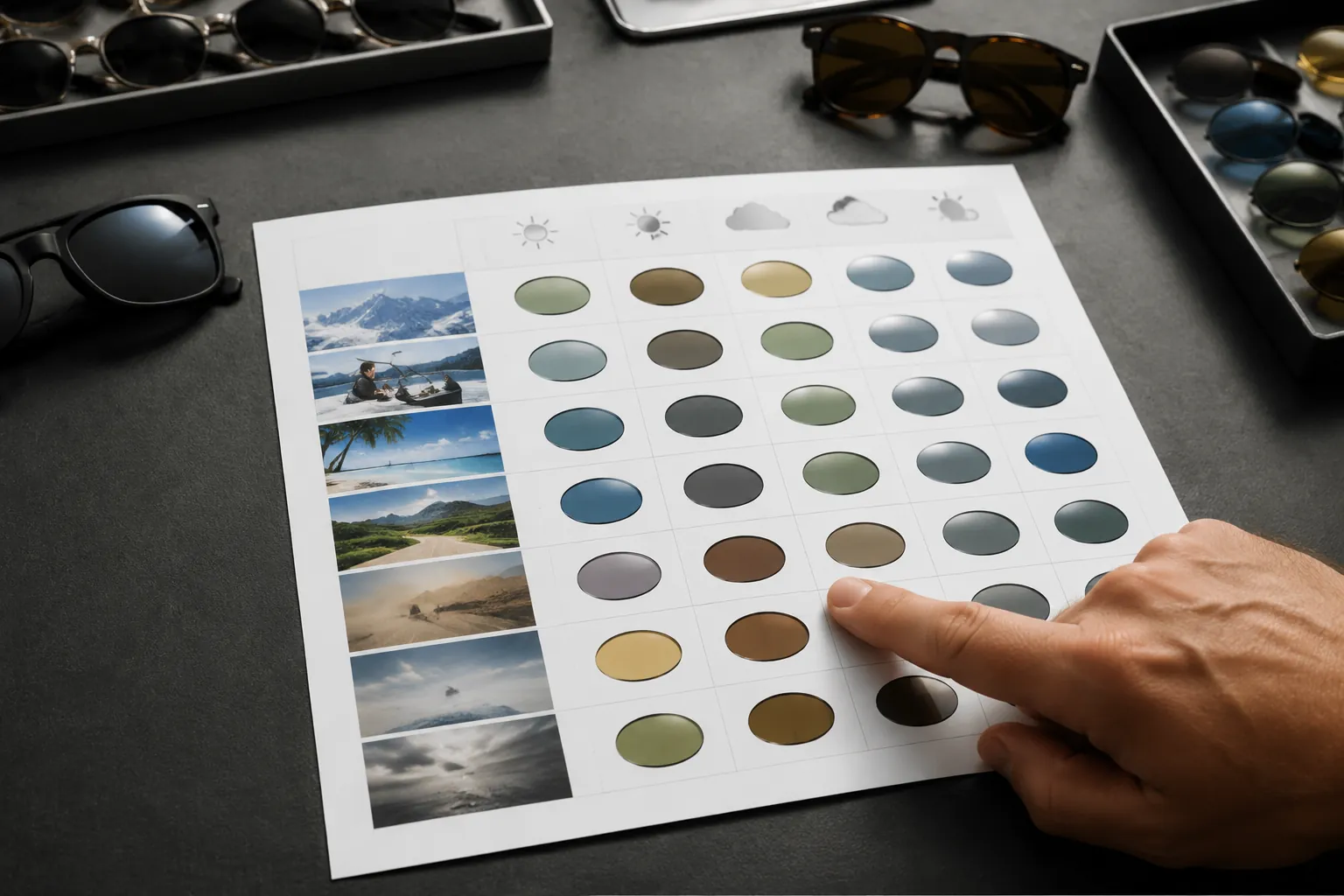
If you buy sunglasses in volume, tint choice is not a detail. It affects sell-through, complaint rates, and how much dead stock you carry into the next season. This guide is for brands, importers, distributors, and retailers that need to match polarized lens colors to climate and channel without guessing. It also shows where factory capability, testing, and MOQ reality matter.
Start with the job the lens must do
Polarized sunglasses are often sold as if lens color is only a styling choice. It is not. Tint changes perceived brightness, color balance, and how well the product fits the use case. A buyer in Florida, Queensland, or southern Spain does not shop the same way as a buyer in northern Europe.
The rule is simple: the stronger the sun, the more your assortment should lean toward darker, higher-coverage options. In urban retail and fashion channels, you need more neutral tints and mirror finishes because the buyer often chooses by look first. In outdoor and sport-heavy channels, function wins. If the channel expects road use, water use, or high-glare conditions, the tint needs to support that use case. Not just look good on a card.
At factory level, this decision needs to happen early. Lens tinting is not the same as spraying a frame. In-house tinting helps keep color batches tight and reduces mismatch between sample and bulk. LumiShades does injection molding, acetate cutting, CNC milling, lens tinting, decoration, and QC in-house. That matters if you want a stable color program across a few core SKUs instead of a random mix of one-off styles.
The practical goal is simple: keep the SKU count low enough to manage inventory, but broad enough to cover the main weather and channel buckets. That is how you avoid overbuying a color that looks nice in a catalog and then sits in the warehouse.
Build your tint map by climate, not by taste
Climate affects how a tint performs in the hand. Buyers in hot, bright markets want stronger glare control and darker perceived transmission. Buyers in overcast markets often prefer lighter tints because very dark lenses can feel heavy on cloudy days and reduce repeat purchase.
| Climate / use case | Recommended tint direction | Why it sells | Common mistake |
|---|---|---|---|
| Hot, high-UV, bright outdoor markets | Grey, green, brown, mirrored variants | Controls brightness and feels serious for daily wear | Choosing fashion tints that look good in photos but feel too light outside |
| Coastal and water-heavy regions | Grey or brown with mirror | Good glare management on reflective surfaces | Ignoring mirrored back reflection and lens finish quality |
| Cloudier urban markets | Light to medium grey, light brown, muted fashion tints | Better for all-day wear and mixed conditions | Overstocking very dark lenses that feel too harsh |
| Sport / outdoor work channels | Grey, brown, or green polarized lenses | Practical, familiar, low complaint risk | Mixing fashion tints into a function channel |
Grey is the safest default. It keeps color perception relatively neutral. Brown boosts contrast in many outdoor settings, especially if your customer values depth perception and terrain detail. Green sits between grey and brown and still works as a mainstream choice for classic frames.
Strong fashion tints can work, but only in the right channel. Beach shops, lifestyle boutiques, and influencer-led online stores can move blue, pink, or gradient lenses. In wholesale distribution, those same colors may underperform unless the frame shape and channel match closely.
Channel strategy: one lens does not fit every buyer
Different sales channels buy sunglasses for different reasons. That sounds obvious. Still, most dead stock comes from ignoring it.
- Mass retail: keep the assortment tight. One or two core polarized tints, usually grey and brown. Buyers want low risk, easy replenishment, and few returns.
- Sport and outdoor retail: prioritize function. Grey, brown, and green are easier to sell than decorative colors because staff can explain the use case fast.
- Fashion boutiques: you can widen the color range, but the frame shape has to carry the design. Here, tints can be a selling point if packaging and merchandising are clean.
- E-commerce DTC: use a narrow hero assortment. Too many lens colors create choice paralysis and inventory fragmentation. Keep one core neutral tint, one warmer option, and maybe one seasonal variant.
Channel-specific pricing matters too. With LumiShades, MOQ starts at 50 pairs per design. Pricing improves at 300, 1000, and 5000+ pairs, with volume pricing down to about $2.10 per pair. That means a buyer should not build a 12-color lens program unless the channel can support the inventory. A better approach is to test two or three colors, then scale the winners.
For a retailer, the right lens choice is the one that turns. For a distributor, the right lens choice is the one that can be reordered without re-educating the market every season. Keep that in mind before chasing novelty.
Use a small core palette, then add one controlled wildcard
A practical polarized assortment usually starts with three core lens colors and one optional fashion color. That is enough to cover most markets without scattering stock.
- Core 1: Grey for neutral daily wear and broad channel compatibility.
- Core 2: Brown for contrast-focused outdoor use and warm-market retail.
- Core 3: Green for classic styling and legacy sunglasses programs.
- Wildcard: a seasonal fashion tint such as blue, pink, or gradient, used only where the channel can support it.
The wildcard should be a test item, not a default. Put it into a smaller buy, measure sell-through, and compare it with the core colors at the same frame price. Do not confuse social media attention with wholesale demand. They are not the same thing.
If you want tighter control, ask the factory for a tint sample set before bulk. LumiShades provides samples in 7-10 days and bulk production in 25-35 days. That timing lets you check color, density, and front/back reflection before you commit to a large order. On polarized lenses, small visual differences matter. A tint that looks acceptable under showroom lighting can look too dark or too flat in daylight.
For repeat programs, lock the lens spec in writing: tint target, polarization orientation, surface finish, logo decoration method, and packaging standard. That reduces disputes when you reorder six months later.
What changes in production: tint, coating, decoration, and QC
Lens color is not only a design choice. It has production consequences. Tint consistency depends on resin, dye concentration, immersion time or coating method, batch temperature, and QC checks. If a factory does not control these steps in-house, color drift shows up fast across a bulk order.
LumiShades runs in-house lens tinting and QC, which is useful for private label programs because the color and finish can be checked before shipment. The factory also handles laser engraving, pad printing, and metal logo plates, so you can keep the lens choice aligned with branding without sending parts to multiple vendors.
For buyers, the useful QC points are basic. Check lens left-right consistency, front tint uniformity, edge finish, polarization alignment, and logo placement. Ask for defect limits in writing. If you do not define acceptable variation, someone else will define it for you at packing time.
Material choice matters too. Acetate frames suit premium fashion positioning, while injection-molded frames are usually better for cost and scale. With CNC milling and acetate cutting in-house, a factory can support both short runs and larger replenishment orders. That makes it easier to keep the same tint program across different frame families.
Compliance: match the market before you ship
Compliance is not a box to tick after the order is placed. It affects what tint claims you can make and which markets you can enter. LumiShades states real certifications and registrations only: CE EN ISO 12312-1, FDA registration, ANSI Z80.3, AS/NZS 1067, REACH, ISO 9001, and BSCI.
For overseas buyers, the practical point is direct: check the destination market requirements before finalizing the lens spec. CE EN ISO 12312-1 applies to EU sunglasses. ANSI Z80.3 matters for the U.S. market, and AS/NZS 1067 matters for Australia and New Zealand. REACH covers restricted substances. FDA registration is part of U.S. regulatory handling, but it does not replace product testing or correct labeling.
Do not ask the factory to promise a certification it does not hold. That creates clearance risk and delays. Align tint, category, labeling, and test reports with the market before production starts. If you sell into multiple regions, keep a compliance matrix by SKU. It saves time. It also stops the sales team from mixing product claims that do not belong together.
How to buy the right mix without bloating inventory
The safest buying plan is to start narrow and build from actual sell-through. A typical first order might be 50 to 300 pairs per design for testing, then a second order at 300 to 1000 pairs once the winner is clear. That structure fits the MOQ and still gives room to compare tint performance across channels.
Use these controls:
- Limit tint count per frame: two core colors plus one test color is enough for most programs.
- Standardize lens base color across frame families: it reduces mismatch and simplifies reorders.
- Separate fashion and function channels: do not mix their forecast.
- Use sample approval before mass production: check tint, mirror effect, polarization, and logo placement under daylight, not only under warehouse lights.
- Track returns by reason: if buyers say "too dark," "too flat," or "color looks off," that tells you more than a sales report.
Most dead stock comes from trying to make one lens color do too much. If you sell into three channels, give each channel a different primary lens strategy. Keep the assortment boring where boring sells.
A simple buyer playbook for the next order
If you are planning a custom polarized sunglasses order, use this sequence. First, define the market and channel. Second, choose one neutral tint and one contrast tint. Third, decide whether the wildcard color is worth the inventory risk. Fourth, request samples and check them outdoors. Fifth, lock the compliance target before bulk.
For most buyers, the best setup is not complicated: grey for general use, brown for warmer light and contrast, and one controlled seasonal tint if the channel can support it. That keeps the buy manageable and improves repeat ordering.
If you are sourcing from Wenzhou, ask direct questions about tint consistency, turnaround, MOQ breakpoints, and which compliance standard each SKU is built to meet. LumiShades has been manufacturing since 2009, ships to 60+ countries, and reports 5M+ pairs per year with 98.5% on-time delivery. Those numbers do not matter by themselves. What matters is whether the factory can repeat the same lens spec six months later without drifting. That is the real test.
Buyer rule: pick the tint for the channel first, then decorate the frame. Reversing that order usually creates inventory problems.
Have a custom sunglasses project in mind?
Send us your styles, target market and quantities and we will return a detailed quote with MOQ, lead time and a sample plan.
Get a QuoteWhy source this from Wenzhou with LumiShades
Wenzhou in Zhejiang Province is widely regarded as China’s eyewear manufacturing capital, producing a large share of the world’s sunglasses. That concentration matters to buyers: a deep local supply chain for acetate sheet, hinges, lens blanks, plating and packaging means shorter component lead times, easier color and material matching, and a workforce with decades of eyewear-specific skill. LumiShades has manufactured in this ecosystem since 2009, and our vertical integration — in-house injection molding, acetate cutting, CNC milling, lens tinting, decoration and quality control — means no part of your order is quietly subcontracted to a workshop you cannot audit.
For international buyers, that vertical control translates into accountability. When a single factory owns every step, defects are traced and fixed at source rather than bounced between vendors, and your specifications survive intact from first sample to bulk. We back this with 15+ years of experience, shipments to 60+ countries, more than 5 million pairs produced per year and a 98.5% on-time delivery rate. Our certifications — CE EN ISO 12312-1, FDA registration, ANSI Z80.3, AS/NZS 1067, REACH, ISO 9001 and BSCI audit — mean the compliance documentation your market requires already exists. Explore our manufacturing capabilities and quality control process to see how this works in practice.
Frequently asked questions
What are the safest polarized lens colors for a first wholesale order? Grey and brown. They are the easiest to sell across mass retail, outdoor, and e-commerce channels, and they create fewer complaints than fashion tints.
How many lens colors should I stock per frame model? Usually two core colors and one test color. More than that only makes sense if the channel has proven demand and the inventory system can handle it.
Does a darker lens always mean better sun protection? No. Darker tint changes perceived brightness, but compliance and UV performance depend on the lens construction and tested standard, not just visual darkness.
How fast can I get samples and bulk production? With LumiShades, samples are 7-10 days and bulk production is 25-35 days, assuming the spec is final and materials are available.
Which compliance standard should I ask for? Match the destination market: CE EN ISO 12312-1 for EU, ANSI Z80.3 for the U.S., and AS/NZS 1067 for Australia and New Zealand. Also check REACH where relevant.
What MOQ should I expect for custom polarized sunglasses? LumiShades states 50 pairs per design MOQ. Pricing improves at 300, 1000, and 5000+ pairs, so the per-unit cost gets better as the run gets larger.
Ready to start?
Explore our round sunglasses or request a quote — our sales team replies within 12 hours.
Request a Quote