
Photochromic Polarized vs Polarized Lenses Wholesale
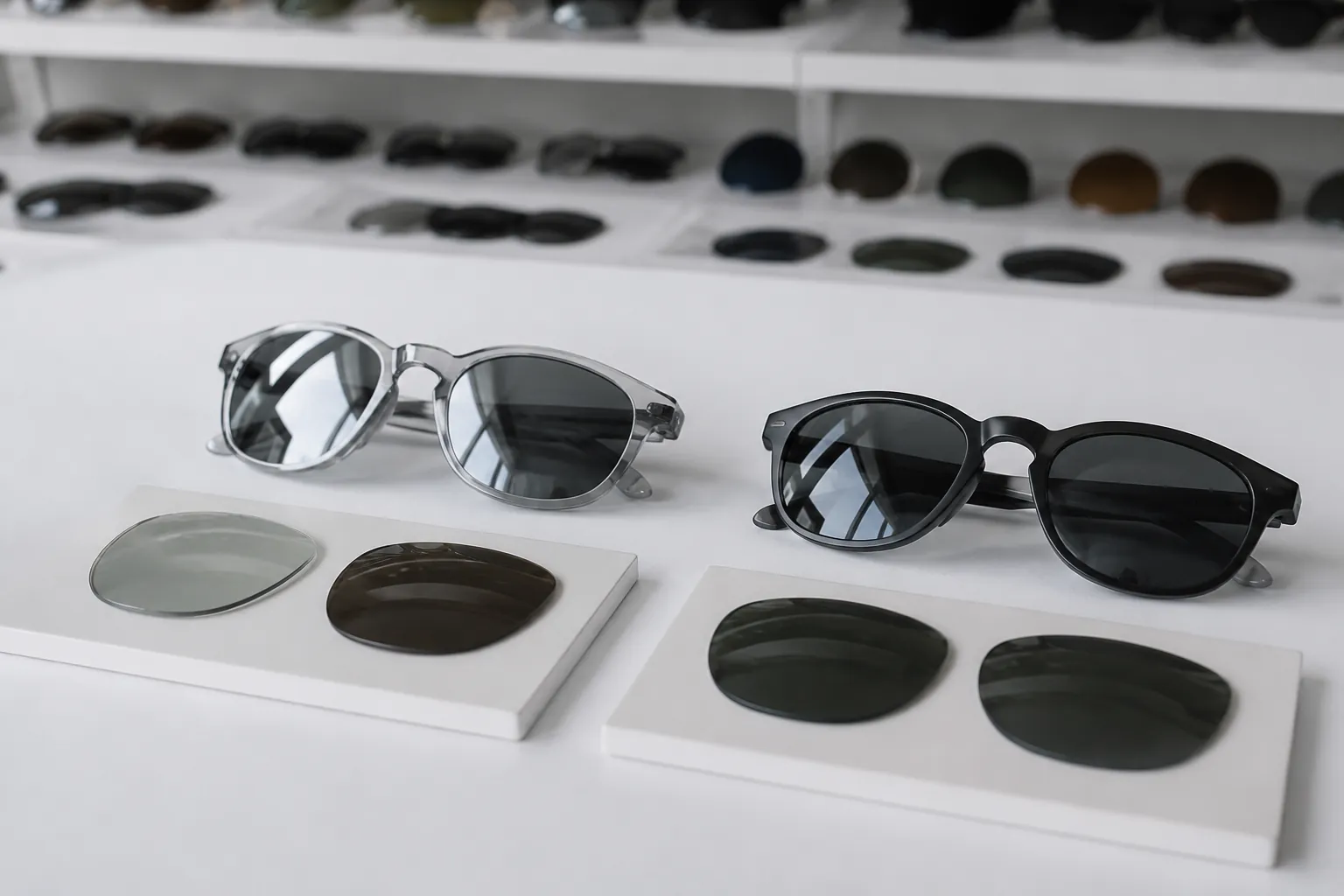
For volume sunglasses buyers, lens choice is not a small spec detail. It affects unit cost, sampling risk, lead time, compliance files, QC workload, and sell-through. This guide is for brands, importers, distributors, and retailers that need a practical buying plan. It explains where photochromic-polarized lenses can justify a higher price, where standard polarized lenses are the safer commercial choice, and what to confirm with your factory before issuing a PO.
What each lens setup does
Polarized lenses and photochromic-polarized lenses solve different problems. Treat them as separate product choices, not simple finish options.
Standard polarized lenses use a polarization film in the lens stack to reduce glare from horizontal reflections on roads, water, snow, glass, and other flat surfaces. The benefit is easy to explain: less glare and better visual comfort in bright outdoor settings. The tint and polarization axis are fixed, so performance should stay consistent when production is controlled well.
Photochromic-polarized lenses combine polarization with a UV-responsive lens that darkens in ultraviolet exposure and becomes lighter when UV exposure drops. The wearer gets glare reduction plus light adaptation in one pair. Good idea. More variables. Performance depends on the lens formula, UV conditions, frame coverage, and even whether the wearer is behind a vehicle windshield.
Production is also less forgiving. Photochromic-polarized lenses require tighter control of material selection, tint matching, activation behavior, fade-back behavior, and left-right lens matching. If these controls slip, the approved sample may not match the bulk run. Worse, the left and right lenses may not match each other.
So the buying question is simple: do you need stable glare reduction at the lowest practical cost, or a higher-value lens that supports changing light conditions and a premium retail story? The answer depends on channel, climate, price point, and how clearly the end customer understands the benefit.
Where each lens sells best
Channel fit matters as much as lens specification. A technically stronger lens can still sell poorly if the buyer does not understand why it costs more.
- Standard polarized: a strong fit for driving, fishing, marine, golf, promotional programs, and mass retail because the value proposition is direct: glare reduction.
- Photochromic-polarized: a better fit for travel, outdoor lifestyle, cycling, hiking, commuter eyewear, and optical-style assortments where one pair needs to work across changing light.
- Mixed assortments: useful when you want a clear entry-to-premium ladder, with standard tinted or standard polarized as the base and photochromic-polarized as the upsell.
Climate changes the decision. In markets where customers move often between shade and direct sun, photochromic-polarized lenses can make sense because the light adaptation is visible and useful. In beach, boat, and driving-led programs, standard polarized often performs better commercially. The buyer wants reliable outdoor glare control and may not pay extra for transition behavior.
Use this rule: if the customer is shopping mainly on price, standard polarized usually has the cleaner sell-through profile. If the customer is shopping on convenience and all-day wear, photochromic-polarized gives you a stronger upsell story.
For private label or own-brand retail, the lens type should match the shelf plan. A single-SKU outdoor program usually benefits from a simple polarized lens. A tiered program with enough margin room can use photochromic-polarized as a premium anchor SKU, especially when the frame design is versatile and the sales team can explain the benefit fast.
Cost logic and MOQ planning
Price is not driven by lens material alone. Setup, yield, inspection time, decoration, packaging, and rework risk all affect landed cost. This is especially true at lower MOQs.
At LumiShades, the stated MOQ is 50 pairs per design, with price breaks at 300, 1,000, and 5,000+ pairs. A buyer can test a design with a small run, but unit price usually improves once setup, QC, and packing costs are spread across larger volume. On repeat programs, pricing can improve depending on frame material, lens specification, logo work, and packaging. Photochromic-polarized lenses usually cost more than standard polarized lenses because the lens stack is more complex and the process needs tighter control.
The cost difference is not just the lens. It also comes from more inspection steps, higher first-run scrap risk, and extra checks for UV response and fade-back behavior. A standard polarized lens may need alignment, transmission, tint, and visual checks. A photochromic-polarized lens may also require activation testing under a defined UV source. At a low MOQ, a small rejection rate can change the real unit cost quickly.
Colorway logic matters too. One base design may quote cleanly. Multiple lens colors, frame colors, or logo versions can add handling steps or separate QC requirements. If you need several variants, confirm whether they count as one design family or separate MOQ items.
| Option | Typical buyer use | Cost logic | Trade-off |
|---|---|---|---|
| Standard polarized | Driving, fishing, mass retail | Lower material cost and simpler QC; easier to scale into repeat volume | No light-reactive tint change |
| Photochromic-polarized | Travel, outdoor lifestyle, premium retail | Higher lens-stack cost, more verification steps, and higher first-run complexity | Better light adaptation, higher unit price |
| Non-polarized tinted | Fashion-led or price-led programs | Lowest cost and simplest production path | No glare reduction; weaker outdoor performance |
If your retail price band is tight, do not put photochromic-polarized lenses into every frame or color. Use them on the SKU that can carry the margin. Keep the rest of the range simpler, sharper, and easier to reorder.
Lead time, process, and quality risks
Lead time depends on how stable the spec is before production starts. For custom sunglasses, samples typically take 7-10 days and bulk production takes 25-35 days when the design, lens spec, decoration method, and packaging are approved before mass production.
In an in-house workflow, a supplier may handle injection molding, acetate cutting, CNC milling, lens tinting, decoration, and QC under one roof. That can reduce handoff risk. Lens issues often appear between process steps. A frame can look correct on paper but still create distortion if the lens curve, groove depth, or bevel does not match the lens stack thickness.
A good factory should check lens seating, temple alignment, final wrap, and edge stress. The lens should fit cleanly. It should not be pinched. It should not rattle.
For polarized products, key checks include polarization axis alignment, tint consistency, surface clarity, and the absence of visible stress marks or unwanted optical effects. For photochromic-polarized products, the supplier should also verify activation response and recovery behavior under a defined test setup. The target is batch consistency and left-right lens consistency, not perfect behavior under every possible light source.
- Confirm the exact lens type, base tint, and target visual appearance before sampling.
- Approve the frame front curve and lens seating tolerance so the lens is not pinched or loose.
- Check polarization orientation and glare reduction in real outdoor light.
- Test photochromic activation and recovery with a defined UV exposure routine.
- Lock decoration only after lens behavior is approved so late artwork changes do not affect the lens build.
Quality usually slips in predictable places: unmatched base tint, uneven photochromic response, weak left-right matching, or missing cycle checks on first runs. A lens may look right at first and drift after repeated exposure. Ask for batch-level confirmation, not only one approved sample pair.
Compliance and buyer documents
Compliance is not paperwork to chase after shipment. It should be tied to the exact lens type, final frame, destination market, and buyer channel.
The certifications and standards commonly requested for sunglasses programs include CE EN ISO 12312-1, ANSI Z80.3, AS/NZS 1067, REACH, FDA registration, ISO 9001, and BSCI. Use the documents that apply to your destination market and your buyer's compliance checklist.
CE EN ISO 12312-1 is central for sunglasses sold in many European channels. ANSI Z80.3 is relevant for U.S. sunglass performance expectations. AS/NZS 1067 applies to Australia and New Zealand. REACH covers chemical substance control and can apply to materials, coatings, and added treatments. FDA registration is part of the U.S. market access process, but it does not mean every SKU is automatically approved for every channel.
The report must match the final build. A dark gray polarized lens and a photochromic-polarized lens may not share the same validation scope, even if the frame is identical. If the lens material, coating stack, or color tone changes, assume the compliance file may need review.
Before mass production, ask for the full document set, including test scope, lab name, issue date, and SKU description used in the report. If you sell through a retail chain, marketplace, or importer with its own review process, this step can prevent weeks of back-and-forth after shipment.
Ask for the compliance file before mass production, not after shipment. A document issue is easier to fix at the factory than at destination.
Design choices that affect sales
Many wholesale buyers focus on lens type and ignore the full frame-lens system. That is risky. Real performance depends on the complete build.
Photochromic-polarized lenses need enough UV exposure to activate as intended. Deep wraps, heavy brow coverage, and some vehicle windshields can reduce the UV reaching the lens surface. The result may be slower or less visible activation. Standard polarized lenses are more predictable in these settings because they rely mainly on polarization alignment and stable tint, not UV-triggered change.
Frame material also changes production behavior. Injection-molded frames are often the easiest route for repeat volume because they offer strong dimensional consistency and better cost control. Acetate can support a more premium retail position, but the lens cut, bevel, and seating tolerance need closer attention. If the front curve is too aggressive or the eyewire groove is shallow, the lens can show edge stress, distortion, or fit issues.
For wholesale sunglasses, the goal is consistent lens seating across the batch. The lens should sit flush, stay secure, and assemble without excessive force. The factory should check symmetry, even pressure, and stable alignment after decoration and final assembly. If the lens system sits near the edge of spec, color and optical results are more likely to drift during production.
Decoration can also affect sell-through and durability. Laser engraving, pad printing, hot stamping, and metal logo plates carry different risks. Pad print is fast and flexible but can wear if placed where hands or cleaning cloths rub often. Laser engraving is durable on certain materials but can expose contrast variation if the frame finish is thin. Metal plates can add perceived value, but they may create weight or fit issues if placed too close to the hinge or if they force a late tooling change. For photochromic-polarized builds, finalize artwork early. Late structural changes add risk.
What to order by buyer type
Your channel should decide the lens, not the other way around. Build the order around who buys from you, how they sell, and how often they reorder.
- Brands building a core outdoor line: start with standard polarized. It is easier to price, easier to explain, and easier to replenish when demand is steady.
- Importers serving mixed climates: add photochromic-polarized as a premium SKU only if retail buyers clearly want one-pair utility across changing light.
- Distributors selling to optical or outdoor stores: stock both, but keep photochromic-polarized limited to a few proven frame shapes that already sell well.
- Retailers running private label programs: test polarized first, then introduce photochromic-polarized as an upsell once sell-through data supports the higher ticket.
If it is your first order, keep the structure simple. One strong polarized program tells you more about supplier control than three weak variations. You learn whether the factory can hold color, curve, assembly, decoration, and packaging consistently. Once that baseline is proven, you can add the more complex lens type with lower risk.
A practical assortment is often one core polarized shape in two or three lens colors, plus one photochromic-polarized hero SKU if the market can support it. That keeps buying manageable and avoids tying up cash in too many slow-moving variants.
Practical order checklist
Before you send a PO, confirm the details that affect cost, fit, compliance, and sell-through. Small misses become expensive later.
- Confirm the exact lens type: standard polarized, photochromic-polarized, or both.
- Ask for the base tint, activation behavior, and recovery behavior on photochromic items.
- Lock the MOQ, the price break ladder, and whether mixed colors count toward one design.
- Request the compliance set for your destination market: CE EN ISO 12312-1, ANSI Z80.3, AS/NZS 1067, REACH, FDA registration, ISO 9001, and BSCI, as applicable.
- Approve a sample in real sunlight and shade, not only under indoor lighting.
- Confirm the decoration method, logo placement, and any lens-care instructions before bulk production.
- Ask how the factory checks polarization axis, tint uniformity, and left-right match during QC.
If your supplier handles molding, cutting, tinting, decoration, and QC in house, that can reduce handoff risk because fewer steps move between vendors. Still, do not rely on the claim alone. Ask how each step is controlled for your SKU.
For buyers moving from test order to repeat volume, use a simple path: sample first, confirm fit and lens performance, then place bulk once the approved sample matches the intended channel. After the first run, review sell-through. If the photochromic premium earns its space, scale it. If not, keep standard polarized as the volume driver.
Have a custom sunglasses project in mind?
Send us your styles, target market and quantities and we will return a detailed quote with MOQ, lead time and a sample plan.
Get a QuoteWhy source this from Wenzhou with LumiShades
Wenzhou in Zhejiang Province is widely regarded as China’s eyewear manufacturing capital, producing a large share of the world’s sunglasses. That concentration matters to buyers: a deep local supply chain for acetate sheet, hinges, lens blanks, plating and packaging means shorter component lead times, easier color and material matching, and a workforce with decades of eyewear-specific skill. LumiShades has manufactured in this ecosystem since 2009, and our vertical integration — in-house injection molding, acetate cutting, CNC milling, lens tinting, decoration and quality control — means no part of your order is quietly subcontracted to a workshop you cannot audit.
For international buyers, that vertical control translates into accountability. When a single factory owns every step, defects are traced and fixed at source rather than bounced between vendors, and your specifications survive intact from first sample to bulk. We back this with 15+ years of experience, shipments to 60+ countries, more than 5 million pairs produced per year and a 98.5% on-time delivery rate. Our certifications — CE EN ISO 12312-1, FDA registration, ANSI Z80.3, AS/NZS 1067, REACH, ISO 9001 and BSCI audit — mean the compliance documentation your market requires already exists. Explore our manufacturing capabilities and quality control process to see how this works in practice.
Frequently asked questions
Is photochromic-polarized always better than polarized? No. Choose photochromic-polarized only when your channel values light adaptation enough to support the higher price and added specification control. If the buyer mainly wants glare reduction, standard polarized is usually the better commercial choice.
What MOQ should I expect for custom polarized sunglasses? At LumiShades, the stated MOQ is 50 pairs per design. Price improves at 300, 1,000, and 5,000+ pairs, so ask for the full price break ladder before you quote your retail or wholesale price.
Will photochromic-polarized lenses slow production? They can, especially during sampling and first production, because the lens response needs to be checked in addition to fit, tint, and polarization. Manage this by locking the lens spec early, approving the sample in real light, and confirming the factory's activation and recovery test method.
Which certifications matter for export sunglasses? Use the certifications and standards that apply to your market and buyer requirements: CE EN ISO 12312-1, ANSI Z80.3, AS/NZS 1067, REACH, FDA registration, ISO 9001, and BSCI. Ask for the exact report scope so you can verify that the document matches the final SKU.
What is the safest first order if I am unsure? Start with one standard polarized SKU in a proven frame shape and verify color, fit, packaging, and sell-through. Add one photochromic-polarized SKU only if your channel can explain the premium and the order volume justifies the added complexity.
Ready to start?
Explore our aviator sunglasses or request a quote — our sales team replies within 12 hours.
Request a Quote