
Solid Tint vs Gradient vs Mirror Lenses by Channel
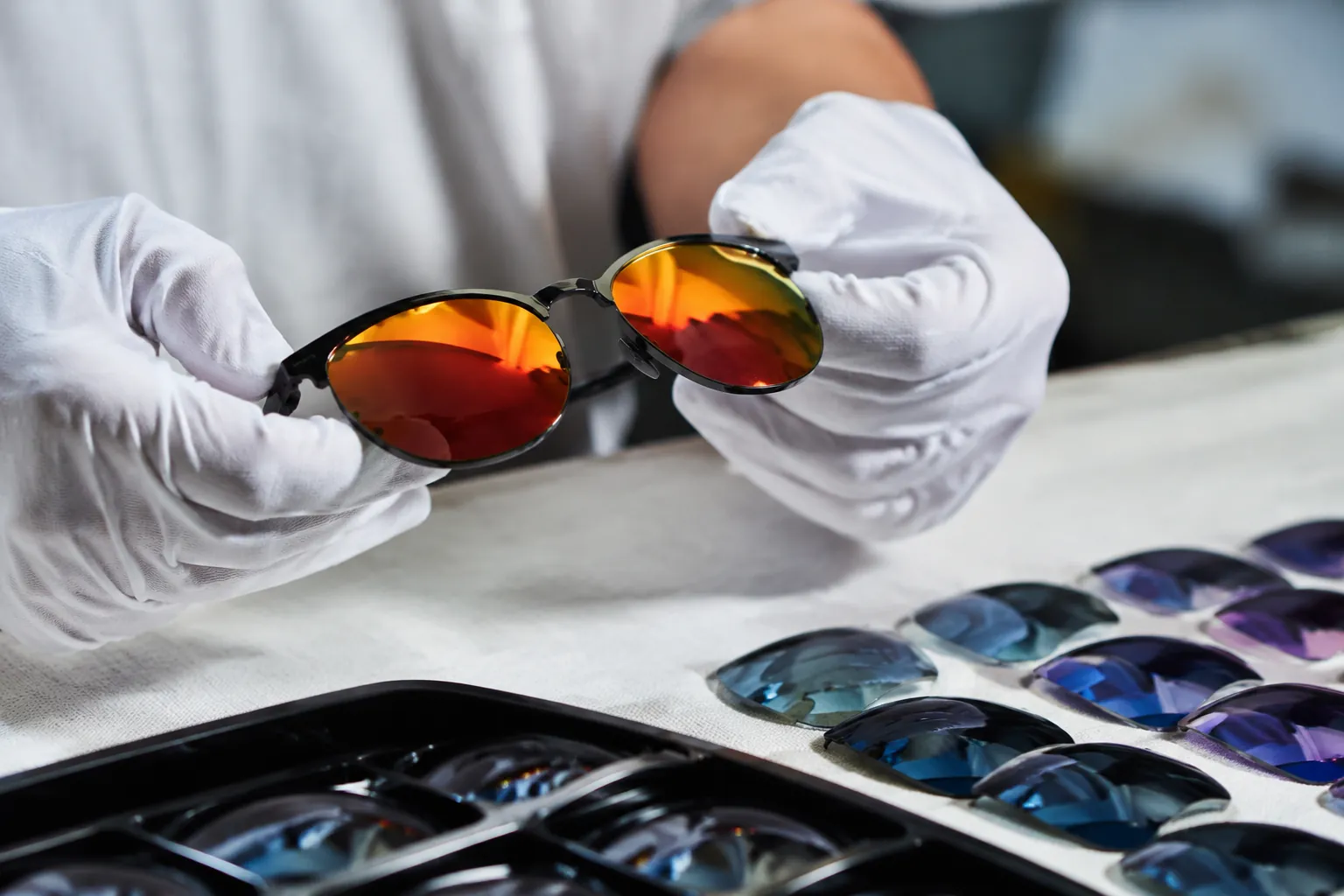
This guide is for brand owners, importers, distributors, and retail buyers choosing lens finishes for custom sunglasses programs. Pick the wrong finish and you can slow approvals, raise landed cost, increase complaint risk, and create confusion around claims and compliance. Pick the right one and the product fits the shopper, the selling environment, the price point, and the reorder model. Use the framework below to choose solid tint, gradient, or mirror lenses across retail, fashion, sports, promo, and travel programs.
Start with channel economics, not personal taste
Many buyers choose lens finish from a design sample under showroom lighting. That is a weak starting point for a commercial order. First ask which finish fits the channel's margin, return profile, replenishment pattern, and visual standard.
Solid tint is usually the lowest-risk option. It is easy to explain, easier to reproduce, and accepted across men's, women's, and unisex assortments. Gradient works best where shoppers try frames on in person and buy partly on looks. Mirror is the most channel-sensitive finish. It can sell well in sports, outdoor, youth fashion, and resort programs. It also creates more complaints if coating durability, color matching, or packing discipline is weak.
At factory level, the finish changes the process. A basic tinted lens typically goes through lens preparation, tinting or color application, hard coating where applicable, curing, visual inspection, edging, and assembly. A gradient lens adds tighter control over fade position and pair matching because the transition line is visible. A mirror lens adds a reflective coating layer and makes cleaning, handling, and packing more important because marks show fast.
So treat lens finish as a commercial decision. Not a style debate. If the line is built for replenishment, stable margin, and low returns, solid tint is usually the safest start. If the line is built for boutique or department-store sell-through, gradient may justify the extra approval work. If the product must stand out on a sports wall or summer display, mirror can earn the upcharge, but only if the coating spec and packing method are locked early.
A buyer's side-by-side comparison
| Lens finish | Best-fit channels | Commercial strengths | Typical risks | Cost and lead-time effect |
|---|---|---|---|---|
| Solid tint | Mass retail, core fashion, promo, travel basics | Broad appeal, easier color control, stronger reorder repeatability, fewer shopper questions | May feel too basic for trend-led launches if frame styling is simple | Usually the lowest-complexity option; often the easiest to approve and scale |
| Gradient | Fashion retail, department stores, boutique chains, women's assortments, travel lifestyle | Higher perceived style value, lighter visual effect on the face, strong fit for citywear and dressier looks | More subjective approval, visible fade variance, harder left-right pair matching | Usually adds process control and approval time compared with solid tint |
| Mirror | Sports, outdoor, resort, youth fashion, summer capsule programs | Strong shelf impact, high visual differentiation, effective on wrap and active frames | Scratch visibility, color variance, confusion between mirror and polarization, stricter packing needs | Usually the highest handling and finishing complexity of the three |
For most programs, the logic is simple. If the order needs broad distribution, clean replenishment, and low approval friction, start with solid tint. If the line needs more fashion value and the channel can support tighter visual approvals, consider gradient. If the product must stand out from a distance on an outdoor or summer display, mirror deserves a look.
Keep finish separate from actual product quality. None of these finishes makes a SKU premium by itself. Perceived quality comes from the full package: frame material, lens material, hard-coat quality, color consistency, logo execution, and packaging. A poorly coated mirror lens will generate complaints faster than a well-made solid smoke lens in a better frame.
- Lowest operational risk: solid tint.
- Best style upgrade for fashion channels: gradient.
- Highest display impact: mirror.
- Most stable for repeat orders: solid tint, then gradient, then mirror.
Where solid tint wins on MOQ, cost, and reorder control
Solid tint is the workhorse finish. It covers the widest range of use cases with the fewest production complications. Common commercial colors include smoke, brown, green, and green-grey tones. Shoppers know them. Retailers know them. That reduces friction at shelf level.
For private label programs, solid tint usually protects entry-level MOQ economics best because it avoids some of the approval sensitivity that comes with gradient and mirror. It also works across many frame styles without forcing the buyer into a trend-heavy look. If a buyer is testing a market, opening a new account, or building a core replenishment line, solid tint is usually the easiest place to begin.
Solid tint also fits standard branding and packaging combinations well. Buyers can pair tinted lenses with common logo methods, barcode labels, polybags, pouches, or basic cases while keeping production straightforward. Once the spec adds multiple appearance-sensitive elements at low quantity, such as custom mirror color, polarized construction, special logo hardware, and premium packaging, control gets harder.
From a QC standpoint, solid tint is simpler to inspect. Teams usually check lens shade consistency, visible light transmission target, surface defects, edge quality, left-right pair match, and frame-lens assembly fit. Variation can still happen. But there are usually fewer subjective calls than with gradient or mirror.
That makes solid tint the best default for core retail, distributor stock, travel basics, promo programs with practical budgets, and low-risk replenishment SKUs.
Where gradient earns the extra approval work
Gradient lenses sell best when customers buy with their eyes first. The darker top zone and lighter lower zone can soften how a frame looks on the face and suit citywear or women's styles well. In many boutique and department-store assortments, that visual lift is enough to justify tighter process control.
The challenge is approval. Gradient is not judged the same way as solid tint. Two batches can both sit within an acceptable transmission range and still look different enough for a buyer to reject one. Buyers notice more than darkness. They notice fade position, transition smoothness, left-right symmetry, and how the gradient works with frame size and lens curve.
On plastic lenses, gradient is commonly created through controlled color application before final finishing. The process is sensitive to time, temperature, concentration, angle, and fixture consistency. Small shifts in visible fade position may be acceptable on one program and unacceptable on another, depending on the approved standard. That is why a physical approval sample matters.
- Approve a physical counter sample, not only a phone image or render.
- Define the top shade, lower shade, and target fade height in writing.
- State whether the approval standard is appearance-first, transmission-first, or both.
- Request pre-production confirmation under neutral lighting before bulk assembly.
Gradient is especially strong in women's assortments, boutique retail, travel lifestyle collections, and department-store private label. It is much weaker in low-price promo programs, where the extra nuance is often lost and the budget is usually better spent on frame quality, branding, or packaging.
Plan for more approval time. Gradient does not always add major cost, but it often adds more discussion, more sample comparison, and a higher chance of revision before production starts.
Where mirror pays off and where it creates avoidable complaints
Mirror lenses work because they create instant visual impact. On a sports rack, summer end-cap, or resort display, a blue, silver, green, red, or gold flash coating can help a product stand out from several feet away. Mirror is especially effective on wrap frames, active shapes, youth-oriented fashion, and outdoor stories built around color and energy.
But mirror is also the easiest finish to overspec for the wrong channel. Buyers sometimes assume mirror means better performance, and shoppers often assume mirror means polarized. It does not. Mirror is a reflective surface treatment. It can sit on a non-polarized lens or on a polarized lens, and those are different constructions with different cost, durability, and claim implications.
Production risk is higher because the reflective layer shows defects more clearly. Light scratches, rub marks, coating haze, contamination before packing, or small left-right color differences are more visible than on basic tints. That is why good factories inspect mirror lenses carefully before assembly and again before final packing. Protective packing details matter here.
- Sports and outdoor: strong fit, especially for wrap frames and bright color stories.
- Seasonal fashion: useful for limited drops and summer capsules.
- Mass retail basics: often too trend-sensitive for core replenishment.
- Low-budget promo: usually not the first choice unless appearance impact matters more than long-term durability.
If the buyer wants mirror, define the coating level early. Ask whether the offer is mainly cosmetic mirror or whether it includes an upgraded coating spec. Confirm the approved color reference, the expected appearance under neutral light, and the packing method used to reduce abrasion in transit. Mirror can work well commercially. But only when finish, material, packaging, and channel promise match.
Compliance, materials, and decoration choices buyers should verify
Finish choice does not replace compliance. A mirror lens still has to meet the target market standard. A gradient lens still needs safe construction, correct labeling, and material compliance. Buyers importing into multiple regions should confirm the route before approving color, packaging, or product claims.
Relevant certifications and compliance references may include CE EN ISO 12312-1, ANSI Z80.3, AS/NZS 1067, REACH, FDA registration, ISO 9001, and BSCI. The practical rule is simple: do not assume a general certificate covers every SKU. Ask which reports, registrations, or management-system documents apply to the exact frame-and-lens construction being ordered, and check whether testing is current and market-relevant.
Material behavior matters as much as finish. PC lenses are common in lightweight sunglasses and active styles because they are widely used, impact-resistant, and easy to tint. Polarized lens constructions are common when glare reduction is part of the sales promise, but they add cost and require precise product claims. Lower-cost fashion lens options may suit some trend programs, but buyers should review scratch behavior, optical quality, and complaint risk before placing them into demanding channels.
Decoration decisions also affect risk and cost. Standard temple logo methods can include pad printing, screen printing, laser engraving, foil stamping, or metal logo inserts depending on the frame material. Simple one-color printing is usually the easiest to execute at lower volume. More complex logo hardware or packaging components may improve presentation, but they also add tooling, approval points, or lead-time pressure.
Every project should confirm at least these points:
- Lens category and transmission: suitable for intended sunwear use and destination market.
- Applicable standard: align CE EN ISO 12312-1, ANSI Z80.3, or AS/NZS 1067 with the target region.
- Chemical compliance: verify REACH or other required material controls for the destination market.
- Traceability: keep approved samples, test records, label files, and packing references by SKU.
This is not paperwork for its own sake. It reduces border delays, internal confusion, and disputes when a reorder happens months later and the original sample team is no longer involved.
How finish choice changes sampling, bulk timing, and price breaks
Lens finish affects the production calendar more than many first-time buyers expect. Solid tint is usually the easiest finish to approve quickly because the visual standard is simpler. Gradient needs closer visual confirmation because fade placement and pair matching are visible. Mirror often needs extra attention because coating color, reflectivity, and surface condition are easier to dispute if the sample reference is vague.
The basic commercial pattern is predictable. Small custom runs help with market testing, but unit cost is usually less efficient at low volume because setup, handling, and packing are spread across fewer pieces. As volume rises, buyers often gain better material efficiency, steadier production flow, and lower cost per pair, provided the specification stays controlled.
| Order stage | Solid tint | Gradient | Mirror |
|---|---|---|---|
| Sampling | Usually the fastest visual approval | Needs physical fade approval and clear appearance reference | Needs coating appearance approval and careful handling review |
| MOQ suitability | Usually the safest option for low-volume custom runs and broad assortments | Possible at low MOQ but more approval-sensitive | Possible at low MOQ but more sensitive to complaint risk and handling quality |
| Bulk control points | Shade consistency, surface defects, assembly fit | Fade position, top-bottom tone, left-right pair matching | Coating uniformity, scratch marks, pair matching, packing protection |
| Reorder stability | Highest | Moderate | Most sensitive to appearance variation |
Short version: if launch timing is tight, solid tint is usually the safest route. If the channel rewards visual refinement and margin can absorb more review time, gradient may be worth it. If the product must make a strong first impression in active or seasonal channels, mirror can justify the extra control points.
A practical selection framework by channel
Use finish selection across the full assortment, not one SKU at a time. Strong lines balance core volume, fashion interest, and trend risk instead of forcing every style into the same finish.
- Mass retail chains: Start with solid smoke, brown, or green on core shapes. Add gradient only where the customer clearly responds to a fashion update.
- Fashion boutiques and department stores: Build around solid plus gradient. Use mirror as a seasonal accent rather than the base of the line.
- Sports and outdoor: Start with solid or mirror depending on the price point and product promise. If the frame is performance-driven, mirror often makes more sense than gradient.
- Promo and event merchandise: Stay with solid tint unless campaign visuals require a flashier look. Put budget into logo visibility, basic compliance, and delivery reliability.
- Travel retail: Mix solid for core volume and gradient for style-led SKUs. Use mirror selectively for resort or holiday periods.
The most disciplined buyers also build with failure risk in mind. Core volume usually sits in solid tints because reorders are easier and appearance control is more stable. Fashion risk can sit in gradient because it can lift perceived value without becoming as sensitive as mirror. Trend risk usually sits in mirror because it is the most exposed to appearance variance and seasonality.
If you are entering a new channel, avoid launching every style with mirror lenses at once. Test a limited number of SKUs first, track sell-through and return reasons, and review any coating-related complaints before expanding the finish across a broader program.
That approach is not conservative. It is disciplined. It protects open-to-buy, reduces avoidable rework, and gives the buyer real channel evidence before scaling the finish across a larger line.
Have a custom sunglasses project in mind?
Send us your styles, target market and quantities and we will return a detailed quote with MOQ, lead time and a sample plan.
Get a QuoteWhy source this from Wenzhou with LumiShades
Wenzhou in Zhejiang Province is widely regarded as China’s eyewear manufacturing capital, producing a large share of the world’s sunglasses. That concentration matters to buyers: a deep local supply chain for acetate sheet, hinges, lens blanks, plating and packaging means shorter component lead times, easier color and material matching, and a workforce with decades of eyewear-specific skill. LumiShades has manufactured in this ecosystem since 2009, and our vertical integration — in-house injection molding, acetate cutting, CNC milling, lens tinting, decoration and quality control — means no part of your order is quietly subcontracted to a workshop you cannot audit.
For international buyers, that vertical control translates into accountability. When a single factory owns every step, defects are traced and fixed at source rather than bounced between vendors, and your specifications survive intact from first sample to bulk. We back this with 15+ years of experience, shipments to 60+ countries, more than 5 million pairs produced per year and a 98.5% on-time delivery rate. Our certifications — CE EN ISO 12312-1, FDA registration, ANSI Z80.3, AS/NZS 1067, REACH, ISO 9001 and BSCI audit — mean the compliance documentation your market requires already exists. Explore our manufacturing capabilities and quality control process to see how this works in practice.
Frequently asked questions
Which lens finish is safest for a first private label order? Solid tint is usually the safest first choice because it is the easiest finish to explain, approve, and repeat. For a first order, ask the supplier for 1) a physical approval sample, 2) the target lens color name and visible light transmission range, 3) the lens material specification, and 4) the applicable compliance route for the destination market. Keep the approved sample and written spec as the reorder reference.
Does a mirror lens automatically mean polarized? No. Mirror is a surface finish, not a polarization feature. A mirror lens can be non-polarized or polarized depending on the underlying lens construction. To avoid claim errors, make the supplier state the exact lens build on the quotation, sample approval, carton labels, and product-page copy. If polarization is required, ask for the polarization specification and test confirmation for the exact SKU.
Can gradient lenses meet the same compliance standards as solid lenses? Yes. Gradient, solid, and mirror lenses can all be compliant if the finished sunglasses are built and tested for the destination market. The buyer should confirm which standard applies to the SKU, such as CE EN ISO 12312-1, ANSI Z80.3, or AS/NZS 1067, and request documentation tied to the actual frame-and-lens combination rather than relying on a general factory statement.
How should I approve gradient color before bulk production? Approve a physical sample under neutral lighting and keep it as the master reference. In writing, define 1) the top shade, 2) the lower shade, 3) the target fade position, 4) whether left-right symmetry is appearance-critical, and 5) whether the final decision is based on appearance, transmission, or both. Before bulk assembly, ask for a pre-production confirmation against that approved sample.
What order quantity usually improves pricing meaningfully? Pricing usually becomes more efficient as volume increases because setup, handling, and packing are spread across more units. The exact breakpoints depend on frame material, lens construction, branding method, and packaging. Ask the supplier for a tiered quote by quantity using the same specification, and compare not only unit price but also sampling cost, tooling, packaging cost, and expected lead time so you can see where the commercial structure improves.
Ready to start?
Explore our square sunglasses or request a quote — our sales team replies within 12 hours.
Request a Quote