
Factory vs Trader for Sunglasses: A B2B Decision Guide
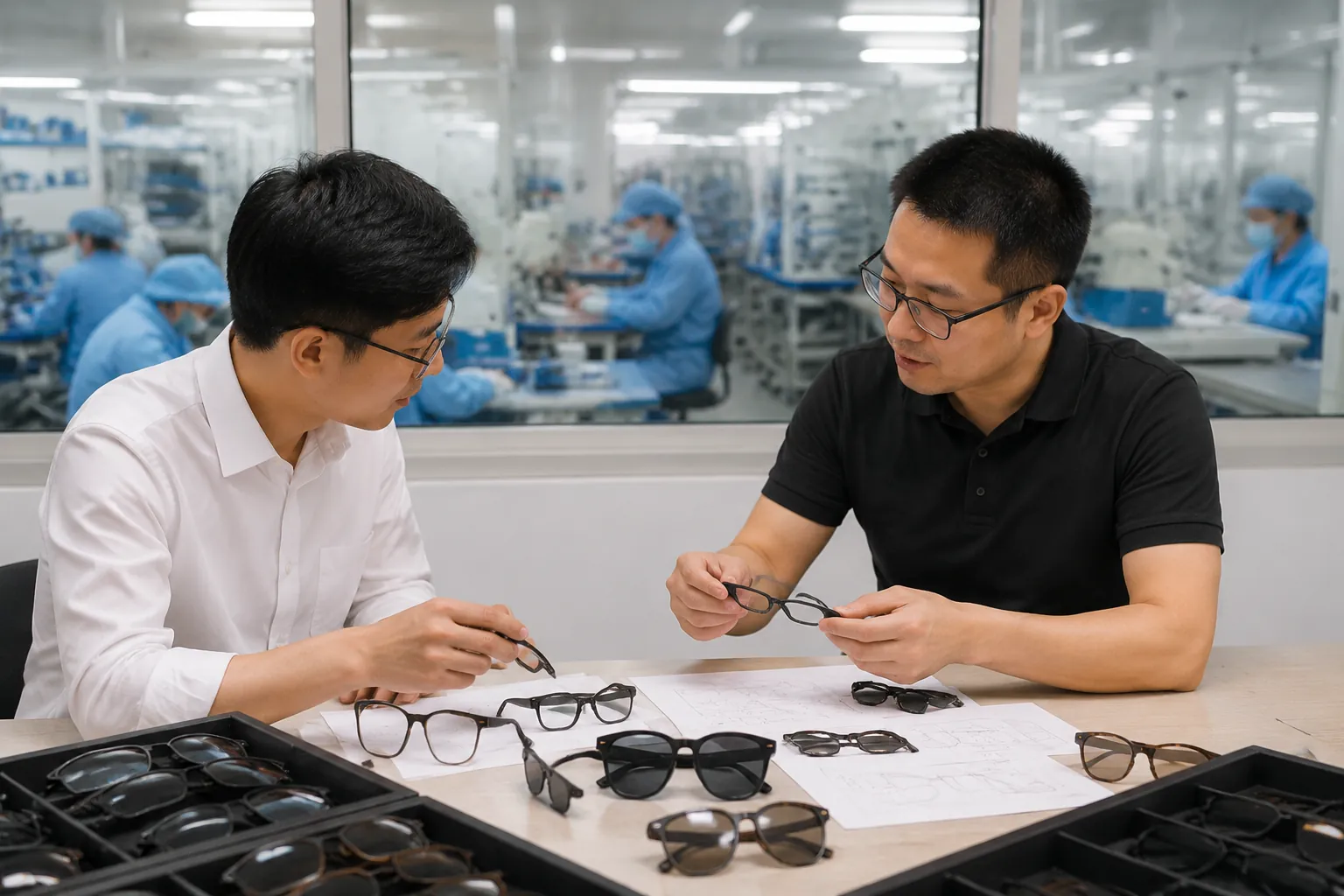
This guide is for brand owners, importers, distributors, and retailers buying sunglasses in volume. The goal is simple: help you decide whether factory-direct sourcing or a trading company better fits your order size, customization level, compliance risk, and internal buying capacity. The difference is not just margin. It affects how closely samples match bulk production, how fast technical issues are resolved, how clearly compliance documents map to the actual SKU, and who owns the problem when hinge alignment, lens category, logo position, or packaging specs drift. Two quotes may look similar. The real gap is usually in process control, traceability, and problem solving.
Start with the operating model, not the first quote
Many buyers compare unit price first and supplier structure second. In sunglasses, that often leads to the wrong choice. A factory and a trading company can both send a clean quote, but the operating model behind that quote decides who controls tooling, materials, process tolerances, testing samples, and corrective action after the order is placed.
A factory makes product. A trading company manages supply. Simple distinction. Big consequences. If a frame front warps after cooling, if lens fit is too tight, or if a metal logo sits off-center on the temple, the fastest answer usually comes from the team running production, not from an intermediary relaying messages.
That matters because sunglasses are not a one-part purchase. Frame material, lens material, hinge installation, surface finishing, printing, logo application, packaging, and final inspection all affect whether bulk production matches the approved sample. On injected frames, shrinkage and cooling can affect fit and symmetry. On acetate styles, cutting, polishing, and assembly consistency can change the final look and feel. Even basic decoration work can go wrong if alignment or surface prep is inconsistent.
For simple stock programs, either model can work. For custom development or quality-sensitive programs, factory-direct sourcing usually gives better visibility. Buyers can ask direct questions about materials, tooling status, finishing steps, inspection points, and change control. Start there. Not with the first price.
Use order size and SKU mix to narrow the choice fast
Volume changes the math. At low quantities, a trader can be efficient because they spread communication, coordination, and consolidation costs across multiple customers or factories. At medium and higher volume, the extra layer usually shows up in price, revision speed, and schedule control.
| Buying situation | Factory-direct fit | Trading company fit | What usually happens in practice |
|---|---|---|---|
| 50-200 pairs per design | Possible if the factory accepts small MOQs | Often strong | Trader may consolidate orders and place them with factories that prefer larger runs |
| 300-1,000 pairs per design | Usually strong | Still workable | Direct pricing often becomes easier to justify because setup and approval costs are spread across more units |
| 1,000-5,000 pairs per design | Best fit in many cases | Useful mainly for multi-factory coordination | Factory scheduling, material planning, and quality consistency matter more than convenience |
| Many SKUs at 50-150 pairs each | Can be inefficient | Often strong | Trader can consolidate small runs, packaging work, and shipment timing across styles |
The logic is practical. A small order still needs artwork review, sample approval, decoration setup, quality prep, and export documents. That work does not disappear because the quantity is low. As volume rises, those fixed tasks are spread across more units, which can improve the economics of buying direct.
In eyewear, suppliers often price by quantity breaks rather than a smooth curve. There is a reason:
- machine setup and color confirmation are spread across more units
- printing plates, laser files, or other decoration prep carry less cost per pair
- material purchasing can improve at larger lot sizes
- packing lines run more efficiently when one SKU stays on line longer
If you are testing several designs at low quantity, a trader may be the cleaner option. If one style is moving into repeat volume, direct factory communication often improves both cost and control.
Customization depth should decide who owns communication
Customization level is where supplier structure starts to matter. A stock sunglass with a simple temple print is not the same project as a new acetate shape with a custom wire core, a specific bevel profile, selected lens color, applied metal logo, microfiber pouch, and retail box set.
Buyers can divide projects into three bands:
- Low complexity: stock mold, standard lens option, simple print, standard pouch or plain box
- Medium complexity: custom color match, polarized lens option, laser engraving, foil logo, mixed packaging components
- High complexity: new tooling, acetate lamination selection, CNC detailing, embedded logos, strict hinge feel, multiple sample approvals
Why does this matter? Because every extra process adds another control point. Frame dimensions, lens fit, logo placement, polishing quality, and print alignment all affect whether bulk production matches the approved sample. Tolerance expectations also change by market position. A promotional style may allow more visual variation than a premium fashion program.
Factory-direct communication becomes more valuable as complexity rises because technical questions can be answered at the source. Buyers can confirm whether the logo is pad printed, foil stamped, laser engraved, glued, or inlaid; whether the lens is TAC, nylon, PC, acrylic, or another material; whether the hinge is standard or spring-loaded; and which steps are done in-house versus outsourced.
For low-complexity orders, traders are often capable coordinators. For medium- and high-complexity programs, direct access to engineering, production, and quality teams usually cuts revision loops and lowers the risk that an approved sample cannot be reproduced consistently in bulk.
Compliance is not a file. It is process control.
Many sourcing mistakes happen because buyers treat compliance as a document request instead of a production-control issue. In sunglasses, reports and declarations matter only if they match the exact build: frame material, lens material, filter category, surface treatment, labeling, and final construction.
Depending on the target market and product spec, buyers may need to review CE EN ISO 12312-1, ANSI Z80.3, AS/NZS 1067, REACH, or FDA registration status. These are not interchangeable. One document set does not automatically apply to every style or colorway. Change the lens category, material, or coating, and the review may change too.
Factory-direct sourcing often helps because traceability questions can be checked against the real bill of materials and production route. Serious buyers should confirm:
- the target market and the exact standard or regulatory requirement for that SKU
- the final frame material, lens material, filter category, and any coating or treatment before testing or document review
- that the tested sample matches the approved production construction
- that labels, warnings, and declarations match the destination market
- that any later material or process change triggers a compliance review
This is where weak supplier structures show up fast. If the supplier cannot map documents to the exact sunglass specification, or cannot explain which sample construction was used for testing, risk rises quickly. A disciplined trader can manage this well. But if compliance exposure is high, direct factory access is often safer because there are fewer gaps between paperwork and production reality.
Management-system and social-compliance documents such as ISO 9001 or BSCI can be useful signals of internal discipline, but they do not replace product-specific compliance review for sunglasses sold into regulated markets.
Lead time is really a control and bottleneck issue
Buyers often ask, "Who is faster?" Ask a better question: "Who controls the path to shipment?" A trader may answer emails quickly while still relying on factory capacity they do not control. A factory may communicate more directly, and if molding, cutting, lens processing, decoration, assembly, and QC are managed internally, the schedule is often easier to follow.
Lead time varies by product type, material, customization level, and packaging scope. There is no single reliable number for all custom sunglasses programs. A repeat order based on an existing mold and approved packaging can move much faster than a new project that includes fresh tooling, packaging development, or multiple sample revisions.
Ask the supplier to break the schedule into real process blocks:
- artwork review and sample confirmation
- tooling, CNC programming, or color matching
- frame production and polishing
- lens sourcing, cutting, tinting, or coating
- logo decoration and finishing
- assembly, inspection, packing, and export preparation
This matters because delays are rarely random. They usually sit in packaging approvals, material shortages, decoration rework, subcontracted processes, or overloaded finishing and inspection capacity. A supplier that can identify the likely bottleneck is usually more reliable than one that offers a short headline lead time without a process map.
A trader can add value if you need mixed products from several factories consolidated into one shipment. For a single sunglasses program, every extra communication loop can add delay when approvals, changes, or corrective actions are needed. That is why lead time should be judged as a control issue, not a sales claim.
Where factory-direct saves money, and where it does not
Factory-direct pricing is not automatically lower on every project. On small orders, a capable trader can sometimes compete because they pool demand, buy standard components more efficiently, and consolidate packaging or shipping work. But once the specification is stable and reorder potential is real, direct factory economics often improve.
The right cost comparison has four layers, not one:
- unit cost: frame, lens, hinges, decoration, packaging
- development cost: samples, tooling, engineering changes, testing samples
- quality cost: rejects, sorting, replacements, claims, corrective shipping
- management cost: communication load, inspections, document follow-up, delay handling
For a straightforward injected style at moderate volume, the gap between a trader and a factory may be small. At higher volume or on repeat orders, the extra layer usually becomes easier to spot because direct factories can adjust pricing based on purchasing leverage, line efficiency, and process stability.
Compare cost against expected reorder volume, not just the first pilot run. A low launch quantity can distort the decision if the real program is meant to scale. In eyewear, long-run cost is shaped heavily by setup recovery, repeatability, change control, and defect prevention, not only by the first line on the quote.
A practical risk screen before you place the PO
Good sourcing is less about chasing the cheapest opening quote and more about reducing the chance of an expensive surprise. Before placing a purchase order, run both factories and traders through the same risk screen.
| Risk area | Ask a factory | Ask a trader | Red flag |
|---|---|---|---|
| Specification control | Who signs off the BOM, color standard, and golden sample? | How are changes controlled across suppliers and versions? | Unclear answer on frame material, lens category, or approved sample ownership |
| Process visibility | Which steps are in-house: molding, acetate cutting, CNC, decoration, assembly, QC? | Which supplier makes each component and who coordinates them? | No clear process map or refusal to identify the production route |
| Quality system | What is checked in-line and what is checked before packing? | Who performs final inspection and against which standard? | Only generic "we check everything" language |
| Delivery reliability | What is the normal lead-time range for this product type and where do delays usually happen? | What is the fallback if one source or packaging vendor slips? | No contingency plan |
Ask for specifics, not slogans. What visual standard is used for logo position? How are lens scratches checked? Are hinge function and alignment reviewed before packing? Is carton marking verified against the PO and destination labels? Is final release based on a defined inspection method such as AQL or another agreed shipment standard?
If the supplier cannot explain defect prevention, change ownership, and the route from raw material to finished carton, take that as a warning whether they are a factory or a trader. Process maturity matters more than presentation.
The decision framework: choose factory, trader, or both
Use a simple rule set. Do not argue this in theory.
- Choose factory-direct if you need custom development, direct technical communication, stronger compliance traceability, more control over repeat programs, or better visibility into production and QC.
- Choose a trading company if you need many small mixed orders, several categories beyond sunglasses, one contact managing multiple suppliers, or support your internal sourcing team does not have.
- Use both if your assortment has two layers: core sunglasses sourced direct from a qualified factory, and smaller trial items, accessories, or fragmented replenishment handled by a trader.
For many buyers, the answer changes over time. Early-stage brands may start with a trader while they test shapes, packaging, and market response at low volume. Once one or two SKUs show stable demand and repeat orders become predictable, moving those core styles to factory-direct can improve cost control and product consistency. Larger importers often use both models on purpose: factory-direct for core volume and technical programs, trader-led sourcing for smaller mixed orders or category expansion.
Match the sourcing structure to the job. If the program is simple, fragmented, and low volume, a trader may be efficient. If the program is technical, repeatable, and quality-sensitive, direct factory access usually gives better control. That is the decision logic.
Have a custom sunglasses project in mind?
Send us your styles, target market and quantities and we will return a detailed quote with MOQ, lead time and a sample plan.
Get a QuoteWhy source this from Wenzhou with LumiShades
Wenzhou in Zhejiang Province is widely regarded as China’s eyewear manufacturing capital, producing a large share of the world’s sunglasses. That concentration matters to buyers: a deep local supply chain for acetate sheet, hinges, lens blanks, plating and packaging means shorter component lead times, easier color and material matching, and a workforce with decades of eyewear-specific skill. LumiShades has manufactured in this ecosystem since 2009, and our vertical integration — in-house injection molding, acetate cutting, CNC milling, lens tinting, decoration and quality control — means no part of your order is quietly subcontracted to a workshop you cannot audit.
For international buyers, that vertical control translates into accountability. When a single factory owns every step, defects are traced and fixed at source rather than bounced between vendors, and your specifications survive intact from first sample to bulk. For procurement review, buyers can request process records, approved samples, quality checkpoints and project-specific compliance files before placing a bulk order. Required testing and documentation are confirmed against the destination market and product specification rather than assumed from a generic certificate list. Explore our manufacturing capabilities and quality control process to see how this works in practice.
Frequently asked questions
Is factory-direct always cheaper for custom sunglasses? No. Factory-direct is not automatically cheaper on every order. For small runs, a trader may be competitive because they consolidate demand, place mixed orders, and absorb sourcing administration. To compare accurately, ask both sides for the same specification, packaging scope, Incoterm, sample cost, tooling cost, and inspection terms. Then compare not only unit price but also who controls revisions, who owns quality issues, and what pricing looks like if the style reorders at a higher volume.
What is the biggest advantage of using a trading company? Coordination. A capable trading company can manage small mixed quantities, multiple suppliers, packaging consolidation, and shipment planning through one contact point. That helps if you buy more than sunglasses, if your order is spread across many SKUs, or if your internal team does not have time to manage several factories directly. Before choosing a trader, ask which factories they use, how they control sample versions, who owns final QC, and how they handle a defect claim after shipment.
How should I verify compliance for my exact sunglass model? Start with the destination market, then confirm the exact build of the SKU. Record the frame material, lens material, filter category, coatings or treatments, labeling, and packaging marks. Ask the supplier to map the relevant documents or test reports to that exact construction, not to a similar style. If you sell into markets that require review against standards or regulatory requirements such as CE EN ISO 12312-1, ANSI Z80.3, AS/NZS 1067, REACH, or FDA registration status, verify that the sample referenced in the documentation matches the final production BOM. If the build changes later, review compliance again.
What lead times are realistic for custom sunglasses? There is no single reliable lead time for all custom sunglasses because timing depends on mold status, material availability, decoration method, packaging scope, and approval speed. The practical way to verify timing is to ask for a stage-by-stage schedule covering sampling, material confirmation, decoration setup, production, inspection, and packing. Also ask which steps are outsourced and which component is most likely to delay shipment. A supplier that can explain the critical path is usually giving you a more useful answer than one that offers a short generic promise.
When should I move from a trader to a factory? Usually when a style has repeat demand, the specification is stable, and direct control matters more than sourcing convenience. Common signs include more frequent reorders, tighter quality expectations, recurring document reviews, or repeated technical changes that are slow to relay through an intermediary. Before moving, confirm that the factory can handle your real volume, share a clear process map, support the required compliance documentation, and manage quality under a defined system such as ISO 9001 if that matters to your supplier approval process.
Ready to start?
Explore our round sunglasses or request a quote — our sales team replies within 12 hours.
Request a Quote