
Sunglass Hinge Strength: A Buyer's Guide
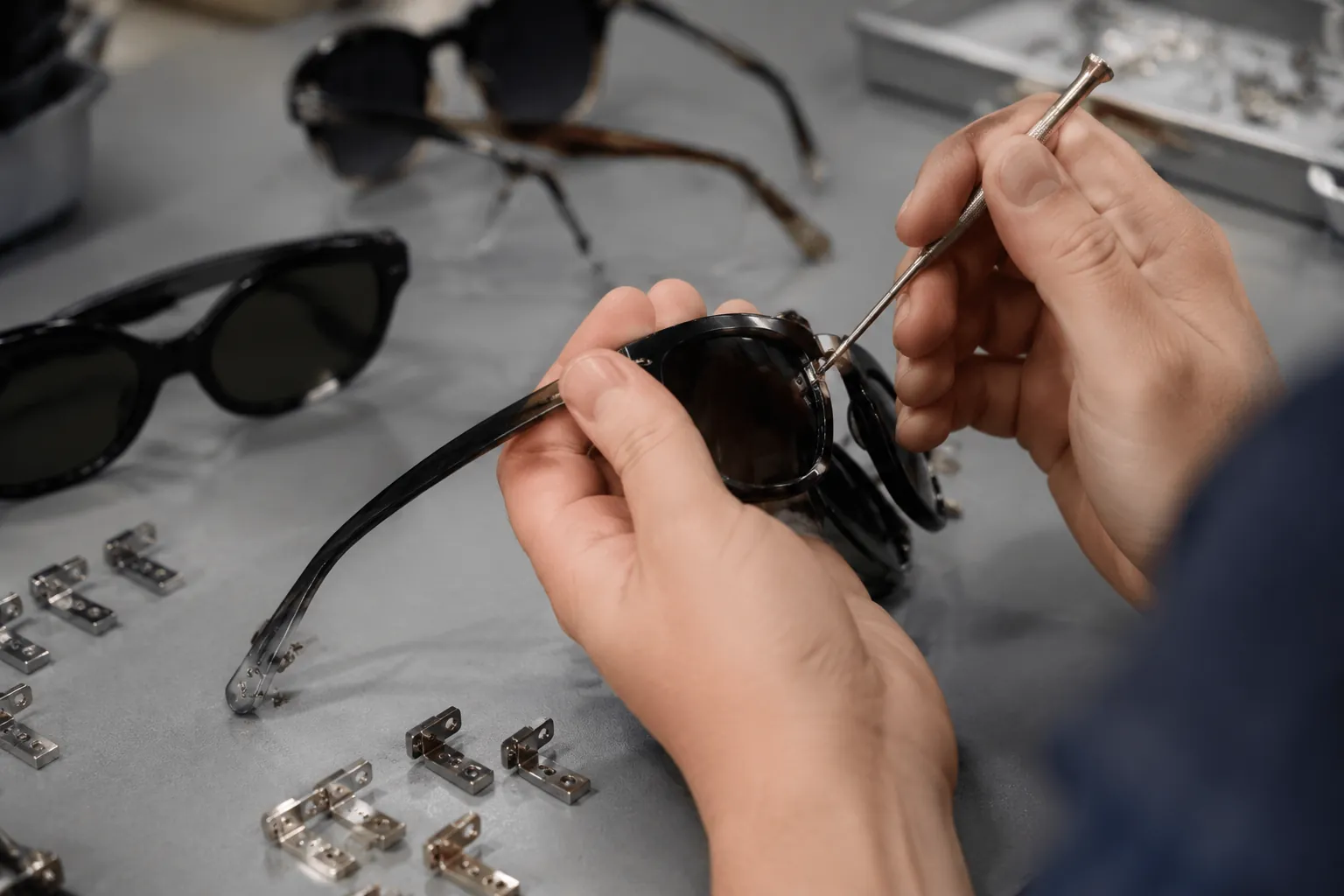
For brands, importers, distributors, and retailers buying sunglasses in volume, hinge choice is not a small detail. It affects returns, shipping damage, perceived quality, and reorder consistency. The right hinge depends on price band, frame material, temple geometry, and how the product will be handled after it leaves the factory.
Why hinge strength matters in volume programs
A hinge looks minor on a spec sheet. It is not. In production, it is one of the first places a weak frame fails. If the hinge is too light for the frame weight, temples loosen, screws back out, or the front cracks around the hinge area. If it is overbuilt, you add cost, weight, and assembly risk without gaining much durability.
In large-volume sunglass programs, hinge choice affects four practical things: resistance to handling damage, day-to-day opening feel, carton damage during shipping, and consistency across reorders. Buyers may not ask for torque data early. Complaints still tend to come back to hinge design, screw retention, or temple alignment.
A workable hinge spec should match the frame weight, temple length, and expected use. Do not choose it by habit. Some programs only need a standard hinge. Others need a spring hinge or heavier multi-barrel construction. The right choice is the one that supports the use case without adding cost or variation.
Review hinge selection with frame material, temple thickness, decoration method, and target price. A hinge that works on a heavier acetate frame may fail on a lighter injection molded style. The frame, hinge, screw, and barrel geometry have to work as one system.
The hinge constructions buyers actually use
Most sunglass programs use a small set of hinge types. The decision comes down to load, assembly speed, repeatability, and how much variation the factory can control.
| Hinge type | Typical use | Strength profile | Cost impact | Buyer note |
|---|---|---|---|---|
| Standard metal hinge | Basic injection molded or acetate frames | Adequate for light to medium duty | Lowest | Works well when screw control and barrel alignment are stable |
| Spring hinge | Mid-price retail sunglasses | Better flex and temple recovery | Moderate | Useful for comfort, but adds parts, assembly time, and QC checkpoints |
| Three-barrel or heavy-duty hinge | Thicker acetate or premium-looking programs | Higher resistance to twist and pull | Higher | Best when the front is heavier, wider, or sold with a stronger quality feel |
| Integrated injected hinge block | Low-cost molded frames | Depends on resin, wall thickness, and mold stability | Lowest to moderate | Tooling quality matters more than the hinge shape itself |
Standard metal hinges are often stamped from stainless steel or plated alloy and assembled with small screws. Spring hinges add a moving arm or tension element, helping the temple flex outward without forcing all stress into the front block. Three-barrel constructions spread load better and usually tolerate rougher handling, if barrel alignment is clean and temple thickness is consistent.
For acetate, the hinge block is usually fitted during milling and heat setting, then secured after the front is cut and polished. For injection molded frames, the hinge insert or molded hinge boss must carry the load without cracking the surrounding resin. In both cases, weak geometry around the hinge can fail faster than the hinge part itself. Tooling accuracy, wall thickness, and screw bite matter as much as the visible hardware.
Match hinge strength to frame material
Frame material sets the baseline. A heavier acetate front can usually support a more substantial hinge assembly. A light injection molded frame cannot hide poor barrel alignment, weak screw retention, or a boss that is too thin for repeated loading.
- Acetate frames: Usually support stronger hinges and more barrel count. The hinge area can carry more metal without feeling top-heavy, but the frame will show hinge misalignment quickly if milling is inconsistent or the hinge pocket is cut unevenly.
- Injection molded frames: Need stable wall thickness around the hinge zone. Over-tight screws can strip the boss, especially in softer resin systems. Underbuilt hinge areas can crack after repeated opening and closing or during abuse testing.
- Metal frames: Follow a different logic. The hinge is often part of a thin temple structure, so fit, solder quality, and fastening consistency matter more than hinge mass.
Each material carries a different risk. Acetate is durable, but it can chip if the hinge pocket is milled too aggressively or heat-set unevenly. Injection molded resin is efficient, but the hinge area is only as good as the mold design, cooling balance, and packing around the boss. Metal frames are thinner, so misalignment is obvious and a loose rivet or weak weld can become a field failure.
The sourcing question is not, "What is the strongest hinge?" It is, "What hinge is strong enough without pushing the frame into a higher cost bracket or creating assembly variation?" That is the decision that protects margin and quality.
Price bands and practical hinge specs
Hinge construction should follow the retail target. Not the other way around. If your landed target is near the low end, over-specifying the hinge hurts margin. If the program is sold on stronger perceived quality, a basic hinge may save cents but raise the risk of complaints later.
As a sourcing rule, a spring hinge usually costs more than a standard hinge because it adds parts, assembly steps, and inspection points. A heavier three-barrel build can also raise cost if the frame needs thicker milling, stronger screws, or more careful alignment. Set the hinge choice before the drawing is finalized.
| Target factory price | Practical hinge choice | Why it fits | Risk if you go cheaper |
|---|---|---|---|
| Below $2.00/pair | Standard metal or molded hinge | Keeps BOM and assembly time under control | Loose feel, higher screw loss, faster wear |
| About $2.10 to $3.20/pair | Standard metal with tighter barrel control or a light spring hinge | Balances cost and retail feel | Return risk if hinge alignment is not controlled |
| Above $3.20/pair | Three-barrel, spring, or reinforced hinge package | Supports stronger opening cycles and better perceived quality | Less margin if the hinge spec is not matched to use |
Lead time changes with hinge complexity. A standard hinge spec is usually easier for a factory to source and assemble than a custom spring hinge, special finish, or unusual barrel shape. For a promotional launch or seasonal reset, the issue is not only cost. It is also whether the chosen hinge parts are available and stable in production.
At lower quantities, MOQ pressure often comes from component sourcing and color matching rather than labor alone. A small hinge upgrade may work if the factory already has the parts and the process is stable. On a small test order, it is often better to keep the hinge simple and use the sample to validate fit, finish, and market response.
What to ask before hinge approval
Buyers often ask for samples without asking for enough build detail. That is how weak hinge specs reach production. Ask for the actual construction information, not a photo or a general quality promise.
Request the hinge drawing and confirm the key details: barrel count, barrel diameter, screw size, screw length, hinge opening angle, and whether the screw is nylon-patched, thread-locked, staked, or mechanically fixed. For most sunglass programs, the factory should be able to state a target opening angle that fits the frame geometry. Vague numbers usually mean vague control.
- How many barrels are on the hinge, and what is the barrel diameter?
- What screw size is used, and is thread lock, staking, or another retention method part of the process?
- What is the target opening angle?
- How is temple alignment checked before packing?
- What happens if hinge torque drifts during mass production?
On acetate programs, ask how the hinge is fitted after front cutting and milling. Confirm the pocket tolerance, heat-setting method, and whether alignment is checked before or after polishing. On injection programs, ask whether the hinge insert is molded in or assembled later. These routes behave differently in QC. A molded-in hinge can be efficient, but mold wear can push units off-center. A post-assembled metal hinge gives more adjustment, but assembly labor and screw control become more important.
Decoration can also affect the hinge area. Hot stamping, laser marking, pad print, and metal logo plates add process steps near the temple. Poor placement can crowd the hinge pocket or block screw access. Review hinge approval with decoration artwork, not after it.
Ask whether the factory operates under ISO 9001 and, where relevant, whether it has BSCI audit coverage. These systems do not guarantee product performance. They do show whether the supplier has structured process controls and records you can audit.
How to test hinge strength without overtesting
You do not need a lab program for every frame. You do need a sensible validation routine before bulk release. The aim is simple: catch weak joints, stripped screws, and poor temple symmetry before they become repeat defects.
For pre-production review, use a small but representative sample set from each relevant colorway, cavity, or hinge supplier batch. That is enough to catch obvious variation without turning approval into a certification project. If the program is large or the hinge is new, move to a short pilot run and inspect the first and last cartons separately.
- Open-close cycle check: Open and close the temples repeatedly by hand to see whether tension drops quickly or the temples begin to wobble.
- Torque feel: Compare samples from cavity to cavity or batch to batch. The hinge should feel similar across the run.
- Side-load check: Apply light lateral pressure at the temple. The front should not twist excessively.
- Packaging simulation: Confirm the hinge does not loosen after packing compression and carton vibration.
For tighter validation, define acceptance criteria in writing. Examples include no visible screw back-out after cycle checking, temple symmetry within a defined visual tolerance, and no cracking or whitening around the hinge area after side-load checking. If you need measurable tolerances, ask the factory to report temple angle symmetry, hinge centering, and torque consistency at QC instead of relying only on visual inspection.
For programs that need compliance support, keep the test scope tied to the target market. CE EN ISO 12312-1, ANSI Z80.3, AS/NZS 1067, REACH, and FDA registration may apply depending on the market, but they do not replace mechanical validation. A compliant lens system does not make up for a weak hinge. Treat the hinge as its own risk item.
Reorder consistency and process control
The real problem in large programs is often not the first order. It is the second and third. A buyer may approve a sample that feels fine, then receive a reorder months later that opens tighter, sits crooked, or uses a different screw finish. That creates claims. It also weakens trust.
Consistency starts with controlled process points. The factory needs stable tooling, the same hinge supplier or in-house parts, documented screw specifications, and a packing QC step that checks temple alignment before cartons are closed. If the frame is acetate, milling depth around the hinge must stay stable and polishing must not cut into the hinge pocket. If it is injection molded, hinge boss thickness, gate position, and mold wear need routine review.
Good factories track failure modes by batch. If a run shows loose torque, they should know whether the issue came from screw supply, contamination, plating variation, or one cavity drifting out of specification. That kind of root-cause control protects the reorder, not just the first sample.
Repeatability should be documented in the supplier's quality system. If the factory works to ISO 9001, ask how hinge checks are recorded at incoming, in-process, and final inspection. If it also has BSCI coverage, that can support broader supplier qualification. Product consistency still depends on manufacturing controls.
Buyer rules before PO release
If you need a fast decision, use this rule set.
- Choose a standard hinge for tight price programs and simple fashion sunglasses.
- Choose a spring hinge if the program needs better comfort or a stronger quality feel.
- Choose a heavier multi-barrel hinge for thicker acetate fronts, larger lens shapes, or premium positioning.
- Do not overbuild the hinge on a light injection molded frame unless the market really needs it.
- Lock the screw specification, barrel count, alignment check, and finish standard before bulk approval.
Also align hinge choice with MOQ and launch timing. If the order is small, prioritize stable processes and available parts. If the program is large, invest in a better hinge package, tighter inspection, and clearer drawing control. Defect cost compounds quickly at volume.
Before releasing the purchase order, confirm the hinge specification in writing. Small omissions cause big disputes later, especially when the first order works but the reorder drifts.
- Frame material and hinge type are named clearly.
- Barrel count, screw size, screw finish, and opening angle are specified.
- Sample approval includes temple alignment and opening feel.
- Bulk QC includes hinge torque, screw retention, and visual symmetry.
- Compliance documents match the target market, including CE EN ISO 12312-1, ANSI Z80.3, AS/NZS 1067, REACH, or FDA registration as needed.
- Supplier quality credentials such as ISO 9001 and, where relevant, BSCI are verified.
The bottom line: choose hinge strength with frame material, price point, lead time, and reorder risk in mind. For high-volume sunglasses, the cheapest hinge that survives real use is better than a fancy part that creates assembly variation. If you are sourcing from Wenzhou or any other production center, make the factory show the hinge specification and inspection method. A description is not enough.
Have a custom sunglasses project in mind?
Send us your styles, target market and quantities and we will return a detailed quote with MOQ, lead time and a sample plan.
Get a QuoteWhy source this from Wenzhou with LumiShades
Wenzhou in Zhejiang Province is widely regarded as China’s eyewear manufacturing capital, producing a large share of the world’s sunglasses. That concentration matters to buyers: a deep local supply chain for acetate sheet, hinges, lens blanks, plating and packaging means shorter component lead times, easier color and material matching, and a workforce with decades of eyewear-specific skill. LumiShades has manufactured in this ecosystem since 2009, and our vertical integration — in-house injection molding, acetate cutting, CNC milling, lens tinting, decoration and quality control — means no part of your order is quietly subcontracted to a workshop you cannot audit.
For international buyers, that vertical control translates into accountability. When a single factory owns every step, defects are traced and fixed at source rather than bounced between vendors, and your specifications survive intact from first sample to bulk. For procurement review, buyers can request process records, approved samples, quality checkpoints and project-specific compliance files before placing a bulk order. Required testing and documentation are confirmed against the destination market and product specification rather than assumed from a generic certificate list. Explore our manufacturing capabilities and quality control process to see how this works in practice.
Frequently asked questions
For a $2.10 factory target, should I use a spring hinge or a standard hinge? Start with a standard hinge unless the buyer brief calls for extra flex or a softer temple feel. A spring hinge can be right, but it adds parts, assembly steps, and QC points, so it should be justified by the product position.
What causes hinge failure most often in sunglasses? The most common causes are loose screws, poor barrel alignment, weak frame material around the hinge area, and a hinge spec that does not match the frame weight. In volume production, inconsistent assembly and inspection often make the problem worse.
How many pairs should I sample before bulk approval? Sample enough to see variation, not just one perfect pair. For a new hinge spec, review multiple samples from each cavity, colorway, or batch, and use a short pilot run when the hinge or supplier is new.
Can one hinge spec work for acetate and injection frames? Sometimes, but not usually. Acetate can carry more hinge weight and often supports more substantial construction. Injection molded frames need tighter control around the hinge boss and often perform better with a lighter, simpler hinge design.
Does a stronger hinge help compliance? No. Compliance requirements such as CE EN ISO 12312-1, ANSI Z80.3, AS/NZS 1067, REACH, and FDA registration are separate from mechanical durability. A strong hinge supports the product, but it does not replace the required test program.
What should I lock first in the drawing: hinge or lens? Lock the frame structure and hinge area together first, then finalize lens fit. If the hinge changes later, temple alignment and overall geometry can shift, which can affect fit and assembly stability.
Ready to start?
Explore our sport wrap sunglasses or request a quote — our sales team replies within 12 hours.
Request a Quote