
Sunglasses Branding Details That Affect Retail Readiness
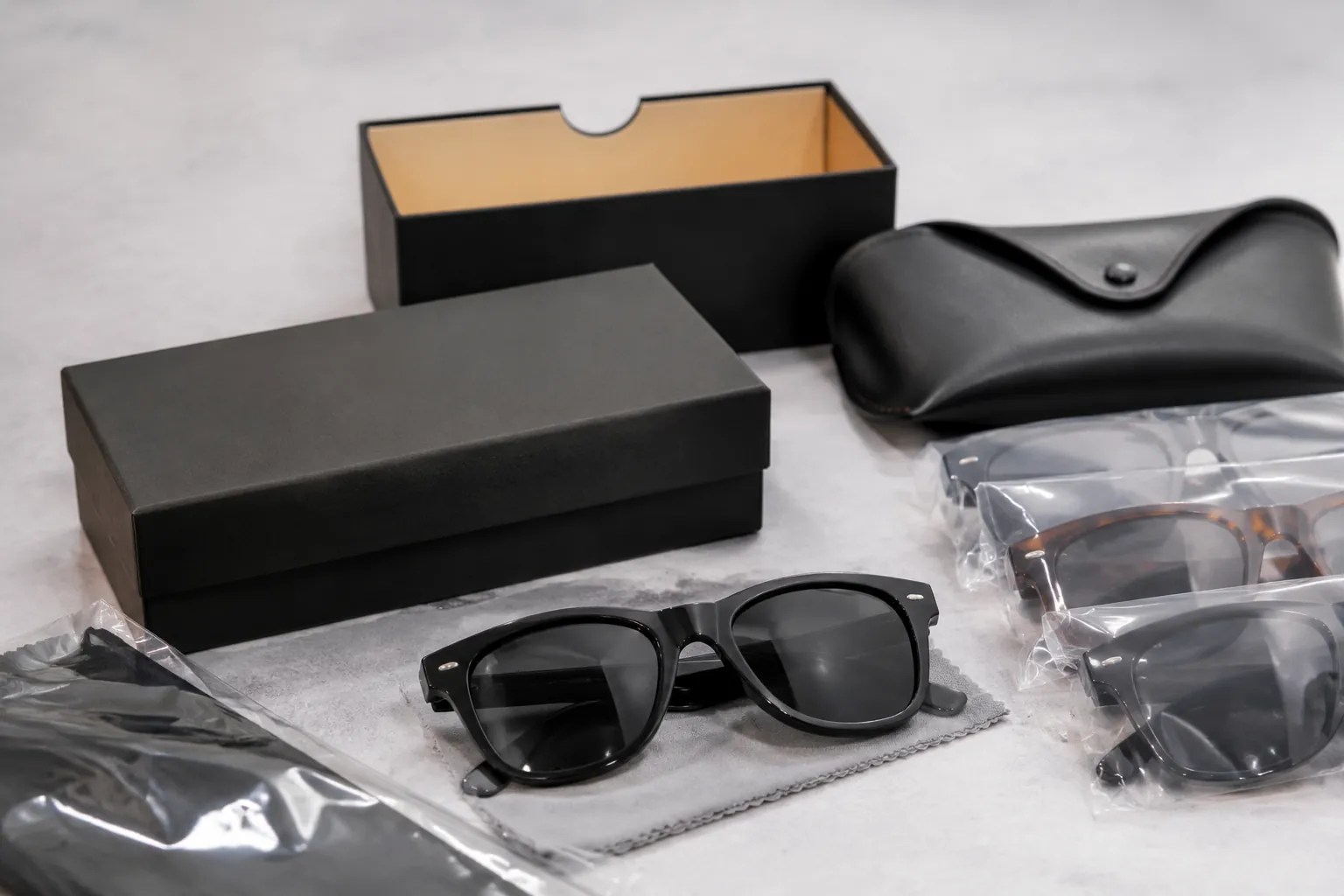
This guide is for brand owners, importers, distributors, and retailers sourcing custom sunglasses in volume. It focuses on branding details that affect retail presentation, product identification, and packaging execution before the customer even tries on the frame. These details usually cost far less than new tooling. But they can still decide whether a shipment arrives shelf-ready or needs relabeling, repacking, or claim correction. The aim is not to add more logos. It is to give each branding element a clear job and make sure the finished set matches the approved product specification.
Set a branding hierarchy before you place logos
Many buyers approve frame decoration first and leave tags, stickers, and cases until late in development. That creates avoidable revisions. Each branding element has a different job. A retail-ready sunglasses program works better when you define each item by function: product identity, retail presentation, product information, traceability, or protection. Then the factory can build artwork control and pack-out around a fixed plan instead of improvising near production.
On sunglasses, the frame usually carries the longest-life branding. The outer temple mark is the main identity element in use. The inner temple text is often used for model references or other approved product identification. Some programs also add a small lens mark for brand recognition, but only if it does not affect appearance or leave residue. Everything else supports retail handling. Hang tags communicate style or lens information fast. Stickers highlight a specific lens feature before handling. Cases, pouches, and cloths affect perceived value and protect the product in packing, transit, and display.
A practical hierarchy is:
- Frame branding for identity and permanent traceability.
- Hang tags for presentation, SKU handling, and product callouts.
- Stickers for fast visual information and stock control.
- Cases and cloths for protection and perceived value.
This matters because each item has different limits. A temple logo must stay legible after repeated handling. A hang tag must stay readable without scratching the lens or hiding the frame shape. A lens sticker must peel off cleanly. A case must fit the actual folded frame and any included cloth or tag, not a drawing or standard size reference. Repeating the same oversized logo across all four usually weakens the result.
For most OEM sunglasses programs, branding decisions should be frozen by the pre-production sample stage. Late changes to artwork position, temple text, or packaging format often trigger new proofs, new setup, or replacement accessory materials. One complete branding sheet approved early is usually more reliable than approving each piece separately at different times.
Temple marks do the hardest work, so specify them clearly
The temple is the hardest-working branding area on a sunglass frame. It is visible when the frame is worn. It is visible when the frame is folded in packaging. It is often used for product identification too. So method selection matters. The decoration process has to match the frame material, surface texture, and expected handling conditions. A logo that looks sharp on the first sample can still fail in use if it sits too close to a hinge flex point, crosses a textured surface, or depends on weak adhesion.
On injection-molded plastic, pad printing is common for outer logos and inside-temple text. It is widely used because tooling needs are limited and artwork changes are easier to manage. Its main weakness is wear resistance. If the print is too large, too close to the hinge bend area, or applied on a highly curved or textured surface, scuffing can appear sooner. Laser marking can be a better option for permanent inside-temple information on compatible materials because it is generally less likely to rub off, although the appearance is usually subtler than ink print.
On acetate or other premium frame constructions, engraved or recessed branding may be used, sometimes with color fill. That can produce a stronger long-term result, but buyers should confirm exactly what is being approved: surface marking only, unfilled engraving, or engraving with filled color. These are different processes with different appearance tolerances and lead-time effects. Inserted metal logo plates can also create a stronger retail look than large printed branding, but the assembly method matters. Ask how the plate is fixed and how the factory checks that it stays seated during handling.
At sample stage, approve these points in writing:
- Outer temple logo position measured from a clear reference point such as hinge centerline
- Inside temple text content, font size, and reading order
- Allowed position tolerance for visible marks
- Color reference for ink, laser tone, or plating finish
- Rubbing or abrasion check method after curing and normal packing contact
Small shifts are easy to spot on narrow temples, especially on slim fashion frames. Do not approve from artwork alone. Use an actual sample with measured placement. If the logo is visible when worn, placement consistency is part of perceived quality.
Hang tags should identify the product fast
A hang tag is not decoration. In retail, it often has to identify the style, support barcode or SKU handling, and communicate a lens feature or collection message in seconds. If it tries to do too much, the layout gets crowded and the product gets harder to shop. Good tags are easy to scan and do not block the frame silhouette.
Most sunglasses programs use either a folded card tag or a single card tag attached with string, elastic loop, or a plastic fastener. The right stock and attachment method depend on the sales channel and pack-out. A rigid premium card can improve hand feel, but if it sits directly against the lens or frame front it can also create friction or pressure marks in transit. Check tags on the fully packed product, not on a loose sample only.
Keep content limited to information that helps the buyer or store team identify the product. Typical items include brand, model or collection name, frame color, lens color, SKU, barcode, and a verified lens feature such as polarized. Product claims should never be added casually. If the tag says "polarized," "UV400," or another lens-related statement, that wording must match the approved lens specification for that production order. Unverified copy creates compliance risk and return risk. Not just a design issue.
Useful tag content usually includes:
- Brand and collection or model name
- Frame color and lens color code
- SKU or barcode
- Polarized note if the production lens is actually polarized
- Basic lens category or sun-use note where required by the retail program
Placement matters as much as wording. Ask the factory to attach the tag after final cleaning when possible. Early attachment can trap dust, twist around the hinge during bagging, or increase rubbing against the lens. Before mass production, approve the final tag on the packed sample and verify three things: the barcode scans, the tag does not block the front view, and the attachment method does not mark the frame or lens.
Use stickers only when they solve a real problem
Lens stickers help when they make an important product feature visible before the customer handles the frame. The common example is polarized identification. The common mistake is using large stickers with generic claims that add clutter but no useful information. Oversized stickers also increase the risk of fingerprints, adhesive residue, and weak shelf presentation.
If you use a sticker, keep the message specific and the size controlled. A small sticker for polarized identification or lens category is often enough if the retailer needs that information visible on display. Position it so store staff or customers can remove it without touching the optical center more than necessary. Adhesive choice matters. If adhesion is too weak, stickers fall off in cartons or during handling. If it is too strong, removal can leave residue, haze, or marks on the finished lens.
Always test the sticker on the actual finished lens used for production. Surface cleanliness, coating type, and curing condition all affect performance. The check is simple: apply the production sticker to the finished production lens, leave it in place for a defined period under normal conditions, then peel it and inspect the surface under good light for residue, lifting, or visible marking. Approval on an uncoated development lens is not enough.
| Branding item | Best use | Main risk | Buyer check point |
|---|---|---|---|
| Lens sticker | Fast callout for polarized or lens category | Residue, haze, or poor adhesion | Peel test on finished production lens |
| Temple print | Permanent visible branding | Rub-off or misalignment | Position approval and abrasion check |
| Hang tag | Shelf presentation and SKU control | Overcrowded design or lens scratching | Attachment method and packed orientation |
| Case branding | Perceived value and protection | Wear, odor, or poor fit | Fit test with folded frame and cloth |
If you are selling through chain retail or managing many styles, standardize sticker logic. Use one rule for sticker size, wording, and placement. That makes warehouse handling easier and reduces shelf confusion. Stickers should support the product system, not compensate for weak core branding.
Case, pouch, and cloth details change value perception fast
Buyers sometimes spend substantial time refining frame trim and very little time reviewing the case or pouch. That is a mistake. The accessory often shapes the first tactile impression of the product. Poor fit, strong odor, weak closures, or fast-wearing print can lower perceived quality even when the sunglasses themselves are solid.
Soft pouches, hard cases, folding cases, and EVA zip cases fit different price points and channels. A launch program may use a microfiber pouch and cloth to control cost and reduce shipping volume. A gift-oriented retail set may justify a more structured branded case. The right choice depends on the sales channel, target price, breakage risk, and folded frame size. There is no standard answer.
The approval checks are simple. Put the actual folded frame into the chosen case together with the cloth and tag if that reflects the shipping configuration. Confirm that the frame sits correctly, the case closes without pressure on the front, and no trim or hinge component contacts the lenses in a damaging way. If the frame has a large wrap front, a deep lens profile, or thick temples, a standard stock case may not fit even if it looks fine in a catalog photo.
Branding method affects durability here too. Pad printing is common on many accessory surfaces, but wear can vary with texture and coating. Debossing or attached metal details may last longer on some mid-range programs, provided lead time and minimum order requirements are acceptable. For cleaning cloths, simple artwork usually reproduces more reliably than fine detail because print edges soften on fabric compared with coated paperboard.
Odor should be reviewed as part of quality control, not dismissed as a minor packaging issue. Materials such as PU coverings, EVA components, adhesives, and fabric backings can all affect smell. If the shipment is going into a market or retail program with stricter material review, include accessory materials in the compliance check and request clear material information from the supplier before bulk approval.
Keep compliance visible, but keep it accurate
Retail-ready branding is not only about appearance. It also has to support accurate product identification and market-specific documentation. Any product-facing statement must match the approved specification. Buyers should not copy claims from an older model, a competitor sample, or a generic template. If the production lens or frame construction changes, the wording may need to change too.
If the product is supplied to a market where standards or documentation apply, branding should stay aligned with the relevant technical file and approved sample. Real examples buyers commonly encounter include CE EN ISO 12312-1, ANSI Z80.3, and AS/NZS 1067 for sunglasses, plus supplier or system references such as REACH, FDA registration, ISO 9001, and BSCI in qualification or documentation workflows. These are not interchangeable. And they do not all belong on retail-facing artwork. FDA registration, ISO 9001, and BSCI are not consumer product feature claims and should not be used as front-of-tag badges.
Good practice is to separate information into three layers:
- Permanent frame marking for model traceability and core identification.
- Retail tag or sticker information for quick buyer-facing product details.
- Carton and document control for shipment, audit, and importer records.
This keeps the product visually clean while making warehouse checks and post-shipment traceability easier. It also reduces the chance that a packaging artwork revision triggers a full relabeling exercise. A simple rule works well: if a statement cannot be supported by the exact production specification and the intended market documentation, it should not appear on the retail-facing piece.
This is especially important for lens-related wording such as polarized status, UV claims, lens category, and any market-specific conformity statement. The safest process is to have product management, compliance, and packaging review those claims together before final artwork release.
Freeze details early to protect lead time and cost
Branding details do not usually disrupt a sunglasses project because they are expensive. They cause delays because they are approved too late or revised after dependent items are already in process. Typical examples include late barcode changes, reopened temple text, a revised tag dieline, or a case selected from a photo without a physical fit check.
The production effect is simple. Once the factory has approved frame decoration, printed packaging, and accessory purchasing on one consistent specification, execution gets easier. If those items keep moving independently, the risk of mismatch rises. A corrected barcode may require a tag reprint. A changed temple script may require new pad print approval. A different case size may affect carton planning and pack-out. None of these changes is unusual alone. Together, they slow release.
Typical delay points include:
- Barcode format not confirmed
- Tag dieline not approved
- Temple text language still changing
- Case size chosen from photo only, not by fit test
- Sticker claims not matched to final lens spec
The most reliable approach is to issue one branding sheet before pre-production approval. That sheet should cover frame marks, temple text, tag artwork, sticker type, accessory branding, and pack-out rules. It should also define who signs off each item and whether any packaging materials may be purchased before all artwork is final. That will not remove every risk. It will make responsibility and sequence much clearer.
If the order includes multiple colorways, standardization helps. Keeping one tag structure, one sticker size, one case family, and a controlled SKU matrix usually reduces execution errors compared with creating a different accessory system for every variant.
A simple buyer checklist before mass production
Before releasing bulk production, review the branding package as one complete system. A frame can pass sample approval and still arrive retail-unready if the wrong adhesive was used, the case is too shallow, or the tag covers the front shape. One packed sample tells you more than several loose component approvals because it shows the product in the condition the customer or store team will actually receive.
- Match branding to material: confirm which parts are pad printed, laser marked, engraved, or fitted with metal plates.
- Check visual balance: review outer temple logo size against actual temple width, not artwork only.
- Confirm permanent text: lock inside temple model code, color code, and any market-specific identification.
- Review sticker behavior: test removal on the actual finished lens, not an uncoated development sample.
- Fit the case: insert the exact folded frame with tag and cloth, then test pressure and closure.
- Audit carton logic: make sure SKU, barcode, and color identifiers match inner pack and master carton records.
- Approve one packed golden sample: not just a loose frame, but the complete retail set exactly as it will ship.
Retain that final packed sample as the reference for bulk inspection. If the order includes several colorways and any branding element changes by color, maintain a SKU matrix that links model, frame color, lens color, barcode, tag version, and packaging variant. Approve that matrix before production starts and, where practical, confirm a packed sample for each version that differs. That is usually easier than correcting mixed stock after packing or after shipment.
Have a custom sunglasses project in mind?
Send us your styles, target market and quantities and we will return a detailed quote with MOQ, lead time and a sample plan.
Get a QuoteWhy source this from Wenzhou with LumiShades
Wenzhou in Zhejiang Province is widely regarded as China’s eyewear manufacturing capital, producing a large share of the world’s sunglasses. That concentration matters to buyers: a deep local supply chain for acetate sheet, hinges, lens blanks, plating and packaging means shorter component lead times, easier color and material matching, and a workforce with decades of eyewear-specific skill. LumiShades has manufactured in this ecosystem since 2009, and our vertical integration — in-house injection molding, acetate cutting, CNC milling, lens tinting, decoration and quality control — means no part of your order is quietly subcontracted to a workshop you cannot audit.
For international buyers, that vertical control translates into accountability. When a single factory owns every step, defects are traced and fixed at source rather than bounced between vendors, and your specifications survive intact from first sample to bulk. We back this with 15+ years of experience, shipments to 60+ countries, more than 5 million pairs produced per year and a 98.5% on-time delivery rate. Our certifications — CE EN ISO 12312-1, FDA registration, ANSI Z80.3, AS/NZS 1067, REACH, ISO 9001 and BSCI audit — mean the compliance documentation your market requires already exists. Explore our manufacturing capabilities and quality control process to see how this works in practice.
Frequently asked questions
What branding detail gives the biggest retail impact for the lowest cost? Usually the strongest low-cost combination is a clean outer temple mark plus a clear hang tag. The temple mark carries brand identity when the frame is worn or folded, and the hang tag helps the product read quickly on shelf. Ask the supplier to show both on the same packed sample so you can judge visibility, balance, and whether the tag interferes with presentation.
Should I print compliance claims like CE or FDA on the hang tag? Only print product-facing claims that are correct for the exact production specification and target market. Do not use compliance wording as decoration. FDA registration is a supplier-related qualification item, not a generic retail badge, and references such as ISO 9001 or BSCI also do not belong on a consumer hang tag as product features. Before approving artwork, cross-check every claim against the technical file and the market where the sunglasses will be sold.
Are lens stickers worth using on all models? No. Use stickers only when they solve a retail handling need, such as identifying polarized lenses or showing lens category where the sales format requires it. Keep them small and test the production sticker on the finished production lens for clean removal and acceptable appearance. If a sticker adds no operational value, it usually adds clutter instead.
At what stage should I approve temple text and tag artwork? Approve them during sample development and freeze them no later than the pre-production sample stage. Do not wait until the frame itself is already approved for bulk. Before release, verify the exact temple wording, logo position, barcode format, tag attachment method, and any lens-related claims on one packed reference sample.
How do I reduce branding mistakes on a mixed-color order? Create a SKU matrix that links each model and colorway to its frame color, lens color, barcode, tag version, sticker version, and packaging variant. Require the factory to use that matrix for pre-production confirmation and carton marking. If any branding differs by colorway, approve a packed sample for each affected version rather than assuming one approval covers all variants.
Ready to start?
Explore our wayfarer sunglasses or request a quote — our sales team replies within 12 hours.
Request a Quote