
Private Label Sunglasses Packaging That Feels Premium
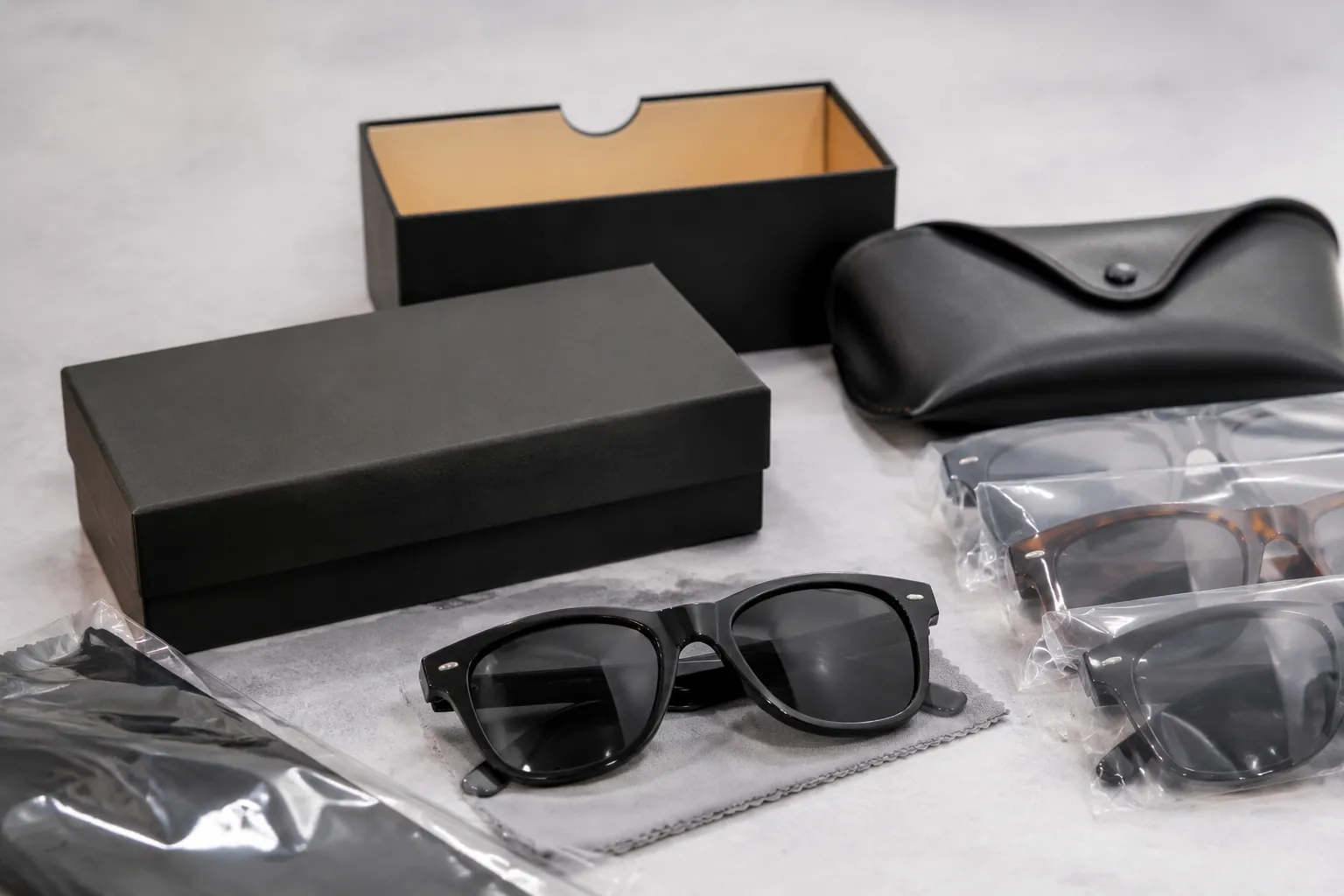
This guide is for brands, importers, distributors, and retailers sourcing custom sunglasses in volume. The aim is simple: choose packaging that improves first-touch perception, protects frames and lenses in transit, and meets retail or e-commerce needs without adding avoidable cost, MOQ pressure, or launch delays. Start with the product. Then match packaging to frame construction, lens sensitivity, labeling needs, order size, and production timing.
Start with the unboxing sequence, not the box spec
Many buyers start by listing components: hard box, microfiber pouch, cleaning cloth, hang tag, barcode sticker, and thank-you card. That often adds cost without fixing the real issue. Start with the first handling sequence instead. How does the carton open? Does the frame sit neatly? Are the lenses clean? Does anything shift, snag, shed fibers, or carry a strong material odor?
Perceived value usually comes from four control points: rigidity, fit, surface cleanliness, and restraint. Rigidity means the carton keeps its shape during normal handling and stacking. Fit means the frame stays secure without rattling inside the pack. Surface cleanliness means no dust, lint, adhesive residue, transfer marks, or scuffs on the frame, lenses, pouch, or carton. Restraint means controlled branding and finishes. Not too much.
These points are easier to check than vague claims about "luxury" presentation. A simple folding carton with clean edges, consistent print, and a stable insert often feels better than a larger rigid box with loose contents or uneven finishing. The same logic applies to branding. One well-placed logo used consistently across temple, pouch, carton, and label usually looks stronger than multiple logos scattered at different sizes and positions.
Packaging also needs to follow the frame program. Mirror, flash, or dark lenses show rub marks and dust fast, so they often need protective sleeves or tissue. Frames with metal logo plates, sharp acetate bevels, or high-wrap sport geometry may need more pouch clearance or a different insert shape than a basic fashion frame. Treat packaging as part of the product spec. Not as a last artwork task.
The packaging details buyers notice first
If you want private label sunglasses to feel more expensive without paying gift-box cost, focus on the details buyers and end customers notice right away.
- Correct box size: Leave enough room for easy insertion and removal, but not so much that the frame moves freely inside the pack.
- Insert structure: EVA, die-cut card, and molded pulp can all work if the insert supports the frame consistently and presents it cleanly.
- Pouch hand feel: A soft, well-finished microfiber pouch usually feels better than thin promotional fabric and also helps protect the lenses.
- Lens protection: A PE bag, lens sleeve, or soft tissue wrap helps reduce rubbing during internal handling, bulk packing, and transit.
- Print quality: A simple logo with sharp edges, even coverage, and good adhesion reads better than complex graphics with weak registration.
- Color discipline: Controlled use of black, white, grey, kraft, or one accent color is usually safer than mixing too many finishes or effects on a mid-market line.
These are execution choices, not status symbols. On many commercial programs, better insert fit and cleaner lens protection improve perceived value more than changing the outer box format.
Decoration method matters too. Screen printing is common for simple carton artwork because it is cost-effective and repeatable. Foil stamping can work well if coverage stays controlled and registration stays accurate. Push it too far and variation shows quickly. On pouches, heat-transfer logos can deliver crisp detail, but buyers should confirm adhesion and rub resistance on the actual fabric. Embroidery may sound premium, yet on low-profile microfiber it can add bulk and distort the area where the frame should sit flat.
Where the money goes: packaging options versus value
Packaging add-ons are easier to judge when separated by sales channel and by function. E-commerce needs transit protection and clean arrival. Retail programs usually need barcode logic, stackability, and a consistent shelf look. Promotional or fast-turn programs may care more about speed and simple setup than structural complexity.
| Packaging detail | Typical cost effect | Perceived value impact | Lead-time effect | Best use case |
|---|---|---|---|---|
| Matte folding carton | Low to medium | High when print and board quality are consistent | Low | Most private label and retail-ready programs |
| Rigid setup box | Medium to high | High when the retail positioning supports it | Medium | Gift sets, premium DTC launches |
| Microfiber pouch | Low | High because it is handled directly | Low | DTC, fashion retail, branded basics |
| Die-cut card or EVA insert | Low to medium | High because it controls movement | Low to medium | E-commerce and export packing |
| Foil stamp or spot UV | Medium | Medium when used selectively | Medium | Brand-led cartons with simple artwork |
| Story card or care insert | Low | Low to medium | Low | Compliance, care, or brand messaging |
The takeaway is simple. If budget is tight, prioritize pouch quality, lens protection, and internal fit first. A rigid box with loose or marked contents disappoints. A simple carton with stable presentation usually performs better in both perception and logistics.
MOQ logic matters too. Some packaging elements only become economical once setup cost is spread across a larger order. Custom printed cartons, custom inserts, multiple barcode versions, and split packaging by channel can all make sense. Not always on a pilot run. Ask for packaging quotes by tier and compare the unit-cost effect of each upgrade before approving artwork.
A practical packaging stack by order size
Order size should guide packaging complexity. A common mistake is specifying a retail gift-pack concept for a small trial order, then absorbing avoidable tooling, proofing, and packing cost.
- Small pilot orders: Use a standard folding carton, branded sticker or simple print, microfiber pouch, and lens sleeve or PE bag. Keep structures standard unless the product price clearly supports custom tooling.
- Growing private label runs: Move to a custom printed folding carton and a dedicated insert once order volume is stable enough to justify setup cost.
- Established repeat orders: Refine board quality, insert geometry, barcode labels, care cards, and outer-carton markings so the packaging supports warehouse and retail requirements consistently.
- Large multi-channel programs: Consider split packaging by sales channel or destination market while keeping as many shared components as possible to control cost and reduce complexity.
Lead time usually breaks into three linked workstreams: frame production, packaging production, and final pack-out. Packaging can become the delay point even if frame production stays on schedule, especially if the order needs fresh dielines, repeated artwork corrections, market-specific label changes, or specialty finishes such as foil or spot UV. Buyers who approve frames quickly but stall on packaging artwork create preventable shipment risk.
There is a labor effect too. Standardized pack-out is usually faster and more consistent because operators follow the same orientation, folding method, barcode position, and accessory sequence. Mixed accessories, shifting insert versions, or unclear pouch-folding instructions slow the line and raise the risk of mismatch.
Materials and decoration choices that hold up in transit
Packaging has to survive export handling, courier movement, shelf stocking, and returns inspection. If it scuffs, transfers ink, or deforms under pressure, it creates claims instead of value.
For cartons, matte finishes often present more cleanly than high-gloss surfaces because gloss shows fingerprints and abrasion faster, especially on dark colors. Soft-touch lamination can feel premium, but buyers should test it for scratch resistance and edge wear in master cartons. Kraft can work well for outdoor or eco-positioned lines, but check small legal text and barcode contrast on the final substrate.
For pouches, microfiber remains a practical choice because it protects lenses and can also handle light cleaning. Cotton drawstring bags may support a natural or fashion story, but they are bulkier, pick up dust more easily, and do less for lens care. If you use a drawcord pouch, approve the cord quality, knot security, and seam finish on a physical sample. Not just artwork.
For inserts, die-cut card is economical and clean for many frame shapes. EVA gives more cushioning and a more controlled hold for some sport or wrap styles. Molded pulp can support sustainability positioning, but its tolerances and surface texture should be checked against the actual frame design to avoid catching, abrasion, or uneven presentation.
Decoration timing matters as well. Temple printing should be fully cured before bagging to reduce transfer or rub risk. Laser engraving is durable and low-risk during pack-out, though visually subtler. Metal logo plates can improve frame presentation, but they need packaging clearance so they do not mark the pouch interior or contact nearby surfaces during bulk handling.
Compliance and labeling: put the right information in the right place
Premium presentation means little if the goods need relabeling, trigger importer questions, or fail to match the supporting documents. Packaging should support compliance without crowding the main consumer-facing surfaces.
For sunglasses entering regulated markets, product markings, insert content, hang tags, and outer labels should match the actual declarations and test scope for that model. Depending on market and program requirements, buyers may need to align packaging with standards or systems such as CE EN ISO 12312-1, ANSI Z80.3, AS/NZS 1067, REACH, and FDA registration where relevant. If a supplier presents factory or social compliance credentials such as ISO 9001 or BSCI, verify those separately and do not confuse them with product compliance. Simple rule: do not print claims that go further than the documents behind the product.
- Temple marking: Useful for core identity information such as brand, model, or other required product references.
- Hang tag: Useful for retail-facing information that may vary by market or customer account.
- Insert card: Best for care instructions, warnings, limitations of use, and market-specific technical text.
- Outer label: Best for SKU, barcode, carton count, country of origin, and warehouse handling information.
This separation matters commercially too. Filling the main carton with technical text weakens presentation and can force reprints if one market changes its labeling requirements. A cleaner primary pack plus a compliant insert card usually gives more flexibility and lowers obsolete packaging risk when a buyer changes language versions, importer details, or SKU coding.
Before bulk packing, confirm a labeling matrix that shows what appears on the frame, on the consumer pack, on any insert, and on the master carton. Also decide which elements can stay as stickers instead of preprinted artwork. That choice often improves lead-time control and inventory flexibility.
Common mistakes that make sunglasses look cheaper
Most disappointing unboxing results are not caused by low budget alone. They usually come from weak sequencing, loose tolerances, inconsistent labeling, or poor final pack-out control.
If the frame arrives clean, centered, protected, and easy to remove, buyers tend to read it as quality. If it rattles, sheds lint, or shows pressure marks and rub lines, it feels cheaper even when the frame itself is sound.
- Oversized boxes: They increase freight volume, allow movement, and make the frame feel under-supported.
- Weak labels: Crooked barcode stickers, bubbling corners, or low-contrast print make the package look rushed.
- Unprotected lenses: Dark, gradient, mirror, and flash lenses show marks quickly if packed without basic surface protection.
- Overdecoration: Too many finishes on a mid-market line often make quality variation more visible.
- Late artwork approval: Frames may be ready while packaging is still in revision, creating avoidable shipment delays.
- No pack-out SOP: Without a standard method, operators may orient temples differently, fold pouches inconsistently, or mix accessories across SKUs.
A practical buyer checklist helps control these risks. Ask for a packed approval sample, not just a frame sample. Check lens cleanliness under strong light. Confirm that logos, metal trims, hinges, and temple tips do not catch on the pouch or insert. Verify barcode position and carton-mark logic before bulk packing begins. If the order is large enough, request pilot-run pack-out photos or a short inspection summary from the supplier.
Final inspection should cover both product and presentation: frame finish, lens cleanliness, accessory matching, print quality, label accuracy, and pack-out consistency before export cartons are sealed. That is often the difference between a good packaging idea on paper and a shipment that actually matches it.
How buyers can evaluate packaging before mass production
The best way to control packaging quality is to review it as a working sample, not as separate parts. A flat carton proof, a pouch swatch, and a frame sample do not show how the final consumer pack performs once assembled.
Ask the supplier for one packed sample using the intended frame, lens type, pouch, insert, carton, and labels. Review it for fit, cleanliness, ease of removal, and branding consistency. If the program is for e-commerce, ask how the inner pack will be protected inside the shipping configuration. If it is for retail, confirm that barcode placement, shelf orientation, and carton dimensions match the customer's requirements.
It also helps to review a short approval checklist before mass production starts. Confirm the final artwork file version, print method, substrate, label data, country-of-origin statement, and any compliance text. If certifications or management systems such as ISO 9001 or BSCI are part of supplier evaluation, request current documentation directly rather than relying on packaging claims or sales language.
In practice, the most reliable packaging programs are usually the simplest fully specified ones. Clear materials. Controlled labeling. One approved packing method. One packed approval sample. Those basics do more for consistency than adding decorative extras late in the process.
Have a custom sunglasses project in mind?
Send us your styles, target market and quantities and we will return a detailed quote with MOQ, lead time and a sample plan.
Get a QuoteWhy source this from Wenzhou with LumiShades
Wenzhou in Zhejiang Province is widely regarded as China’s eyewear manufacturing capital, producing a large share of the world’s sunglasses. That concentration matters to buyers: a deep local supply chain for acetate sheet, hinges, lens blanks, plating and packaging means shorter component lead times, easier color and material matching, and a workforce with decades of eyewear-specific skill. LumiShades has manufactured in this ecosystem since 2009, and our vertical integration — in-house injection molding, acetate cutting, CNC milling, lens tinting, decoration and quality control — means no part of your order is quietly subcontracted to a workshop you cannot audit.
For international buyers, that vertical control translates into accountability. When a single factory owns every step, defects are traced and fixed at source rather than bounced between vendors, and your specifications survive intact from first sample to bulk. We back this with 15+ years of experience, shipments to 60+ countries, more than 5 million pairs produced per year and a 98.5% on-time delivery rate. Our certifications — CE EN ISO 12312-1, FDA registration, ANSI Z80.3, AS/NZS 1067, REACH, ISO 9001 and BSCI audit — mean the compliance documentation your market requires already exists. Explore our manufacturing capabilities and quality control process to see how this works in practice.
Frequently asked questions
Should I spend more on the outer box or the pouch first? Start with the pouch, lens protection, and internal fit. Ask your supplier to quote two versions side by side: one with a standard carton and upgraded pouch or insert, and one with a more expensive outer box. Then review packed samples using the same frame. In many programs, the upgraded pouch and better fit improve perceived quality more than a box upgrade.
What is the best packaging setup for a private label order that is still testing the market? Keep the structure simple and repeatable: a standard or simple custom carton, branded microfiber pouch, basic lens sleeve or PE bag, and clear barcode labeling if needed. Ask for a packed sample before approving bulk production. That lets you check presentation and protection without taking on unnecessary tooling or complex finishing.
Can packaging changes delay bulk production? Yes. Packaging can delay shipment if artwork is approved late, labels change after proofing, or the project needs new dielines, specialty finishes, or multiple language versions. To reduce risk, lock the packaging spec early, confirm the final artwork version in writing, and ask the supplier to show how packaging timing fits the overall production schedule.
Do I need compliance information printed on the main gift box? Not necessarily. First confirm what the destination market and importer actually require for that model. Then decide which information belongs on the frame, insert card, hang tag, outer label, or main carton. Keeping technical or market-specific text on inserts or labels often makes the packaging cleaner and easier to update if requirements change.
How do I reduce damage claims during shipping without overpacking? Focus on movement control and surface protection. Ask for a carton that fits the frame properly, an insert that holds the product in position, and a lens sleeve, tissue, or PE bag that prevents rubbing. Then review a packed sample and, if possible, have the supplier perform a simple handling check before mass packing. Extra decorative components do less to prevent claims than a stable pack structure.
Ready to start?
Explore our cat-eye sunglasses or request a quote — our sales team replies within 12 hours.
Request a Quote