
Trading Company or Factory for Private Label Sunglasses?
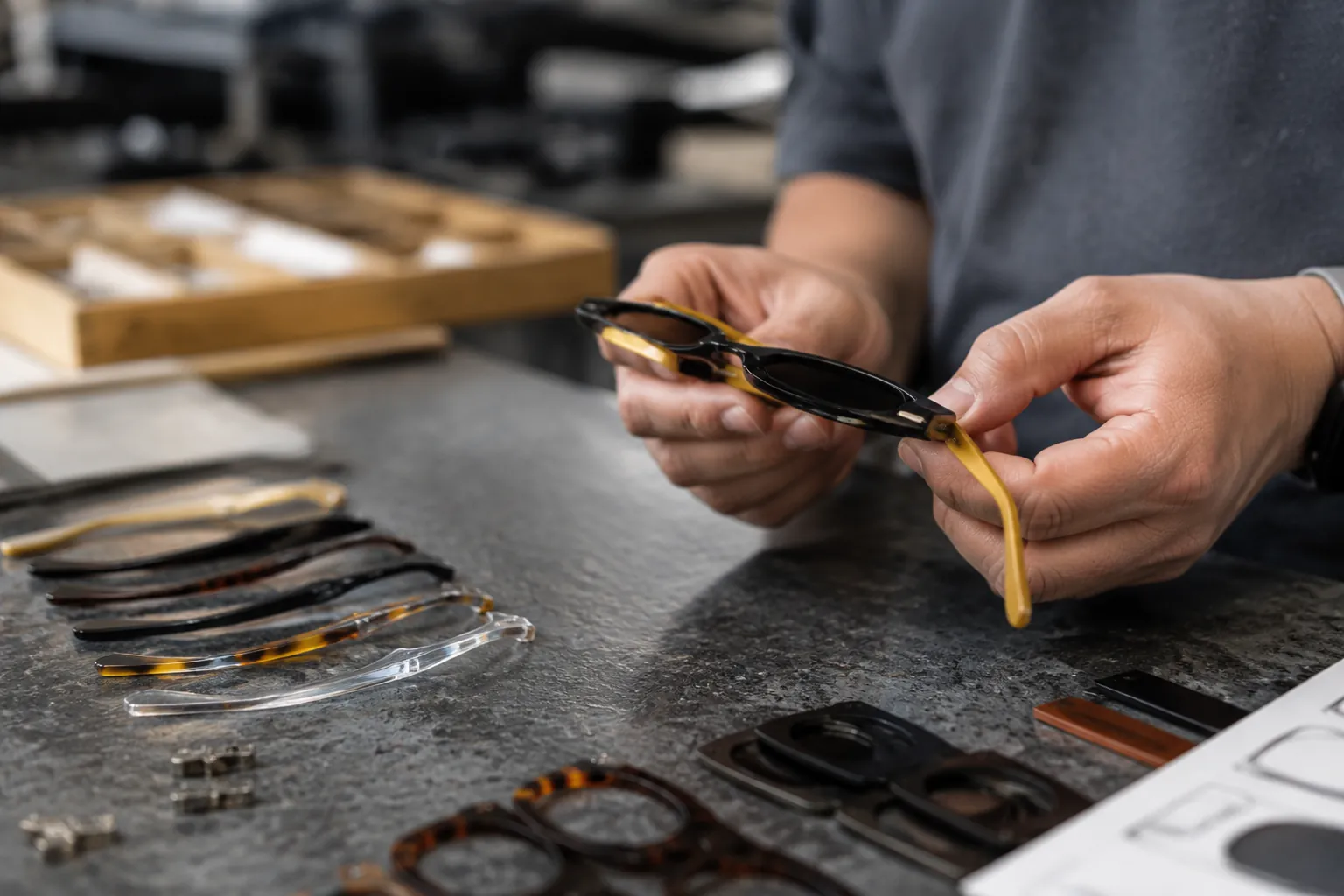
This guide is for overseas brands, importers, distributors, and retailers choosing between a trading company and a direct factory for private label sunglasses. Price matters, but it is not the whole decision. Supplier type affects MOQ logic, sample correction speed, material control, logo quality, compliance traceability, QC responsibility, lead time, and reorder consistency. The examples below follow practical eyewear production logic from Wenzhou manufacturing, including small test orders, 300/1000/5000+ pair price breaks, typical sample and bulk timelines, and the process details that decide whether sunglasses pass inspection or become returns.
The Real Question Is Control
A trading company can be useful. A direct factory can also be difficult if the buyer keeps changing artwork, sends vague specifications, or approves samples casually. Supplier type is not a moral test. It is a control decision.
For simple stock-frame sunglasses with one small logo, a trader may save time by collecting options from several workshops. For a private label program with custom frame colors, lens categories, logo placement, retail packaging, barcode labels, and repeat orders, direct factory sourcing usually gives better visibility. The reason is simple: the factory controls the steps that create the product.
At LumiShades in Wenzhou, production discussions can be tied directly to frame forming, acetate processing, CNC work where applicable, lens tinting, decoration, assembly, and QC. That matters when defects need a cause. Mold shrinkage. Temple screw torque. Pad print adhesion. Lens color drift. Hinge alignment. Nose bridge comfort. Packaging errors. Each issue points to a real production step.
With a trader, the technical question often travels through an intermediary before it reaches the actual line. Sometimes the answer is accurate. Sometimes it comes back as a general "no problem." That is not a control plan.
Practical rule: if your sunglasses are a repeat private label SKU, not a one-off giveaway, production accountability is usually worth more than an easier first conversation.
Head-to-Head Supplier Comparison
Use this comparison as a first screening tool. These factors affect landed cost, inspection results, launch dates, and reorder stability.
| Decision factor | Trading company | Direct factory | Buyer implication |
|---|---|---|---|
| Quoted price | Usually includes a coordination margin over factory cost | Closer to production cost, especially at 300, 1000, and 5000+ pairs | Direct sourcing gives clearer price logic once volume is real |
| MOQ flexibility | May combine stock from several suppliers | Depends on mold, color, lens, decoration setup, and packing method | Factory MOQ shows what is practical to produce, not only easy to sell |
| Sample correction | Feedback passes through an intermediary | Engineers, sample room, and production staff can review defects directly | Faster diagnosis for fit, tint, hinge, logo, and packaging issues |
| QC control | May inspect finished goods but may not control the process | Can inspect raw materials, first pieces, in-process goods, and final cartons | Process control reduces unresolved disputes when defects appear |
| Compliance traceability | May collect reports from multiple factories | Documents should match the actual factory, product type, lens, and material | Cleaner support for CE EN ISO 12312-1, ANSI Z80.3, AS/NZS 1067, REACH, and FDA-related files |
| Reorder consistency | May switch workshops when capacity is tight | Can reuse tooling, color standards, BOMs, fixtures, and inspection records | Better for retailers and brands that need repeatable SKUs |
There is one fair exception. If you need several unrelated eyewear types in very small quantities, a trader may coordinate faster. But if your main product is private label sunglasses, direct factory contact becomes more valuable with every repeat order.
Where the Price Difference Comes From
Sunglasses pricing is not one number. It is a stack of frame material, forming method, lens type, decoration, packaging, yield loss, inspection time, overhead, and margin. A trading company adds coordination margin. A factory adds manufacturing margin. Both need to make money. The question is what the added cost buys: control, speed, convenience, or risk reduction.
LumiShades can support small test orders from 50 pairs per design when the selected frame, lens, and decoration method allow it. That type of order works for market testing, influencer drops, club programs, boutique retail trials, or colorway validation. At small quantities, the unit price is higher because setup time, sample-room labor, logo fixture adjustment, and packing preparation are spread over fewer units.
Pricing usually improves when the run becomes more efficient, commonly around 300 pairs, 1000 pairs, and 5000+ pairs. Exact unit cost depends on frame type, lens specification, decoration method, packaging, inspection requirements, and current material pricing.
Material choice changes both cost and product behavior. PC injection frames are efficient for stock molds and promotional or fashion programs, but color consistency depends on pigment mixing and injection stability. TR90 is lighter and more flexible, useful for sport and active styles, but it requires control of warpage and temple curve. Acetate gives a more premium look and richer color depth, but cutting, tumbling, polishing, and hinge insertion add labor. A black injection frame hides cosmetic variation better than translucent crystal, champagne, or tortoise colors, where flow marks, pigment streaks, and shrinkage are easier to see.
- Low-cost configuration: stock PC mold, standard black or smoke color, UV400 tinted lenses, one-position pad print logo, polybag or basic pouch.
- Mid-range configuration: selected frame color, PC or TR90 frame, UV400 or polarized lens, pad print or laser logo, microfiber pouch, barcode label.
- Higher-control configuration: custom color standard, acetate or specialty frame, polarized or category-specific lens tint, metal logo plate, retail box, stricter AQL inspection.
If a quote is far cheaper than the rest, ask what was removed. It may be lens performance, coating quality, hinge durability, inspection time, carton strength, or packaging thickness. Cheap sunglasses become expensive when returns, relabeling, replacement shipments, or retailer chargebacks start.
Sampling Is the First Real Test
Sampling is not about getting a good photo. It is the first test of whether the supplier understood the specification.
For private label sunglasses, a useful sample should confirm frame shape, material feel, color, lens tint, logo method, hinge feel, temple alignment, packaging, barcode position, and basic wearing comfort. If the sample does not prove those points, it is not ready for bulk approval.
LumiShades typically prepares samples in 7 to 10 days after specifications and artwork are clear, depending on the selected model and customization level. A logo-on-stock-frame sample is usually faster because the frame and lens already exist. A new acetate color, custom TR90 shade, mirror lens, gradient tint, or revised temple decoration needs more trial time. Bulk production should not start until a physical pre-production sample is approved and retained by both buyer and factory.
Good sample comments are measurable. "Move logo 3 mm toward the temple tip" is useful. "Make it look more premium" is not. Buyers should define logo size in millimeters, frame color by Pantone or physical swatch, lens category by intended market, and packaging by dieline or approved reference sample. For fit and assembly, reasonable checkpoints include temple symmetry, logo position tolerance, smooth hinge opening without grinding, stable screw tightness, and no sharp burrs at the nose bridge, hinge area, or lens groove. Numeric tolerances should be agreed before production because they vary by material, frame design, and fixture stability.
- Send a written specification with frame material, color reference, lens category, logo artwork, packaging, barcode, destination market, and target quantity.
- Approve digital mockups only for placement and proportion. Do not treat them as production approval.
- Review the physical sample under daylight and indoor light because lens tint and frame color can shift.
- Check hinge opening, temple balance, nose bridge comfort, screw tightness, lens seating, and logo durability.
- Write comments as measurable instructions, including millimeters, color references, and defect photos.
- Approve a final pre-production sample before bulk goods start.
Direct factory communication makes corrections more exact. If pad printing smears, the team can check ink selection, surface treatment, curing time, and fixture position. If a lens sits unevenly, the team can check lens edging, groove consistency, frame warpage, and assembly pressure. That is a manufacturing conversation, not a catalog conversation.
Decoration Methods and Common Failures
Private label sunglasses often succeed or fail on small details: the logo edge, temple mark, lens print, pouch logo, or box finish. Decoration should match the material, surface curve, order quantity, and brand standard.
Pad printing is common for logos on temples and lenses because it handles curved surfaces and small artwork. It is cost-effective, but adhesion depends on surface cleanliness, ink selection, curing time, and whether the frame has oil, mold release, or polishing residue. Laser marking can work well for some metal parts and coated surfaces, but it may be too subtle on dark plastic unless contrast is tested. Hot stamping or metal logo plates create a more premium look, but they need accurate placement, stable adhesive or pin fixing, and enough flat area on the temple. Lens logos need special care because they must not interfere with vision, create optical distortion, or fail rub testing.
Ask for the decoration process before approving price. A one-color pad print on a stock temple is not the same as a recessed metal badge, debossed logo, foil detail, or multi-position print. Each added position brings setup time and inspection risk. A practical factory will confirm print location, artwork size, color code, fixture method, and acceptable tolerance before bulk production. For visible temple logos, the tolerance should be confirmed against the frame shape and fixture stability, then recorded in the approved sample or QC checklist.
Packaging decoration has its own failure points. A microfiber pouch logo may shift because fabric stretches. Retail box color can vary between print batches. Barcode labels can wrinkle on curved hangtags. Carton marks must match the packing list, SKU, color, quantity, and destination requirements. These details are not cosmetic once goods reach a warehouse or retailer receiving desk.
QC Failure Modes Buyers Should Watch
Most sunglasses defects are predictable. The same problems appear again and again: loose hinges, lens scratches, tint mismatch, frame warpage, logo misalignment, sharp edges, poor temple balance, weak packaging, wrong labels, and mixed colors in cartons. A good supplier does not pretend defects never happen. It catches them early, records what was found, and shows how the issue was corrected.
For plastic injection frames, check shrinkage, sink marks, flash, gate trimming, stress whitening around hinges, and parting-line roughness. For TR90 frames, watch temple twist, frame front deformation, and uneven flexibility. For acetate frames, inspect cutting accuracy, lamination marks, polishing quality, hinge insertion, and temple curve consistency. For lenses, check tint uniformity, optical distortion, UV performance, surface scratches, edge chipping, and whether the lens category label matches the actual product.
Direct factories can run QC at several points: incoming material inspection, first-piece inspection, in-process checks, decoration inspection, assembly inspection, and final random inspection. This matters because defects can be traced faster when QC is connected to the production step. If lens tint is off, the tint bath, lens batch, or timing can be checked. If metal plates lift, adhesive, surface preparation, pressure time, and curing can be reviewed.
- Before production: confirm approved sample, BOM, artwork, lens category, color standard, packaging layout, carton marks, destination market, and inspection standard.
- During production: inspect first pieces before the full run continues, especially after molding, cutting, tinting, and decoration setup.
- After decoration: rub-test printed or engraved logos and check placement against the approved sample.
- Before shipment: run final inspection using AQL or an agreed defect standard, with critical, major, and minor defects defined in advance.
Do not rely only on final inspection. By then, fixing the order may mean rework, repacking, or remaking. For a 1000-pair order, one wrong logo position can become 1000 defects if the first-piece check was skipped.
Compliance Must Match the Actual Product
Compliance is not a logo on a PDF. For overseas buyers, sunglasses compliance depends on destination market, lens type, wearer category, and product claim. The document set should match the actual product, not a random file from another SKU.
LumiShades lists compliance references including CE EN ISO 12312-1, FDA registration, ANSI Z80.3, AS/NZS 1067, REACH, ISO 9001, and BSCI. Buyers should request current copies and check the company name, report holder, issue date, test standard, product description, lens category, material scope, and any limits or exclusions. Do not add certifications to marketing copy just because they sound helpful. Importers create risk when they make claims that are not supported by current documents.
For the EU, CE EN ISO 12312-1 is relevant for general-use sunglasses, and REACH matters for restricted substances in materials and surface-contact components. For the United States, FDA registration relates to the supplier's regulatory status, and ANSI Z80.3 is commonly used for non-prescription sunglasses performance. For Australia and New Zealand, AS/NZS 1067 is the key sunglasses standard. UV400, polarized, mirrored, children's, sports, and fashion claims may require different checks, labeling, or retailer documentation.
Review labeling before cartons are sealed. Lens category, warnings, manufacturer or importer details, country of origin, care instructions, barcode, SKU, and batch reference can matter depending on market and retail channel. If your supplier cannot explain which report applies to which SKU, slow down. That gap becomes your import risk, not the supplier's sales problem.
Lead Time and Scale-Up Discipline
Bulk lead time is where sourcing decisions become visible. LumiShades quotes typical bulk production at 25 to 35 days after sample approval, material confirmation, artwork lock, packaging approval, and deposit or payment-term settlement. The clock should not start while the buyer is still changing the logo color, barcode format, or retail box dieline.
A realistic sequence includes material preparation, frame molding or acetate cutting, polishing or finishing, lens preparation and tinting, decoration, assembly, QC, packaging, carton marking, and export handover. Some steps run in parallel. Others cannot. You cannot final-pack sunglasses before logo inspection. You cannot finish assembly before lenses and frames are both ready. Special lenses, custom colors, or retail packaging can add days if materials need to be ordered or remade.
Trading companies sometimes give one delivery promise without showing where the order sits. A direct factory should be able to say whether your order is in molding, polishing, lens tinting, decoration, assembly, final QC, or packing. That visibility matters if you are booking freight, launching retail promotions, or coordinating distributor deliveries.
For a serious private label program, scale up in controlled steps. Start with 50 pairs per design when the selected model and customization method support that MOQ. Confirm sample speed, communication accuracy, decoration quality, inspection handling, and document quality. Then compare pricing at 300, 1000, and 5000+ pairs for the winning SKUs. Ask for milestone dates, not just a ship date: material ready date, first-piece approval date, decoration start date, assembly date, final inspection date, packing date, and handover date. The supplier that gives clear milestone answers is usually easier to manage later.
Have a custom sunglasses project in mind?
Send us your styles, target market and quantities and we will return a detailed quote with MOQ, lead time and a sample plan.
Get a QuoteWhy source this from Wenzhou with LumiShades
Wenzhou in Zhejiang Province is widely regarded as China’s eyewear manufacturing capital, producing a large share of the world’s sunglasses. That concentration matters to buyers: a deep local supply chain for acetate sheet, hinges, lens blanks, plating and packaging means shorter component lead times, easier color and material matching, and a workforce with decades of eyewear-specific skill. LumiShades has manufactured in this ecosystem since 2009, and our vertical integration — in-house injection molding, acetate cutting, CNC milling, lens tinting, decoration and quality control — means no part of your order is quietly subcontracted to a workshop you cannot audit.
For international buyers, that vertical control translates into accountability. When a single factory owns every step, defects are traced and fixed at source rather than bounced between vendors, and your specifications survive intact from first sample to bulk. We back this with 15+ years of experience, shipments to 60+ countries, more than 5 million pairs produced per year and a 98.5% on-time delivery rate. Our certifications — CE EN ISO 12312-1, FDA registration, ANSI Z80.3, AS/NZS 1067, REACH, ISO 9001 and BSCI audit — mean the compliance documentation your market requires already exists. Explore our manufacturing capabilities and quality control process to see how this works in practice.
Frequently asked questions
Is a trading company always more expensive than a factory? Usually a trading company adds a coordination margin, but that does not always mean worse total cost. For very small mixed orders, a trader may save time by consolidating products from several workshops. For repeat private label sunglasses, direct factory sourcing usually gives clearer cost structure, faster sample correction, and stronger process control, especially once orders reach 300, 1000, or 5000+ pairs.
What MOQ should I expect for private label sunglasses? MOQ depends on the frame, lens, logo method, packaging, and whether you use a stock model or custom components. LumiShades can support test orders from 50 pairs per design when the selected configuration allows it. For better pricing, ask for a quantity ladder at 50, 300, 1000, and 5000+ pairs, and confirm exactly what changes at each level: material, lens type, logo method, packaging, inspection standard, and lead time.
How long should samples and bulk production take? A logo-on-stock-frame sample commonly takes about 7 to 10 days after specifications and artwork are clear. More complex work, such as custom colors, special lenses, acetate development, mirror coating, or revised packaging, can take longer. Bulk production is typically 25 to 35 days after the final sample, material, artwork, packaging, and payment terms are approved. Ask for milestone dates instead of relying only on a final ship date.
Which compliance documents should I ask for? Ask based on destination market and product claim. For EU general-use sunglasses, request CE EN ISO 12312-1 support and REACH documentation where relevant. For the United States, ask about FDA registration and ANSI Z80.3. For Australia and New Zealand, ask for AS/NZS 1067. Also request ISO 9001 or BSCI documents if you need factory-management or social-compliance evidence. Check that each document matches the supplier name, product type, lens category, material scope, issue date, and intended market.
What should I inspect before approving bulk shipment? Inspect against the approved pre-production sample and written specification. Check lens scratches, UV and tint requirements, optical distortion, frame symmetry, hinge tightness, screw security, logo placement, print adhesion, sharp edges, packaging, barcode labels, carton marks, SKU mix, and color mix. Use AQL or another agreed inspection standard, and define critical, major, and minor defects before production starts.
When does direct factory sourcing become worth it? Direct factory sourcing becomes worth it when the sunglasses carry your brand name and you need repeat SKUs, controlled QC, clear compliance traceability, custom decoration, stable color standards, or better pricing at volume. It is especially useful when you need technical answers about lens tint, frame material, hinge feel, logo adhesion, packaging accuracy, or corrective action after inspection.
Ready to start?
Explore our square sunglasses or request a quote — our sales team replies within 12 hours.
Request a Quote