
How to Qualify an ODM Sunglasses Catalog Order
This guide is for brand owners, importers, distributors, and retailers sourcing private label sunglasses from an ODM catalog. A good photo is not enough. You need to know whether the exact model can be produced consistently, branded cleanly, tested for the destination market, packed correctly, and reordered without uncontrolled changes in fit, finish, or lens performance. Use this framework before paying for custom samples or placing a first purchase order. It will help you cut weak catalog options early and ask suppliers for evidence you can check.
Start with the model file, not the catalog image
An ODM catalog is often a mix of active models, old tooling, stock-supported styles, discontinued customer variants, and designs that stay in the catalog because the image still gets inquiries. A render or styled product shot does not prove that a frame is production-ready.
Before discussing colorways, logo placement, or packaging, ask for the technical file for each model under review. At minimum, that file should show marked size, overall front width, lens width, bridge, temple length, lens height, hinge type, frame material, lens material, target weight, decoration areas, and available lens options. If the supplier has stronger documentation, ask for CAD views, mold or production status, and the most recent production date for the model.
Production data matters. It tells you whether the model is being made now or only exists as a catalog reference. If a supplier only sends edited images and says the size is standard, slow down. In eyewear, the same marked size can still wear differently because of front width, bridge shape, lens curve, temple angle, and nose contact.
- Ask for: 3-5 current models within your target FOB range, instead of a full catalog with mixed production status.
- Request: CAD or dimension sheet, available colors, tooling or production status, most recent production run date, stock component availability, and actual sample lead time.
- Confirm: whether the quoted sample will be made from current production tooling and current components, or whether it is a showroom sample.
- Filter out: models with incomplete dimensions, no recent production history, unclear tooling status, or no credible compliance path for your sales market.
If you are buying for chain retail, marketplaces, or distributors, ask for packing details before PO: individual bag type, pouch or case option, barcode label placement, carton pack count, carton marking, and whether left-right temple print orientation is standardized. These are operating requirements, not cleanup tasks after approval.
Check fit on paper, then on real wearers
Fit can turn a strong-looking catalog frame into slow-moving stock. A frame may look balanced in a studio photo but sit too flat, slide on the nose, touch the cheeks, tilt on the face, or create temple pressure during normal wear.
Start with measurements. Do not stop there. A size such as 54-18-145 gives lens width, bridge, and temple length, but it does not fully describe overall front width, nose geometry, temple spread, hinge opening, or how the frame wraps around the face. Two sunglasses with the same marked size can fit very differently.
| Fit checkpoint | What to ask for | Useful reference range or method | Risk if ignored |
|---|---|---|---|
| Overall front width | True outer width in mm, measured across the widest front points | Compare against your approved fit block or target customer profile | Frame feels too narrow, too oversized, or unstable on the intended wearer |
| Bridge geometry | Photos from front, side, and underside; saddle, keyhole, molded pad, or adjustable pad details | Marked bridge size helps, but shape and contact area are more important | Sliding, nose pressure, poor comfort, or cheek contact |
| Temple spread and hinge opening | Open angle, spring hinge or fixed hinge, and retention feel on sample | Test on narrow, average, and wider head widths where possible | Pressure behind the ears, loose fit, uneven sit, or higher return risk |
| Lens height | Vertical lens coverage in mm | Compare with intended style category and sun coverage requirement | Poor coverage, weak proportions, or unexpected cheek contact |
After the paper check, test real samples on real wearers. Use at least three people if possible: one narrower face, one average face, and one wider face. Have each person wear the frame for 10-15 minutes, move their head normally, and report pressure, slipping, cheek contact, uneven frame position, and whether the frame needs heavy manual adjustment to sit correctly.
Ask the supplier what tolerances they control for temple alignment, lens seating, frame front symmetry, and warpage. Minor final adjustment can be normal in eyewear production. A production model should not need major hand correction on every pair.
For acetate-looking frames, confirm the construction. Is the model cut from acetate sheet, or is it injection molded with an acetate-effect finish? These are different products. Acetate can give stronger pattern depth and a premium hand feel, but it depends on sheet quality, polishing, hinge setting, and storage control. Injection-molded frames can be more repeatable at volume when tooling, color batching, and finishing are well controlled.
Read materials as QC evidence
Material choice is not just a price question. It affects finish quality, color stability, lens retention, decoration durability, hinge performance, and the defects your inspection team should expect. Do not settle for plastic, acetate, or metal as the whole answer.
| Material | Best use | Common failure mode | What to verify |
|---|---|---|---|
| Injected plastic | Promotional programs, fashion volume, price-sensitive retail, and repeatable color programs | Flash lines, sink marks, gloss variation, gate marks, color batch variation | Gate cleanup, surface uniformity, cavity consistency, color approval method, print rub resistance |
| Acetate | Higher perceived value, stronger color pattern depth, thicker fashion silhouettes | Warping under poor storage, polishing variation, visible lamination, hinge looseness | Sheet source, temple core specification, polishing standard, hinge anchoring, storage and packing method |
| Metal | Lightweight fashion, rimless or slim silhouettes, adjustable nose pad designs | Plating wear, solder weakness, screw loosening, nose pad assembly issues | Plating adhesion, solder or weld quality, symmetry, screw torque retention, pad arm alignment |
| Mixed material | Distinctive styling, higher perceived retail value, contrast trims or brow details | Tolerance stack-up between parts, loose trim joints, inconsistent assembly feel | Joint stability, assembly sequence, added QC points, spare part handling, rework method |
Lenses need the same level of proof. Ask whether the standard lens is PC, TAC polarized, nylon, CR-39, or another material. PC is common in mass-market sunglasses because it is impact resistant and cost efficient. TAC polarized lenses can add retail value, but check haze, delamination risk, edge quality, and polarization consistency. Mirror and flash coatings need extra review because scratch resistance, color consistency, and coating durability are common claim points.
Ask for lens category, UV claim, visible light transmittance target, lens material, tint method, and the test standard used for the destination market. If the supplier tints lenses in-house, ask how lot consistency is controlled and how approved lens color is referenced on repeat orders. This matters most for gradients, fashion tints, mirrors, and polarized options.
Verify tooling and reorder control
A catalog model may be newly developed, actively running, or several years old. Age alone does not disqualify a style. Tooling condition and process control matter more.
Ask direct questions. Tie each answer to the specific model number:
- When was this mold, tool, or production program first made?
- When was the model last produced in bulk?
- Has the mold had repairs, insert changes, or cavity replacements?
- Are all cavities currently producing the same acceptable appearance and fit?
- For acetate or CNC-cut models, is the same programming file, sheet specification, hinge specification, and finishing standard still used?
In injection frames, tooling or process issues often show up around hinge seats, lens grooves, nose detail, temple mating surfaces, parting lines, and gate cleanup. In acetate frames, the risk is usually repeatability: sheet sourcing, cutting, tumbling, polishing, hinge setting, and manual finishing.
Set a reorder reference protocol before the first PO. Keep one sealed golden sample from the approved pre-production or approved production lot. On every repeat order, compare production against that reference for front width, frame color, gloss, lens hue, logo placement, hinge feel, lens fit, and total weight. A catalog image is not a specification. Memory is not a control method.
Use the sample phase to lock the exact construction you intend to buy. Approving a similar lens, similar hinge, or similar decoration method creates drift. Any later change to lens color, mirror, hinge, logo plate, coating, or packaging should be treated as a specification change and reviewed before production.
Test branding space before approval
Many catalog frames provide less usable branding space than buyers expect. A temple may look wide in a photo but offer limited decoration area once curvature, taper, hinge hardware, surface texture, and hand contact are considered.
Ask for a decoration map that shows the exact printable, engravable, stampable, or inlay area in millimeters. Request artwork placement on the actual size drawing, not only on a marketing mockup. On slim temples, the safe logo height may be only a few millimeters. On wider temples, usable length and height can still be limited by curvature or contact zones.
Choose decoration based on frame material, surface finish, order size, and expected wear:
- Pad printing: practical for simple logos, low setup complexity, and low-MOQ private label runs. It needs a smooth, suitable surface and should be checked for rub resistance.
- Laser engraving: durable on compatible coated metals or suitable plastics, but contrast can be subtle. Approve from physical samples, not digital mockups alone.
- Hot stamping or foil: can look premium on selected acetate or coated surfaces, but alignment, adhesion, and wear resistance must be tested.
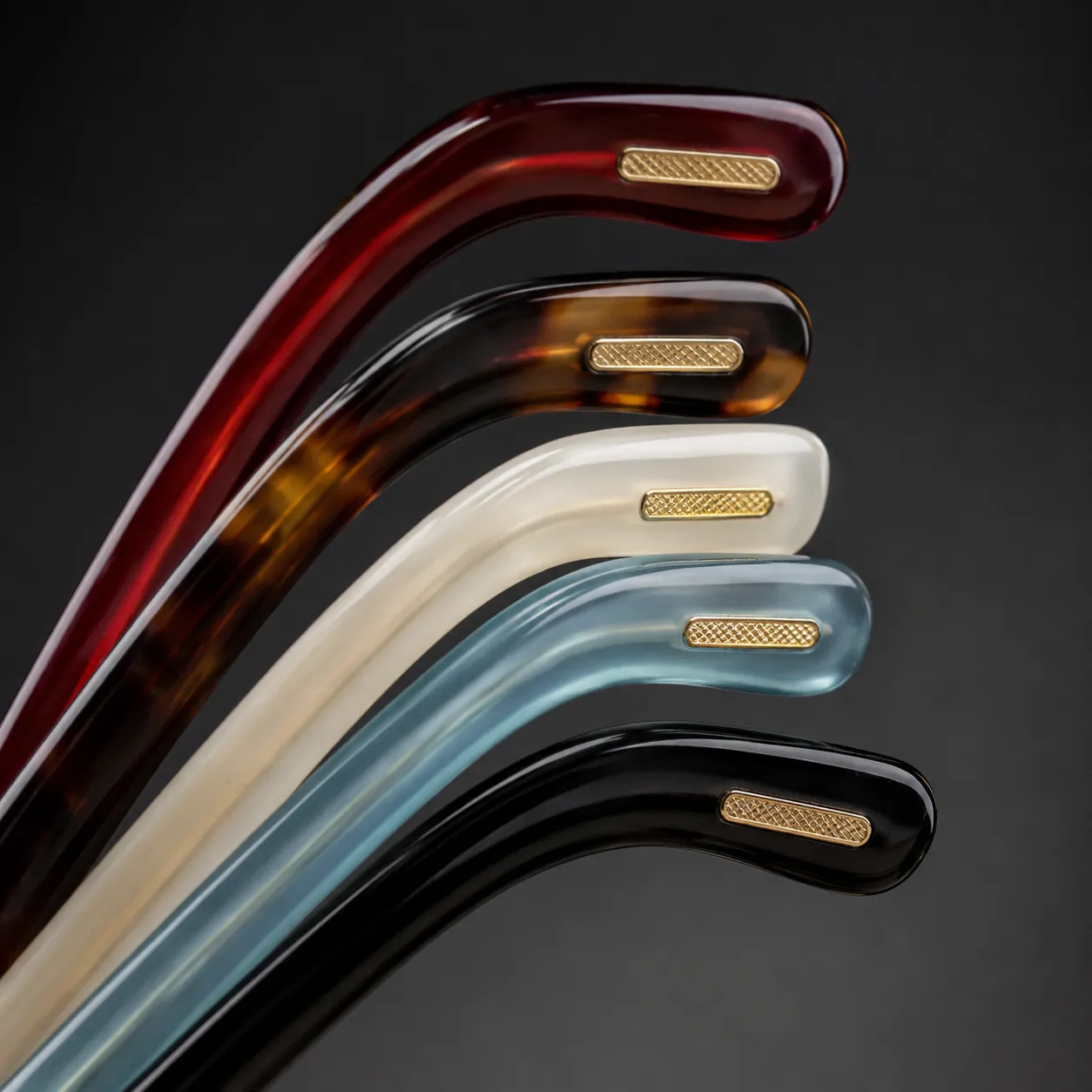
- Metal logo plates or inlays: higher perceived value, but they require stable recess dimensions, secure assembly, and extra QC attention.
Ask for logo placement tolerance, left-right orientation requirements, and the supplier's rub-test or adhesion-check method for the chosen decoration. On narrow temples, even a small shift can be obvious. For low-MOQ orders, simpler decoration usually reduces yield risk. More complex branding can make sense when the order quantity supports setup work and the supplier can prove stable execution on samples.
Match compliance to the exact configuration
Do not choose a model first and leave compliance until the end. Sunglasses compliance is tied to a specific configuration, not to a factory's general capability. Frame construction, lens material, lens tint, filter category, polarization, mirror coating, labeling, and destination market can all affect what evidence is needed.
For Europe, buyers commonly need CE compliance for sunglasses under the applicable product rules, with testing aligned to EN ISO 12312-1. For the United States, buyers may request evidence aligned with ANSI Z80.3, and non-prescription sunglasses or spectacle lenses may also require appropriate FDA registration and device listing responsibilities depending on the role of the manufacturer, importer, or private labeler. Australia and New Zealand commonly reference AS/NZS 1067. Chemical requirements may also apply, especially REACH for the EU. Buyers may separately request factory management or social compliance documents such as ISO 9001 or BSCI, but those do not replace product testing.
Request the following before sample approval:
- Current test reports tied to the same product configuration or a clearly justified equivalent construction
- Lens category, UV performance, and visible light transmittance details
- Material declarations relevant to REACH or other chemical screening requested by the buyer
- Confirmation that logo plates, coatings, inks, plating, or trims do not materially change the tested configuration
- Required labeling, warnings, product information, and packaging markings for the destination market
If you later change lens color, mirror coating, polarization type, lens material, frame material, coating, or decorative hardware, ask whether the existing report still applies. Do not assume one tested colorway covers the full style family. Have the change reviewed against the relevant standard before shipment when there is any doubt.
Build the first order around risk
MOQ is not only a commercial term. It is also a risk-control tool. A supplier may support a small private label run, but a small order does not prove that the model is ready for a larger seasonal rollout. Use the first order to validate fit, finish, packaging, decoration durability, inbound QC results, and early customer feedback.
A practical first-order process usually works like this:
- Shortlist 3-5 models that fit the target price band, customer profile, compliance route, and brand positioning.
- Sample 2-3 finalists using the intended lens material, lens color, and logo method.
- Approve one golden sample per model and lock the specification sheet.
- Place a controlled first commercial order if the style is trend-led, unproven, or technically complex.
- Move to a larger price break only after sell-through feedback and inbound QC results support the decision.
Price breaks should be judged with total exposure in mind. A lower unit cost is useful only if the finished goods meet the agreed specification and can be sold without excessive returns, markdowns, replacements, rework, or air freight. A larger first PO may reduce the piece price but increase the loss if fit, decoration, lens shade, or packaging has not been validated.
Ask how assortment complexity affects lead time and QC. Multiple frame colors, lens tints, mirror coatings, polarized options, and packaging versions increase coordination work. Each variable should be listed on the specification sheet and reflected in sample approval. Fewer variables usually make the first order easier to control.
Use a pre-PO checklist
Weak catalog candidates consume time because they stay under discussion without enough production evidence. If the supplier cannot answer basic model, material, compliance, and QC questions before deposit, the risk usually grows after PO.
Pre-PO pass checklist: technical sheet received, recent production status confirmed, fit sample tested on real wearers, material and lens specification fixed, decoration map approved, compliance documents reviewed for the destination market, golden sample retained, packaging defined, labeling confirmed, and reorder comparison method agreed.
Reject or pause the model when you see these red flags:
- No clear answer on tooling condition, production status, or last bulk run
- Only edited photos and no dimensioned drawing or size sheet
- Logo area described generally instead of measured in millimeters
- Compliance reports unrelated to the proposed frame and lens construction
- Sample differs from catalog image, quotation, or specification without explanation
- No stated QC checkpoints for lens fit, hinge feel, frame alignment, decoration, or cosmetic finish
- Supplier cannot confirm whether the sample represents current production materials and components
A good ODM catalog order is not about picking the most attractive photo. It is about selecting a model that can be repeated with controlled fit, stable branding, documented materials, and compliance evidence for the sales market. Treat catalog frames as starting points. Verify before PO approval.
Have a custom sunglasses project in mind?
Send us your styles, target market and quantities and we will return a detailed quote with MOQ, lead time and a sample plan.
Get a QuoteWhy source this from Wenzhou with LumiShades
Wenzhou in Zhejiang Province is widely regarded as China’s eyewear manufacturing capital, producing a large share of the world’s sunglasses. That concentration matters to buyers: a deep local supply chain for acetate sheet, hinges, lens blanks, plating and packaging means shorter component lead times, easier color and material matching, and a workforce with decades of eyewear-specific skill. LumiShades has manufactured in this ecosystem since 2009, and our vertical integration — in-house injection molding, acetate cutting, CNC milling, lens tinting, decoration and quality control — means no part of your order is quietly subcontracted to a workshop you cannot audit.
For international buyers, that vertical control translates into accountability. When a single factory owns every step, defects are traced and fixed at source rather than bounced between vendors, and your specifications survive intact from first sample to bulk. We back this with 15+ years of experience, shipments to 60+ countries, more than 5 million pairs produced per year and a 98.5% on-time delivery rate. Our certifications — CE EN ISO 12312-1, FDA registration, ANSI Z80.3, AS/NZS 1067, REACH, ISO 9001 and BSCI audit — mean the compliance documentation your market requires already exists. Explore our manufacturing capabilities and quality control process to see how this works in practice.
Frequently asked questions
How many catalog models should I sample before placing a first private label order? Start by screening 3 to 5 models on paper. Review the dimension sheet, material specification, lens options, branding area, tooling or production status, and compliance route. Then sample only the strongest 2 to 3 models using the same lens material, lens color, decoration method, and packaging direction you are considering for the order. Do not spend sample budget on models that lack basic technical files or a clear compliance path.
Is MOQ 50 pairs enough for a real market test? It can be enough for a controlled commercial test of style demand, fit feedback, logo durability, and packaging presentation, especially for a new brand or trend-led style. It is not enough to prove long-term reorder stability. Use the small run to inspect production quality, record customer complaints, compare the goods to the approved sample, and decide whether the model deserves a larger repeat order.
What is the biggest reorder risk with ODM sunglasses? The main risk is specification drift between the approved sample and later production. Drift can show up in frame width, gloss, color, lens shade, hinge feel, lens seating, logo position, or packaging details. Control it by keeping a sealed golden sample, locking a written specification sheet, confirming current tooling or production status before each reorder, and inspecting repeat production against the approved reference.
Which branding method is safest on a low-MOQ order? Pad printing is often the simplest low-MOQ option for a smooth temple and a simple logo because setup is usually less complex than plates, inlays, or multi-step decoration. It still needs approval on a physical sample and a basic rub or adhesion check. If the buyer needs stronger permanence, laser engraving may work on compatible materials, but contrast, position, and readability must be confirmed before PO.
Do compliance reports for one colorway cover all colorways? Not automatically. A report is useful only if it matches the product configuration being sold or if the supplier can justify equivalence under the relevant standard. Changes to lens material, lens tint, visible light transmittance, mirror coating, polarization, frame material, coatings, or decorative hardware may require review or new testing for CE EN ISO 12312-1, ANSI Z80.3, AS/NZS 1067, REACH, or FDA-related obligations where applicable.
Ready to start?
Explore our wayfarer sunglasses or request a quote — our sales team replies within 12 hours.
Request a Quote