
Private Label Polarized Sunglasses Specs for Buyers
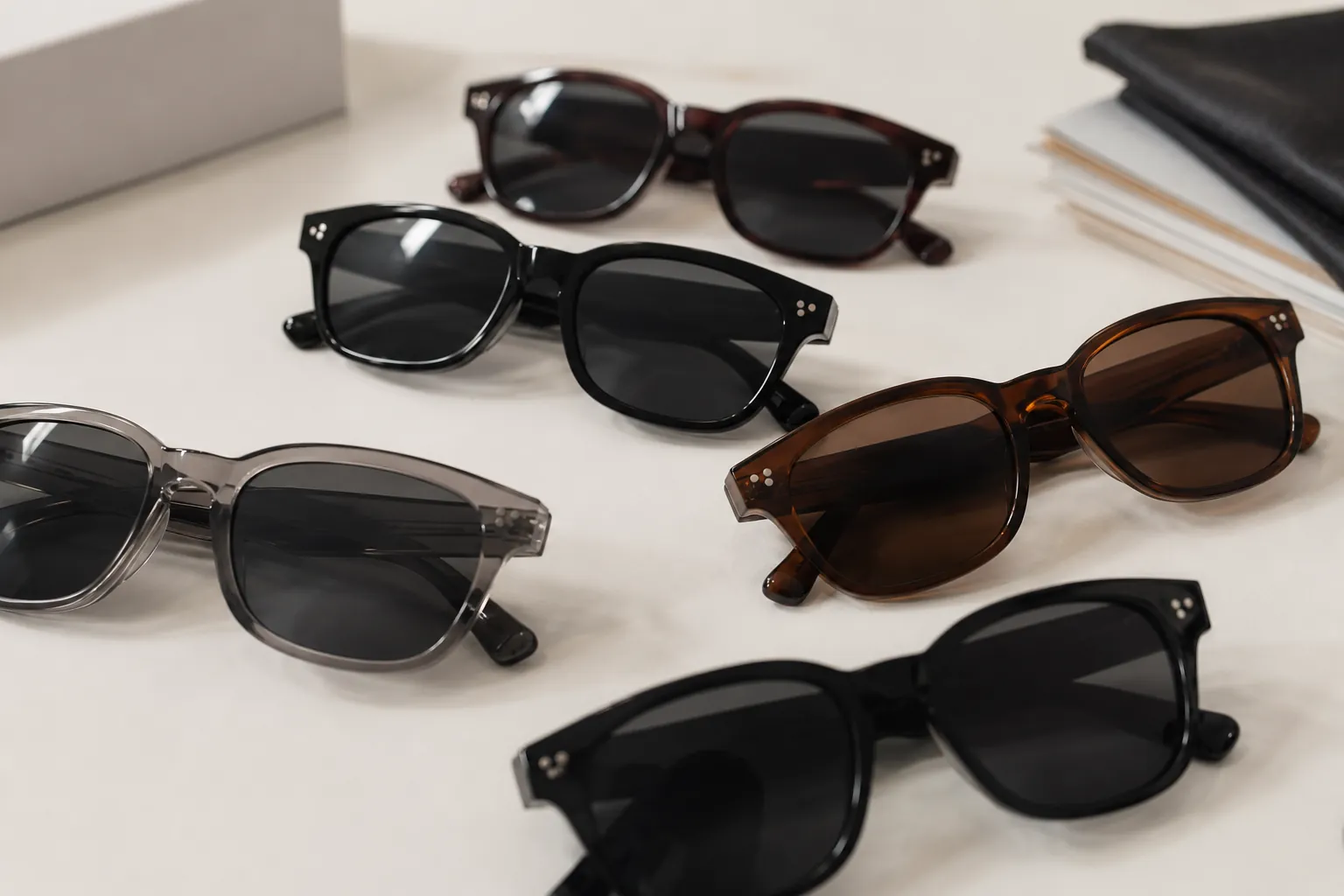
This guide is for brands, importers, distributors, and retail buyers preparing private label polarized sunglasses orders. It explains the lens, frame, decoration, inspection, packaging, MOQ, and lead-time details to confirm before sampling or bulk production starts. The goal is simple: clearer quotations, fewer sample revisions, and fewer disputes over claims such as "polarized," "UV400," and "Category 3."
Start With the Lens Claim
Many buyers begin with frame shape, logo placement, and packaging. That is natural. But for polarized sunglasses, the lens specification should come first. A good-looking frame with weak polarization, unclear UV claims, or the wrong filter category can create compliance risk, customer returns, and costly relabeling.
Write the lens claim in one clear sentence before requesting a quote. For example: TAC polarized lens, UV400, CE EN ISO 12312-1 compliant, Category 3 smoke gray, 8% to 18% visible light transmission, suitable for general outdoor use, not suitable for night driving. That sentence gives the supplier direction on lens material, tint density, test standard, labeling, warning text, and carton marks. It is much stronger than "black polarized lens."
For OEM and private label production, the buyer should define the target claim before sample development. If the purchase order only says "UV polarized," the supplier may quote a lens that passes a simple demonstration card but does not match the retail claim, destination-market rules, or buyer's product page.
- Lens material: TAC is common for private label polarized sunglasses because it is light, thin, and cost-efficient; PC can offer stronger impact resistance but needs tighter optical and stress control.
- UV claim: Use UV400 or define ultraviolet blocking up to 400 nm; do not treat polarization as UV protection.
- Filter category: Category 2 is generally 18% to 43% visible light transmission; Category 3 is 8% to 18%; Category 4 is 3% to 8% and is not suitable for driving.
- Market standard: Confirm the required standard by destination market, such as CE EN ISO 12312-1, ANSI Z80.3, AS/NZS 1067, REACH, FDA registration, ISO 9001, or BSCI where applicable.
Put Polarization Specs in Writing
Polarization is not a sticker. It is a filter layer, often laminated inside the lens structure, that reduces horizontal glare from roads, water, snow, and glass. For B2B orders, the real issue is consistency from the approved sample to bulk production. A good sample means little if mass production uses a different film, adhesive, tint bath, coating process, or lens batch without approval.
For TAC polarized lenses, a typical structure may include TAC protective layers, adhesive layers, a polarizing PVA film, UV treatment, tint, and optional hard coating or mirror coating. Thickness, curve, coating, and cutting method should be confirmed for the actual frame. Poor adhesive control, incorrect lamination conditions, or excessive assembly stress can cause bubbles, haze, edge lift, delamination, or lens popping after heat exposure.
Set a practical polarization requirement. At minimum, the supplier should check each production batch with a polarized test card and a second polarized lens rotated 90 degrees. For larger or higher-risk orders, define carton sampling, acceptance criteria, and defect classification before production. If the product is sold for fishing, driving, water sports, or outdoor retail, batch control should be tighter. Weak polarization is easy for end users to spot.
| Specification Item | Buyer Requirement | Production Risk Controlled |
|---|---|---|
| Film orientation | Consistent polarization axis across left and right lenses, checked after cutting and assembly | Mismatched orientation can reduce glare control and cause wearer discomfort |
| Polarization verification | Test card check plus random batch inspection by SKU, lens color, and carton lot | Helps prevent non-polarized or weakly polarized lenses entering bulk cartons |
| Lamination quality | No visible bubbles, wrinkles, haze, delamination, or edge lift after cutting and assembly | Defects often appear after edging, drilling, heating, or frame insertion |
| Pair color matching | Left and right lenses visually matched under neutral light and compared with the approved sample | Visible color differences look poor on retail shelves and can trigger returns |
| Heat behavior | Basic heat exposure check on assembled samples, especially for dark colors and mirror lenses | Identifies warpage, lens popping, adhesive failure, and coating instability before shipment |
Separate UV400 From Compliance
UV400 means the lens is claimed to block ultraviolet radiation up to 400 nm. It is a performance claim. Compliance standards are the rules or test methods used to evaluate sunglass safety, optical quality, filter category, labeling, and, in some cases, chemical restrictions. Do not mix these up. Keep them separate in the specification sheet, test request, packaging copy, and product page.
For Europe, CE EN ISO 12312-1 is commonly requested for sunglasses. For the United States, ANSI Z80.3 is commonly referenced, and FDA registration may be relevant for suppliers or import handling. For Australia and New Zealand, AS/NZS 1067 is commonly requested. REACH is a European chemical compliance requirement that can apply to frame materials, coatings, inks, metal decorations, screws, nose pads, and packaging components. ISO 9001 and BSCI relate to management systems and social compliance. They do not replace product testing for a specific sunglass SKU.
Do not add a certification or compliance statement to a retail page unless you hold a current document that applies to the product being shipped. Ask whether the report covers the same lens color, filter category, frame material, coating, decoration, and packaging components used in your order. A smoke Category 3 lens report does not automatically support a yellow Category 1 lens. A PC frame chemical report does not automatically support an acetate model with metal logo plates and printed temples.
Buyer rule: match the report to the shipped product. If the material, tint, coating, decoration, supplier batch, or production process changes, confirm whether the existing compliance file still supports the claim.
Match Lens Color, Category, and Use
Lens color is not only a fashion choice. It affects visible light transmission, color perception, retail labeling, and the use case a buyer can safely claim. A dark-looking lens is not automatically safer. A light lens can still provide UV400 protection if it has been properly treated and tested. Tint controls wearer comfort and filter category. UV treatment controls ultraviolet protection.
For private label orders, define both color and filter category. Category 3 is common for bright sunlight, beach, travel, and general outdoor use because it reduces strong sunlight without entering the Category 4 driving restriction. Category 2 is suitable for medium sunlight and many fashion styles. Category 1 is a light tint and should not be positioned as strong sun protection. Category 4 is very dark, usually reserved for intense glare environments, and should be clearly marked as not suitable for driving.
| Lens Option | Typical Buyer Use | Specification Note |
|---|---|---|
| Smoke gray polarized | Driving, beach, general outdoor | Neutral color perception; often specified as Category 3 with 8% to 18% VLT |
| Brown polarized | Fishing, outdoor lifestyle, sport fashion | Warmer contrast; check pair matching because brown tint shifts are easy to see |
| Green polarized | Classic fashion, casual outdoor | Good retail appearance; confirm tint consistency after hard coating or mirror coating |
| Mirror polarized | Sport, resort, promotional retail | Mirror coating adds scratch, color, adhesion, and consistency requirements |
If you sell through retailers or marketplaces, keep claims simple and defensible. "UV400 polarized Category 3 sunglasses" is clearer than broad lifestyle promises. Make sure the product page, hangtag, pouch insert, warning label, and carton label use the same lens category, warnings, and use instructions.
Frame Material Changes Lens Risk
The same polarized lens can behave differently in different frames. Injection frames, acetate frames, metal fronts, rimless drilling, and high-curve sport frames all place different stress on the lens. Confirm frame construction before approving lens thickness, base curve, edge shape, and assembly method.
Injection-molded PC, TR, or similar plastic frames are efficient for volume programs and color runs, but shrinkage, warpage, and lens groove tolerance must be controlled after molding. Acetate frames can feel more premium, but they require cutting, tumbling, polishing, hinge installation, and hand adjustment. The lens groove must not be too tight, especially on thick acetate fronts. Metal frames and rimless designs may require drilled lenses, screws, bushings, or nylon wire. Each point can add stress.
Lens cracking often starts at the edge or drill hole and may not show in sample photos. Ask the supplier to check assembled lens fit, temple opening pressure, hinge alignment, nose pad symmetry, and frame warpage after basic heat exposure. For curved sport frames, also check optical distortion. High base-curve lenses need tighter control because the wearer may see waves or pulling at the side view if the lens is forced into the frame.
- Confirm lens thickness and base curve before mold adjustment or frame approval.
- Approve assembled samples, not only loose lenses and empty frames.
- Check lens groove pressure, especially on acetate and high-curve styles.
- Test the final decorated version, including logo plates, pad print, hot stamping, or laser engraving.
Control Decoration, Packaging, MOQ, and Samples
Private label sunglasses often fail commercially when the buyer approves the shape but not the full retail execution. Decoration method, packaging, MOQ, sample timing, and price tier should be reviewed together. Each one affects cost, lead time, and inspection difficulty.
Common decoration methods include pad printing, laser engraving, hot stamping, metal logo plates, temple printing, and lens marking. Pad printing is cost-efficient for simple one-color logos, but ink adhesion depends on the frame material and surface finish. Laser engraving is clean and durable on suitable materials, but it may be subtle on dark colors. Metal logo plates can look premium but require accurate recess depth, glue control, and placement tolerance. Lens printing or stickers need extra caution because they may affect appearance, scratch expectations, or consumer interpretation of lens claims.
Compare MOQ and price only after the lens, frame, decoration, packaging, inspection level, and compliance requirements are defined. A simple injection frame with TAC polarized lenses and pouch packaging will not price like an acetate frame with metal logo plates, mirror polarized lenses, custom box, barcode labels, and multi-market inserts. If a supplier quotes MOQ, sample time, bulk lead time, or volume price, ask whether the quote includes final artwork, packaging materials, testing, inspection, and destination-market labeling.
- Sample approval: approve the physical frame fit, lens tint, polarization, logo, hinge tension, packaging, and warning text whenever possible.
- Artwork control: provide logo files, Pantone references, print size, position tolerance, and packaging layout before sampling.
- MOQ planning: confirm MOQ by design, color, lens option, and packaging version; do not assume one MOQ covers every variation.
- Cost drivers: mirror coating, acetate polishing, metal logos, custom packaging, barcode labeling, and additional compliance reports can all increase cost.
- Lead-time control: separate sample timing from bulk production timing, and state when the clock starts: after artwork approval, deposit, material approval, or signed sample.
Inspect Before Cartons Are Sealed
Inspection should not wait until cartons are sealed. A polarized sunglasses order has several failure points: lens film, tinting, coating, frame molding, acetate polishing, decoration, assembly, cleaning, and packing. A useful QC plan checks the product at each stage and defines what happens if a critical defect is found.
At incoming inspection, check lens sheets or finished lenses for polarization, UV performance according to the agreed method, tint, scratches, bubbles, haze, and coating defects. For frames, check color, shrinkage, hinge parts, screw quality, nose bridge shape, and surface finish. During assembly, check lens fitting pressure, temple alignment, nose pad position, logo placement, and screw tightness. Final inspection should include wearing comfort, pair matching, visual defects, carton count, barcode or SKU label, pouch, cleaning cloth, warning text, and master carton marks.
AQL can be agreed before production, but buyers should also name critical defects. Non-polarized lenses in a polarized order should be critical. Wrong UV claim should be critical. Sharp edges near the temple or bridge should be critical. Incorrect compliance labeling and mixed SKUs should be critical. Minor cosmetic marks can be classified separately under the agreed AQL plan.
| Inspection Stage | Key Checks | Common Failure |
|---|---|---|
| Incoming lens | Polarization, UV400 claim, tint, coating surface, lens batch identity | Wrong lens batch, uneven tint, bubbles, haze, or coating scratches |
| Frame production | Color, shrinkage, hinge fit, surface defects, groove tolerance | Warped fronts, loose temples, tight lens grooves, or color mismatch |
| Decoration | Logo position, adhesion, print sharpness, metal plate alignment | Pad print rubbing off, crooked logos, glue overflow, or plating scratches |
| Final packing | Pair matching, labels, accessories, carton count, warning text | Mixed SKUs, missing compliance wording, wrong barcode, or missing pouch |
Use a Purchase Order Checklist
A vague purchase order creates expensive conversations after production. A clear purchase order is not necessarily long. It is specific. For private label polarized sunglasses, attach a spec sheet with drawings, Pantone or physical color references, lens requirements, logo artwork, packaging layout, inspection standard, and destination market.
Include commercial details too. State MOQ by design and color, target quantity, price tier, sample deadline, bulk delivery window, payment terms, shipping method, and carton requirements. Schedule discipline depends on timely buyer approvals, available materials, confirmed artwork, and clear compliance wording. Late artwork, changed packaging, and unclear claims can delay production because the supplier cannot inspect or label a claim that was never written down.
- Lens: material, polarized requirement, UV400 claim, tint color, VLT or filter category, coating, and mirror finish if used.
- Compliance: CE EN ISO 12312-1, ANSI Z80.3, AS/NZS 1067, REACH, FDA registration, ISO 9001, or BSCI as applicable to the destination market and supplier scope.
- Frame: material, color reference, hinge type, lens curve, temple length, nose fit, and assembly method.
- Branding: laser engraving, pad printing, hot stamping, metal logo plate, artwork size, position, color, and tolerance.
- QC: AQL level, critical defects, inspection photos, polarization test method, UV verification method, and carton sampling plan.
- Packing: pouch, cloth, retail box, barcode, warning label, user information, master carton marks, and country-specific wording.
If a supplier resists putting key specifications in writing, treat that as a risk signal. Reliable production teams usually prefer clear specs because they reduce rework, disputes, and inconsistent inspection decisions.
Have a custom sunglasses project in mind?
Send us your styles, target market and quantities and we will return a detailed quote with MOQ, lead time and a sample plan.
Get a QuoteWhy source this from Wenzhou with LumiShades
Wenzhou in Zhejiang Province is widely regarded as China’s eyewear manufacturing capital, producing a large share of the world’s sunglasses. That concentration matters to buyers: a deep local supply chain for acetate sheet, hinges, lens blanks, plating and packaging means shorter component lead times, easier color and material matching, and a workforce with decades of eyewear-specific skill. LumiShades has manufactured in this ecosystem since 2009, and our vertical integration — in-house injection molding, acetate cutting, CNC milling, lens tinting, decoration and quality control — means no part of your order is quietly subcontracted to a workshop you cannot audit.
For international buyers, that vertical control translates into accountability. When a single factory owns every step, defects are traced and fixed at source rather than bounced between vendors, and your specifications survive intact from first sample to bulk. For procurement review, buyers can request process records, approved samples, quality checkpoints and project-specific compliance files before placing a bulk order. Required testing and documentation are confirmed against the destination market and product specification rather than assumed from a generic certificate list. Explore our manufacturing capabilities and quality control process to see how this works in practice.
Frequently asked questions
Is UV400 the same as polarized? No. UV400 means the lens is claimed to block ultraviolet radiation up to 400 nm. Polarization means the lens uses a filter to reduce glare. Specify both separately, for example: "TAC polarized lens, UV400, Category 3, 8% to 18% VLT." Ask the supplier for test evidence that supports the UV claim and inspect polarization during production.
What MOQ should I use for a first private label polarized order? Use an MOQ that matches your risk, not only the lowest quoted number. Confirm whether MOQ is counted by frame design, frame color, lens color, logo method, or packaging version. For a first order, many buyers start with fewer SKUs and one or two lens options so inspection, packaging, and compliance documents stay manageable. Ask the supplier to quote price breaks at realistic quantities before finalizing the launch range.
How long should samples and bulk production take? Sample and bulk timing should be written into the quotation and purchase order. Ask the supplier when timing starts: after artwork confirmation, deposit, lens approval, packaging approval, or signed sample. Also ask what can reset the schedule, such as changing lens color, mirror coating, logo placement, packaging structure, barcode files, or compliance wording after approval.
Which compliance standards should I request for polarized sunglasses? Match the request to the destination market and sales channel. Common examples include CE EN ISO 12312-1 for Europe, ANSI Z80.3 for the United States, AS/NZS 1067 for Australia and New Zealand, and REACH for EU chemical compliance. FDA registration may be relevant for supplier or import handling in the United States. ISO 9001 and BSCI can support supplier qualification, but they do not replace product-specific sunglass testing.
Can I use one test report for every lens color? Do not assume that one report covers every version. Ask whether the report applies to the exact lens color, filter category, coating, frame material, decoration, and supplier batch in your order. A smoke Category 3 lens report may not support a yellow Category 1 lens, and a non-mirror report may not support a mirror-coated version. Keep the report file linked to the SKU or material set being shipped.
What defects should be treated as critical in inspection? Critical defects should include non-polarized lenses in a polarized order, unsupported or incorrect UV claims, unsafe sharp edges, incorrect compliance labeling, missing required warnings, mixed SKUs, and wrong lens category. Put these defects in the inspection checklist before production starts. Minor cosmetic issues, such as small packaging marks, can be handled separately under the agreed AQL level.
Ready to start?
Explore our cat-eye sunglasses or request a quote — our sales team replies within 12 hours.
Request a Quote