
Polarized vs Non-Polarized Wholesale Sunglasses
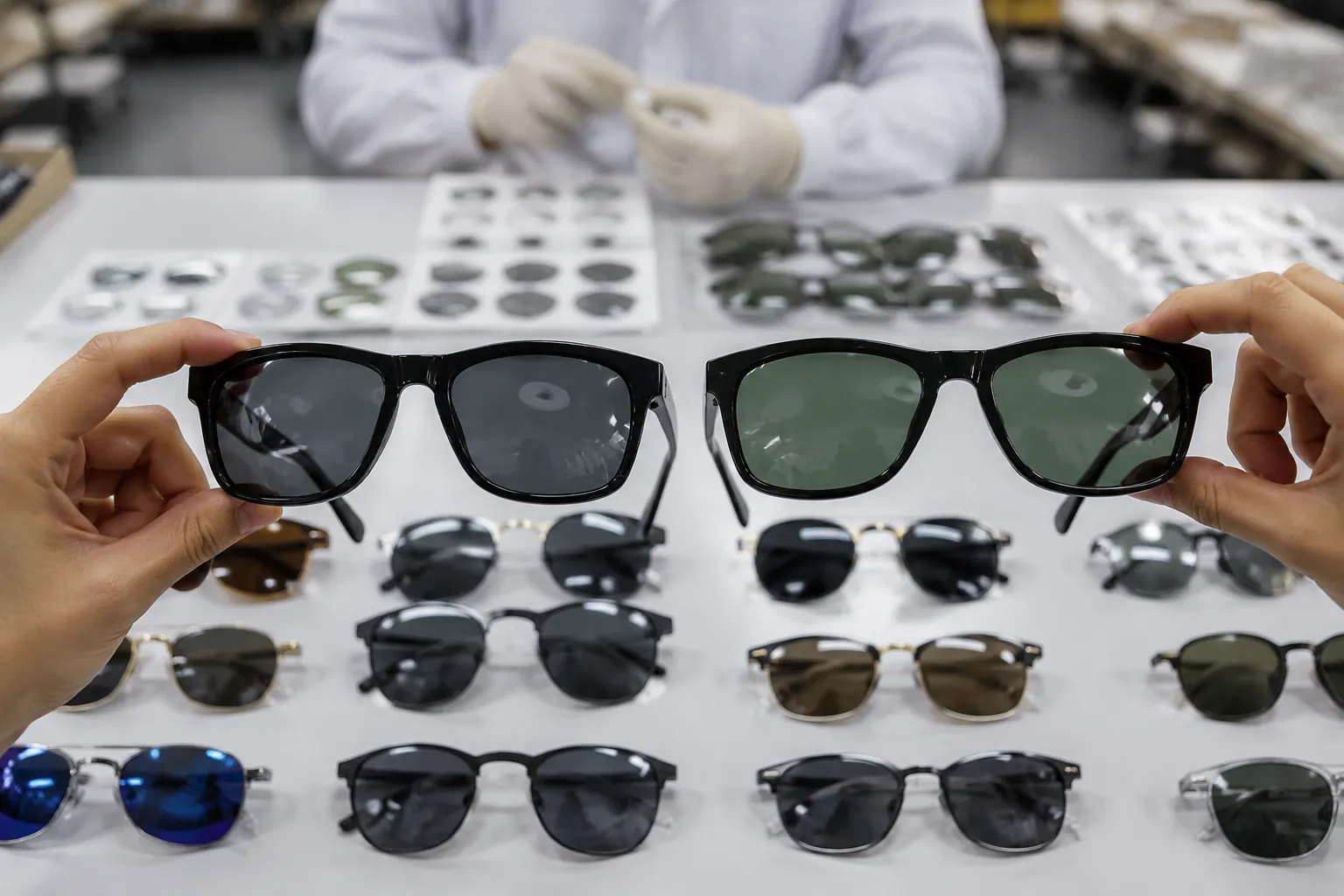
If you buy sunglasses for brands, importers, retail chains, or marketplaces, polarization is not a simple upgrade. It changes cost, inspection, packaging claims, and sometimes sell-through by channel. This guide shows where polarized lenses make sense, where they add friction, and how to choose a lens mix that fits your market, price band, and compliance needs.
The real buying decision
Polarized and non-polarized sunglasses solve different problems. The wholesale choice is rarely about optics alone. Polarized lenses use a light-filtering film to reduce reflected glare from water, roads, glass, and snow. Non-polarized lenses reduce brightness, but they do not target that reflected glare.
That difference is easy to show in a store. It matters more in sourcing. Lens type affects cost, inspection, packaging, and how the product is explained on shelf or on a product page.
Start with the channel. Ask a simple question: what is the customer buying this pair for? A fisherman, boater, driver, or outdoor sports buyer often expects polarization. A fashion buyer usually cares more about shape, color, and price. Match the lens to the buying intent. If you do not, you may pay for a feature the customer never asked for.
There is also a production reality. Polarized lenses usually need tighter control over film alignment, lamination stability, and visual inspection than standard tinted lenses. If the polarizing axis shifts, the pair can look mismatched or perform unevenly. So ask the factory how it controls lens consistency, what it checks, and what counts as a defect.
Do not pick one lens type for every account by default. Map the lens to the channel, the claim, and the margin band. Polarized belongs where function sells the product. Non-polarized belongs where price, speed, and style lead the order.
Where polarization adds value
Polarization matters most when glare is the problem. That is why it works well in fishing, boating, driving, snow, and some outdoor sport programs. It reduces reflected light from flat or wet surfaces. That can improve comfort in bright conditions.
For sourcing teams, the value usually comes from three places. It gives the product a clearer functional story. It can support a higher ticket in the right channel. It can also make a basic frame look more premium without changing the frame platform.
- Reduces reflected glare from roads, water, glass, and pavement.
- Improves perceived contrast in bright outdoor conditions.
- Supports clearer product copy, hangtags, and sales scripting.
- Can premiumize an existing frame family without retooling the frame.
- Helps functional assortments justify higher AOVs in sport and travel channels.
Polarized lenses are not always better. They can make some LCD screens, dashboards, and instrument panels harder to read at certain angles. If your channel includes drivers, cyclists, pilots, or general outdoor users, say that plainly. Clear positioning is better than avoidable returns.
Cost is not only about the lens. Polarized production can add inspection time and raise reject risk if the batch is not controlled well. Even when the frame cost stays fixed, those extra controls can change margin by account.
Where non-polarized wins
Non-polarized sunglasses usually win in fashion-led programs, entry-price tiers, and broad casual distribution. They are cheaper, easier to produce, easier to replenish, and easier to sell when the customer mainly cares about style. In volume programs, the simpler lens structure can also reduce process variables and lower the chance of inspection issues.
That simplicity matters in channels where the buyer does not want to explain lens technology. Department stores, souvenir shops, promotional programs, gift sets, and low-AOV online listings often move faster with a clean style story and a lower landed cost. In those channels, the customer is choosing shape, color, and fit, not optical performance.
Non-polarized styles also help with assortment structure. A solid wholesale line usually needs entry, core, and premium tiers. Non-polarized SKUs can anchor the lower tiers while polarized styles carry the utility tier. That gives sales more price laddering without forcing every frame to carry the same lens cost.
Replenishment is simpler too. If you reorder often across multiple accounts, non-polarized programs are usually easier to duplicate because there are fewer lens-specific details to lock down. For buyers who need fast turns, that can matter more than a feature only some customers value.
Head-to-head lens comparison
| Factor | Polarized | Non-Polarized |
|---|---|---|
| Glare control | Strong on reflective surfaces such as water, roads, and snow | Basic brightness reduction only |
| Best channels | Fishing, boating, driving, outdoor sport, travel | Fashion, promo, gifting, entry retail |
| Typical cost impact | Higher material cost and tighter QC requirements | Lower cost and simpler processing |
| Customer education needed | Moderate to high, especially for screen visibility trade-offs | Low |
| Lead-time sensitivity | Higher if film alignment, tint, or packaging claims change | Lower, with fewer lens-specific steps |
| Compliance focus | Must still meet market-specific eyewear standards | Must still meet market-specific eyewear standards |
The point is simple: polarization is a feature, not a default upgrade. If you sell to mixed channels, carrying both specs is usually safer. Forcing one lens type across every account may look tidy on paper, but it can weaken conversion where the wrong spec misses the customer's intent.
Factory control matters on both lens types. Frame symmetry, lens centration, edge fit, coating consistency, and cosmetic finish all need control. With polarized pairs, ask how the factory checks polarizing consistency and left-right matching within a batch. If the supplier cannot explain the standard, the process is not well defined.
Decoration should match the final claim. Laser engraving on the lens edge, pad printing on the temple, hot stamping on the case, and foil logos on packaging all need to match the approved spec. A "polarized" mark should appear only when the lens spec is approved and the packing copy matches it exactly.
How it changes cost and lead time
One common mistake is treating polarization as a small add-on. In practice, it can affect raw material cost, lamination labor, reject rate, packaging, and inspection time. If your pricing ladder runs on low, mid, and high volume tiers, the lens choice can move you between tiers faster than the frame choice does.
At LumiShades, MOQ starts at 50 pairs per design, which makes it easier to test a polarized SKU without overcommitting inventory. Samples are typically 7-10 days when the spec is clear. Bulk production is usually 25-35 days after sample approval, assuming there are no artwork or specification changes. Any change to frame color, lens tint, polarization requirement, logo method, or packaging claim can add time because it may require a new sample or updated QC review.
A practical procurement sequence keeps the order moving:
- Confirm frame model, lens color, and polarized or non-polarized requirement first.
- Approve the exact sample with the final lens spec and decoration method.
- Lock compliance documents for the destination market before mass production.
- Freeze packaging claims, labels, and any polarization callouts.
- Run pre-shipment QC on clarity, fit, alignment, finish, and cosmetic consistency.
Think in tiers, not one universal unit price. Lower volumes absorb setup and inspection cost less efficiently, so a polarized lens can look expensive at 50 or 100 pairs. At higher volume, the same spec is easier to absorb. The real question is not what the cheapest lens is. It is what lens lets you hold margin at the volume you can actually sell.
Compliance is not optional
Compliance is where many buyers get careless. Polarized does not mean safer by default, and non-polarized does not mean non-compliant. Sunglasses still need to meet the right standard for the destination market, the lens category, and the claims printed on the product or packaging.
For wholesale programs, keep the certification set limited to what is actually relevant and supportable. The certifications and references commonly used in eyewear sourcing include CE EN ISO 12312-1, ANSI Z80.3, AS/NZS 1067, REACH, FDA registration, ISO 9001, and BSCI. Do not ask a supplier for paperwork the factory or product cannot substantiate. Customs, retail onboarding, and marketplace review teams check documents closely.
Use the right standard for the market and keep the claim aligned to the approved sample:
- EU and many European buyers: CE EN ISO 12312-1 is the common eyewear reference.
- United States: FDA registration and ANSI Z80.3 are frequently requested.
- Australia and New Zealand: AS/NZS 1067 is the key reference point.
- Material compliance: REACH matters for restricted substances and material declarations.
If you are buying polarized lenses, ask how the factory verifies optical consistency and how it checks batch-to-batch matching. Also confirm whether sample approval includes the exact wording for any product claim. Compliance paperwork without spec control is not enough. The shipped product must match the approved sample in lens type, tint, and labeling.
Decoration and compliance are linked. If you use printed logos, etched marks, or branded cases, make sure the artwork does not imply a protection level or standard the product has not been approved for. The safest wholesale programs keep the claim set simple, accurate, and consistent across lens, frame, case, and carton.
How to choose by channel and market
Channel choice should drive the lens choice, not the other way around. A practical way to decide is to map each program by customer intent, price band, and explanation burden. The more the customer buys for function, the more likely polarization matters. The more the customer buys for style or gifting, the more likely non-polarized will win.
| Channel | Recommended lens strategy | Why |
|---|---|---|
| Fishing / boating | Polarized core assortment | Glare control is the core selling point |
| Driving / travel | Polarized with clear labeling | Functional benefit is easy to explain |
| Fashion retail | Mostly non-polarized, selective polarized premium SKUs | Style usually sells first |
| Promotional / gift | Non-polarized | Lower cost and simpler messaging |
| Marketplace / DTC mixed catalog | Both, separated by use case | Search intent varies by customer |
Market maturity matters too. In some markets, buyers already understand polarization. In others, it needs education and tighter merchandising. If your team cannot explain the lens in one sentence, the customer probably will not pay a premium for it. That is not a product problem. It is a merchandising problem.
For private label buyers, a dual strategy is often the most practical. Use core non-polarized styles for volume, then a smaller polarized line for functional channels. That spreads risk, protects price coverage, and gives sales a simple upsell path without bloating the catalog. It also lets you test which accounts actually convert on the feature instead of assuming every customer wants the same spec.
A practical sourcing checklist
Put the spec in writing before you place the order. Loose language creates disputes later, especially when multiple factories or agents are involved. If the supplier says "polarized available," that is not enough. The purchase order and sample approval should state the exact lens type, finish, claim, and packing language.
- State polarized or non-polarized on the PO and sample approval.
- Confirm lens color, visible light transmission target, and mirror or tint finish if used.
- Specify the decoration method: laser engraving, pad printing, metal logo plate, or no lens mark.
- Ask for the market-specific compliance documents before mass production.
- Check whether the frame material suits the lens build and edge finishing method.
- Confirm MOQ, tier pricing, sample timing, bulk lead time, and rework policy.
Factory capability matters because not every plant controls molding, acetate cutting, CNC milling, tinting, decoration, and QC in-house. In-house control usually means fewer handoffs, faster problem solving, and better consistency when a batch drifts. That matters more with polarized lenses because a small visual defect can create a larger reject rate than a standard tinted lens.
If you want the cleanest result, align the commercial and technical specs before sampling. Lock the lens type, write down the acceptance criteria, approve the artwork, and verify the claim language. Then keep the order stable through production. Polarized versus non-polarized is not a style debate. It is an assortment decision. Use polarization where glare control is the reason to buy, and use non-polarized where price, speed, or fashion drives the order.
Have a custom sunglasses project in mind?
Send us your styles, target market and quantities and we will return a detailed quote with MOQ, lead time and a sample plan.
Get a QuoteWhy source this from Wenzhou with LumiShades
Wenzhou in Zhejiang Province is widely regarded as China’s eyewear manufacturing capital, producing a large share of the world’s sunglasses. That concentration matters to buyers: a deep local supply chain for acetate sheet, hinges, lens blanks, plating and packaging means shorter component lead times, easier color and material matching, and a workforce with decades of eyewear-specific skill. LumiShades has manufactured in this ecosystem since 2009, and our vertical integration — in-house injection molding, acetate cutting, CNC milling, lens tinting, decoration and quality control — means no part of your order is quietly subcontracted to a workshop you cannot audit.
For international buyers, that vertical control translates into accountability. When a single factory owns every step, defects are traced and fixed at source rather than bounced between vendors, and your specifications survive intact from first sample to bulk. For procurement review, buyers can request process records, approved samples, quality checkpoints and project-specific compliance files before placing a bulk order. Required testing and documentation are confirmed against the destination market and product specification rather than assumed from a generic certificate list. Explore our manufacturing capabilities and quality control process to see how this works in practice.
Frequently asked questions
Should I make all wholesale sunglasses polarized? No. Polarized lenses fit sport, driving, boating, and other outdoor utility channels where glare control matters. Non-polarized styles are usually better for fashion, promo, gifting, and entry-price programs where cost and style matter more than glare reduction. A mixed assortment is usually the safer wholesale strategy.
Does polarization change compliance requirements? It does not replace compliance. You still need the right market documents and test references for the destination market, such as CE EN ISO 12312-1, ANSI Z80.3, AS/NZS 1067, REACH, and FDA registration where applicable. The lens type must also match the approved sample and product claims.
What MOQ should I expect for polarized custom sunglasses? MOQ depends on the factory and the build, but LumiShades starts at 50 pairs per design. That is a workable level if you want to test a polarized SKU before a larger run. Ask whether MOQ changes by frame material, lens color, or decoration method.
How long does sampling and bulk production take? Typical samples take 7-10 days when the spec is complete. Bulk production is usually 25-35 days after sample approval, assuming there are no changes to artwork, lens spec, or packaging. The fastest way to keep timing stable is to freeze the design before sampling starts.
When does polarization hurt sell-through? It can hurt sell-through in fashion-led, price-led, or gift channels where customers do not value glare control and do not want a higher ticket. It can also hurt if the product page or packaging does not explain the benefit clearly. In those channels, simpler non-polarized styles usually convert better.
What should I ask a factory before ordering polarized lenses? Ask for the exact lens specification, the inspection method, the compliance documents, the sample approval process, pricing by volume tier, the decoration method, and the rework policy. Also confirm whether the factory controls tinting and QC in-house and how it verifies batch consistency for polarized pairs.
Ready to start?
Explore our square sunglasses or request a quote — our sales team replies within 12 hours.
Request a Quote