
Polarized TAC vs PC Lenses: Cost, Risk, and Fit
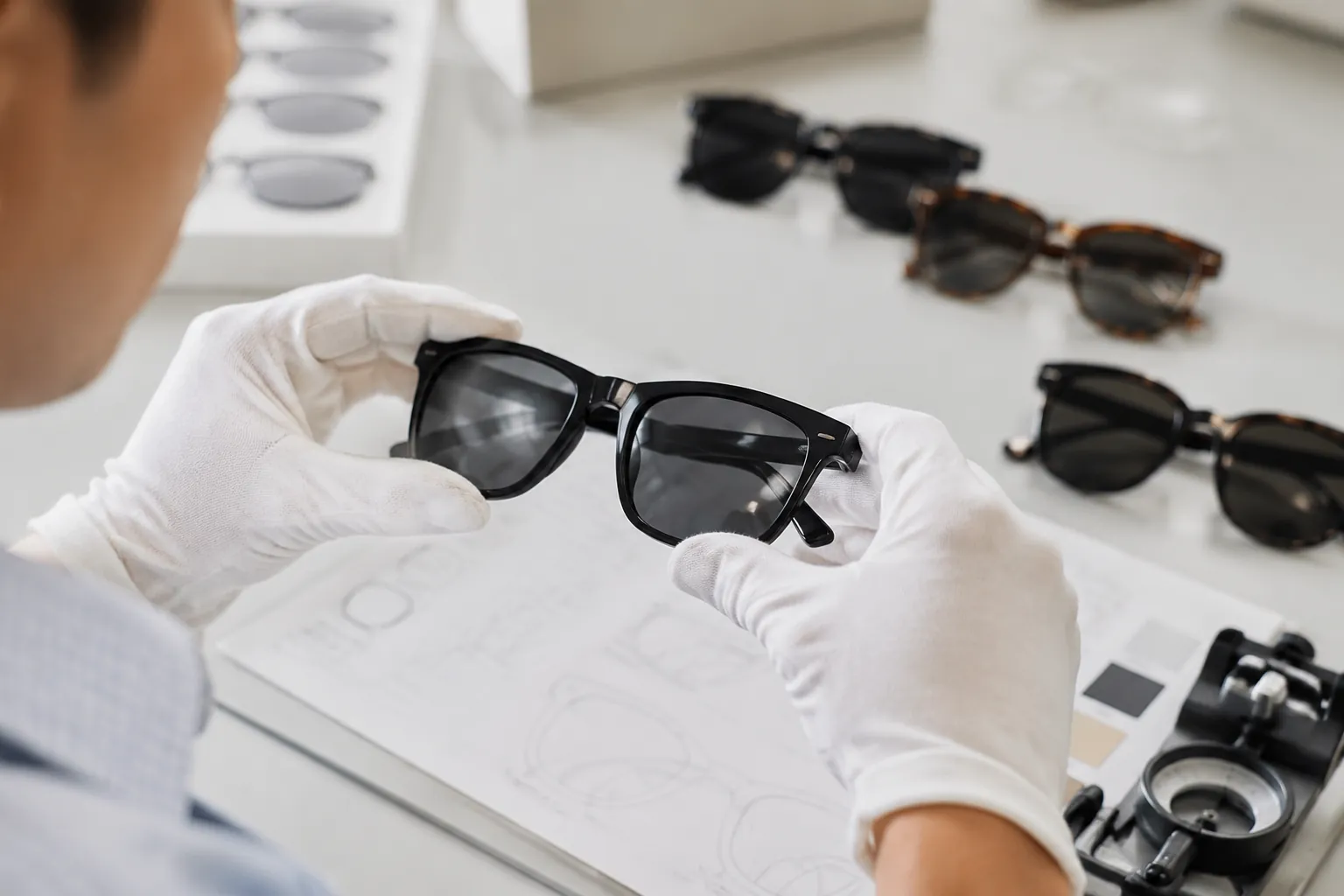
This guide is for buyers building a sunglasses line and choosing between polarized TAC and polarized PC lenses. Both can work. They differ in construction, durability, processing risk, and channel fit. The right call depends on use case, frame design, compliance needs, and target cost. Use this as a sourcing checklist before you issue an RFQ or approve samples.
Start with the channel and use case
Buyers often ask, "Which lens is better?" That is usually the wrong question.
For sourcing, the useful question is this: which lens spec best fits the channel, use conditions, compliance requirements, and target price?
Polarized TAC is common in fashion sunglasses, promotional programs, gift sets, and private-label lines where cost matters and the product is not positioned for high-impact use. Polarized PC is common in sport, outdoor, driving, youth, fishing, boating, and other active-use programs where toughness matters more.
If the style is fashion-led and sold mainly on look, branding, and price, TAC is often the first material to check. If the product will be handled hard, worn during movement, or sold in channels where durability complaints are more likely, PC is often the safer starting point.
That is why channel fit comes before material preference. Lens choice affects quoted cost, sample approval, frame fit, coating requirements, test planning, and the complaint pattern you may see after shipment.
What TAC and PC mean in a polarized lens
TAC means triacetate cellulose. In sunglasses, polarized TAC lenses are usually laminated builds made from TAC layers, adhesive layers, and a polarized film. They are widely used in fashion eyewear because they are light and often cost less than polarized PC options.
PC means polycarbonate. A polarized PC lens uses a polycarbonate substrate with a polarized layer or polarized construction, depending on the supplier's process. Polycarbonate is known for impact resistance and is widely used where toughness is a priority.
For buyers, the material difference usually shows up in four areas:
- Optical consistency: both can perform well if processed well, but buyers should judge production-level samples, not a single hand sample.
- Impact resistance: PC usually has the edge and is often preferred for active-use eyewear.
- Surface performance: both TAC and PC usually need a hard coat or similar treatment to improve scratch resistance.
- Manufacturing sensitivity: both need process control, but the risk points differ. For TAC, watch lamination quality. For PC, watch forming, coating, and assembly control.
Do not buy on appearance alone. One sample can look fine in either material. The real issue is whether the supplier can hold tint, polarization, coating quality, and frame fit across bulk production.
Head-to-head comparison for sourcing decisions
| Factor | Polarized TAC | Polarized PC | Buyer takeaway |
|---|---|---|---|
| Typical cost position | Usually lower | Usually higher | TAC is often checked first for price-sensitive programs |
| Optical performance | Can suit fashion and general wear if lamination is well controlled | Can suit general and active use if coating and processing are well controlled | Approve against production samples and defined tolerances |
| Impact resistance | Lower than PC | Higher | PC is commonly preferred for sport and active channels |
| Weight | Lightweight | Lightweight | Weight is rarely the deciding factor |
| Scratch resistance | Depends heavily on coating system | Depends heavily on coating system | Ask for coating details and scratch-performance checks |
| Frame and shape fit | Common in standard fashion shapes | Often preferred where higher toughness is needed | Confirm fit against actual frame geometry and assembly method |
| Typical channel fit | Fashion retail, promo, value-oriented private label | Sport, outdoor, driving, youth, active retail | Match the lens to real use, not just price |
Compare finished-pair specs, not lens material in isolation. Hard coating, mirror finish, tint, logo application, packaging, and QC requirements all affect cost and risk.
Geometry matters too. Lens performance and assembly reliability depend on lens shape, base curve or wrap, edge finish, and frame groove design. A material that works in one frame may be the wrong choice in another if fit or forming demands change.
How the cost difference shows up in a quote
Lens material affects more than the line item called "lens." It can also change processing steps, coating needs, yield, rejection risk, and assembly tolerance.
At a broad commercial level:
- TAC is usually the lower-cost route for polarized fashion sunglasses.
- PC usually costs more, but that premium may make sense if the use case demands higher impact resistance.
- Decoration and finishing can change total pair cost more than the base material difference.
For RFQs, define the non-negotiables first: target market, frame material, intended use, required reports, decoration method, and target landed cost. Then test whether TAC or PC fits inside those limits.
A useful quote comparison keeps these variables constant across both options: same frame, same tint family, same coating requirement, same branding method, same packaging, and same quantity break. That is the only clean way to isolate the cost effect of TAC versus PC.
Also ask the supplier to call out any added cost for sample tooling, coating upgrades, mirror treatment, color matching, or extra inspection. Those items can matter more than the material switch itself.
Failure modes that matter after shipment
Most eyewear problems show up in use, not on the quote sheet. Buyers should ask how the supplier controls the failure modes tied to each lens build.
- Delamination or bubbling: especially relevant to laminated TAC builds if lamination control is weak. Ask how the factory checks for bubbles, edge defects, haze, and film alignment.
- Surface scratching: both TAC and PC can trigger complaints if the coating system is weak or inconsistent. Ask what coating is used and what internal scratch or abrasion checks are applied.
- Stress at the edge or groove: poor fit between lens and frame can create assembly or wear problems. This matters more in wrapped frames or tight-retention designs.
- Optical inconsistency between batches: control this by approving a defined tint range, polarization requirement, and visual standard, not just one reference sample.
- Durability complaints in active use: if the product is meant for movement, outdoor use, or rough handling, PC is often the first material to evaluate because of its impact-resistance profile.
For sample approval, ask for more than a finished pair. Get the construction details too: lens material, coating type, polarization spec, tint reference, and target market standard. That makes later troubleshooting much easier.
Compliance is tied to the finished style
For export programs, lens choice has to fit the compliance path for the finished product. Buyers often ask suppliers for documentation or support tied to CE EN ISO 12312-1, ANSI Z80.3, AS/NZS 1067, REACH, FDA registration, ISO 9001, and BSCI.
These are not interchangeable. Use them precisely.
- CE EN ISO 12312-1, ANSI Z80.3, and AS/NZS 1067 refer to sunglass performance and safety requirements for finished eyewear in those markets.
- REACH covers chemical compliance obligations relevant to materials and components in applicable markets.
- FDA registration may appear in supplier paperwork for the US market, but it does not replace product testing to the relevant sunglass standard.
- ISO 9001 and BSCI cover factory systems or social compliance expectations. They do not prove that a specific sunglass style meets a market performance standard.
Material changes can affect test outcomes. Switch from TAC to PC, or change coating, tint, mirror finish, lens category, or geometry, and the finished product may need to be reviewed again against the applicable standard and labeling rules.
Keep the main point clear: compliance applies to the finished style, not the base lens material by itself. A lens that works in one frame design is not automatically suitable in another if the optical setup, lens category, markings, or assembly differ.
A practical spec path for common buyer scenarios
Use this simple framework during RFQ and sample review.
| Buyer scenario | Recommended lens direction | Why | Watch-outs |
|---|---|---|---|
| Fashion private label, price-sensitive retail program | Polarized TAC | Common starting point for cost-controlled fashion sunglasses with polarization | Confirm lamination quality, coating quality, and tint consistency |
| Sport or outdoor retail, active wear, higher durability expectations | Polarized PC | Commonly preferred where impact resistance and toughness matter more | Check coating performance, frame fit, and final margin impact |
| Small test launch with multiple colorways | TAC first in many fashion-led cases; PC if the use case is clearly active | Helps align the initial sample plan with the likely commercial position | Keep decoration simple until the sell-through case is proven |
| Kids or teen-focused program | Often lean toward PC | Rough handling is more likely in this channel | Do not overlook frame durability and hinge quality |
If you are undecided, ask for both materials in the same frame shape with the same tint, branding, and finish. Then compare more than appearance. Check frame fit, surface behavior after normal handling, and the documentation available for the target market.
A good sample review should answer a few blunt questions: Does the lens fit the frame reliably? Is the coating acceptable? Is the tint within the approved standard? Does the supplier name the target market standard for that exact build? If not, the review is not complete.
How to brief the factory so you get the right lens first time
Weak RFQs slow sampling and create avoidable mistakes. A better RFQ for polarized sunglasses should include:
- Target market: US, EU, Australia/New Zealand, or multi-market
- Intended use: fashion, driving, fishing, sport, youth, promo, or general retail
- Target retail and target landed cost: state both
- Lens preference: TAC, PC, or open to recommendation
- Required reports or standards: CE EN ISO 12312-1, ANSI Z80.3, AS/NZS 1067, REACH, or other buyer-required documentation as applicable
- Frame construction: injection, acetate, metal, or combination
- Decoration: laser marking, pad print, metal logo plate, hot stamp, or embossing
- Volume plan: sample quantity and expected order quantities by style
Be specific about details that affect lens performance and fit: frame geometry, lens shape, wrap or base curve requirement, logo position, tint reference, and whether you need polarization confirmed before bulk production.
If the program is cost-sensitive, ask the supplier to quote both TAC and PC under the same finished spec. If the program is compliance-sensitive, ask which exact build the supplier expects to submit or support for testing. If the program is durability-sensitive, ask what construction and coating checks are done before shipment.
Practical rule: if price and fashion positioning drive the project, start with TAC. If impact resistance and active use drive it, start with PC. Then confirm with samples, documentation, and the applicable finished-product standard.
Have a custom sunglasses project in mind?
Send us your styles, target market and quantities and we will return a detailed quote with MOQ, lead time and a sample plan.
Get a QuoteWhy source this from Wenzhou with LumiShades
Wenzhou in Zhejiang Province is widely regarded as China’s eyewear manufacturing capital, producing a large share of the world’s sunglasses. That concentration matters to buyers: a deep local supply chain for acetate sheet, hinges, lens blanks, plating and packaging means shorter component lead times, easier color and material matching, and a workforce with decades of eyewear-specific skill. LumiShades has manufactured in this ecosystem since 2009, and our vertical integration — in-house injection molding, acetate cutting, CNC milling, lens tinting, decoration and quality control — means no part of your order is quietly subcontracted to a workshop you cannot audit.
For international buyers, that vertical control translates into accountability. When a single factory owns every step, defects are traced and fixed at source rather than bounced between vendors, and your specifications survive intact from first sample to bulk. We back this with 15+ years of experience, shipments to 60+ countries, more than 5 million pairs produced per year and a 98.5% on-time delivery rate. Our certifications — CE EN ISO 12312-1, FDA registration, ANSI Z80.3, AS/NZS 1067, REACH, ISO 9001 and BSCI audit — mean the compliance documentation your market requires already exists. Explore our manufacturing capabilities and quality control process to see how this works in practice.
Frequently asked questions
Is polarized TAC always cheaper than polarized PC? Usually, but do not assume the cheaper lens material creates the lower-risk program. To compare properly, ask for quotes using the same frame, tint, coating requirement, branding method, packaging, and quantity. Then ask the supplier to separate the lens-material difference from any added cost for coating, mirror finish, color matching, decoration, or inspection. Judge the finished pair, not just the lens line item.
Can TAC lenses pass the same sunglass compliance standards as PC lenses? Potentially yes, but compliance is judged on the finished product, not on lens material alone. If you sell into the EU, US, or Australia/New Zealand, ask the supplier which finished style is being reviewed against CE EN ISO 12312-1, ANSI Z80.3, or AS/NZS 1067, and whether any change in lens material, tint, coating, or geometry could affect the result. Do not accept a vague claim that "the material passes." Ask for documentation tied to the final build.
Which lens is better for sport sunglasses? Polarized PC is usually the first material buyers review for sport or active-use sunglasses because polycarbonate has a stronger impact-resistance profile than TAC. That said, you still need to confirm coating quality, frame retention, optical suitability, and the relevant market standard for the finished style. For wrapped or active frames, ask specifically about lens fit, edge finishing, and any special assembly controls.
If I am launching a small test order, which lens should I start with? If the product is fashion-led and price-sensitive, TAC is often the practical starting point because it is widely used in value-oriented polarized sunglasses. If the product is clearly aimed at sport, outdoor, teen, or rough-use channels, sample PC as well. The best approach is to request the same frame in both materials, keep tint and branding constant, and compare appearance, fit, coating quality, and documentation before locking the spec.
What should I ask a supplier to provide before I approve the lens specification? Ask for: 1) the exact lens material and polarized construction, 2) the coating description, 3) the tint reference or approved color standard, 4) the intended market standard for that build, such as CE EN ISO 12312-1, ANSI Z80.3, or AS/NZS 1067, 5) confirmation of polarization performance for the sample, and 6) any known limits tied to frame curve, assembly method, or decoration. That gives you a usable approval record instead of a decision based on appearance alone.
Ready to start?
Explore our aviator sunglasses or request a quote — our sales team replies within 12 hours.
Request a Quote