
Split Shipments for Sunglasses Launches
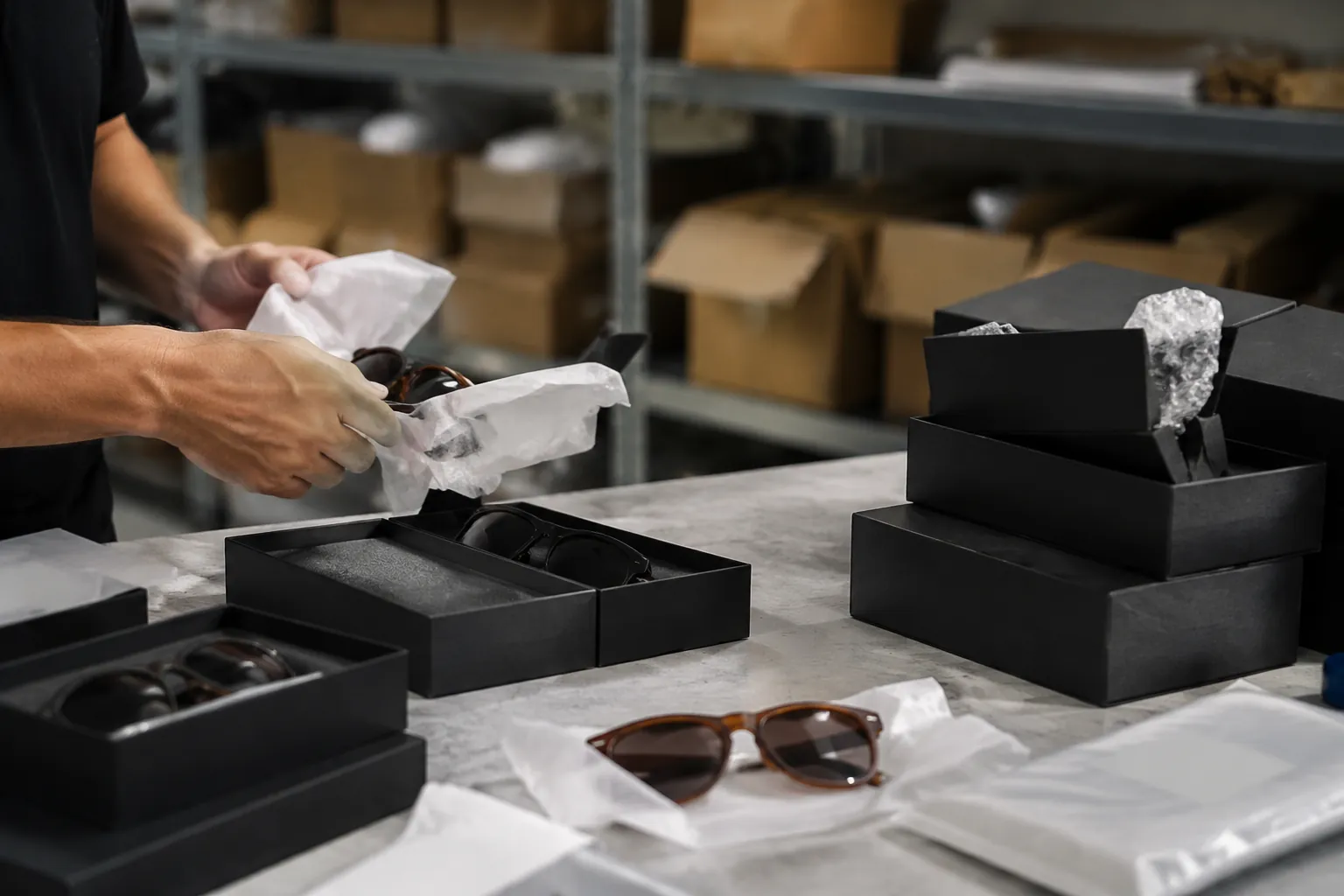
This guide is for eyewear brands, importers, distributors, and retail buyers that must hit a fixed sunglasses launch date without flying the full order. It shows how to split samples, launch stock, main sea freight, and reorder buffers around real factory timing, MOQ limits, material behavior, decoration risk, and compliance checks. Use it before issuing the purchase order. Once cartons are packed at the factory gate, most good options are gone.
Start with the sellable date, not the ship date
A split shipment plan starts with one hard date: the day inventory must be ready to sell. Not the ex-factory date. Not the vessel departure date.
Work backward from the sellable date and include export booking, customs clearance, inland trucking, warehouse receiving, barcode scanning, carton checks, retail allocation, and a delay buffer.
For custom sunglasses, the factory calendar usually has four blocks: sample approval, material and tooling preparation, bulk production, and final inspection plus packing. At LumiShades in Wenzhou, standard samples usually take 7-10 days after confirmed specifications. Bulk production is typically 25-35 days after sample approval and deposit. Complex acetate polishing, gradient lens tinting, metal trim, custom hinges, or multi-position logo decoration can push timing toward the upper end.
A practical backward plan for a seasonal drop may look like this: launch date minus 7 days for warehouse intake and retail allocation, minus 7-14 days for customs and inland delivery, minus 5-8 days for air freight or 25-40 days for sea freight depending on destination and port conditions, minus 25-35 days for production, and minus 7-10 days for samples. Add buyer decision time. Internal approval meetings often take longer than making the sample.
Blunt rule: if launch is less than 45 days away and the style is not physically approved, plan an air component. Sea freight alone is unlikely to protect the date.
Use split shipments to separate speed from cost
The point of split shipment is simple: pay for speed only where speed protects revenue. For most sunglasses launches, that means a small air shipment for the first selling window and a larger sea shipment for the main season.
| Shipment type | Typical use | Timing logic | Cost impact | Main risk |
|---|---|---|---|---|
| Pre-production samples | Fit, color, logo, lens tint, and packaging approval | 7-10 days from confirmed spec; courier often 3-5 days | Low quantity, high courier cost per pair | Approving from photos without checking lens category or fit |
| Air launch stock | Campaign launch, influencer kits, key retailers, marketplace opening | Ships after final QC; often 5-8 days transit plus clearance | High freight per pair; acceptable when margin or launch penalty is high | Sending too little and stocking out before sea goods arrive |
| Main sea shipment | Core inventory for stores, distributors, or 3PL replenishment | Usually 25-40 days port-to-door depending on lane | Much lower freight per pair at carton, pallet, or LCL scale | Weak paperwork, port delay, insufficient buffer |
| Reorder shipment | Top-up for best sellers | Triggered by sales velocity and replenishment lead time | Air for emergency SKUs; sea for stable replenishment | Waiting until stock is already below safety level |
A common starting split is 10-20% by air and 80-90% by sea. A retailer tied to a paid media date may air 25-30%. A distributor with flexible delivery windows may air only samples, sales kits, and the first account allocation.
There is no universal split. The right mix depends on gross margin, promised delivery dates, penalty clauses, sales exposure, and how visible the launch will be to customers.
Approve samples as production standards
Samples are not souvenirs. They are the control standard for bulk production.
A phone photo cannot confirm hinge feel, lens shade, frame balance, nose fit, or packaging compression. Final approval should be based on a physical sample, signed specification, artwork file, color reference, and packing layout.
Set measurable tolerances before bulk production. Typical commercial tolerances for sunglasses may be around ±0.5 mm for lens width and bridge, ±1.0 mm for temple length and frame front width, and ±0.3-0.5 mm for logo position, depending on the process. Check lens tint and frame color against a physical color chip or approved sample under daylight and indoor retail lighting.
- Frame material: Injection molded PC/TR90 frames are efficient and consistent, but color depends on masterbatch control and gate trimming. Acetate frames look more premium, but cutting, tumbling, hand polishing, and sheet pattern variation require tighter visual approval.
- Fit and structure: Record lens width, bridge, temple length, frame front width, hinge opening, screw tightness, temple closing alignment, and nose fit. Loose screws and uneven temple pressure create returns.
- Lens performance: Confirm lens category, UV400 claim, visible light transmission, polarization if required, and destination standard. Common requirements include CE EN ISO 12312-1 for the EU, ANSI Z80.3 for the U.S., and AS/NZS 1067 for Australia/New Zealand.
- Decoration: Pad printing can lose opacity on dark or textured temples. Laser engraving may look weak on translucent material. Metal logo plates need controlled recess depth. Hot stamping can crack if the temple curve is too aggressive.
- Packaging: Approve pouch, case, cloth, leaflet, barcode label, retail box, master carton size, and carton marks. A larger hard case can increase volumetric weight sharply on air freight.
LumiShades keeps injection molding, acetate cutting, CNC milling, lens tinting, decoration, and QC in-house, which helps reduce sample-to-bulk drift. Still, buyers should approve clear physical references. Ten email comments are weaker than one signed sample and one locked spec sheet.
Build air freight around minimum launch stock
Air freight should cover the first selling window. It should not cover the whole forecast unless the margin supports it.
Estimate demand for the first two to four weeks, then decide which SKUs must be live on day one. Many brands should air hero colors, campaign colors, and committed retailer allocations. Slower test colors can wait for sea freight.
Use a simple formula: air quantity = expected sales before sea arrival + safety stock. If sea stock may arrive 28 days after air stock and the forecast is 40 pairs per day, the base need is 1,120 pairs. Add 15-25% safety stock if advertising is heavy, weather is favorable, or retailer sell-through is uncertain. If budget is tight, reduce the number of SKUs in the air shipment rather than starving every SKU.
Carton planning matters. Put urgent SKUs in separate cartons and mark each carton with SKU, color, lens type, quantity, PO number, and destination. Avoid mixing five colors in every carton unless the warehouse specifically requests mixed cartons. Mixed cartons slow receiving and create short-pick errors during launch week.
Sunglasses often bill by volumetric weight, not actual weight. A lightweight plastic frame in a large hard case may cost more to fly than expected. For online-first launches, consider compact protective packaging for the air portion. Ship retail display trays, oversized gift boxes, or spare cases with the sea shipment.
Sea freight needs clean paperwork and strong packing
Sea freight is cheaper at scale, but it is less forgiving. A document error can burn more time than a production delay.
Before the main shipment leaves through Wenzhou, Ningbo, or Shanghai routing, confirm the commercial invoice, packing list, HS code, importer details, carton count, gross weight, net weight, country-of-origin marking, and shipping marks.
Compliance documents must match the destination, lens type, and claim. Do not request irrelevant certificates just to fill a file. For sunglasses, common documentation includes CE EN ISO 12312-1 for Europe, FDA registration information and ANSI Z80.3 performance expectations for the U.S., AS/NZS 1067 for Australia/New Zealand, REACH review for restricted substances, and factory-level ISO 9001 or BSCI where buyers require management or social compliance evidence. LumiShades can support those listed certifications, but buyers should confirm exact shipment requirements with their importer, broker, or lab.
Sea cartons should be designed for stacking, vibration, and humidity. Use inner polybags, pouches, or lens protection to prevent rubbing. Keep temples folded consistently. Do not overpack cartons so tightly that hinge screws press into neighboring lenses. For acetate styles, avoid hot storage because frames can deform. For promotional injection frames, confirm screw tightness and hinge function before packing. Field repair after distribution is rarely economical.
Let MOQ and price breaks shape the shipment plan
MOQ and price tiers are logistics decisions, not just purchasing details.
LumiShades supports a 50-pair MOQ per design, which can work for test colors, small campaigns, or retailer exclusives. But very low quantities are less efficient. Freight per pair, setup time, and QC handling all get heavier. At 300 pairs, unit economics usually improve. At 1,000 and 5,000+ pairs, material planning, decoration setup, and carton loading become more efficient. Suitable high-volume specifications can move toward about $2.10 per pair.
Plan split shipments by SKU, not only by total order quantity. A weak 5,000-pair order might contain 12 colors with thin quantities and messy warehouse work. A stronger plan puts volume behind two or three hero SKUs, then uses smaller quantities for fashion colors.
- Hero SKUs: Order enough to reach better price tiers and send the first 15-25% by air if launch exposure is high.
- Test SKUs: Keep quantities near MOQ or 300 pairs and ship by sea unless tied to a campaign or retailer commitment.
- Retailer exclusives: Separate labels, carton marks, and inner packs at the factory if the customer has strict receiving rules.
- Urgent reorders: Keep frame, lens, logo, packaging, and carton marks unchanged. Any change can restart approval.
Small changes are not always small in production. A new lens tint can require tint matching and VLT checking. A new temple print can require artwork films, pad setup, ink testing, and adhesion review. A new logo plate can require recess control and fitting checks. If speed matters, reorder the approved spec.
Set reorder triggers before the first carton ships
Reorder planning should happen before launch. Sunglasses demand can spike because of weather, travel season, retail placement, or one strong social campaign. If the reorder starts only when the warehouse is nearly empty, the brand is already late.
Use three numbers: daily sales velocity, replenishment lead time, and safety stock. If a SKU sells 30 pairs per day and the realistic replenishment window is 40 days, the reorder point starts at 1,200 pairs before buffer. Add safety stock based on forecast volatility. For a stable wholesale program, 10-15% may be enough. For a campaign-driven DTC launch, 20-30% is safer.
Ask the factory which components can be reserved. For repeat programs, it may be possible to hold common lenses, hinges, screws, logo plates, or packaging materials, but this must be agreed commercially. Raw material consistency matters. Black injection frames are easier to repeat than translucent champagne, smoke grey, or tortoise effects with tight shade targets. Acetate sheet patterns vary by batch; buyers should either accept controlled variation or reserve sheet material.
Keep a short reorder file for every SKU: approved sample photos, lens category, artwork, Pantone or material reference, decoration method, packaging file, carton marks, test requirements, and last inspection notes. Good records cut back-and-forth and protect the timeline.
A practical timeline for a 5,000-pair launch
Below is a workable model for a 5,000-pair custom sunglasses launch with four SKUs. Adjust it for your freight lane, customs process, and warehouse rules. The goal is simple: get enough stock live on time while the lower-cost main shipment follows.
| Day | Action | Buyer decision needed | Factory/logistics output |
|---|---|---|---|
| Day 1 | Confirm tech pack, artwork, lens requirements, packaging, target price | Final SKU list, launch date, air/sea planning assumption | Sample order opened |
| Day 8-11 | Review physical samples | Approve, reject, or revise with measured comments | Signed sample, color standard, bulk specification |
| Day 12 | Release bulk order | Deposit, compliance documents, carton split, barcode rules | Material purchase, molding/cutting, lens tinting, decoration plan |
| Day 37-47 | Final QC and packing | Approve inspection, confirm air and sea carton labels | Inspection report, packing list, export cartons |
| Day 40-55 | Air stock arrives | Prioritize receiving and first allocations | Launch inventory available |
| Day 65-90 | Sea stock arrives | Allocate to stores, distributors, or 3PL | Main inventory replenishes channels |
For this example, sending 750-1,000 pairs by air and 4,000-4,250 pairs by sea may work if the forecast is moderate. If the launch is tied to paid media, a retailer circular, or a short seasonal window, increase the air share. If the date can move, protect margin and send more by sea. The right answer is commercial, not emotional.
Have a custom sunglasses project in mind?
Send us your styles, target market and quantities and we will return a detailed quote with MOQ, lead time and a sample plan.
Get a QuoteWhy source this from Wenzhou with LumiShades
Wenzhou in Zhejiang Province is widely regarded as China’s eyewear manufacturing capital, producing a large share of the world’s sunglasses. That concentration matters to buyers: a deep local supply chain for acetate sheet, hinges, lens blanks, plating and packaging means shorter component lead times, easier color and material matching, and a workforce with decades of eyewear-specific skill. LumiShades has manufactured in this ecosystem since 2009, and our vertical integration — in-house injection molding, acetate cutting, CNC milling, lens tinting, decoration and quality control — means no part of your order is quietly subcontracted to a workshop you cannot audit.
For international buyers, that vertical control translates into accountability. When a single factory owns every step, defects are traced and fixed at source rather than bounced between vendors, and your specifications survive intact from first sample to bulk. We back this with 15+ years of experience, shipments to 60+ countries, more than 5 million pairs produced per year and a 98.5% on-time delivery rate. Our certifications — CE EN ISO 12312-1, FDA registration, ANSI Z80.3, AS/NZS 1067, REACH, ISO 9001 and BSCI audit — mean the compliance documentation your market requires already exists. Explore our manufacturing capabilities and quality control process to see how this works in practice.
Frequently asked questions
How many sunglasses should we send by air for a launch? A common starting point is 10-20% of the order, but calculate it by expected sales before sea stock arrives plus safety stock. For high-exposure launches, 25-30% by air may be justified. Prioritize hero colors and committed retail accounts.
Can we approve samples by photos and videos to save time? Use photos and videos for early screening only. Final approval should be based on a physical sample so the team can check fit, hinge feel, lens tint, logo position, packaging, labeling, and material finish.
What tolerances should we define before bulk production? For many commercial sunglasses, buyers use about ±0.5 mm for lens width and bridge, ±1.0 mm for temple length or frame front width, and ±0.3-0.5 mm for logo placement, depending on the material and decoration process. Agree tolerances before production.
What certifications should we request for sunglasses shipments? Request documents that match your market: CE EN ISO 12312-1 for Europe, ANSI Z80.3 and FDA registration information for the U.S., AS/NZS 1067 for Australia/New Zealand, and REACH where restricted substances are reviewed.
Will changing logo or lens color delay a reorder? Often, yes. A new logo, lens tint, temple print, or packaging change can require artwork approval, tint matching, decoration setup, and sample confirmation. Keep the approved spec unchanged for urgent reorders.
What is the realistic production timing after sample approval? At LumiShades, bulk custom sunglasses production is typically 25-35 days after sample approval and deposit. Samples usually take 7-10 days, depending on frame material, lens type, decoration, and packaging complexity.
Should small test orders use air or sea freight? For 50-300 pairs per design, air or courier often makes sense because sea freight handling can be inefficient at low volume. For 1,000+ pairs, compare an air portion for urgent stock with sea freight for the balance.
Ready to start?
Explore our square sunglasses or request a quote — our sales team replies within 12 hours.
Request a Quote