
Photochromic Sunglasses for Private Label Buyers
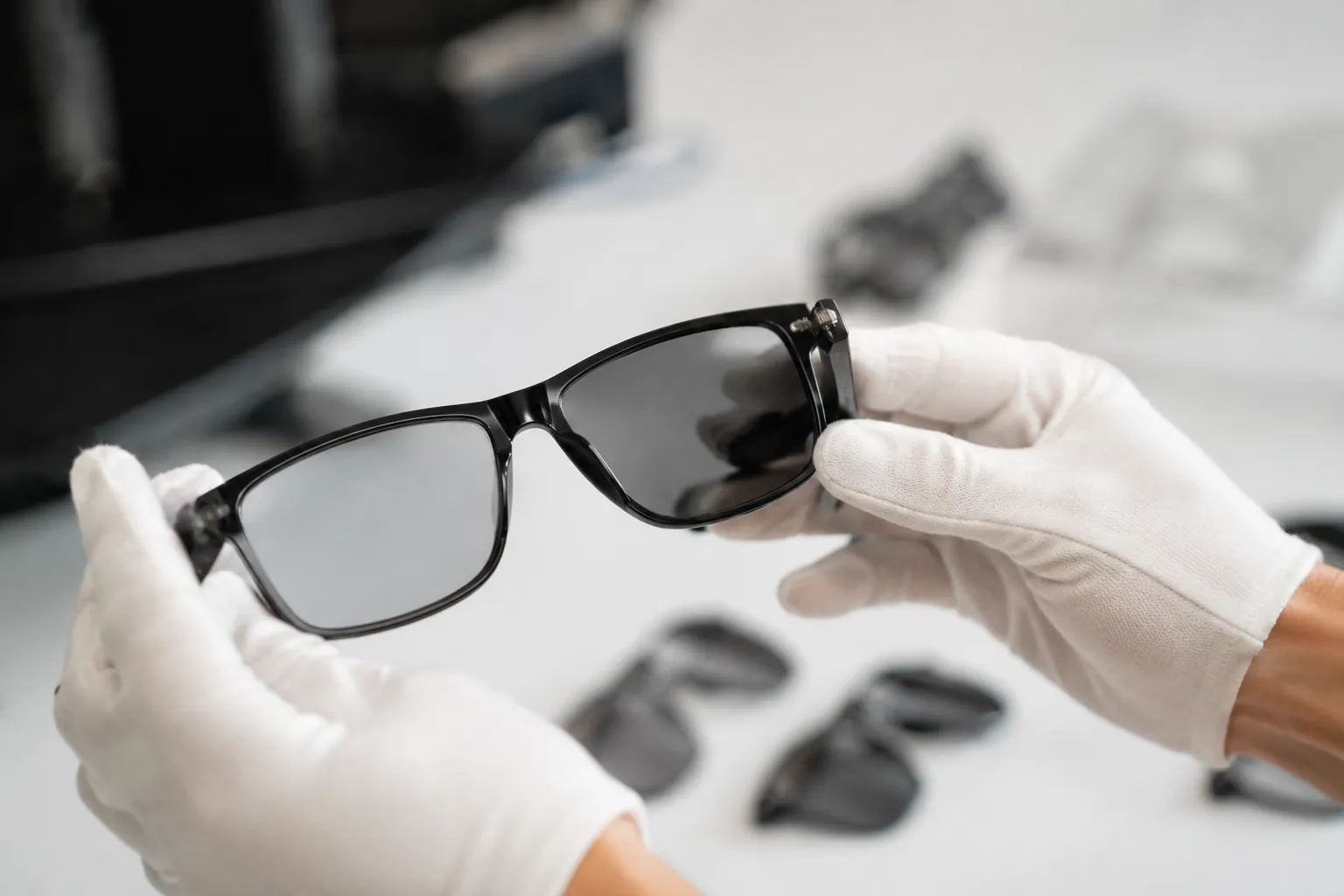
This guide is for brands, importers, distributors, and retail buyers evaluating photochromic sunglasses for private label programs. It explains where light-adaptive lenses make commercial sense, which specifications to request before sampling, and how to avoid vague tint-change claims that create customer complaints. The goal is simple: approve a lens that performs in the intended use case, under stated test conditions, not only under a factory lamp.
Where Photochromic Sunglasses Make Sense
Photochromic sunglasses change tint when exposed to ultraviolet light. They fit products that move between changing light conditions. They do not replace every sunwear category. For private label buyers, the strongest uses are outdoor sport, travel, fishing, hiking, cycling, outdoor work, and lifestyle eyewear for people moving between shade and sun.
The product still needs a clear reason to exist. A standard grey or brown UV400 lens is usually cheaper and easier to explain. It is also easier to keep consistent from batch to batch. Photochromic SKUs work best when the retail story is specific: commuting, all-day travel, active outdoor use, a second pair for sports customers, or a prescription-ready concept that reduces the need for separate clear and sun lenses.
Do not launch photochromic across every frame at once. Start with one or two proven silhouettes. Then test one lens route per frame family. A small validation order can help confirm demand. The economics usually improve as volume increases because lens procurement, decoration setup, packaging, and QC time are spread across more units. Photochromic lenses cost more than standard tinted lenses. That is normal. The margin must support sampling, compliance review, and customer education.
Frame choice matters too. A standard full-rim acetate or injection frame is usually easier to industrialize than a highly curved shield. That changes if the lens supplier can prove stable curvature, tint uniformity, and optical performance on that exact geometry. If the goal is a premium outdoor line, one well-specified photochromic style is safer than several styles built around loose claims.
The Lens Technology Behind the Claim
Most photochromic sunglass lenses use UV-reactive molecules that change structure when exposed to ultraviolet light and return toward a lighter state when UV is removed. In plain terms, the lens darkens outdoors and fades back indoors. The function may be built into the lens material, applied as a coating, or included in a layered construction. That depends on whether the lens is TAC, PC, nylon, or a prescription substrate.
That construction affects activation behavior, optical clarity, scratch resistance, coating durability, and batch consistency. Buyers should not approve a lens from one sunny photo or a short showroom demo. The relevant questions are measurable. How light is the lens before activation? How dark does it become? How long does it take to reach the target? How long does it take to fade back? What happens after heat, humidity, cleaning, or repeated cycles?
Temperature matters. Many photochromic lenses darken less in high heat and more in cooler conditions. That is common. The exact result depends on the lens construction. If the sunglasses will be sold for hot climates, outdoor sport, or travel, test samples in conditions close to the target market before confirming product claims.
Photochromic behavior also interacts with UV400 protection, visible light transmission, polarization, mirror coatings, and base tint. A clear-to-grey lens behaves differently from a light-grey-to-dark-grey lens. If you want a fashion-forward look at rest, a visible base tint may be right. If you want a near-clear indoor appearance, ask for a high starting VLT and verify that the activated darkness still meets the sunglass category for the destination market. Polarized photochromic lenses are possible. They need tighter control of lamination stability, axis alignment, haze, stress marks, and edge quality.
Specs to Put in the Purchase Brief
A weak brief says "photochromic lens, UV400, good quality." That is not enough to quote accurately, sample consistently, or inspect production. A usable brief gives measurable targets, test conditions, and acceptance limits. The supplier knows what to build. The buyer knows what to reject.
- Starting tint: Define the pre-activation visible light transmission and whether the lens should look near-clear, lightly tinted, or visibly tinted indoors.
- Activated tint: State the target visible light transmission after UV exposure and confirm whether the result must meet a specific sunglass filter category for the destination market.
- Activation time: Specify the time allowed to reach the target darkness under a stated UV lamp or outdoor test condition.
- Fade-back time: Define the acceptable recovery time indoors and the VLT level that counts as "recovered."
- Temperature condition: Record the test temperature because heat can reduce activated darkness for many photochromic lenses.
- Optical tolerance: Ask for limits on haze, distortion, and prismatic imbalance, especially for wrap frames or performance sunglasses.
- Surface durability: Request scratch resistance, coating adhesion, and cleaning-resistance expectations for the selected lens construction.
- Compliance target: Confirm the destination market standard before artwork, labeling, and claims are finalized.
For compliance, use the market you are shipping into, not a random certificate stack. Relevant eyewear and supply-chain documents may include CE EN ISO 12312-1, ANSI Z80.3, AS/NZS 1067, REACH, FDA registration, ISO 9001, and BSCI, depending on the order, destination, and buyer requirements. A certificate helps only if it applies to the product type, the test method, the supplier scope, and the destination market. One valid, product-relevant report is better than several documents that do not support the claim.
Packaging and labeling should match the approved test result. If the lens reaches a defined VLT under a defined UV condition, use that condition in the claim language. Avoid phrases such as "instant darkening," "works in all sunlight," or "driving lens" unless the supplier can provide evidence for that exact claim and the buyer has tested it in the intended use case.
Common Lens Routes and Trade-Offs
The right lens route depends on retail price point, frame geometry, compliance needs, and the optical consistency expected by the sales channel. A low-cost fashion program should not use the same construction logic as a premium fishing, cycling, or performance product. The table below shows a practical sourcing view for common photochromic lens paths.
| Lens route | Best use case | Typical advantage | Buyer watchpoint |
|---|---|---|---|
| TAC photochromic | Fashion and mid-price retail sunglasses | Lightweight and cost-controlled for many standard frame styles | Check tint uniformity, edge quality, delamination risk, and scratch resistance after cleaning |
| PC photochromic | Sports, kids, and impact-focused outdoor eyewear | High impact resistance and broad frame compatibility | Watch for haze, stress marks, coating issues, and optical distortion on curved designs |
| Nylon photochromic | Performance sunglasses and wrapped shields | Good optical clarity and flexibility for higher-base curves | Higher cost; request distortion testing on the exact frame curvature |
| Polarized photochromic | Fishing, water, snow, and glare-sensitive lifestyle lines | Combines glare reduction with adaptive tinting | Confirm polarization axis, LCD visibility, lamination stability, and heat-cycle performance |
Material choice should follow the wear scenario. TAC can work for fashion programs, but it needs control around coating scratches, edge finishing, and lamination. PC is useful when impact resistance matters, but coating quality and stress control are important because haze and marks can become visible. Nylon is often better for higher-curve or performance-oriented frames, though it raises the cost floor. Polarized photochromic lenses can support a premium line, but they also add failure modes, so QC should include inspection under bright light, on white paper, and through an LCD screen.
If the frame has a high-base wrap or shield profile, a flat sample lens is not enough. Curvature changes how the lens sits in the frame, how edges distort, and how stress appears during edging and assembly. For private label orders, processes such as injection molding, acetate cutting, CNC milling, lens tinting, laser engraving, pad printing, and metal logo attachment must be planned around the selected lens route. Do not add them after lens approval.
Sampling Plan That Catches Problems Early
Samples should prove more than appearance. A proper photochromic sampling round should verify frame fit, lens material, base tint, activation behavior, fade-back behavior, coating quality, decoration placement, packaging instructions, and claim wording. Sampling time depends on lens availability, decoration complexity, tooling needs, and whether the selected lens is already available or must be sourced specially.
The best sampling process is simple and repeatable. First, confirm frame material, lens material, base tint, target activated tint, compliance destination, and decoration method before lens cutting begins. Second, request more than one sample pair when the tint target is still being narrowed, because a single photo can hide variation. Third, test samples outdoors and indoors at a recorded temperature, then capture the same positions and lighting at defined time points. Fourth, place the lens against both white and dark backgrounds to check tint uniformity, edge variation, haze, and unwanted color shift.
Then wear the sample in real conditions. Check cheek contact, temple pressure, nose fit, and whether the lens edge distorts text, road lines, or horizons. Buyers can also run a basic handling check: open and close hinges repeatedly, clean the lens with the intended cloth and cleaner, and expose the sample to warm storage conditions that are realistic for the sales market. These checks do not replace laboratory testing, but they help catch obvious failures before bulk production.
Always approve one signed golden sample with a lens code, frame color, decoration reference, packaging reference, compliance target, and approved claim wording. Keep that sample available to purchasing, production, and QC. If a supplier changes a lens batch, coating route, or lens source later, the golden sample gives both sides a practical reference for color, darkness, fade-back, and cosmetic acceptance.
Production Controls in a Wenzhou Factory Setting
Photochromic sunglasses need tighter in-process control than basic tinted sunglasses because the lens itself is a key risk point. The frame may be injection molded, acetate cut, or CNC milled, but the lens can be affected by dust, edge chipping, coating scratches, wrong pairing, heat exposure, or contamination during assembly. If the line is rushed, defects may show up as tint inconsistency, cloudy areas, surface marks, or a visible mismatch between left and right lenses.
A practical production flow is: incoming lens inspection, frame component inspection, lens cutting, edging, assembly, hinge and temple adjustment, decoration, cleaning, activation check, final optical and cosmetic QC, pouch or box packing, and carton inspection. For decorated orders, laser engraving, pad printing, and metal plate attachment should be controlled carefully because rework after lens installation can damage coatings or leave contamination that is hard to remove.
Process control should include batch traceability for lenses and coatings. The factory should be able to identify the lens code used, the production lot, the assembly date, and the inspector responsible for final checks. Buyers should also define inspection criteria for cosmetic defects, tint mismatch, activation behavior, coating marks, distortion, and packaging accuracy. Photochromic products are more sensitive to visible variation than standard tinted sunglasses. Early detection matters.
Bulk lead time should be confirmed in the purchase order after the supplier reviews lens availability, decoration, packaging, compliance documents, and order volume. Additional time may be needed for custom molds, special lens procurement, metal logo tooling, packaging development, or multi-market documentation. Repeat orders move more predictably when the lens code, golden sample, and approved claim language stay unchanged.
Pricing, MOQ, and Margin Reality
Photochromic sunglasses usually cost more than standard UV400 tinted sunglasses because the lens construction, coating route, performance checks, and reject risk are more demanding. Price should be discussed as a system, not only as a unit number. The real question is whether the product can be produced repeatedly with stable tint behavior, acceptable cosmetics, accurate packaging, and a return rate the channel can tolerate.
MOQ is a development decision. A small order may suit validation, boutique drops, distributor samples, or market testing, but unit economics are less efficient because setup, sourcing, packaging, and QC work are spread over fewer units. Larger orders often improve lens procurement and production planning. They also increase the cost of a wrong lens choice. Before scaling, confirm the golden sample, lens code, compliance target, packaging claims, and inspection standard.
Buyers should compare landed cost, not only FOB price. Include freight, packaging damage risk, reject allowance, testing cost, label changes, and the cost of handling complaints if the lens underperforms in heat, shade, or vehicle use. A low first quote may hide slower activation, weaker final darkness, poor fade-back, inconsistent base tint, or lower coating durability. Saving a little on the lens can create larger service and return costs later.
Margin planning also depends on channel type. A wholesale distributor, marketplace seller, optical retailer, and DTC brand may have different tolerances for price, warranty exposure, and customer education. If the product is positioned as premium, it is usually better to pay for stable tint behavior and clean optics than to chase the lowest factory quote. Photochromic eyewear earns shelf space by working predictably.
Buyer Pitfalls That Cause Returns
The biggest mistake is accepting a vague claim such as "turns dark in sunlight." That phrase does not tell the customer how dark, how fast, under what light source, or at what temperature. If the answer is not measurable, it should not appear on packaging, product pages, retailer sell sheets, or sales training materials. Stronger programs use defined VLT targets, test conditions, and carefully limited claim language.
- Overpromising car performance: Many vehicle windshields block a significant amount of UV, so standard photochromic lenses may not darken strongly inside a car. Test in the intended vehicle condition before making a driving claim.
- Ignoring heat: Hot conditions can reduce activated darkness for many photochromic lenses. Test samples in the expected selling climate, not only in a cool office.
- Mixing lens batches: A repeat order using a different lens lot or source may show a different base tint, activation speed, or final darkness. Lock the lens code and keep the golden sample.
- Skipping compliance checks: CE EN ISO 12312-1, ANSI Z80.3, AS/NZS 1067, REACH, FDA registration, ISO 9001, and BSCI serve different purposes. Confirm which documents are required for the destination and buyer channel.
- Choosing the wrong frame: Deep wraps and shields can create distortion or stress marks if lens material, curvature, and edging are not matched properly.
- Using weak packaging claims: If the package says "adaptive lens" but the buyer expects full darkening in a car or instant darkening outdoors, dissatisfaction is predictable.
Good photochromic programs are controlled and specific: measured specs, approved samples, locked lens materials, documented test conditions, market-appropriate compliance, and claims that match the real product. That is what keeps returns lower and repeat orders easier to manage.
Have a custom sunglasses project in mind?
Send us your styles, target market and quantities and we will return a detailed quote with MOQ, lead time and a sample plan.
Get a QuoteWhy source this from Wenzhou with LumiShades
Wenzhou in Zhejiang Province is widely regarded as China’s eyewear manufacturing capital, producing a large share of the world’s sunglasses. That concentration matters to buyers: a deep local supply chain for acetate sheet, hinges, lens blanks, plating and packaging means shorter component lead times, easier color and material matching, and a workforce with decades of eyewear-specific skill. LumiShades has manufactured in this ecosystem since 2009, and our vertical integration — in-house injection molding, acetate cutting, CNC milling, lens tinting, decoration and quality control — means no part of your order is quietly subcontracted to a workshop you cannot audit.
For international buyers, that vertical control translates into accountability. When a single factory owns every step, defects are traced and fixed at source rather than bounced between vendors, and your specifications survive intact from first sample to bulk. For procurement review, buyers can request process records, approved samples, quality checkpoints and project-specific compliance files before placing a bulk order. Required testing and documentation are confirmed against the destination market and product specification rather than assumed from a generic certificate list. Explore our manufacturing capabilities and quality control process to see how this works in practice.
Frequently asked questions
Can photochromic sunglasses replace regular sunglasses in a retail range? Not usually as a full replacement. Use them for customers who move between shade and sun, such as travelers, cyclists, hikers, anglers, and outdoor workers. Keep fixed dark lenses for beach, fashion-only, and simple driving-positioned SKUs unless your testing proves the photochromic lens meets that use case.
What activation speed should I ask for in sampling? Ask the supplier to state activation time under a defined UV source or outdoor condition, with temperature recorded. Your brief should define starting VLT, target activated VLT, time to reach that target, and fade-back time indoors. Do not approve a sample based only on a visual demonstration.
Will photochromic lenses darken inside a car? Often only weakly, because many windshields block UV that standard photochromic lenses need for activation. If the product page or packaging mentions driving, test the exact lens in a vehicle, in the target market conditions, before approving the claim.
What certifications should I request for private label sunglasses? Start with the destination market and buyer channel. Commonly relevant documents include CE EN ISO 12312-1 for EU sunglasses, ANSI Z80.3 for the US, AS/NZS 1067 for Australia and New Zealand, REACH for restricted substances, FDA registration where applicable, plus ISO 9001 and BSCI for factory management or social compliance expectations. Verify that each document applies to the actual product and supplier scope.
What is a realistic order path for a first photochromic SKU? Begin with a controlled validation order or sample run, approve a signed golden sample, lock the lens code, confirm compliance needs, and finalize packaging claims before scaling. Increase order volume only after you have checked activation, fade-back, heat behavior, optical quality, and customer-facing claim language.
Ready to start?
Explore our sport wrap sunglasses or request a quote — our sales team replies within 12 hours.
Request a Quote