
How to Source Polarized Sunglasses Without Overpaying
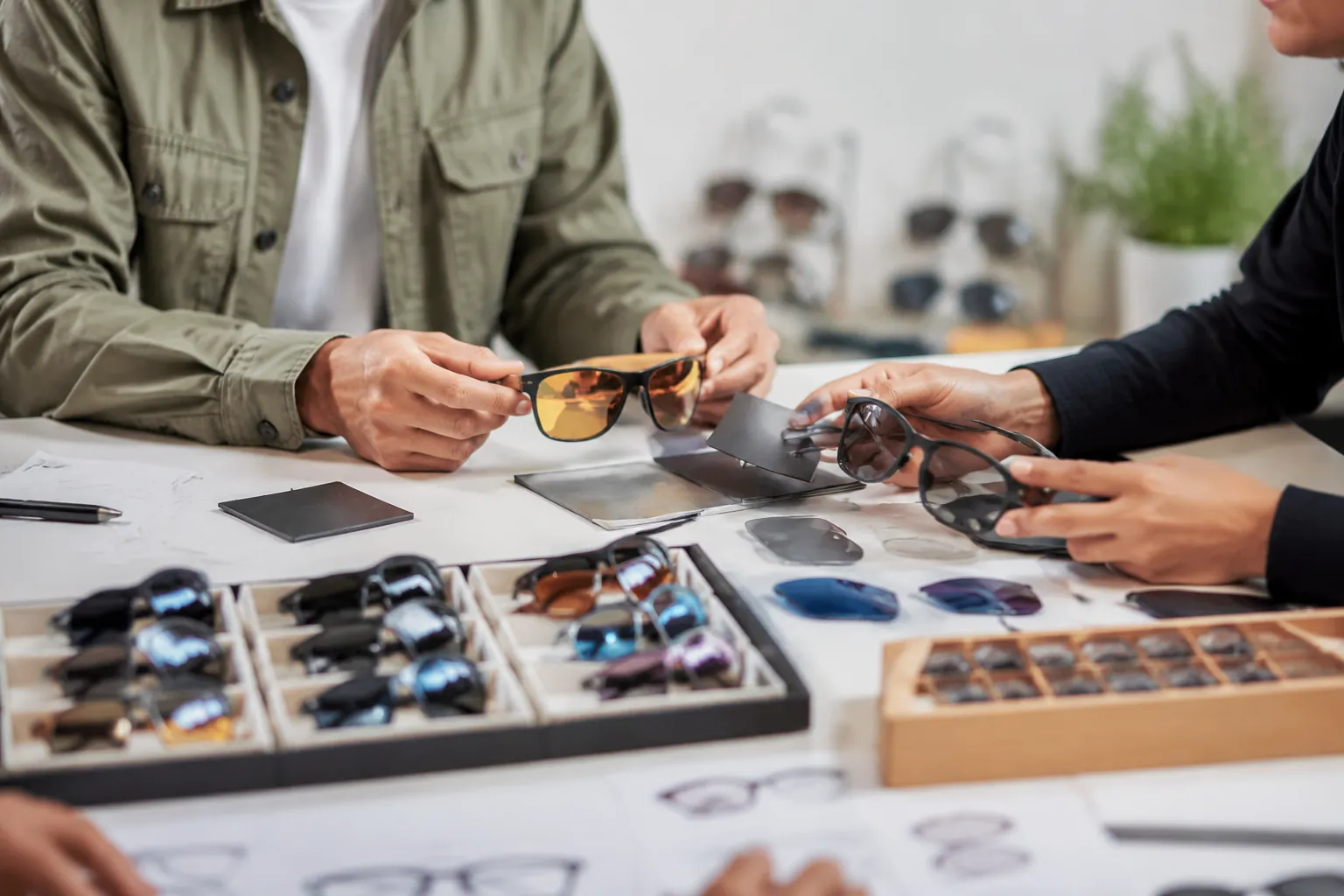
Polarized sunglasses can be a useful upgrade for driving, fishing, boating, snow sports, outdoor work, and other glare-heavy use cases. They can also add cost without adding real buyer value if the specification is vague. For OEM and private-label buyers, the key is to define what the lens must do, how it will be tested, what compliance evidence is required, and which quote items are included. This guide explains how polarization works, what to request from a supplier, where cost enters the product, and how to compare bulk eyewear quotes on a like-for-like basis.
What polarization actually changes
Polarized lenses reduce reflected glare by using a filter that blocks certain light waves, especially glare reflected from horizontal surfaces such as water, wet roads, snow, vehicle dashboards, and polished floors. Polarization does not automatically make a lens darker. Lens darkness comes from tint density and visible light transmission, while polarization is a separate glare-reduction function.
That distinction matters in sourcing. A lens can be polarized but still be poorly suited to the product if the tint is too dark, too light, uneven, or optically distorted. For example, a dark polarized lens may work well for open-water use but feel unsuitable for lower-light daily wear. A lighter polarized lens may be comfortable for lifestyle use but less effective for intense glare. Wrapped sport frames also need closer optical control because lens curvature can make distortion more noticeable.
Buyers should treat polarization as a use-case decision, not a universal premium feature. It is usually easier to justify for driving, boating, fishing, skiing, beach products, and outdoor workwear. For a fashion-led SKU, the same budget may deliver more value through better hinges, frame finishing, lens clarity, packaging, or branding. Buyers should also separate polarization from UV protection. A polarized lens still needs an appropriate UV-performance claim supported by the correct test basis for the target market.
Request the right lens specification
Most sourcing mistakes begin with an incomplete quote request. A line that says only "polarized lens" is not enough to compare suppliers. The quote should identify lens material, polarization construction, visible light transmission target, UV claim basis, coating requirements, color or tint target, and acceptable optical quality. If the supplier cannot state these points clearly, the offer is not ready for approval.
Common lens materials include TAC, polycarbonate, and nylon-based materials. TAC is widely used in polarized sunglasses because it is lightweight and commonly laminated. Polycarbonate is often selected when impact resistance is important. Nylon-based lenses are often used in sport eyewear where clarity, flexibility, and dimensional stability may matter. The right choice depends on the intended market, frame design, compliance requirements, and price target.
- Lens material: TAC, polycarbonate, or nylon-based lens
- Polarization construction: laminated filter, embedded layer, or supplier-defined structure
- Visible light transmission: target range by SKU and market use
- UV claim: test basis for the finished lens, not only a catalog claim
- Coating: hard coat, mirror, AR, hydrophobic, or other specified treatment
- Optical quality: check distortion, haze, tint uniformity, and lens alignment
For samples, request a finished pair and, when possible, a loose or cut lens sample. A flat lens sample helps check tint, haze, and polarization response. A finished pair shows how the lens performs after cutting, edging, fitting, and frame assembly. For wrapped frames, ask the supplier how lens alignment and visual distortion are checked, because small errors are more visible on curved designs.
If working with a factory such as LumiShades, ask which steps are handled in-house and which are outsourced. In-house frame production, lens tinting, decoration, and QC can reduce coordination risk, but buyers should still verify the actual process used for the specific order. The approved sample, production specification, and final inspection standard should all describe the same product.
Where the cost comes from
Polarization adds cost in several places. The lens material and polarizing filter are only part of the price. The factory may also need additional lamination or insertion steps, more inspection, tighter edge control, higher rejection allowance, and careful packing to prevent abrasion. These costs vary by material, lens curve, coating, tint, frame construction, order size, and inspection requirement.
Small orders often carry higher unit costs because setup, color matching, cutting loss, decoration setup, and inspection time are spread across fewer pairs. A 50-pair pilot order can require much of the same preparation as a larger run, but with fewer units to absorb that work. As volume increases, fixed preparation costs are distributed more efficiently, although complex decorations or difficult lens specifications can still raise the price.
LumiShades states an MOQ of 50 pairs per design and offers tiered pricing at 300, 1000, and 5000+ pairs. Buyers should treat each tier as a commercial reference, not as proof that all specifications cost the same. Final pricing depends on the frame material, mold status, lens material, coating stack, decoration method, packaging, compliance documentation, and inspection standard.
Ask for a quote structure that separates frame cost, lens cost, decoration, packaging, testing or documentation charges, and shipping terms where applicable. This prevents false comparisons. A low quote may exclude an anti-scratch coating, logo process, retail packaging, labels, or compliance documents. A useful supplier quote should make the inclusions and exclusions clear before sampling begins.
Quote comparison table buyers should use
Before approving samples, build a price-and-spec matrix. Every supplier should quote against the same commercial scope: same lens material, same polarization construction, same visible light transmission target, same coating, same decoration, same packing, same inspection expectation, and same compliance requirement. If one supplier leaves fields blank, the quote cannot be compared fairly.
| Order tier | Typical buyer use | What to confirm | Cost pressure |
|---|---|---|---|
| 50 pairs/design | Prototype, market test, small retail drop | Lens type, tint target, sample lead time, pack method, artwork, inspection scope | Highest unit cost because setup, cutting loss, and manual checks carry more weight |
| 300 pairs | First production run | Yield expectation, QC checkpoints, decoration process, replacement policy, carton details | Cost begins to improve but remains sensitive to rework and decoration setup |
| 1000 pairs | Regional launch or distributor order | Color match, transmission range, coating spec, carton spec, reorder control | Material use improves and process consistency becomes easier to evaluate |
| 5000+ pairs | Core program or repeat replenishment | Tooling stability, batch control, compliance documents, packing standardization | Best scale efficiency when the design and materials are stable |
Decoration should also be quoted precisely. Pad printing, laser engraving, foil stamping, heat-transfer graphics, soft-touch paint, metal plaques, and logo inserts have different setup costs, durability risks, and rejection rates. A quote that includes a basic temple print is not equivalent to a quote with metal logo inserts or multi-color surface finishing. Ask the supplier to identify the exact process and whether the quoted price includes artwork setup, pre-production approval, and production inspection.
How polarized lenses are made and where defects start
Polarized lens defects usually appear in predictable places. The lens may show uneven tint, haze, surface scratches, trapped particles, bubbles, edge chips, stress marks, or misalignment after assembly. These issues can come from the lens material, lamination process, tinting, cutting, edging, fitting, cleaning, or packing. Defects are more likely when the specification is unclear or when production steps are split across multiple uncontrolled suppliers.
A controlled production flow should include incoming material checks, lens processing, tint or coating verification, cutting, edging, fitting, surface inspection, frame assembly, final QC, and packing. Buyers do not need to audit every machine setting, but they should understand where quality is checked and what happens when a lens fails inspection. Sorting defects only at the end is more expensive and less reliable than preventing them during production.
Frame decoration can create additional risk. Metallic finishes, matte spray, two-tone paint, soft-touch coating, and inserted logos may require curing time or special handling before lens fitting. If frames are assembled before the finish is stable, later defects can include fingerprints, coating marks, stress whitening, or poor lens seating. The sample approval standard should cover both lens performance and frame finish durability.
The practical buying rule is simple: the cheapest polarized lens is the one that meets the agreed standard without rework. Re-cutting, re-tinting, re-polishing, replacing scratched lenses, or repacking damaged goods can erase the savings from an aggressive quote. At scale, yield and defect control are often more important than the lowest first price.
Compliance checks that actually matter
Compliance should match the destination market, product category, lens type, tint, and final construction. Do not accept a generic certificate bundle unless it is relevant to the actual SKU being ordered. A certificate for a different lens material, tint category, frame material, or production batch may not support the product you ship.
- EU: CE evidence linked to EN ISO 12312-1 for sunglasses
- US: FDA registration and ANSI Z80.3 where required by the buyer or market
- Australia/New Zealand: AS/NZS 1067 where applicable
- Chemical compliance: REACH for restricted substances where applicable
- Factory systems: ISO 9001 for quality management and BSCI for social compliance
LumiShades states that it has certifications and registrations including CE EN ISO 12312-1, FDA registration, ANSI Z80.3, AS/NZS 1067, REACH, ISO 9001, and BSCI. Buyers should request current documents and confirm their scope, validity dates, issuing body, product coverage, and relevance to the destination market. Certification claims should be checked against the exact model, not treated as a blanket guarantee.
Two checks are especially important. First, the tested product should match the production product, including lens tint, coating, frame material, and decoration where relevant. Second, if the buyer changes the lens color, transmission level, coating, material, or frame construction after approval, the compliance basis may need to be reviewed again. This is particularly important for sunglasses because visible light transmission and lens category can affect market classification.
A practical document request is: "Send the compliance evidence that applies to this SKU, this lens material, this tint or transmission range, this destination market, and this production batch." That wording helps separate useful compliance evidence from unrelated paperwork.
What to ask before you approve samples
Sample approval should work like a pre-production gate. The sample should represent the same lens material, polarization construction, tint target, coating, frame material, decoration, logo placement, and packaging that will be used in bulk production. If the sample is hand-finished or made with substitute materials, the supplier should label it as a reference sample rather than a production-standard sample.
- Confirm lens material, polarization construction, tint target, coating, and UV claim basis.
- Check glare reduction outdoors and inspect clarity under indoor lighting.
- Review frame fit, temple tension, hinge feel, lens seating, and left-right alignment.
- Inspect scratches, haze, bubbles, coating marks, edge chips, and tint uniformity.
- Compare the approved sample against the quote, artwork, packaging, and compliance scope.
For repeat orders, ask how the supplier controls batch consistency. Tint tone, mirror intensity, transmission range, logo color, and frame finish should match the approved standard within agreed tolerances. If a reorder arrives noticeably darker, greener, more reflective, or less consistent than the first shipment, the commercial problem belongs to the brand even if the supplier caused it.
LumiShades states that sample production can take 7–10 days and bulk production can take 25–35 days, depending on design and material readiness. Buyers should confirm timelines after the final specification is locked. New molds, unavailable materials, coating revisions, decoration changes, compliance review, or failed sample rounds can extend the schedule.
A simple buying rule for OEM teams
Do not pay for polarization unless glare reduction supports the product's selling point. For driving, fishing, boating, snow, beach, and outdoor utility products, polarization is often worth evaluating. For entry-price fashion sunglasses, the same money may produce stronger commercial value through better frame finishing, clearer non-polarized lenses, stronger packaging, or more durable decoration.
Before approving any quote, define the user, destination market, compliance requirement, lens material, polarization construction, visible light transmission target, coating stack, decoration method, packaging, MOQ, lead time, and acceptable landed cost. Then ask every supplier to quote against the same basis. This keeps the comparison focused on real specification differences rather than sales language.
For buyers sourcing from Wenzhou or other eyewear production hubs, the strongest supplier is not necessarily the one with the broadest catalog. It is the one that can state the lens material, polarization method, test basis, compliance scope, decoration process, production lead time, inspection standard, and pricing logic clearly. That is how OEM teams avoid paying extra for vague upgrades and build polarized sunglasses that perform as specified.
Have a custom sunglasses project in mind?
Send us your styles, target market and quantities and we will return a detailed quote with MOQ, lead time and a sample plan.
Get a QuoteWhy source this from Wenzhou with LumiShades
Wenzhou in Zhejiang Province is widely regarded as China’s eyewear manufacturing capital, producing a large share of the world’s sunglasses. That concentration matters to buyers: a deep local supply chain for acetate sheet, hinges, lens blanks, plating and packaging means shorter component lead times, easier color and material matching, and a workforce with decades of eyewear-specific skill. LumiShades has manufactured in this ecosystem since 2009, and our vertical integration — in-house injection molding, acetate cutting, CNC milling, lens tinting, decoration and quality control — means no part of your order is quietly subcontracted to a workshop you cannot audit.
For international buyers, that vertical control translates into accountability. When a single factory owns every step, defects are traced and fixed at source rather than bounced between vendors, and your specifications survive intact from first sample to bulk. We back this with 15+ years of experience, shipments to 60+ countries, more than 5 million pairs produced per year and a 98.5% on-time delivery rate. Our certifications — CE EN ISO 12312-1, FDA registration, ANSI Z80.3, AS/NZS 1067, REACH, ISO 9001 and BSCI audit — mean the compliance documentation your market requires already exists. Explore our manufacturing capabilities and quality control process to see how this works in practice.
Frequently asked questions
Is polarized always better than non-polarized for sunglasses? No. Polarized lenses are better only when glare reduction is valuable for the user, such as driving, fishing, boating, snow, beach, or strong outdoor use. For low-price fashion sunglasses, buyers should compare the added lens cost against improvements in frame quality, hinge feel, lens clarity, packaging, or decoration. Ask the supplier to quote both polarized and non-polarized versions using the same frame and packaging so the cost difference is visible.
What should be on a polarized lens quote? A usable quote should list lens material, polarization construction, visible light transmission target, tint color, UV claim basis, coating stack, frame material, decoration method, packaging, MOQ, tiered pricing, sample lead time, bulk lead time, inspection standard, and compliance documents included. If any field is missing, ask the supplier to revise the quote before comparing it with other offers.
Does polarization replace UV protection? No. Polarization reduces reflected glare; UV protection addresses ultraviolet exposure. A buyer should request the UV-performance basis for the finished lens and confirm that the compliance evidence applies to the actual lens material, tint, and coating being ordered. Do not rely on the word "polarized" as proof of UV protection.
Which certifications or documents should buyers request? Request documents that match the destination market and the exact SKU. Relevant evidence may include CE EN ISO 12312-1 for the EU, ANSI Z80.3 and FDA registration for the US where required, AS/NZS 1067 for Australia and New Zealand, REACH where chemical compliance applies, and factory-level ISO 9001 or BSCI documents. Check validity dates, product scope, issuing body, and whether the tested product matches the approved sample.
Why does the unit price fall at higher volume? Unit price often falls because setup, color matching, cutting loss, decoration setup, inspection labor, and packing preparation are spread across more pairs. However, the price should still reflect the actual specification. Ask for tiered pricing at the same lens material, coating, decoration, packaging, and compliance scope; otherwise the lower price may simply exclude important items.
How long should sampling and bulk production take? LumiShades states a reference timeline of 7–10 days for samples and 25–35 days for bulk production when the design is clear and materials are available. Buyers should confirm the timeline after locking the specification. New molds, unavailable lens materials, coating changes, complex decoration, failed sample rounds, or compliance review can extend production.
Ready to start?
Explore our rimless sunglasses or request a quote — our sales team replies within 12 hours.
Request a Quote