
How to Spec Lens Tint Sets for Multi-Market Sunglasses
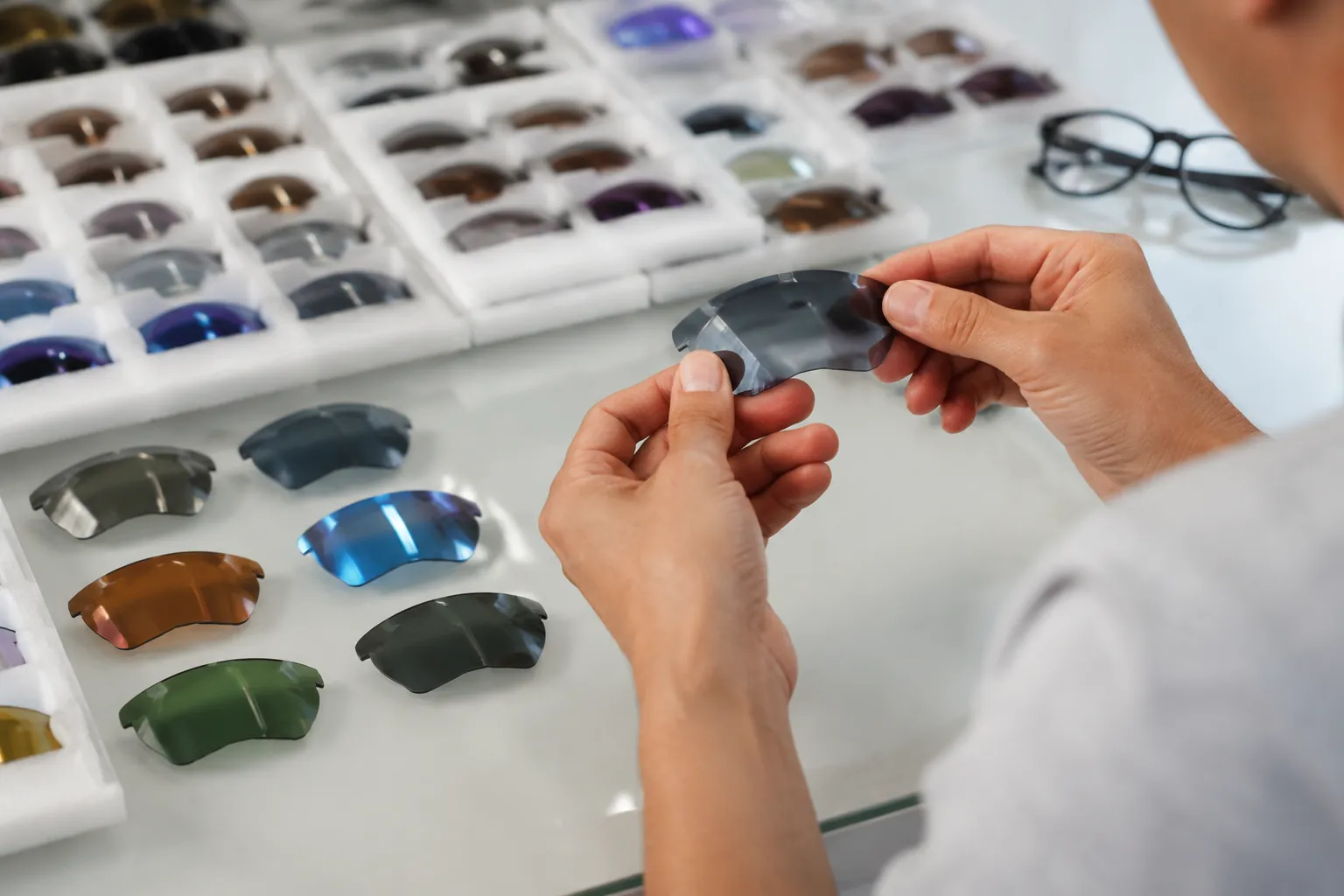
If you buy sunglasses for more than one market, one frame and one lens color will not support the whole program. The better approach is to spec one frame platform with a controlled tint set that matches each region, season, and channel. Done well, this helps you manage inventory, keep reorders consistent, and reduce approval risk. It also makes the lens mix easier to adapt by market while the frame stays fixed.
Start with the sales channel, not the lens catalog
Most tint mistakes start with the wrong question. Buyers ask which lens color looks best. The more useful question is where each SKU will sell, what price it must hit, and what the customer expects at shelf. A resort chain, a fashion retailer in Northern Europe, and an online drop for a trucker-style frame do not need the same lens set, even if the frame platform is identical.
Build the program around channel behavior first. Fashion retail usually wants strong shelf appeal, a clean on-face look, and a tint that photographs well. Outdoor and travel channels usually need darker neutral tints, glare reduction, and clear sun-use positioning. Promotional programs often need the lowest possible cost structure and the fewest variants, because every added lens color creates another setup, another packing step, and another chance for mix-ups. If you skip this step, you risk slow-moving stock and fragmented inventory.
For one frame platform, three tint families usually cover most needs: smoke, brown or amber, and mirror fashion tints. Smoke is the default because it works with many frame colors and is easy to merchandise. Brown gives warmer contrast and often fits driving and outdoor use. Mirror layers add visual impact, but they also require tighter control of coating uniformity, scratch protection, and edge handling.
Think like a planner, not a designer. If the same frame is going to Europe, the Middle East, and North America, the lens set should be the variable. Decide what each market actually needs before you decide what looks attractive. The frame becomes the constant, and the tint set becomes the market adapter.
Use a tint set with a job, not a rainbow
For multi-market programs, a tight tint matrix is usually the safest choice. Do not spec eight colors simply because the factory can make them. Start with three to five SKUs that each have a clear role, a clear buyer, and a clear reorder logic. That keeps inventory easier to read and reduces the risk of tiny lots damaging your price structure.
- Smoke 3% to 15% VLT: core retail, broad market, and the safest all-rounder for year-round stocking.
- Brown or amber 10% to 20% VLT: driving-oriented looks, outdoor retail, and buyers who want more contrast perception.
- Green 10% to 20% VLT: classic or heritage programs where the color cue matters as much as the performance cue.
- Mirror smoke or mirror blue: premium fashion drops, resort programs, and seasonal launches that need shelf impact.
- Gradient smoke: lifestyle channels and indoor-outdoor wear, but only if fade consistency and lens edge quality are stable.
The important point is not the color name. It is the visible light transmission, base tint stability, and repeatability from batch to batch. A smoke lens specified at 15% VLT that shifts noticeably in the next run can trigger complaints, especially if one region compares it with a previous lot. Buyers should ask for a target band, not a single point, so the factory has a controlled window without drifting outside the approved look.
Material behavior matters too. Polycarbonate, nylon, and TAC do not tint the same way, and the result can change with process time, temperature, and coating stack. If the supplier says the same tint will produce the same result across different base materials, ask for written test data or a production sample made from the intended material. The base lens changes how the dye loads, how stable the result is under heat, and how the lens reads under different light sources.
LumiShades can run lens tinting in-house, which matters because tint control, coating, decoration, and QC stay within one process flow. That reduces handoff risk and makes shade matching easier when a buyer compares a first sample lot to bulk production. It also shortens the loop if a sample needs adjustment before approval.
Match tint darkness to region and use case
Different markets tolerate different darkness levels, but the buying logic is simpler than many compliance sheets suggest. Darker lenses generally sell better in high-glare markets and summer assortments. Lighter tints usually work better for fashion, spring launches, and indoor-outdoor wear. The goal is not to make every region unique; it is to match the most common use case without creating unnecessary SKUs.
| Tint type | Typical buyer use | Typical VLT band | Strengths | Trade-offs |
|---|---|---|---|---|
| Smoke | Core retail, broad market | 3% to 15% | Neutral look, easy to merchandise, works with most frame colors | Can look flat if the frame color is weak or the lens base is too cool |
| Brown/amber | Driving, outdoor, active lifestyle | 10% to 20% | Better contrast perception, warmer look, strong summer sell-through | Not every fashion buyer wants a warm tone, and it can read more functional than premium |
| Green | Classic and heritage programs | 10% to 20% | Balanced color, traditional appeal, good for classic silhouettes | Less common in fast fashion and can be harder to explain at shelf |
| Mirror fashion tints | Seasonal drops, premium channels | Effective VLT depends on base tint and coating | High shelf impact, strong perceived value, useful for limited launches | Coating consistency, abrasion resistance, and edge protection need tighter control |
Think in assortments, not single lenses. A distributor supplying three regions may need one smoke core SKU, one brown regional SKU, and one mirror fashion SKU for launch displays. The frame can stay identical. That is how you control stock while still giving sales teams enough variety to work with. In many programs, a 70% core, 20% secondary, and 10% seasonal mix is a practical planning model, but the exact split should be based on sell-through data and channel demand.
Region also affects how a lens is perceived after production. A darker tint can look acceptable in a cloudy market but feel too heavy in a bright, high-sun market if the frame is already visually dense. Likewise, a light lens in a premium fashion setting may look stylish but may not meet the customer's expectation for heat reduction or eye coverage. That is why buyers should approve a tint in the context of the frame color, lens curvature, and retail channel, not as a standalone chip sample.
Build around compliance from the first sample
Lens tint is not only appearance. It sits inside the product's compliance file, and the earlier you lock the tint spec, the fewer surprises you get at bulk approval. For Europe, sunglasses should be evaluated against CE EN ISO 12312-1. For the U.S., buyers commonly ask for FDA registration where applicable and for testing against ANSI Z80.3. For Australia and New Zealand, AS/NZS 1067 is the relevant eyewear standard. REACH matters for substance control in the EU supply chain. These requirements are not afterthoughts; they influence what the lens can be, how it is tested, and what claims you can print.
For a buyer, the useful move is to lock the tint spec before final approval. That means defining the target VLT, the intended use, and whether any mirror or coating layer is included. If a lens is meant for general fashion use, say so in the spec sheet. If it is intended for stronger sun exposure, make the darker target explicit and ask for the corresponding test method, not just the color sample.
Ask for sample documentation with the lenses in the same configuration that will be mass produced. A hand-adjusted sample that was made outside the intended process route is not a reliable bulk reference if the factory will tint in controlled batches. You want the same route for sample and bulk: same lens material, same tint process, same coating stack, and same packing method. If the production line will change between sample and bulk, the sample tells you less about final output.
For practical approval, ask the factory to state the acceptable production tolerance in writing. A useful spec should include the target VLT range, the color tolerance against the master sample, and the cosmetic limits for haze, banding, edge bleed, or coating defects. If the supplier cannot give a numeric answer, they are asking you to approve by eye alone, which is risky for any program that needs reorders.
LumiShades handles QC in-house, so the sample-to-bulk comparison can be checked within the same process flow. That matters when the tint itself is part of the selling point, because compliance and aesthetics need to be tied to the same reference point.
Control the spec sheet like a production part, not a mood board
A proper tint spec sheet should read like a factory instruction, not a design presentation. Include the items that actually affect cost, yield, and complaint risk. If the spec is vague, the factory will fill in the blanks with its own assumptions, and that is where color drift and reject rates begin to rise.
- Lens material: confirm PC, nylon, TAC, or another base material before discussing tint, because each material accepts color differently.
- Target VLT range: set the acceptable band, not just a color name, and note whether the tolerance is symmetrical or one-sided.
- Base tint depth: define the shade target and whether a gradient is allowed, including top and bottom VLT if relevant.
- Mirror or coating requirement: specify face-side color, coating method, and adhesion expectation after handling, cleaning, and packing.
- Surface finish: glossy, matte, anti-scratch, hydrophobic, or anti-reflective if applicable, with the correct order of layers.
- Inspection criteria: haze, color shift, edge defects, visible streaks, coating pinholes, and any allowable cosmetic threshold.
There is a practical reason for this order. Material affects tint uptake. Tint depth affects reject rate. Mirror coatings affect handling and packing. Surface finish changes how the lens looks under store lighting and how easily it scratches during assembly. If the factory has to guess any of these, the sample may look fine while the bulk lot drifts. That is where margin disappears.
Decoration should also be specified with the same discipline. Pad printing is usually the lowest-cost option for logos and can hold well if the ink system is matched to the lens or frame substrate. Laser engraving gives a cleaner premium look on selected components but can slow cycle time and requires consistent depth control. Small metal logo plates or heat-transfer marks can also work, but each method changes scrap risk, assembly time, and packaging protection. If the program is price-sensitive, a single-color pad print on the temple plus one standard tint is often the simplest combination. If it is premium, a mirror lens plus laser engraving may justify the extra cost, but only if the packaging and QC can protect the finish.
LumiShades has injection molding, acetate cutting, CNC milling, lens tinting, decoration, and QC in-house. That is useful because tint, fit, and decoration can be managed under one factory control point. Fewer interfaces mean fewer assumptions, and fewer handoffs make it more likely that the first approved sample matches bulk production.
Use price breaks to shape your tint mix
Multi-market programs should be priced as a system, not as independent SKUs. With LumiShades, MOQ starts at 50 pairs per design, and pricing improves at 300, 1000, and 5000+ pairs. At higher volumes, the price per pair can improve significantly depending on material, coating, and decoration. That means the tint set you choose has a direct cost effect, because every added lens color spreads setup and inspection effort across fewer units.
If you split a 1,000-pair order across six lens colors, each SKU may become too small to reach the best price band. In practice, many buyers do better with one core tint at larger volume, one secondary tint at moderate volume, and a small seasonal allocation, rather than too many low-volume variants. The factory run becomes simpler, changeover waste drops, and packing control is easier. More importantly, you avoid overproducing slow sellers just to support a color palette.
Lead times matter as well. Samples in 7 to 10 days are reasonable when the tint stays within an existing process window. Bulk in 25 to 35 days is a common planning range for a custom run with decoration and QC, assuming the specification is already approved. If you ask for a new mirror color, a special gradient, and mixed lens pairing in the same order, build in more time. A new tint formula may need extra test pulls, and a new coating stack may require an additional adhesion check before bulk release.
Good buyers also ask how the supplier handles reorders. If the factory can archive the approved master sample, production recipe, and inspection standard, repeat business is faster and less risky. If the program depends on a person remembering which shade was approved, reorder quality will eventually slip. A real specification turns repeat work into a process, not a memory test.
Plan for inventory by season and market type
The cleanest multi-market programs usually follow a simple logic: one frame, one core lens, and one or two controlled alternates. This keeps stock from fragmenting across too many low-turn colors. It also makes it easier to rebalance inventory between markets if one channel underperforms. The goal is not variety for its own sake; the goal is sell-through with manageable replenishment.
A practical launch plan looks like this:
- Core SKU: smoke lens for year-round volume.
- Secondary SKU: brown or amber for outdoor and driving-heavy markets.
- Seasonal SKU: mirror or gradient for short promotional windows.
- Retail-only SKU: a brighter fashion tint for display-led channels.
If a market is price-sensitive, do not chase too many finish options. Use one tint, one frame color, and one decoration method. Pad printing or a small metal logo plate is usually enough. If the market is premium, keep the same frame platform but reserve mirror, laser engraving, or more refined lens finishing for that channel only. The frame tooling stays protected, the inventory stays readable, and quick reorders become easier to manage.
Seasonality should also affect lens load. In hot summer windows, darker smoke and brown usually move faster. In shoulder seasons, a lighter brown or gradient can work better because the customer is looking for a fashion accessory that still offers sun coverage. For winter resort or travel collections, mirror finishes can help create a premium look without changing the frame. Keep those roles separate in the forecast so the factory can plan materials, coating capacity, and packaging correctly.
What to ask your factory before you approve the set
Before sign-off, ask direct questions. Good factories answer with numbers and process details. Weak ones answer with adjectives. If the supplier gives you only "nice," "premium," or "very stable," they are not helping you manage risk.
- What is the target VLT for each tint, and what tolerance do you hold in production?
- Is the tint done in-house or outsourced, and what process route is used for samples versus bulk?
- Can you keep the same base frame while changing only the lens set?
- What is the reject rate for mirror coating, gradient fade, haze, or edge color shift?
- Which compliance route applies to the intended market: CE EN ISO 12312-1, ANSI Z80.3, AS/NZS 1067, FDA registration, REACH, ISO 9001, or BSCI?
- How many days are needed for samples and bulk once the tint formula and decoration method are approved?
- What packing protection is used to prevent lens scratches, coating rub-off, or temple scuffing during transit?
If a supplier cannot answer these without hand-waving, the program is not ready for volume. A good lens tint set is repeatable, inspectable, and easy to reorder. That is the real job. The color is just the visible part. The real value is whether the same approved result can be repeated on the next order without renegotiating the whole spec.
For buyers managing multiple markets, the best practice is to approve the lens set together with the forecast. That means knowing which tint is for core replenishment, which one is for seasonal lift, and which one exists only because a specific retailer wants a special launch. Once those roles are written down, the factory can quote more accurately, produce more efficiently, and protect consistency over time.
Keep the program simple enough to reorder
The best multi-market sunglasses program is usually not the one with the most colors. It is the one that can be produced twice with the same result. Keep the tint set tight, keep the spec sheet specific, and keep the compliance path clear from the first sample. That is how you avoid getting trapped in a one-time development project that cannot be scaled.
For overseas buyers, that means one frame platform, a controlled lens family, and clear rules for which tint goes to which channel. It also means using a factory that can handle molding, cutting, tinting, decoration, and QC under one roof. That setup shortens feedback loops, reduces sample-to-bulk mismatch, and makes problems easier to isolate when they happen.
If you are building a program for brands, importers, distributors, or retailers, start with the sellable tint mix first. Everything else follows from that. When the lens matrix is defined properly, the rest of the project becomes a sourcing exercise instead of a design guess.
Have a custom sunglasses project in mind?
Send us your styles, target market and quantities and we will return a detailed quote with MOQ, lead time and a sample plan.
Get a QuoteWhy source this from Wenzhou with LumiShades
Wenzhou in Zhejiang Province is widely regarded as China’s eyewear manufacturing capital, producing a large share of the world’s sunglasses. That concentration matters to buyers: a deep local supply chain for acetate sheet, hinges, lens blanks, plating and packaging means shorter component lead times, easier color and material matching, and a workforce with decades of eyewear-specific skill. LumiShades has manufactured in this ecosystem since 2009, and our vertical integration — in-house injection molding, acetate cutting, CNC milling, lens tinting, decoration and quality control — means no part of your order is quietly subcontracted to a workshop you cannot audit.
For international buyers, that vertical control translates into accountability. When a single factory owns every step, defects are traced and fixed at source rather than bounced between vendors, and your specifications survive intact from first sample to bulk. We back this with 15+ years of experience, shipments to 60+ countries, more than 5 million pairs produced per year and a 98.5% on-time delivery rate. Our certifications — CE EN ISO 12312-1, FDA registration, ANSI Z80.3, AS/NZS 1067, REACH, ISO 9001 and BSCI audit — mean the compliance documentation your market requires already exists. Explore our manufacturing capabilities and quality control process to see how this works in practice.
Frequently asked questions
How many lens tints should I start with for one frame platform? Start with three if you want a clean, manageable line: one core smoke, one brown or amber, and one seasonal mirror or gradient. Add a fourth only if you already have a clear channel for it. More than five usually fragments inventory unless order volume is high or the channels are clearly separated.
What VLT should I specify for a general retail sunglasses program? Use a target band, not a single number. For general sun use, many buyers specify a smoke lens in the darker range and a brown option in a mid-dark range, then tie the final target to the intended market and compliance route. Write the acceptable band into the spec sheet and use the same band for sample approval and bulk production.
Can I use one frame and change only the lens for different countries? Yes, and that is usually the cleanest sourcing model. Keep the frame platform fixed, then adjust lens tint, coating, and decoration to fit each market while keeping the structural specification unchanged. That helps control tooling, simplifies reorders, and reduces the risk of reworking the entire product each time a market changes.
How long should I allow for samples and bulk? A practical planning range is 7 to 10 days for samples and about 25 to 35 days for bulk after approval, if the tint stays within an existing process window. Allow more time if you are introducing a new mirror color, a special gradient, a new coating stack, or a mixed lens configuration, because those usually require extra process checks.
What certifications should I ask for on a multi-market sunglasses order? Ask for the documents that match the destination market and the factory's own systems: CE EN ISO 12312-1 for Europe, ANSI Z80.3 for the U.S., AS/NZS 1067 for Australia and New Zealand, REACH for EU substance control, FDA registration where applicable, and ISO 9001 or BSCI if you need factory-system evidence. Do not ask for claims the product or supplier cannot actually support, and make sure the test report or certificate matches the exact lens configuration you are approving.
Ready to start?
Explore our round sunglasses or request a quote — our sales team replies within 12 hours.
Request a Quote