
Custom Sports Sunglasses Manufacturing Guide
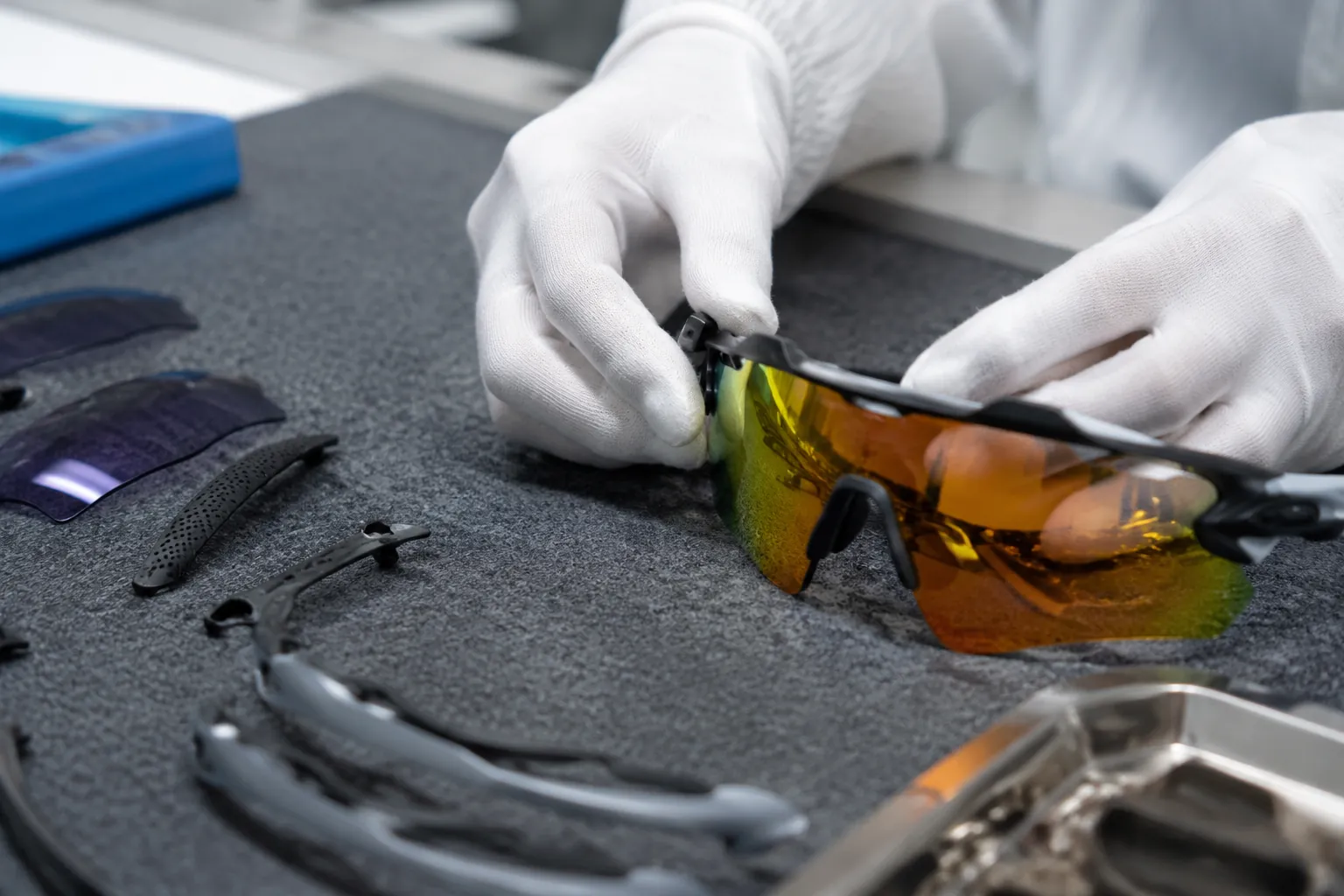
This guide is for brands, importers, distributors, and retailers buying sports sunglasses in volume. It focuses on production details that affect sell-through, returns, and repeat orders: wrap fit, lens retention, tint consistency, material choice, decoration durability, testing, MOQ, and lead-time control. Define the product before tooling. Cut sampling loops. Build eyewear that can handle movement, sweat, sun exposure, and retail handling.
Start With the Use Case, Not the Frame Shape
Sports sunglasses should start with the activity, not a render or a competitor photo. A cycling wrap, running frame, golf model, fishing style, and lifestyle-sport crossover all need different geometry. Lens height, base curve, pantoscopic angle, temple grip, nose pad height, and ventilation clearance change by use case.
A cycling frame usually needs wider horizontal coverage, stable nose fit in a forward head position, and enough upper lens height so the rider does not look over the frame. A running frame needs lower weight, controlled temple pressure, and better airflow to reduce fogging. Fishing models often prioritize polarized lenses and side coverage. Golf frames usually use contrast-enhancing brown or amber-family tints rather than the darkest lens possible.
Before sampling, lock three inputs: target sport, head-size range, and prescription insert requirement. If a prescription insert is needed, the frame must leave enough bridge space and lens-to-eye clearance. If the product is non-prescription only, the design can often be lighter and more open.
Set a weight target and a wear target before tooling. Do not guess. Many buyers aim for a low-weight running frame, a balanced cycling wrap, or a slightly heavier lifestyle-sport acetate or mixed-material style. The exact gram target belongs in the tech pack and should be checked against the approved sample. LumiShades has in-house injection molding, acetate cutting, CNC milling, lens tinting, decoration, and QC, so these choices can be converted into production steps without splitting responsibility across several factories.
Frame Materials and Production Behavior
The main frame options are TR90 or nylon-style injection materials, acetate, and mixed-material constructions. Each behaves differently in molding, finishing, assembly, and long-term wear. Choosing by appearance alone is a common sourcing mistake.
| Material | Best Use | Production Strengths | Key Risks |
|---|---|---|---|
| TR90 / nylon-style injection | Running, cycling, active sport | Lightweight, flexible, stable for volume molding, good recovery after flex | Mold finish, gate marks, shrinkage, and temple whitening must be controlled |
| PC injection | Entry sport, promotional programs | Lower cost, fast output, good impact resistance | Stiffer feel, less premium touch, and chemical sensitivity if coatings are poorly chosen |
| Acetate | Lifestyle-sport crossover | Premium surface depth, rich colors, easy polishing and lamination | Heavier, slower process, less ideal for high-sweat performance use |
| Mixed material | Premium sport retail | Combines grip, branding, comfort, and structure | More assembly steps, more QC points, higher unit cost |
For performance channels, injection frames are usually the workhorse. They support repeatable geometry at scale. Wall thickness, hinge structure, and rib design should be set by the engineer and confirmed in the sample. The right thickness depends on material, part geometry, and required flex. Too thin, and the frame may twist or lose lens retention. Too thick, and sink marks, weight, and cooling variation become problems.
Before tooling, ask for the target material, temple-core design, hinge type, surface finish, and expected flex behavior. On a sports frame, temple recovery after flex matters more than a showroom photo. During sampling, check for white stress marks around the hinge, nose bridge, lens groove, and temple bend. These marks often point to material stress, poor drying, sharp internal corners, or a mold or process issue.
Wrap Fit, Tolerances, and Lens Security
Wrap fit is where sports sunglasses work or fail. A deep wrap improves coverage. It also raises optical and assembly risk. Many sport wraps sit in a moderate-to-high wrap range, but the correct base curve depends on lens design, frame geometry, and use case. If lens curvature, groove depth, and optical center are not controlled, the wearer may see distortion or feel eye strain.
Fit should be checked on faces, not only on a bench. Review temple clamp, nose contact, cheek clearance, helmet compatibility, downward head tilt, and movement during quick turns. For running and cycling, lens-to-face clearance should be set during development and confirmed in wear testing. Too close can trap heat and fog. Too far can allow dust, wind, and side glare.
Lens security depends on the tolerance stack. The lens groove, rim tension, lens edge thickness, screw position, drill holes, and locking tabs all need to work together. Define the tightest tolerances the material and process can hold consistently. Then verify them against the approved sample and the first production run. Loose variation can create gaps, lens rattle, edge chipping, or pop-out risk.
- Check lens pop-out resistance after repeated frame flexing.
- Inspect lens-to-frame gaps under strong side light.
- Test temple spring-back after repeated open-close cycles.
- Confirm left-right nose pad height and angle are symmetrical.
- Review cheek contact with smiling, head tilt, and forward posture.
- Check helmet or cap interference if the product targets cycling or running.
For active sports, request a short wear test during sampling. Bench inspection proves dimensions. Wear testing reveals bounce, sweat slide, fogging, and pressure points. A frame can feel fine for one minute and fail after real movement.
Lens Material, Tint, and Optical Control
Lens choice should follow the performance target, not only the color. PC is common for sports sunglasses because it is light and impact-resistant. TAC polarized lenses are widely used for fishing, driving, and glare-control models. Nylon lenses can offer strong optical performance and are often selected for premium performance styles, though they cost more. The right choice depends on price point, target market, and testing requirement.
Tint must be tied to visible light transmission, or VLT. Do not approve "dark gray" without a number. Gray outdoor lenses are often specified for bright sun. Brown or amber lenses are often selected for contrast. Category 3 lenses are commonly used for strong sunlight, but the final category and labeling must match the target standard and market.
Curved lenses create extra risk. Tint can appear darker at the edge. Mirror coating can show color shift. Optical distortion can increase if the base curve does not match the frame. For wrap sunglasses, ask the factory to check haze, prism, lens center alignment, coating uniformity, and left-right color difference. Agree on a practical color-control target based on the approved master sample and production limits, not a generic number.
Photochromic lenses need real validation. Response time changes with temperature, UV intensity, and lens formulation. A sample that darkens well outdoors in warm weather may react differently in cold conditions. Mirror lenses also need process control. Base tint, vacuum coating, protective top coat, and handling all affect final appearance and durability.
LumiShades runs lens tinting in-house, which helps control bath timing, temperature, drying, and batch records. This matters because color drift is easy for end customers to notice, especially when a retailer displays several pairs side by side.
Decoration Without Creating Failure Points
Decoration adds brand value, but on sports frames it must not weaken the structure or create warranty risk. Common methods include pad printing, laser engraving, hot stamping, metal logo plates, rubber inserts, and in-mold or assembled color accents. Each method has a different durability profile.
Pad printing is cost-effective for temple logos and color marks, but ink adhesion must be tested on the exact substrate and finish. Matte nylon, glossy PC, rubberized coatings, and polished acetate all behave differently. A simple tape test is not enough for sports use. Ask for abrasion, sweat, and alcohol-wipe checks if the logo sits where hands, helmets, or straps rub.
Laser engraving is clean and permanent for serial marks or subtle logos, but depth and heat setting must be controlled. Too much energy can create rough edges, color burn, or local weakness. Metal logo plates look premium, but they add adhesive, recess tolerance, and edge-lift risk. On curved temples, even a small mismatch can cause peeling after heat and sweat exposure.
Keep logos away from high-contact zones: temple tips, helmet contact points, nose bridge edges, and areas rubbed during cleaning. Decoration samples should always be made on the actual production material, color, and surface finish. A logo approved on glossy black acetate does not prove performance on matte black TR90.
Testing Priorities for Athletic Channels
Certification and product testing are related, but they are not the same. Certification shows that a model or process meets a standard. Product testing confirms that the actual production style performs as intended. For overseas buyers, key references may include CE EN ISO 12312-1, FDA registration, ANSI Z80.3, AS/NZS 1067, REACH, ISO 9001, and BSCI. LumiShades should only claim real certifications or registrations, and only when the document applies to the relevant product or factory.
For sports eyewear, testing priority usually starts with lens impact resistance, optical quality, frame retention, coating durability, and chemical compliance. If the lens passes impact but scratches during packing, the product still fails commercially. If the temple logo wears off after short-term sweat exposure, the customer still sees a quality problem.
- Confirm the target market and applicable standard before sampling.
- Lock frame material, lens material, tint, coating, and decoration before mold cutting.
- Review samples for fit, optical alignment, lens seating, and surface finish.
- Run pre-production inspection on first bulk output to catch process drift early.
- Hold final inspection against the approved sample, sealed color standard, and AQL plan.
Request test records tied to the exact style, not only a generic family report. A small change in lens curve, groove depth, or frame geometry can change performance. For wrapped or semi-rimless models, confirm that the lens and frame were tested as a finished assembly.
Useful internal checks include repeated temple open-close cycling, lens retention after flex, sweat exposure on coatings and logos, carton drop testing, screw torque checks, nose pad pull checks, and high/low temperature storage. These do not replace standards. They catch many problems that create returns.
MOQ, Price Breaks, and Lead-Time Logic
Sports sunglasses can look simple but become expensive fast. Mold complexity, lens material, polarization, mirror coating, rubber inserts, metal logos, packaging, and inspection level all affect cost. The smarter buying pattern is to validate the core model first, then add colorways and lens variations after the product proves itself.
| Order Level | Typical Use | Cost Direction | Planning Note |
|---|---|---|---|
| 50 pairs/design | New style test or controlled launch | Highest unit cost | Good for market validation, photos, and first buyer feedback |
| 300 pairs/design | Initial stock for a focused channel | Lower cost than a 50-pair run | Useful for checking packaging, color consistency, and reorder potential |
| 1,000 pairs/design | Core seasonal order | Meaningful price improvement | Better for distributor, retailer, or regional rollout programs |
| 5,000+ pairs/design | Volume program | Can reach lower landed cost depending on specs | Best economics when lens, decoration, and packaging are not overbuilt |
LumiShades MOQ starts at 50 pairs per design. Sample lead time is typically 7-10 days after specification confirmation. Bulk production is usually 25-35 days after sample approval, assuming materials, packaging, and decoration are stable. Add time for new tooling, multiple lens colors, mirror coating, custom packaging inserts, third-party testing, or several logo approval rounds.
Price breaks come from reducing setup waste and spreading fixed work across more units. At 50 pairs, the factory still manages setup, color matching, QC, packaging preparation, and communication. At 1,000 or 5,000 pairs, those costs spread more efficiently. Avoid launching too many low-volume SKUs at once unless the sales channel truly needs them.
What to Put in the Tech Pack Before RFQ
A strong tech pack reduces guessing. A weak one turns the supplier into the designer, engineer, and risk owner. That usually creates delays. For sports sunglasses, include measurements, materials, test targets, decoration instructions, and commercial priorities.
At minimum, specify frame front width, lens width, lens height, bridge width, temple length, base curve, frame material, lens material, lens color, VLT target, coating, logo method, logo location, packaging, compliance market, and target order quantity. If the frame needs adjustable nose pads, anti-slip temple sleeves, helmet compatibility, or prescription insert support, state it before sampling.
Define acceptable tolerances where they matter. Lens color should match the approved sample. Left-right lens seating should be even. Hinge screws should not loosen during normal open-close cycling. Visible logo placement should stay centered within the agreed artwork position. If the buyer has a sealed sample, final inspection should compare against it.
Buyer rule: for sports sunglasses, fit and lens security matter more than decorative detail. Customers notice bounce, fog, pressure, and lens movement before they notice a slightly different logo finish.
State the main priority: lowest cost, best optics, lowest weight, strongest grip, or premium appearance. You rarely maximize all five at once. LumiShades can move faster when tradeoffs are clear, because the sample room, molding team, lens team, decoration team, and QC team work toward the same target.
Have a custom sunglasses project in mind?
Send us your styles, target market and quantities and we will return a detailed quote with MOQ, lead time and a sample plan.
Get a QuoteWhy source this from Wenzhou with LumiShades
Wenzhou in Zhejiang Province is widely regarded as China’s eyewear manufacturing capital, producing a large share of the world’s sunglasses. That concentration matters to buyers: a deep local supply chain for acetate sheet, hinges, lens blanks, plating and packaging means shorter component lead times, easier color and material matching, and a workforce with decades of eyewear-specific skill. LumiShades has manufactured in this ecosystem since 2009, and our vertical integration — in-house injection molding, acetate cutting, CNC milling, lens tinting, decoration and quality control — means no part of your order is quietly subcontracted to a workshop you cannot audit.
For international buyers, that vertical control translates into accountability. When a single factory owns every step, defects are traced and fixed at source rather than bounced between vendors, and your specifications survive intact from first sample to bulk. We back this with 15+ years of experience, shipments to 60+ countries, more than 5 million pairs produced per year and a 98.5% on-time delivery rate. Our certifications — CE EN ISO 12312-1, FDA registration, ANSI Z80.3, AS/NZS 1067, REACH, ISO 9001 and BSCI audit — mean the compliance documentation your market requires already exists. Explore our manufacturing capabilities and quality control process to see how this works in practice.
Frequently asked questions
What is a realistic MOQ for custom sports sunglasses? A practical MOQ depends on the amount of customization. For a simple custom run, 50 pairs can work for a controlled launch or buyer test. At 300, 1,000, or 5,000+ pairs, setup and QC costs spread more efficiently and unit pricing usually improves. Ask the factory to quote by design, lens type, and packaging so you can compare full landed cost, not only frame price.
How long do sampling and bulk production usually take? A typical schedule is 7-10 days for samples after specifications are confirmed, then 25-35 days for bulk production after sample approval. The timeline can extend for new tooling, several lens colors, mirror coating, custom packaging, or third-party testing. Protect launch timing by approving the tech pack, sealed sample, and artwork before bulk starts.
Which certifications or registrations should a buyer ask for on performance sunglasses? Ask for documents that match the target market and product: CE EN ISO 12312-1, FDA registration, ANSI Z80.3, AS/NZS 1067, REACH, ISO 9001, and BSCI. Check that each document is current, applies to the relevant product or factory, and can be supported with test reports or audit records. Do not rely on unsupported claims or generic certificates that do not cover the exact style.
What matters most in a sports frame fit test? Check temple pressure, nose contact, lens-to-face distance, cheek clearance, helmet compatibility, and movement during head tilt or quick motion. The frame should stay stable without pinching, slipping, or bouncing. Also confirm that the lenses do not touch the face during normal movement and that the wearer can see clearly in the intended posture.
How should I choose between gray, brown, mirrored, and polarized lenses? Start with the use case. Gray is a safe all-purpose outdoor tint. Brown or amber often works better when contrast matters. Mirror coating helps reduce glare and adds retail appeal, but it adds process-control requirements. Polarized lenses are useful for fishing, driving, and water glare, but they should be specified with the intended market and labeling in mind.
What is the main production risk on wrapped sports sunglasses? The main risk is tolerance stack. Small errors in lens curve, lens edge cutting, groove depth, drill position, or temple alignment can cause lens gaps, pop-out risk, optical distortion, or poor face fit. Wrapped styles should be checked as a finished assembly, not just as separate parts.
Ready to start?
Explore our round sunglasses or request a quote — our sales team replies within 12 hours.
Request a Quote