
PC Injection vs Acetate Frames: Buyer Decision Guide
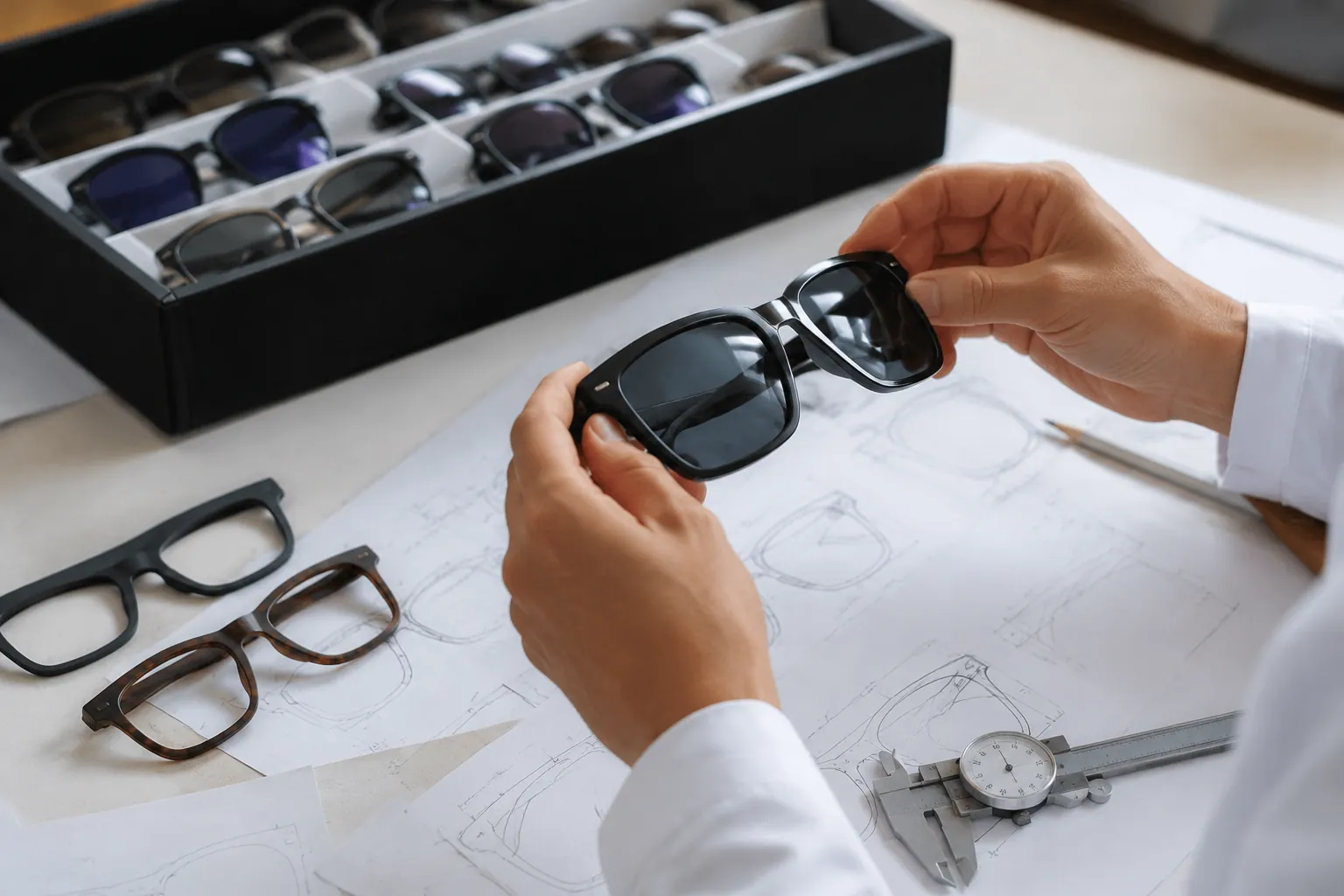
Choosing between PC injection and hand-cut acetate is not mainly a material question. It is a sourcing decision tied to margin, tooling payback, reject risk, lead time, and reorder accuracy. Pick the wrong route and the problem usually appears later: mold changes that cost too much, acetate finishing that drifts, bulk units that do not match the approved sample, or repeat orders that no longer make commercial sense. This guide focuses on the variables that affect factory performance and purchasing risk: target retail, development budget, expected annual volume, dimensional repeatability, decoration method, compliance scope, and how the style is meant to move from a trial run to repeat production.
Start with the business model, not the frame look
Many buyers start with appearance: glossy black, tortoise pattern, thick temples, flat lenses. That is understandable. It is also the wrong starting point.
Start with the commercial model. What retail band must the style hit? What volume is realistic in the first 12 months? Is this a test, or is it meant to become a repeatable platform?
PC injection and hand-cut acetate solve different sourcing problems. PC injection usually works better when geometry must repeat, unit cost must stay under control, and replenishment is likely. Hand-cut acetate usually works better when the frame itself needs to signal value through material depth, layered color, polished edges, and a heavier premium feel.
The risk sits in different places. Acetate sampling often needs more iteration on polish level, edge shape, finish, and pattern choice. PC projects demand more discipline earlier. Once a mold is cut, changes are slower and usually more expensive.
- Start with PC injection if the line is price-led, retail-program driven, or likely to need repeat replenishment.
- Start with acetate if the collection depends on material story, premium touch, and boutique positioning.
- Compare both if the design may become a core carryover but the first order is still a market test.
Simple rule: do not ask which material is better. Ask which route creates less friction over the next 12 months.
Head-to-head: where each route wins and where it gets costly
| Decision factor | PC injection | Hand-cut acetate |
|---|---|---|
| Up-front development cost | Usually higher because mold tooling is commonly required; design changes after mold cut can add cost and time | Usually lower tooling burden for initial development; often easier for short-run silhouette testing |
| Best volume band | Often stronger when a style is expected to repeat at higher volumes because tooling can be amortized over more units | Often stronger for lower-volume tests and premium small-batch collections where material presentation matters more than scale efficiency |
| Typical tolerance behavior | Strong repeatability once the tool and process are stable; lens groove, symmetry, and assembly fit are often easier to hold consistently | Can be consistent with disciplined CNC and finishing control, but visual variation from sheet pattern and hand finishing is more likely |
| Visual character | Clean surfaces, consistent shape, suitable for solid colors and standard gloss or matte finishes | Richer depth, translucent effects, layered laminations, polished bevels, thicker premium appearance |
| Reorder consistency | Usually strong if the same mold, approved color standard, and process controls are maintained | Structurally repeatable, but exact pattern appearance may vary because acetate sheet material is not visually identical lot to lot |
| Typical decoration routes | Pad print, heat transfer, laser marking, painted details, applied logo parts | Laser engraving, metal logo plates, foil details, polished edge reveals, premium hinge presentation |
| Perceived value in hand | Often functional and efficient; usually better aligned with value retail than luxury storytelling | Often higher perceived value when weight, polish, and hinge fit are executed well |
The broad rule is clear. If the program depends on cost control and repeat orders, PC injection is often the safer route. If the frame must help justify a higher shelf price before the customer tries it on, acetate usually gives more merchandising value.
Do not rely on assumptions. Cheap acetate is still cheap acetate, and poor processing will show it fast: wave marks, uneven bevels, loose hinges, warpage, bad polish. On the other side, a well-managed injection program can look cleaner, fit lenses more consistently, and beat a weak acetate project on both quality stability and margin control.
What changes on the factory floor
The route changes more than the material. It changes where production risk lives.
- PC injection process: polycarbonate resin is dried to reduce moisture-related defects, color is introduced, frame parts are molded, cooled, trimmed, and inspected for short shots, flash, sink marks, weld lines, and gate blemishes. Parts then move to decoration, hinge fitting where applicable, lens insertion, frame alignment, and final cosmetic inspection.
- Hand-cut acetate process: cellulose acetate sheets are selected by color and pattern, cut into blanks, CNC milled, beveled, tumbled or hand-shaped, polished through multiple stages, fitted with hinges or wire cores as required, adjusted for symmetry, and checked for surface quality, hinge performance, and final alignment.
For buyers, the practical difference is direct. Injection puts more pressure on mold design, cooling, shrink control, and process stability. Acetate puts more pressure on machining accuracy, polishing discipline, and skilled assembly. Both routes can produce a good frame. The control points are just different.
Use behavior also differs. PC is usually lighter and more impact resistant than acetate, which can suit active, promotional, or entry-price programs. Acetate usually has a denser feel and stronger color depth, but it is less forgiving if polishing heat, storage, or post-processing are handled poorly.
Ask for more than a sample. Ask how the frame will actually be made and which defect risks are most likely for that exact design.
Cost logic: first-order price is not total program cost
Too many sourcing decisions still get made from one sample quote or one unit price. That is a mistake.
With PC injection, the cost is usually front-loaded. Mold tooling requires a bigger initial commitment, but if the style repeats, unit cost can improve because tooling is spread across more pairs. That is why injection often makes more sense for core carryover styles, retail programs with repeat purchase orders, or accounts that need replenishment consistency.
With acetate, the first order is often easier to launch. There is less dependence on dedicated mold tooling, and design changes are less painful during development. That makes acetate useful for trend-led shapes, premium low-volume tests, and styles where the material itself helps sell the product. The trade-off is straightforward: unit cost usually stays more labor-heavy.
Buyers should request pricing in at least three quantity bands that match the real buying plan. Check whether pricing includes packaging, carton marks, logo method, and exact lens specification. A frame that looks cheaper in a quote can turn expensive once logo plates, upgraded hinges, polarized lenses, or premium packaging are added.
- Choose PC injection if you expect replenishment, need lower landed cost over repeat orders, or want tighter repeatability over several seasons.
- Choose acetate if you need premium material cues, want to test a design without committing first to mold tooling, or the style depends on layered color and finish detail.
- Pause the project if target retail does not support the full package of frame, lens, branding, packaging, and compliance work.
The most useful RFQ is not "quote this style." It is "quote the same design intent in both routes, show development cost, unit price at relevant MOQs, and note the likely reject drivers." Compare programs, not isolated unit prices.
Repeatability, tolerances, and the reject points that matter
This is where the difference becomes operational. Not theoretical.
Injection molding is built for consistency once the mold is proven and the process is stable. That usually helps with left-right symmetry, temple fit, lens groove consistency, and assembly speed. It matters even more for chain retail and e-commerce replenishment, where buyers expect later lots to match earlier lots closely.
Acetate can also be highly consistent, but the result depends more on machining control, hand-finishing discipline, and sheet selection. Some visual variation is normal. Pattern placement can shift. Color tone can move slightly between lots. Edge polish quality depends heavily on process control.
Ask specific tolerance questions. Which dimensions are controlled most tightly? Which areas can vary slightly by process? What does the factory check during in-line QC and final inspection? Useful checkpoints include overall front width, lens opening consistency, hinge seating, temple alignment, opening-closing torque, lens seating pressure, and visible cosmetic defects.
Common reject points include:
- PC injection: sink marks near thick sections, weld lines in stress areas, flash at parting lines, uneven color dispersion, stress cracking around hinges, and lens-fit variation caused by shrink behavior.
- Acetate: warpage after polishing, asymmetrical bevels, surface waves, weak lamination appearance, loose hinge fit, polishing inconsistency, and mismatch between temple and front pattern appearance.
If customer complaints are mainly cosmetic, review acetate finishing closely. If complaints are mainly about replenishment mismatch and fit consistency, PC injection often gives the more stable production platform.
Compliance is mandatory, and the test focus changes by route
Frame material does not remove compliance obligations. It changes where buyers need to look harder.
Sunglasses sold into export markets still need to meet the relevant lens and finished-product requirements of those markets, and the sourcing file should define that scope before bulk production starts.
Standards and compliance references commonly requested in this category include CE EN ISO 12312-1, ANSI Z80.3, AS/NZS 1067, REACH, and FDA registration where applicable for market-entry documentation. On the factory and procurement side, ISO 9001 and BSCI may also matter for vendor approval and ongoing compliance review.
The monitoring focus shifts by frame route. With PC injection, pay close attention to dimensional stability affecting lens fit, edge finish after trimming, hinge-area stress, and adhesion of any print or coating. With acetate, review raw-material compliance, finish quality after polishing, and frame stability after heat exposure during processing, storage, and transport.
Also remember that compliance is broader than the frame front and temples. Lens category, UV performance, labeling language, warnings, packaging claims, and market-specific documentation all need to align. A proper pre-production file should include an approved drawing, bill of materials, lens specification, branding positions, packaging specification, and defined test requirements. If any of those items are vague, the project is not ready for bulk.
A practical framework for choosing the route
If the team needs a fast, defensible decision, use this framework.
- Define brand position. If the frame itself must communicate premium value in hand, evaluate acetate first. If the line is value-driven and margin-sensitive, start with PC injection.
- Check tooling appetite. If the project can absorb mold cost and the style has reorder potential over multiple seasons, injection becomes more attractive.
- Estimate 12-month volume. Below a few hundred pairs with uncertain demand, acetate is often the safer test route. For programs likely to scale into the thousands, injection usually improves the cost structure.
- Review reorder expectations. If retail partners expect close repeatability across deliveries, injection generally has the advantage.
- Check the merchandising story. If visible lamination, material depth, polished bevels, or chunky temple construction are part of the sales pitch, acetate usually adds value.
- Confirm decoration method. If the look depends on metal logo plates, engraved details, or exposed polished edges, acetate may support the concept better. If the decoration is straightforward and cost-led, injection often keeps execution cleaner.
A common range strategy is to split the collection: acetate for directional statement styles, injection for core carryover shapes. That keeps visual variety without pushing every SKU into the more labor-intensive route.
Useful rule: buy acetate for impression, buy injection for repetition.
Not universal. Still a good starting point.
How to brief the factory so the sample predicts the bulk order
The route only works if the brief is specific. Vague requests create slow sampling, expensive revisions, and approvals that fail in production.
For either material, send a proper tech pack: front width, lens width, bridge, temple length, target base curve, lens category, color references, hinge type, logo method, packaging, compliance market, and target price. If the project is still choosing between routes, ask for side-by-side costing and written comments on reject risk, likely lead-time pressure points, and which dimensions the factory expects to control most tightly.
Use the sample stage properly. Do not approve on appearance alone. Check opening force, weight balance, temple-tip comfort, face feel, lens seating, logo position, and whether the frame still looks right after repeated handling. For acetate, inspect polish consistency, bevel quality, lamination appearance, and hinge fit. For PC injection, inspect gate cleanup, surface quality, parting-line finish, and any sign of stress around hinge zones.
Before bulk, ask these direct questions:
- Which process step is most likely to create cosmetic rejects on this exact design?
- Which dimensions are held most tightly, and which may vary slightly by process route?
- How is color controlled between the approved sample and the bulk lot?
- What final inspection standard is used for cosmetics, assembly, and logo placement?
- What changes in cost or lead time if the style repeats in higher volumes?
Good buyers do not wait for problems to appear in the warehouse. They force clarity before production starts. That is the difference between buying a sample and buying a program.
Have a custom sunglasses project in mind?
Send us your styles, target market and quantities and we will return a detailed quote with MOQ, lead time and a sample plan.
Get a QuoteWhy source this from Wenzhou with LumiShades
Wenzhou in Zhejiang Province is widely regarded as China’s eyewear manufacturing capital, producing a large share of the world’s sunglasses. That concentration matters to buyers: a deep local supply chain for acetate sheet, hinges, lens blanks, plating and packaging means shorter component lead times, easier color and material matching, and a workforce with decades of eyewear-specific skill. LumiShades has manufactured in this ecosystem since 2009, and our vertical integration — in-house injection molding, acetate cutting, CNC milling, lens tinting, decoration and quality control — means no part of your order is quietly subcontracted to a workshop you cannot audit.
For international buyers, that vertical control translates into accountability. When a single factory owns every step, defects are traced and fixed at source rather than bounced between vendors, and your specifications survive intact from first sample to bulk. We back this with 15+ years of experience, shipments to 60+ countries, more than 5 million pairs produced per year and a 98.5% on-time delivery rate. Our certifications — CE EN ISO 12312-1, FDA registration, ANSI Z80.3, AS/NZS 1067, REACH, ISO 9001 and BSCI audit — mean the compliance documentation your market requires already exists. Explore our manufacturing capabilities and quality control process to see how this works in practice.
Frequently asked questions
If I am launching a new brand with uncertain demand, which route is safer? Usually acetate is the safer starting point if you want a premium look in a small first run and do not want to commit immediately to mold tooling. PC injection can still be the better choice if the concept is price-led, the geometry is unlikely to change, and the style is meant for repeat production. The practical move is simple: ask the supplier for two quotes, one in acetate and one in PC injection, each showing development cost, MOQ, unit price, and the likely effect of a repeat order. Then compare the 12-month program cost, not just the first PO.
Can I get low MOQ on both routes? Often yes, but low MOQ does not mean equal economics. A supplier may accept a small order in either route, yet the cost structure can differ sharply because injection programs may still require tooling and acetate programs remain labor intensive. When reviewing a low-MOQ offer, ask four questions: is tooling required, does the MOQ rely on standard parts or custom parts, are packaging and logo work included, and does the same unit price hold on repeat orders? That tells you whether the MOQ is commercially useful or only technically possible.
Which material is better for exact repeat orders? PC injection is generally better for exact repeatability once the mold, resin grade, color standard, and process settings are controlled. It usually gives more consistent geometry, lens fit, and assembly behavior from lot to lot. Acetate can also be structurally consistent, but exact visual matching is harder because sheet pattern, translucency, and polishing response can vary between material lots. If repeat accuracy matters, ask the supplier to state clearly which attributes should match exactly and which may show normal lot-to-lot variation.
Does acetate always mean better quality? No. Acetate often signals higher perceived value, not automatic higher quality. Quality depends on raw material, machining, polishing, hinge fitting, alignment, and inspection discipline. A poorly processed acetate frame can look worse and perform worse than a well-controlled injection frame. Judge the sample by evidence: symmetry, hinge feel, polish consistency, lens seating, logo execution, and stability after handling. Not by material name.
What compliance documents should I ask for on export sunglasses? Ask according to the target market and product claim. Common requests include test reports or documentation aligned with CE EN ISO 12312-1, ANSI Z80.3, AS/NZS 1067, and REACH, plus FDA registration where applicable for U.S. market-entry documentation. Also request the bill of materials, lens specification, labeling copy, and packaging claims used for the tested sample so you can confirm that the compliance file matches the production version. If your vendor approval process requires it, ask for ISO 9001 and BSCI documentation as part of factory qualification.
Ready to start?
Explore our square sunglasses or request a quote — our sales team replies within 12 hours.
Request a Quote