
PC Injection vs Acetate Look: Cut Cost, Keep Margin
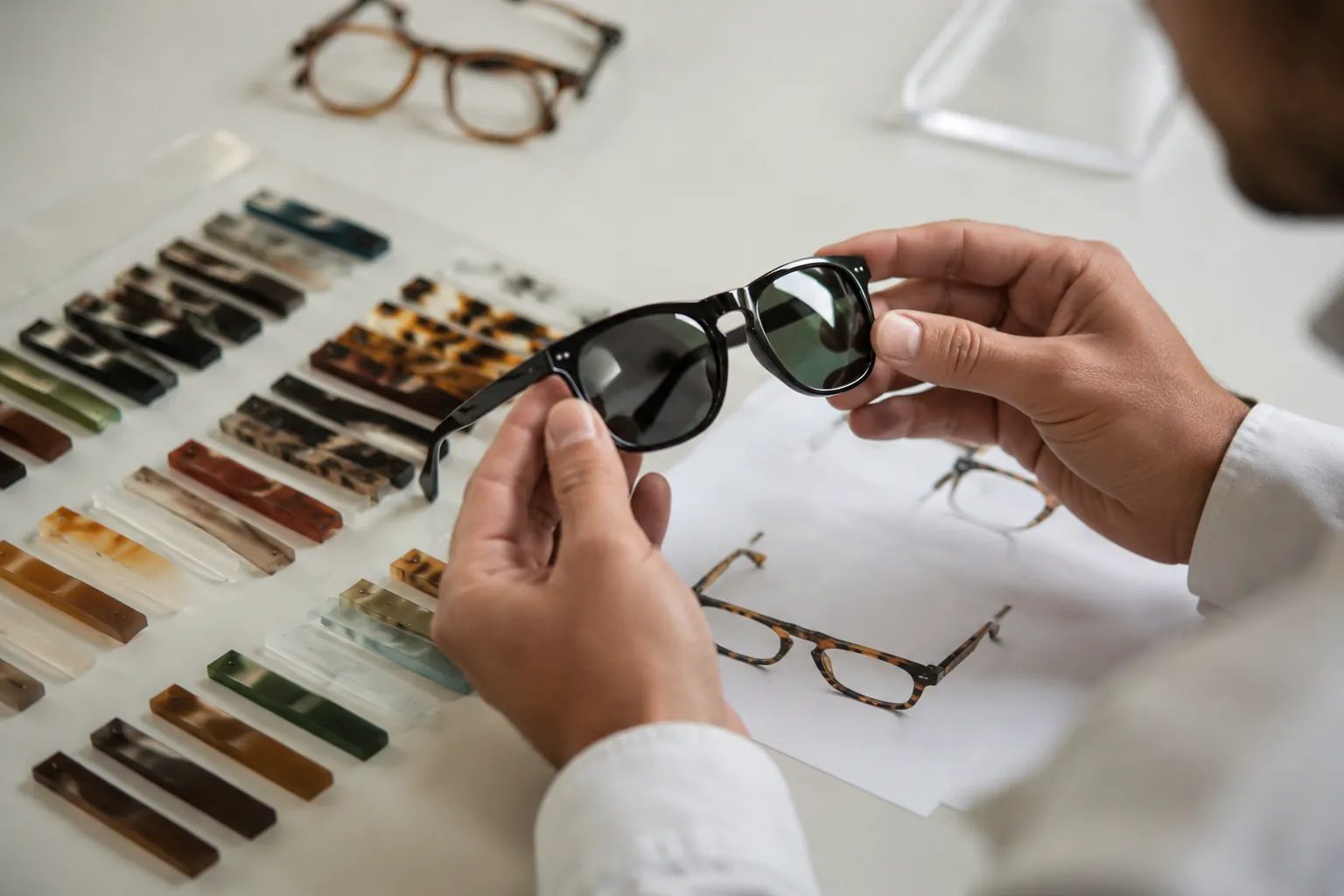
For sunglasses buyers, the "acetate look" is usually a range-planning decision before it is a material decision. If your retail target is tight, frame construction affects margin early—before freight, duty, packaging, and compliance are added. The real sourcing job is to decide which visual cues customers notice, which can be reproduced with PC injection, and where hand-cut acetate still earns its higher cost. This guide compares the two using practical points: process, MOQ, lead time, QC, decoration, and compliance.
1) Start with landed cost, not material preference
Many sourcing discussions start with: "We want acetate styling." That is not a manufacturing brief. It is an aesthetic target, not a costed product plan.
Start with landed cost. Work backward from target retail, channel margin, packaging level, freight mode, import duty, and markdown risk. Then set the allowable ex-factory cost for the full sunglasses package, not just the frame. That usually includes frame, lenses, branding, labels, packaging, inspection, and shipping assumptions.
PC injection and hand-cut acetate solve different problems. Injection molding usually lowers labor content, improves dimensional repeatability, and supports faster bulk output once tooling and specs are fixed. Hand-cut acetate adds machining, polishing, assembly, and manual finishing. Cost goes up. Variation usually does too.
The key question is simple: Which visible and tactile cues actually drive sell-through in this channel? In many commercial programs, customers notice shape, thickness, gloss, lens tint, and branding first. Material is often not the first read. That is why a lower-cost visual tier can work—if you keep the cues that matter.
Ask suppliers for a process-based quotation: frame material, lens material and tint, hinge spec, branding method, packaging, compliance scope, sample timing, bulk lead time, and inspection standard. Without that detail, "acetate look" is vague and expensive.
2) What buyers are paying for in hand-cut acetate
Acetate usually costs more than injection-molded PC for two reasons: the material format and the process route. Buyers are not just paying for the sheet. They are paying for the steps required to turn that sheet into a finished frame.
- Acetate sheets are cut into frame fronts and temples.
- CNC or similar machining creates the outer profile, lens groove, bridge area, hinge pocket, and temple shape.
- Edges are beveled, tumbled, buffed, and polished through multiple finishing stages.
- Hinges are inserted and fixed, then checked for fit and opening/closing action.
- Frames are assembled, heated, adjusted, aligned, and polished again before final inspection.
That route creates the traits buyers often associate with premium eyewear: visible material depth, richer transparency, stronger pattern effects, and a more substantial hand feel in many silhouettes. It also creates more chances for labor variation, cosmetic inconsistency, and reject risk if machining or polishing slips.
Acetate can vary naturally from lot to lot, especially in patterned or laminated sheets. That can be a selling point in premium storytelling. It can also be a problem for repeat-order color consistency in private-label replenishment. If repeat accuracy matters, ask how the supplier controls sheet selection and color approval across lots.
In practical terms, the extra spend on acetate usually buys these visible or perceived benefits:
- Edge character: deeper, softer bevel transitions with a polished look
- Material body: more depth in clear or translucent colors
- Pattern realism: better tortoise, stripe, and laminated effects
- Hand feel: more substance in the hand for many frame builds
- Merchandising story: easier premium positioning when material is part of the sales pitch
If those benefits are central to the product story, acetate may be worth it. If the main cues are shape, gloss, and color, PC injection may do the job at lower cost.
3) Where PC injection works—and where it does not
PC injection is not a hidden substitute for acetate. It is a different build method with clear strengths and limits.
It usually works best on commercial shapes where customers read silhouette, section thickness, gloss, and lens color first. Think bold rectangles, square frames, soft cat-eyes, navigator-inspired shapes, and medium-thick unisex fashion styles. In these cases, a well-designed injection frame can look clean, consistent, and polished.
It usually works less well where the design depends on effects tied closely to acetate, such as:
- deep laminated layers visible through polished bevels
- complex tortoise with strong pattern movement
- very thick temples where visible material body is the luxury cue
- products meant for close side-by-side comparison with premium acetate frames
Process detail matters. A lot. If you want an injection frame to look more expensive, section design must be controlled carefully. Simply asking for "thicker" is not enough. Bad wall transitions can cause sink marks, warpage, uneven gloss, or a blunt, cheap-looking profile. A better discussion covers front profile, edge radius, section balance, and finish targets.
Color matters too. PC usually handles solid colors and straightforward transparent tones better than ambitious pattern imitation. Black, smoke, crystal grey, tea, and some olive tones are often safer because the result depends more on resin clarity and surface finish than on faking layered material effects.
Bottom line: premium impression rarely comes from material alone. It comes from shape, profile, color, gloss, lens choice, and branding. A well-specified PC frame can beat a badly executed "acetate-style" concept. Easily.
4) Head-to-head: cost, MOQ, lead time, decoration, and risk
| Factor | PC Injection Frame | Hand-Cut Acetate Frame |
|---|---|---|
| Best use case | Value to mid-tier retail, large-volume private label, distributor programs, and styles where repeatability matters more than material storytelling | Premium collections, hero SKUs, optical-inspired fashion sun, and products where material identity is part of the value proposition |
| MOQ logic | Often suitable for lower-risk commercial testing when a factory already has a relevant platform or mold route; confirm MOQ by style, color, and branding method | Usually less efficient for very small trials because of higher unit cost and more labor-intensive finishing |
| Indicative unit-cost direction | Typically lower than hand-cut acetate when comparing like-for-like design intent, basic decoration, and similar packaging scope | Typically higher because of acetate sheet use, machining, polishing stages, hinge fitting, and manual finishing |
| Sample lead time | Depends on whether an existing mold can be adapted or new tooling is required; confirm timing based on the actual development route | Depends on machining complexity, color approval, and finishing detail; revisions can take longer if aesthetics are demanding |
| Bulk lead time | Often shorter once tooling and specifications are approved, but actual timing depends on order size, color count, and finishing steps | Often longer because of additional machining, polishing, assembly, and color-control requirements |
| Repeat-order consistency | Generally stronger on shape repeatability and stable solid or transparent colors when process control is good | Can show more natural variation in pattern, polish outcome, and hand-finishing details |
| Decoration options | Pad print, laser marking, hot stamp effects where suitable, painted details, and metal logo components if the construction supports them | Pad print, laser marking, foil or hot stamp where suitable, inlaid details, metal hardware, and broader premium finishing options |
| Main production risk | Looking inexpensive if section design, gloss control, or branding execution is weak | Higher cost exposure, more finishing variability, and greater reject risk from machining or polishing defects |
The rule is straightforward. If the frame will be closely handled, sold on material story, or compared directly with premium acetate brands, acetate keeps a real advantage. If the product must hit a tighter retail band, repeat cleanly, and support faster replenishment, PC injection often gives the better margin structure.
5) Five design and decoration moves that make injection look better
Low-cost sunglasses often look cheap because the brief is weak, not because injection molding cannot produce a polished result. Be specific. Prioritize a few visible upgrades and execute them well.
- Control front thickness, not just total bulk. A stronger brow line and fuller endpieces can add presence, but the proportions must stay balanced. Too much material in the wrong place makes the frame look clumsy.
- Soften the edge break. Harsh edges can read toy-like. Ask for cleaner transitions and better radii on the front, temples, and tips while keeping the build durable.
- Use colors that suit the process. Black, smoke, tea, crystal grey, and selected translucent tones usually read better than low-cost attempts at complex tortoise or lamination effects.
- Upgrade temple presentation. A plain flat temple can expose the budget fast. Consider stepped geometry, cleaner tip shaping, a subtle decorative line, or a well-executed metal logo component if the build allows it.
- Pair the frame with a stronger lens story. Lens color affects perceived value more than many buyers expect. A good smoke gradient, tea gradient, or classic green can improve the result if it fits the brand brief and meets the target standard.
Decoration method matters. A crisp pad print can work fine in commercial programs, but poor registration or weak adhesion will drag the whole product down. Laser marking can give a cleaner, more durable result on some surfaces. Metal logo plates can raise perceived value, but they add QC demands around placement, attachment strength, plating consistency, and edge finish.
Do not pile every premium cue onto one low-cost frame. Pick two or three that customers will notice first. Then hold them consistently in bulk.
6) QC and compliance: small details, big margin impact
On lower-cost programs, QC matters more because the margin buffer is smaller. One good sample proves very little. Bulk consistency is the real test.
Set measurable acceptance criteria before production starts. For sunglasses, that often includes hinge alignment, lens seating, temple symmetry, left-right color consistency, surface cleanliness, decoration position, and opening/closing feel. Cosmetic limits should be defined in advance too: what is acceptable for flow lines, minor polish marks, print offset, plating variation, or surface scratches, and in which viewing zones.
For private-label buyers, the tech pack should lock at least these points:
- target market and required standard set
- lens category or visible light transmission target
- required markings, labels, warnings, and packaging language
- restricted-substance requirements for frame, coating, paint, adhesive, and decoration
- AQL level and named cosmetic acceptance zones
For sunglasses programs, buyers often confirm whether the supplier can support the standards and systems relevant to the target market or customer requirement set, including CE EN ISO 12312-1, FDA registration, ANSI Z80.3, AS/NZS 1067, REACH, ISO 9001, and BSCI. Check this during quotation and sample approval. Not after bulk starts.
Material and decoration choices also affect compliance in practical ways. Lens tint must match the intended category and UV performance requirement. Coatings, inks, paints, adhesives, and metal components must align with the customer's restricted-substance requirements and any legal requirements that apply. If the frame uses mirrored coatings, soft-touch finishes, unusual paints, or metal logo parts, ask for confirmation on both chemical compliance and bulk cosmetic stability before approval.
7) A practical workflow for testing a lower-cost visual tier
If you are not sure whether your market will accept PC injection for an acetate-inspired style, do not argue it out by opinion. Test it properly.
- Select one hero shape. Choose a design where acetate cues are clear, such as a fuller front, stronger temple profile, or polished fashion look.
- Build two versions. Request one acetate reference and one PC injection interpretation with the same design intent, lens color, and branding position.
- Define the full cost scope. Compare frame, lenses, branding, packaging, inspection, and freight assumptions so the decision reflects real commercial conditions.
- Review physical checkpoints. Assess gloss, edge softness, lens fit, hinge action, alignment, branding quality, and perceived hand feel.
- Review shelf and photo performance. Some differences are obvious in hand but minor at shelf or in ecommerce images. Others get worse online.
- Decide by channel, not ideology. Keep acetate for premium doors or hero SKUs if the material story matters. Use PC injection for volume retail if the visual result is good enough.
This split-tier strategy is often more practical than forcing one construction across every market. It protects margin where the channel is price-sensitive while keeping acetate where close inspection, merchandising story, or premium positioning justify the extra spend.
The most common mistakes are predictable: paying for material features the customer does not reward, pushing imitation effects too far, and failing to define repeatability before bulk. The right answer is rarely material purity for its own sake. It is channel fit, spec clarity, and disciplined comparison between design intent and commercial reality.
Have a custom sunglasses project in mind?
Send us your styles, target market and quantities and we will return a detailed quote with MOQ, lead time and a sample plan.
Get a QuoteWhy source this from Wenzhou with LumiShades
Wenzhou in Zhejiang Province is widely regarded as China’s eyewear manufacturing capital, producing a large share of the world’s sunglasses. That concentration matters to buyers: a deep local supply chain for acetate sheet, hinges, lens blanks, plating and packaging means shorter component lead times, easier color and material matching, and a workforce with decades of eyewear-specific skill. LumiShades has manufactured in this ecosystem since 2009, and our vertical integration — in-house injection molding, acetate cutting, CNC milling, lens tinting, decoration and quality control — means no part of your order is quietly subcontracted to a workshop you cannot audit.
For international buyers, that vertical control translates into accountability. When a single factory owns every step, defects are traced and fixed at source rather than bounced between vendors, and your specifications survive intact from first sample to bulk. We back this with 15+ years of experience, shipments to 60+ countries, more than 5 million pairs produced per year and a 98.5% on-time delivery rate. Our certifications — CE EN ISO 12312-1, FDA registration, ANSI Z80.3, AS/NZS 1067, REACH, ISO 9001 and BSCI audit — mean the compliance documentation your market requires already exists. Explore our manufacturing capabilities and quality control process to see how this works in practice.
Frequently asked questions
Can PC injection frames be marketed as acetate-style without misleading customers? Yes, if the wording describes the look rather than misstates the material. Use language such as "acetate-inspired shape," "polished vintage look," or "chunky optical-inspired styling." Do not describe the frame itself as acetate if it is made from PC. Make sure the material listed on specs, labels, compliance documents, and customer-facing packaging is accurate.
At what order size does a PC injection cost-down program usually start to make sense? There is no fixed threshold. It depends on whether the supplier can use an existing mold platform, whether new tooling is needed, how many colors are planned, and what branding or packaging is required. Ask the factory for a price ladder by quantity and a separate note on tooling, decoration setup, and packaging costs. Then compare total landed cost against an acetate version using the same lens, branding, and pack-out assumptions.
Which colors are safest if I want an upscale look on PC injection? Solid black, smoke, crystal grey, tea, and selected translucent tones are usually the safest starting point because they depend on clean molding, resin clarity, and surface finish rather than complex pattern simulation. If you want a more fashion-led look, ask for actual resin chips or approved sample colors under consistent lighting before confirming bulk. Do not assume a printed image of tortoise or layered effects will translate well into production.
How should I compare acetate and PC samples fairly? Keep the comparison controlled. Use the same silhouette, similar dimensions, the same lens tint and lens category target, the same branding position and method where possible, and the same packaging level. Review both samples in three ways: in hand, on shelf, and in product photography. Also record measurable checks such as front width, temple length, lens fit, hinge feel, weight, and cosmetic defects. That gives you a commercial decision, not just a subjective reaction.
What compliance documents should I confirm before bulk production? First confirm the target market, because the required documentation depends on where the sunglasses will be sold. Then ask the supplier which of the following they can support for your program where applicable: CE EN ISO 12312-1, ANSI Z80.3, AS/NZS 1067, REACH, and FDA registration. If your customer also requires factory-level documentation, confirm ISO 9001 and BSCI status separately. In addition, lock the lens category or visible light transmission target, required markings and warnings, restricted-substance requirements, and any test or declaration needed for coatings, paints, adhesives, or metal components before pre-production approval.
Ready to start?
Explore our square sunglasses or request a quote — our sales team replies within 12 hours.
Request a Quote