
OEM vs ODM Sunglasses: Faster, Safer, Better Margin?
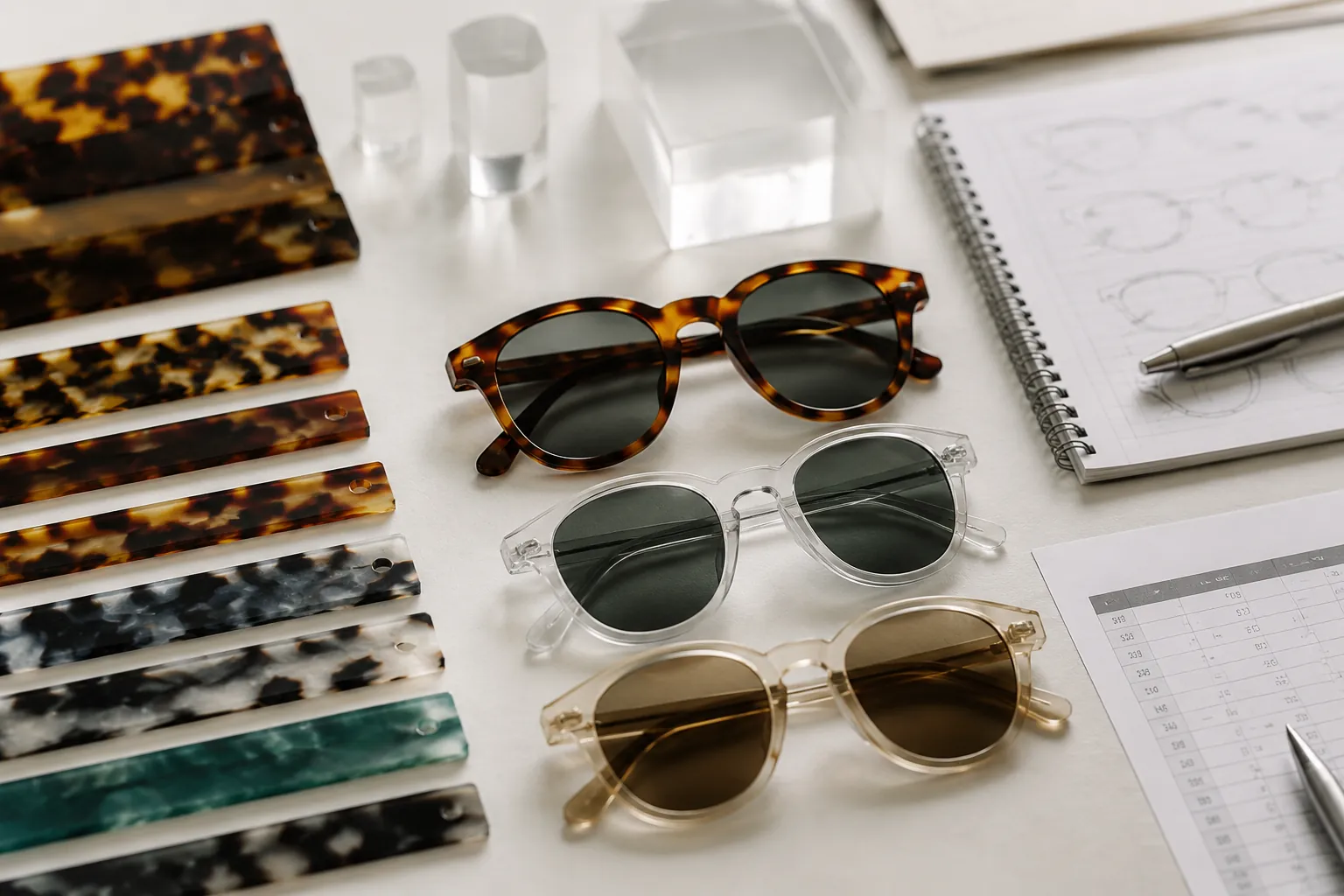
This guide is for brand owners, importers, distributors, and retail buyers deciding between OEM and ODM sunglasses before they lock budget, samples, and delivery dates. The real choice is not custom versus ready-made. It is speed versus control, margin versus setup cost, and differentiation versus production risk. Break the decision into lead time, MOQ, tooling, material behavior, decoration limits, and compliance scope. Then the right route usually gets obvious fast.
Start With the Real Buying Decision
Many buyers frame OEM versus ODM as a design choice. It is usually an operations choice first. You are deciding how much development work, uncertainty, and verification you want to carry from quotation to shipment.
ODM starts with an existing factory platform: a frame the supplier has already tooled, sampled, and produced. Customization is usually limited to frame color, lens tint, logo application, and packaging. Some suppliers may allow small cosmetic changes, but the structure stays the same.
OEM starts from your drawing, reference sample, CAD file, or tech pack. That gives you more control over front shape, temple profile, bridge geometry, hinge details, hardware, and packaging. It also adds engineering review, more approvals, and more chances for revision.
For many first launches, ODM is the lower-risk route. The factory already knows how the frame behaves in molding or machining, how the lenses fit, where decoration can be applied consistently, and which cosmetic points tend to fail. OEM makes more sense when the frame itself is part of the brand story and no existing platform can do the job.
One common mistake: treating OEM like a simple logo change. It is not. It is a development project. Plan for prototype review, corrections, and document control from day one.
Where Time, Cost, and Risk Actually Sit
| Factor | ODM path | OEM path |
|---|---|---|
| Starting point | Existing production frame platform | New drawing, sample, CAD, or concept brief |
| Sample lead time | Usually shorter because the structure already exists | Usually longer if engineering review, prototyping, or tooling is needed |
| Bulk lead time | Usually more predictable after sample approval | Often less predictable because corrections may continue after first sampling |
| MOQ pressure | Often lower because existing parts and processes are already in use | Often higher when custom parts, new molds, or special hardware are involved |
| Tooling exposure | Low to limited | Higher, especially for custom injected parts or proprietary hardware |
| Fit and yield risk | Lower because the frame has production history | Higher until fit, function, and appearance are proven in production |
| Best use case | Fast launches, seasonal programs, retailer collections, market tests | Brand-led collections, differentiated designs, repeat programs with stable volume |
The hidden cost gap is not just unit price. It is how many points in the process can stop progress.
An OEM program may need CAD confirmation, prototype revision, mold adjustment, lens-fit correction, logo hardware testing, and packaging re-approval. That is normal. But each step adds time and creates another approval dependency.
ODM strips out many of those unknowns. A proven platform already gives the supplier a starting point for lens fit, hinge function, temple closure, decoration placement, and cosmetic standards. Less uncertainty usually means less commercial risk. That is why ODM is often the safer choice even when the quoted unit-price difference looks small.
Which Buyers Usually Fit Each Route
The right model depends less on taste and more on timing, cash flow, and reorder confidence.
- New brand with limited budget: Usually start with ODM. It avoids early tooling spend and lets you test demand before paying for custom geometry.
- Retail chain with fixed seasonal deadlines: ODM is often safer because delivery reliability usually matters more than a unique frame architecture.
- Importer testing a new market: ODM usually lowers risk because it supports smaller commitments across several styles or colorways.
- Established brand with a clear design language: OEM may be necessary if existing market platforms do not support your identity or price position.
- Distributor serving several private labels: ODM often gives the best operating efficiency because one proven frame family can carry different branding, lenses, and packaging.
There is also a middle path. Many buyers launch with ODM, track sell-through, then rebuild a winning style as OEM once volume justifies custom parts or a proprietary mold. That sequence makes sense. It cuts sunk cost and gives the OEM brief a real commercial base.
MOQ, Price Tiers, and Why Small Orders Lean ODM
MOQ is not just the minimum order level. It defines how much customization is commercially realistic.
With existing frames, suppliers may offer lower MOQs because the structure, parts, and process are already in place. That usually supports light customization such as frame color, lens tint, logo treatment, and standard packaging. OEM is different. Even if a supplier accepts a small opening order, custom components can still create higher real minimums through mold cost, material purchasing requirements, assembly complexity, or lower line efficiency.
At small quantities, every custom element matters. A metal logo plate adds part cost and assembly steps. A special acetate color may trigger higher material minimums. Polarized lenses cost more than standard tinted lenses. Mirror coatings or lens-category changes may also require extra product verification.
Quote in layers, not as one blended number:
- Base frame cost by quantity tier
- Lens specification: standard tint, gradient, mirrored, polarized, or UV400 requirement
- Branding method: pad print, laser engraving, hot stamp, or metal insert
- Packaging: pouch, cleaning cloth, box, barcode label, and outer carton marks
- Any development or tooling charge for new parts
Simple rule: if volume is small and demand is uncertain, ODM usually wins. OEM starts to make more sense when order size or reorder confidence is strong enough to spread setup cost across multiple runs.
What Buyers Miss in OEM Development
OEM programs usually go wrong on detail, not concept. A rendering can look right and still be hard to produce consistently.
For injected frames, manufacturability depends on wall thickness, structural support, shrink behavior, gate location, cooling balance, and lens-groove consistency. If those points are not resolved, you can get warp, twist, poor symmetry, or unstable lens fit. For acetate, the visual result can be strong, but the process still depends on sheet quality, CNC accuracy, polishing consistency, hinge setting, and final alignment.
Buyers need measurable control points. Not vague comments. Real numbers where possible.
- Front width tolerance against the approved sample or drawing
- Temple length tolerance against the approved sample or drawing
- Logo size and logo position tolerance
- Lens color approval against a signed color reference under agreed viewing conditions
- Hinge function standard, including smooth opening and closing with no obvious looseness or binding
Decoration is another area buyers often under-specify. Pad printing is common and cost-effective, but adhesion should be checked on the actual surface finish. Laser engraving is stable when the substrate and finish respond well. Metal logo plates can improve shelf appeal, but they add alignment risk, extra components, and more reject points. On small runs, simpler logo methods are often easier to control.
The rule is basic: turn aesthetic feedback into production requirements. "Looks premium" is not an inspection standard. Position, size, finish, function, and color need to be defined so the factory and QC team can check them consistently.
Compliance Still Matters on ODM
One expensive assumption is that an existing frame is automatically compliant. It is not. Compliance belongs to the finished product specification sold into a specific market.
For sunglasses, buyers commonly review standards such as CE EN ISO 12312-1, ANSI Z80.3, and AS/NZS 1067, depending on destination. Chemical obligations may involve REACH. In some U.S. import cases, buyers may also ask for FDA registration information in the supplier document set. Factory-level credentials such as ISO 9001 and social compliance references like BSCI can help with supplier assessment, but they do not replace product-level verification.
The main risk is spec drift. Change the lens category, tint density, mirror coating, polarized film, lens material, or another relevant component, and an old test report may no longer match the goods you plan to ship.
- Ask whether the report covers the exact lens and frame configuration you are buying.
- Confirm market-specific labeling requirements, including warnings or filter-category markings where required.
- Recheck chemical status if coatings, decorative parts, inks, or material sources change.
- Do not approve bulk using a report tied to a different build than the final production specification.
So yes, ODM can reduce engineering risk. It does not remove compliance responsibility. Not even close.
A Low-Risk Buying Process That Works
The safest buying path is a gated process with clear approval points. It cuts avoidable delay, protects margin, and gives QC something concrete to inspect against.
- Choose the route first. Decide whether the program is speed-led or identity-led. Do not let an ODM inquiry drift into OEM through uncontrolled revisions.
- Shortlist narrowly. Review a small number of realistic ODM frames or one clearly defined OEM concept. Too many parallel options slow decisions and weaken feedback.
- Lock the commercial target before sampling. State target market, price basis, MOQ, packaging level, and required ship window before sample work starts.
- Create one approval sheet. Put frame color, lens tint, logo size and location, packaging artwork, barcode, carton mark, and assortment details into one controlled document.
- Sample once, then correct precisely. Mark fit, finish, print position, color, and packaging deviations directly. Specific comments get action. Vague comments do not.
- Approve a sealed sample. This becomes the production reference for line setup, in-process control, and final inspection.
- Run a pre-production review. Confirm materials, lens specification, decoration method, hinges or hardware, packaging components, and the applicable compliance file before mass production starts.
- Inspect against the sealed sample and approved specification. Final QC should cover function, cosmetics, lens defects, print adhesion where relevant, assortment accuracy, barcode accuracy, and carton packing.
This process is not glamorous. That is why it works. Most shipment problems are ordinary: wrong lens shade, loose hinges, logo misplacement, mixed assortments, or the wrong packaging artwork. Strong buyers close those gaps before line start, not after freight is booked.
The Practical Rule for Choosing OEM or ODM
Choose ODM if you need faster market entry, lower development exposure, more predictable execution, and a practical path for a first order or test program. It often fits seasonal capsules, retailer programs, and demand validation.
Choose OEM if your brand truly needs a frame shape, construction feature, or hardware package that existing platforms cannot deliver. The trade-off is clear: more engineering work, more approval checkpoints, and usually more schedule risk.
For most buyers, the right answer is commercial, not ideological. Pick the route that gives you the best mix of calendar control, acceptable landed cost, repeatable QC, and compliance confidence for the market you serve. That is what safer means in eyewear sourcing.
Have a custom sunglasses project in mind?
Send us your styles, target market and quantities and we will return a detailed quote with MOQ, lead time and a sample plan.
Get a QuoteWhy source this from Wenzhou with LumiShades
Wenzhou in Zhejiang Province is widely regarded as China’s eyewear manufacturing capital, producing a large share of the world’s sunglasses. That concentration matters to buyers: a deep local supply chain for acetate sheet, hinges, lens blanks, plating and packaging means shorter component lead times, easier color and material matching, and a workforce with decades of eyewear-specific skill. LumiShades has manufactured in this ecosystem since 2009, and our vertical integration — in-house injection molding, acetate cutting, CNC milling, lens tinting, decoration and quality control — means no part of your order is quietly subcontracted to a workshop you cannot audit.
For international buyers, that vertical control translates into accountability. When a single factory owns every step, defects are traced and fixed at source rather than bounced between vendors, and your specifications survive intact from first sample to bulk. We back this with 15+ years of experience, shipments to 60+ countries, more than 5 million pairs produced per year and a 98.5% on-time delivery rate. Our certifications — CE EN ISO 12312-1, FDA registration, ANSI Z80.3, AS/NZS 1067, REACH, ISO 9001 and BSCI audit — mean the compliance documentation your market requires already exists. Explore our manufacturing capabilities and quality control process to see how this works in practice.
Frequently asked questions
Can I start with ODM and later convert the same style into OEM? Yes. That is a common path. Start with an existing frame to test demand, collect sell-through data, and learn which colors, lens options, and price points work. If the style proves repeatable, ask the supplier what would actually need to change to convert it into OEM. Get a written breakdown covering which parts would become custom, whether new tooling is required, what development cost would apply, and whether the compliance file would need updating for the new build.
At what volume does OEM usually start making financial sense? There is no fixed threshold. It depends on frame structure, number of custom parts, tooling cost, and expected reorder pattern. The practical method is to request two quotations: one as ODM and one as OEM, both using the same lens, branding, and packaging assumptions. Then compare unit price, tooling charges, sample cost, lead time, and likely reorder economics. OEM usually makes more sense when the style is expected to repeat and the development cost can be spread across more than one production run.
Does a low MOQ mean I can fully customize everything? Usually no. A low MOQ normally applies to limited customization on an existing frame, such as color, lens tint, logo, and standard packaging. Full structural customization is different. If you want a new mold, custom hardware, special materials, or a non-standard construction, ask the supplier to state in writing which elements are included under the quoted MOQ and which elements trigger separate tooling, higher material minimums, or longer lead times.
What is the safest logo method for small orders? For small runs, pad printing and laser engraving are usually the easiest methods to control because they involve fewer components and fewer assembly variables than metal logo plates. The right method still depends on the surface, finish, and appearance you need. Ask the supplier for a branded sample on the actual material and finish you plan to order, then confirm adhesion, clarity, position, and consistency before approving bulk production.
If a frame already has a test report, do I need new compliance checks after changing the lens color? Possibly, yes. A change in lens tint, category, coating, polarization, material, or another relevant component can affect whether the previous report still applies to the finished product you plan to sell. Ask the supplier to identify exactly which configuration the existing report covers, then compare it item by item with your final specification. If there is any mismatch, confirm with your testing partner or compliance adviser whether updated verification is required before shipment.
Ready to start?
Explore our rimless sunglasses or request a quote — our sales team replies within 12 hours.
Request a Quote