
OEM vs ODM Sunglasses: Cost, MOQ, Tooling, Lead Time
This guide is for overseas brands, importers, distributors, retailers, and promotional buyers choosing between a custom sunglass frame and an existing factory model. OEM and ODM are not just sourcing labels. They change the real budget, sample work, MOQ, tooling risk, decoration options, compliance checks, inspection standards, and lead time. They also change what a buyer can fairly compare at 50, 300, 1000, or 5000 pairs. The aim is simple: choose the route that fits your budget, sales evidence, launch date, need for originality, and destination-market requirements before asking a factory for a final quote.
The short decision: originality or speed
OEM means the product is made to the buyer's design or technical specification. In sunglasses, that can include the frame shape, bridge width, lens groove, hinge seat, temple angle, logo position, surface finish, lens base curve, and packaging structure.
ODM starts from a factory-owned or factory-available model. The buyer then customizes commercial details such as frame color, lens tint, logo method, temple printing, metal badges, pouch, box, barcode labels, and carton marks.
Start with demand proof. If you need a frame shape competitors cannot buy from the same catalog, OEM gives stronger product identity. If you need market feedback, seasonal speed, or a controlled first order, ODM is usually the lower-risk route. A new injection mold can make sense for a repeat style or hero SKU. It rarely makes sense for a small market test unless the test depends on new geometry.
For buyers working with LumiShades in Wenzhou, Zhejiang, the useful questions are practical. Which processes are handled in-house? Which are outsourced? Which existing models are available? Which changes require new tooling or fixtures? Ask for process confirmation on injection molding, acetate cutting, CNC work, lens tinting, laser engraving, pad printing, metal logo plates, assembly, and QC before treating any lead time as firm.
Custom eyewear is not only about appearance. Lens groove depth, hinge alignment, temple opening angle, screw fit, and frame shrinkage decide whether a sunglass feels stable or cheap.
Budget map: what you are really paying for
Most buyers compare only unit price. That is too narrow. A launch budget can include design confirmation, drawings or 3D files, samples, molds or fixtures, material procurement, lens category, decoration setup, packaging, inspection, compliance documents, freight, duty, and possible retesting.
ODM lowers early cost because the frame platform already exists. The factory has production history with the model. Fewer unknowns remain.
| Route | Typical customization | MOQ logic | Lead-time logic | Budget behavior |
|---|---|---|---|---|
| Pure ODM | Existing frame, color choice, lens tint, logo, pouch or box | Lowest MOQ route when the frame, lens, and decoration materials are available | Fastest route because structure and fit are already known | Lowest upfront cost and most reliable early quotation |
| Modified ODM | Existing frame with changed temple decoration, metal plate, mirror lens, or upgraded packaging | More efficient at higher quantities because setup cost is spread across more units | Close to ODM unless a new fixture, logo tool, lens color trial, or packaging sample is needed | Moderate setup cost with stronger brand separation |
| Shared-component OEM | New front or temple using an existing hinge, screw, lens curve, or nose pad system | Better suited to programs with repeat potential because design and fitting checks add fixed work | Requires extra time for prototype review, lens fitting, and assembly testing | Controls tooling spend while improving originality |
| Full OEM | New frame geometry, new mold or acetate program, custom hardware, exclusive components | Best justified when expected volume or margin can absorb development cost | Longest route because design review, mold adjustment, sample loops, and testing may be required | Highest upfront cost, strongest control over product identity |
LumiShades may support small ODM programs from 50 pairs per design when the selected model, material, lens, and logo method are available. The exact MOQ still has to be confirmed against the SKU and customization method.
Economics usually improve as quantity rises. Setup, material procurement, inspection, and packing work are spread over more units. But the quoted unit price is only useful if the assumptions are clear: frame material, lens type, UV requirement, coating, logo method, packaging, inspection level, compliance documents, shipment terms, and order structure. A thick acetate frame with polarized lenses, metal logo plates, and rigid gift packaging will not price like a standard injection frame with UV400 tinted lenses and a simple pouch.
Tooling and tolerances: where OEM gets expensive
Tooling is the hard line between many OEM and ODM projects. For injection sunglasses, a new mold defines the front curve, bridge, lens groove, hinge seat, temple profile, shrinkage allowance, gate position, and parting line.
Small errors matter. Critical fit areas include hinge seating, lens groove width, screw alignment, lens retention, temple opening angle, and overall frame symmetry. The acceptable tolerance depends on material, frame design, mold condition, and the buyer's inspection standard. Put it in the specification. Do not assume it.
If the temple angle is wrong or the lens groove grips too tightly, a better logo will not fix the product. The factory may need to adjust the CAD file, mold steel, injection pressure, cooling time, gate position, lens edge size, or assembly method. These corrections affect cost and lead time. Plan for them in OEM development.
Acetate has a different cost profile. You may avoid a heavy injection mold, but you still pay through CAD or CNC programming, sheet selection, cutting waste, tumbling, polishing, hinge setting, pin drilling, and manual adjustment. Acetate has depth and a premium hand feel. It is also slower and more labor dependent. Sheet thickness, color pattern, cutting direction, and polishing time can all change the final look and fit.
ODM uses an existing mold or proven acetate construction. The factory already knows shrinkage behavior, hinge fit, lens mounting, screw length, polishing result, and assembly yield for that base model. That reduces development uncertainty. The tradeoff is exclusivity. Unless you have a written exclusivity agreement or protected design elements, another buyer may be able to source a similar base model.
A practical middle route is shared-component OEM. For example, create a new front profile but use an existing hinge system, screw size, and lens base curve. Known components reduce assembly risk while the visible frame design becomes more distinct than a catalog model with pad printing.
Materials change cost, feel, and risk
Material choice affects cost, feel, production method, decoration, and inspection risk. PC is common for low-cost injection sunglasses because it is light and efficient to mold. TR90 is flexible and often used for sports or active frames, but decoration adhesion and processing conditions must be checked. Acetate is heavier, richer in color depth, and more premium in feel, but labor, waste, and adjustment time are higher. Metal frames add plating, soldering, nose pad, screw, corrosion, and chemical-compliance questions.
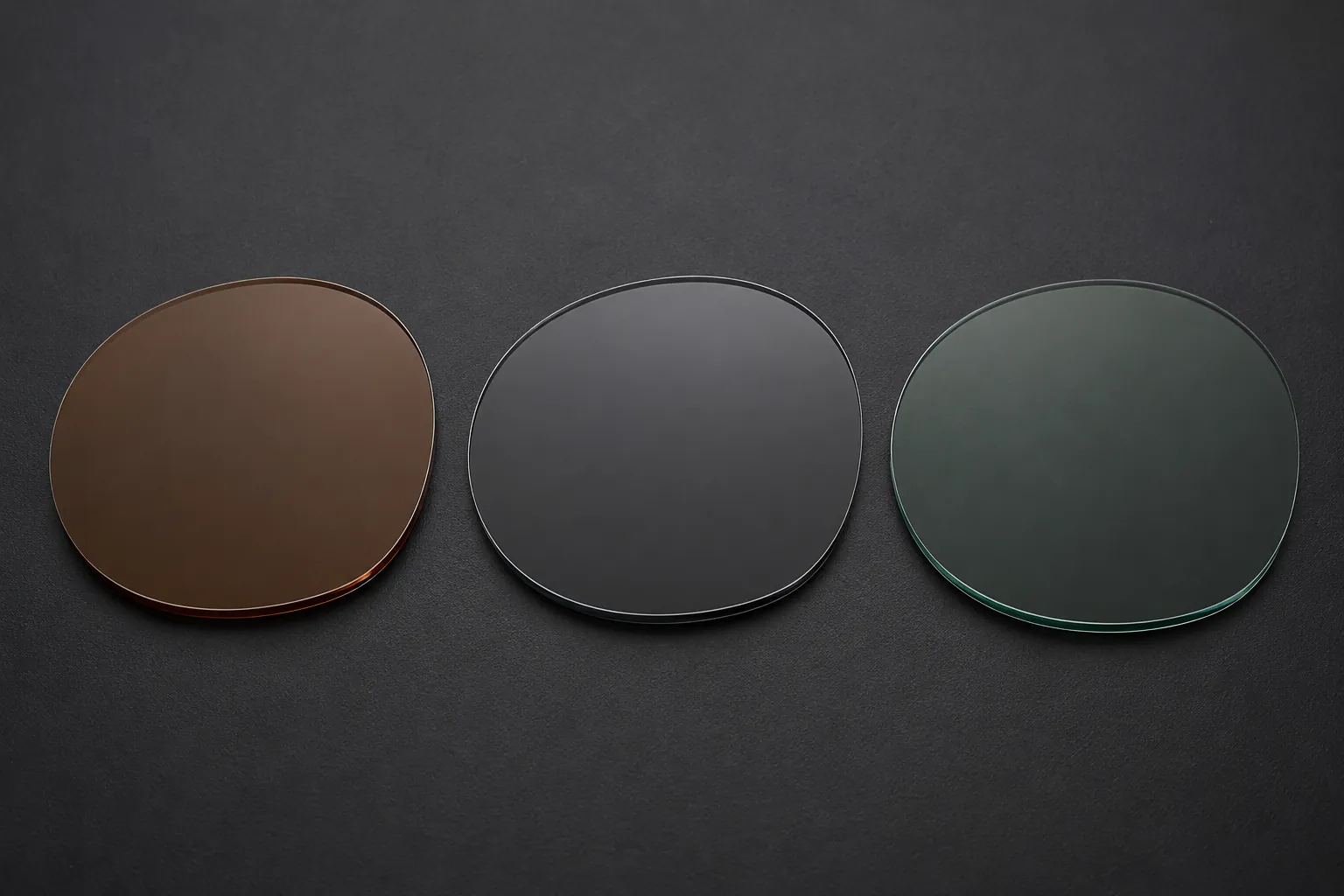
Lenses change the program too. Standard tinted lenses are usually cheaper and faster than polarized lenses. Polarized lenses add material cost and require axis control because poor alignment can affect visual performance. Mirror coatings can improve retail appeal, but they add scratch, adhesion, coating-uniformity, and color-consistency checks. Darker is not automatically better. The lens must match the visible light transmission category and labeling rules for the target market.
- PC injection frame: suitable for low-cost, light-weight, promotional, and larger-volume color programs.
- TR90 frame: useful for flexible sports styles, with decoration and logo adhesion checked before bulk production.
- Acetate frame: premium look and stronger color depth, with slower production and more manual adjustment.
- Metal frame: slim profiles and a refined look, with attention to plating, welding, screw quality, nickel release, corrosion, and chemical restrictions.
- Polarized lens: higher retail value and higher cost, requiring axis, optical, and cosmetic inspection beyond standard tint checks.
Before asking for a final price, specify frame material, lens material, UV requirement, lens category, hinge type, screw color, logo method, color standard, packaging, destination market, and inspection requirement. Without those details, the quote is only a rough estimate.
Lead time is several clocks, not one number
Buyers often ask for production lead time before the product is fully defined. That creates weak planning. Sampling, decoration setup, bulk production, packaging, compliance document preparation, inspection, and freight are separate schedules.
ODM is usually faster because the factory starts from known parts. OEM is slower because the factory must prove that the new geometry works in production and meets the buyer's requirements.
For ODM, ask the supplier to separate sample timing from bulk production timing. Ask for the assumptions behind both. A sample can be delayed by unavailable frame color, lens tint, coating, logo fixture, packaging material, or testing requirement. Bulk production timing should be counted from sample approval, deposit or order confirmation, material readiness, and final artwork approval. Not from the first inquiry date.
OEM should be planned in stages. First confirm drawings, 3D structure, material, hinge, lens base curve, decoration position, lens category, and packaging. Then review prototype parts or first samples. After that come mold adjustment or CNC correction, pre-production sample approval, bulk production, final QC, carton marking, export documents, and shipment booking.
One correction loop can be normal. Repeated loops usually mean the specification was incomplete or the design does not fit the chosen material or production method.
The fastest route is not always the cheapest route. Rushed OEM can waste money because late corrections happen after tooling, material, and packaging decisions are locked. If you are launching into a fixed retail window and the custom frame shape is not essential, ODM or modified ODM is usually more predictable.
Decoration methods: small details create setup cost
Logo and decoration choices affect MOQ, setup cost, unit price, reject rate, and lead time. Pad printing is often economical for small logos on temples or lenses, but it needs a suitable surface, stable ink, and agreed color standard. Laser engraving can be durable and precise on many metal parts and some frame surfaces, but visibility depends on material color and finish. Heat transfer or temple printing can carry more visual detail, but adhesion, abrasion resistance, and color consistency should be checked on production material.
Metal logo plates can make an ODM frame feel more proprietary. They also add tooling or stamping cost, plating control, adhesive or mechanical fixing checks, and cosmetic inspection. A small alignment error on a raised metal badge can be more visible than a small variation in printed artwork.
Lens logos need extra care. Poor ink, bad placement, or weak curing can create retail complaints. They may also interfere with optical or cosmetic requirements.
Packaging changes the commercial picture. A microfiber pouch is low-cost and compact. A folding box improves presentation but adds carton volume. A rigid gift box may support premium retail pricing, but it increases freight volume and requires stronger packaging QC. Barcode labels, warning labels, retail hang tags, country-of-origin marking, and market-specific language should be confirmed before bulk packing starts. After goods are packed, corrections get expensive.
Compliance and inspection: design choices can create testing risk
Compliance is not decoration. Sunglasses sold into regulated retail channels must meet the optical, safety, labeling, and chemical requirements of the destination market. Relevant documents may include CE EN ISO 12312-1, ANSI Z80.3, AS/NZS 1067, REACH, FDA registration, ISO 9001, and BSCI, depending on market, buyer requirement, product type, and supply-chain scope. Ask for current, product-relevant documents. A generic certificate may not apply to the exact product or market.
The standard depends on where the sunglasses will be sold. CE EN ISO 12312-1 is relevant for sunglasses in many European channels. ANSI Z80.3 applies to non-prescription sunglasses and fashion eyewear in the United States. AS/NZS 1067 is relevant for Australia and New Zealand. REACH relates to chemical restrictions in materials, coatings, inks, and metal parts for the European market.
FDA registration may be relevant for eyewear products entering the U.S. market, but it is not a substitute for product-level optical performance checks. ISO 9001 and BSCI are management-system or social-compliance references. They do not prove that a specific sunglass model has passed optical testing.
OEM can increase compliance risk because geometry and lens mounting change. A lens that passes as a flat sample may behave differently once mounted under stress in a tight frame groove. Distortion, loose lens retention, sharp edges, weak hinge function, plating defects, poor screw retention, and color mismatch usually appear after assembly, not on the quotation sheet.
For ODM, request the existing test basis and confirm whether your lens tint, coating, mirror layer, frame material, or logo process requires retesting.
Final inspection should be defined in the purchase order. Many buyers use AQL inspection for cosmetic defects, function, lens scratches, logo position, hinge tension, screw tightness, lens retention, packaging, barcode, and carton marks. If your retail channel has stricter cosmetic grading, write that into the approved sample and inspection checklist. A sunglass acceptable for a beach promotion may not be acceptable for a department-store counter.
A practical selection rule for launch budgets
Use the route that matches your demand proof. If you have no sales history for the style, do not start with a full custom mold only because the unit price looks attractive at a high quantity. That price only helps if you can sell the inventory without heavy discounting. Cash tied in slow-moving frames is still cost.
For a first market test, ODM at a small confirmed MOQ is usually rational. You can test face shape, color demand, lens preference, packaging, and retail price without tying too much cash into tooling. For a brand with traction, modified ODM or shared-component OEM gives more separation while keeping risk controlled. For a core collection that will repeat across seasons, full OEM can make sense if expected volume, margin, and channel needs justify the development cost.
Buyer rule: pay for custom tooling only when the design difference helps you sell more units, protect margin, meet a channel requirement, or build a product identity that an existing model cannot support.
Before placing the order, send a complete spec sheet. Include frame material, lens material, lens category, UV requirement, hinge type, logo method, Pantone or physical color reference, packaging, barcode and labeling needs, destination market, inspection level, carton requirements, shipment terms, and required compliance documents.
Ask the factory to separate tooling, sample, unit price, decoration, packaging, testing, inspection, and freight. That is the only way to compare competing quotes fairly.
The best route is not automatically OEM or ODM. It is the route where your design ambition, launch calendar, compliance needs, MOQ, and cash position agree with each other.
Have a custom sunglasses project in mind?
Send us your styles, target market and quantities and we will return a detailed quote with MOQ, lead time and a sample plan.
Get a QuoteWhy source this from Wenzhou with LumiShades
Wenzhou in Zhejiang Province is widely regarded as China’s eyewear manufacturing capital, producing a large share of the world’s sunglasses. That concentration matters to buyers: a deep local supply chain for acetate sheet, hinges, lens blanks, plating and packaging means shorter component lead times, easier color and material matching, and a workforce with decades of eyewear-specific skill. LumiShades has manufactured in this ecosystem since 2009, and our vertical integration — in-house injection molding, acetate cutting, CNC milling, lens tinting, decoration and quality control — means no part of your order is quietly subcontracted to a workshop you cannot audit.
For international buyers, that vertical control translates into accountability. When a single factory owns every step, defects are traced and fixed at source rather than bounced between vendors, and your specifications survive intact from first sample to bulk. We back this with 15+ years of experience, shipments to 60+ countries, more than 5 million pairs produced per year and a 98.5% on-time delivery rate. Our certifications — CE EN ISO 12312-1, FDA registration, ANSI Z80.3, AS/NZS 1067, REACH, ISO 9001 and BSCI audit — mean the compliance documentation your market requires already exists. Explore our manufacturing capabilities and quality control process to see how this works in practice.
Frequently asked questions
Can I start with 50 pairs and still use my own logo? Possibly, if the supplier has an existing ODM style available and your logo method works with the frame material and surface. Confirm the exact model, frame color, lens option, logo size, logo position, setup charge, sample approval process, and whether the 50-pair MOQ applies per design, per color, or per logo version. Ask for a pre-production photo or approved sample before bulk production.
When should I pay for a new sunglass mold? Pay for new tooling when the frame shape is important to your selling proposition, you expect repeat volume, you need stronger product separation, or a retail channel requires originality. Before paying, confirm who owns the mold, whether exclusivity is included, what files and samples must be approved, how many correction rounds are included, what happens if the mold does not meet the specification, and whether retesting is required after the new frame is assembled.
Will changing the lens tint affect compliance? Yes. Lens color, darkness, coating, mirror finish, polarization, and material can affect visible light transmission, category, optical performance, labeling, and destination-market requirements under standards such as CE EN ISO 12312-1, ANSI Z80.3, and AS/NZS 1067. Ask the supplier whether the exact lens you are ordering has applicable test support, and confirm whether your change requires a new test report.
How long should I plan from sample to shipment? Do not rely on one lead-time number. Ask the factory to separate sample production, sample shipping, artwork approval, material procurement, bulk production, inspection, document preparation, and freight. For ODM, timing should be counted after the model, color, lens, logo, packaging, and order terms are confirmed. For OEM, add time for drawings, prototype review, tooling adjustment, pre-production sample approval, and any required retesting.
How do I compare quotes from different factories fairly? Use the same spec sheet for every factory and ask each supplier to separate tooling, sample cost, unit price, decoration, packaging, testing, inspection, and freight. Confirm frame material, lens material, UV requirement, lens category, logo method, MOQ breaks, lead time after approval, payment terms, carton quantity, shipment terms, and which compliance documents apply to your destination market. A lower unit price is not comparable if it excludes packaging, testing, logo setup, or the correct lens specification.
Ready to start?
Explore our rimless sunglasses or request a quote — our sales team replies within 12 hours.
Request a Quote