
OEM Sunglasses: Brief, Samples, Production
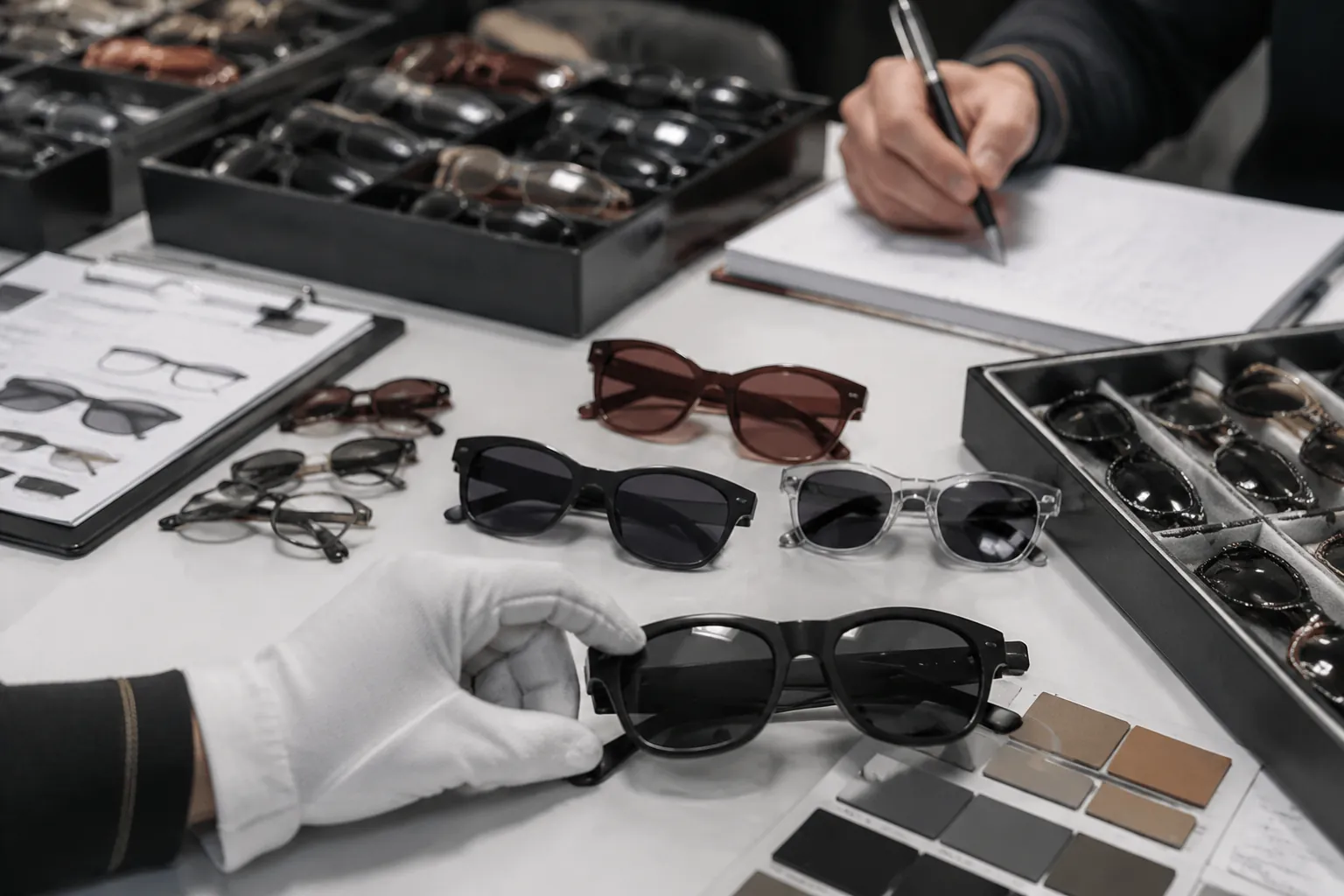
This guide helps fashion brands, importers, distributors, and retailers turn a sunglasses idea into a controlled OEM production order. It covers the decisions that affect tooling, unit price, sample rounds, compliance, packaging, inspection, and delivery timing. Use it to write a clearer factory brief, avoid preventable sample revisions, and build a launch calendar based on real production steps.
Start With a Factory-Ready Design Brief
A sketch is not a production brief. A factory-ready OEM sunglasses brief tells the manufacturer what must be controlled, what can be adjusted for production, and which market the product must satisfy. If the brief is vague, the first sample becomes a guess. Each correction costs time, especially when lens color, logo position, hinge tension, or frame dimensions need to change.
For each style, send front view, side view, temple view, target dimensions, material direction, lens color, hinge preference, logo position, packaging plan, order quantity by color, and destination market. A simple PDF is enough if the dimensions are clear. Reference photos should explain proportion, finish, construction, or mood. They should not ask the factory to copy another brand's protected design.
- Frame width: define the measurement method, such as total front width or hinge-to-hinge width, so the factory checks the same point you approve.
- Lens width and bridge: control fit and lens cutting; even a small bridge change can alter nose fit.
- Temple length: specify the target length and wearer profile instead of assuming one adult size fits every market.
- Front thickness: affects weight, perceived quality, molding limits, polishing time, and lens groove strength.
- Logo size: specify width, height, color, placement, and method, such as laser engraving, pad printing, hot stamping, or metal plate.
- Lens category: define tint darkness, UV claim, visible light transmission target, and destination-market compliance before sampling.
For buyers working with a Wenzhou eyewear factory or any other OEM supplier, the goal is the same: one controlled file that design, tooling, lens, decoration, production, and QC teams can read the same way. Ask which processes are handled in-house and which are subcontracted. That affects sample timing, correction speed, traceability, and accountability.
Choose the Right Frame Route
The biggest early decision is the production route: existing mold, modified mold, new injection mold, or acetate CNC. Buyers often want a unique shape, low MOQ, and low price at the same time. Those goals can clash. Original tooling makes sense when the order plan, repeat potential, and brand value justify the tooling cost.
| Route | Best For | Typical Sample Timing | Cost and MOQ Logic |
|---|---|---|---|
| Existing mold | Fast private label launches, test orders, seasonal colors, influencer drops | Often about 1 to 2 weeks if colors, lenses, and logos are simple and materials are available | Lowest upfront cost; MOQ depends on color, lens, decoration, and packaging requirements |
| Modified mold | Changing temple profile, logo area, bridge feel, or small outline details | Often about 2 to 4 weeks depending on the adjustment, trial fitting, and approval process | Moderate tooling or modification charge; useful when differentiation matters but volume is uncertain |
| New injection mold | Original frame geometry, chain retail programs, long-running hero styles | Often about 4 to 8 weeks before a stable approval sample, depending on tooling complexity and revisions | Highest upfront cost; unit cost usually improves as volume increases and setup time is spread over more pairs |
| Acetate CNC route | Premium thicker frames, laminated colors, tortoise effects, smaller design runs | Often about 2 to 4 weeks for programming, cutting, polishing, fitting, and assembly sample | No injection mold, but material waste, handwork, polishing, and alignment increase unit cost |
Existing molds are not automatically generic. Shape selection, color, lens treatment, hinge hardware, logo method, and packaging can create a commercially distinct style quickly. For a first fashion launch, it is often safer to test sell-through with an existing or lightly modified mold, then invest in new tooling after repeat demand is proven. Protect the cash first.
Match Materials to Price and Fit
Material choice changes weight, hand feel, production speed, surface finish, defect risk, and how sunglasses behave after storage, shipping, heat exposure, or retail display. Do not choose from a render alone. Ask for physical swatches or comparable finished samples, then confirm the supplier can provide the same material in bulk.
Injected plastics such as PC and TR-type materials are common for volume fashion sunglasses because they support stable shapes, faster production cycles, and competitive unit costs. They suit promotional programs, retail chains, seasonal colors, and private label drops. TR-type materials are often used when the buyer wants a lighter or more flexible frame. PC can deliver sharp molded shapes and strong color options, but coating adhesion, stress whitening, gate marks, and warpage need control.
Acetate is denser, warmer to the touch, and suited to deep colors, laminated effects, tortoise patterns, and translucent finishes. It requires sheet cutting, CNC milling, tumbling, polishing, hinge insertion, lens fitting, and more hand alignment. The result can feel more premium, but it adds lead time and inspection points. Metal frames need close control of plating, solder joints, nose pad comfort, screw quality, hinge movement, and temple alignment. Poor plating or weak soldering leads to returns fast, especially around hinges, bridge joints, and nose pad arms.
Before sample approval, confirm hinge type, screw material, lens base curve, expected frame weight, and whether color is molded through or surface coated. Molded-through color hides minor scratches better. Surface coating allows matte, rubberized, metallic, gradient, or special finishes, but it must be checked for adhesion, rub resistance, and packing protection. If your market has restricted substance requirements, confirm whether REACH or other destination-market controls apply to the frame, coating, nose pads, screws, packaging, and printed components.
Set Lens Specifications Before Sampling
Lenses are not a cosmetic afterthought. They affect compliance, comfort, product claims, customer trust, and return risk. Define lens material, tint, UV protection requirement, visible light transmission, lens category, coating, base curve, polarization if needed, and target market before sample making starts.
For non-prescription sunglasses, common compliance references include CE EN ISO 12312-1 for Europe, ANSI Z80.3 for the United States, AS/NZS 1067 for Australia and New Zealand, and FDA registration requirements for sunglasses sold into the U.S. market. REACH may apply to restricted substances in frame materials, coatings, packaging, and accessories for products sold in the EU. If the order ships to several regions, tell the factory at quotation stage. Do not wait until logo and packaging approval.
- UV400: should be supported by testing or supplier documentation; do not rely on a sticker claim alone.
- Lens category: must match the intended use and destination-market rules; some dark lenses are not suitable for driving.
- Visible light transmission: should be specified as a target or approved range, then checked against the relevant standard.
- Gradient tint: needs a physical master sample because top-to-bottom density and color can shift between batches.
- Polarized lenses: add cost and require axis control during cutting and fitting to avoid uneven performance.
- Mirror coating: can look premium but is more sensitive to scratches, fingerprints, abrasion, and handling marks.
Review the exact lens sample under daylight, indoor light, and strong direct light. Some fashionable lens colors look good in a studio photo but distort color, feel uncomfortable outdoors, or fail to match the claimed category. Ask which lens tests the supplier performs internally and which require an accredited third-party laboratory. For regulated markets, keep the test reports and make sure product markings, packaging claims, and sales listings match the tested specification.
Engineer Decoration Early
Branding is where many small OEM sunglasses orders lose time. The frame may be approved, but the logo plate, pad print color, hot stamp foil, or engraving position can still fail. Treat decoration as part of the frame plan, not a late add-on.
Laser engraving is durable and clean on many metal or coated parts, but contrast depends on the base material and coating color. Pad printing works well for temple logos and inner temple text, but very thin lines can fill in, especially on curved or textured surfaces. Hot stamping can create a premium metallic logo, but foil adhesion depends on surface texture, heat, pressure, and coating compatibility. Metal logo plates give a strong retail look, yet they need a flat bonding area, molded recess, rivet, or other reliable fixing method. If a plate sits proud on a curved temple, it can peel, snag, or look uneven.
Provide vector artwork, Pantone references where color matching matters, and a clear placement drawing. Agree on a practical logo position tolerance before sampling, especially on curved, tapered, or flexible temples. Inner temple markings should include only accurate and required information, such as model code, lens category where applicable, country of origin, and compliance marks relevant to the destination market. Do not ask a factory to print certifications, standard references, or regulatory marks the product does not support. That creates customs, marketplace, and liability risk.
Ask the supplier to confirm decoration feasibility before quoting bulk production. The review should cover artwork line thickness, surface curvature, coating compatibility, rub resistance, jig setup, approval sample retention, and bulk inspection criteria. Keep an approved decoration master sample or signed photo record so production and final inspection use the same standard.
Use Samples to Test Manufacturing
Samples are for decisions, not just photos. Treat them as inspection tools. Sample timing depends on the route: existing molds with standard colors and simple logos may be fast, while new molds, special lenses, mirror coatings, custom logo hardware, or special packaging can add serious time. Ask for sample timing after the supplier reviews the full brief.
Check the sample against measurable criteria. Define acceptable tolerances for frame width, lens width, bridge, temple length, front height, logo position, color, and lens performance before bulk production begins. Lens fitting should be tight without stress cracks. Temples should open evenly. Screws should not feel loose. The frame should sit flat without obvious rocking. If a tolerance affects fit, retailer requirements, or packaging, include it in the purchase order or approved specification sheet.
- Measure frame width, lens width, bridge, temple length, and front height against the approved drawing.
- Check left-right balance on a flat surface; rocking usually means alignment correction is needed.
- Open and close temples repeatedly to feel hinge consistency, screw security, and temple tension.
- Inspect logo edges, print sharpness, engraving depth, and placement under strong light.
- Wear the sample outdoors to judge lens comfort, coverage, nose fit, temple pressure, and distortion.
- Confirm pouch, case, barcode label, polybag, warning text, inner box, and export carton fit before bulk packaging is ordered.
Give feedback in one marked PDF, spreadsheet, or controlled revision file with clear decisions: approved, rejected, or approved with listed corrections. Scattered comments across emails and chats cause mistakes. Factories work best from controlled revisions. If you change the frame shape after approving lens, logo, or packaging, expect cost, timing, and approval status to change.
Understand MOQ, Pricing, and Timing
MOQ is not just a sales rule. It reflects machine setup, raw material purchasing, lens preparation, color batching, decoration setup, QC time, packing labor, and whether the supplier is willing to run a small batch. Some suppliers accept low-MOQ trial orders. Others require higher quantities because of material minimums, color batching, or line efficiency. Confirm MOQ by design, color, lens option, logo method, and packaging type.
| Order Size | Best Use | Buyer Risk | Factory Consideration |
|---|---|---|---|
| Low-MOQ trial order | Testing style, fit, color, audience response, or niche demand | Higher unit price, fewer customization options, and limited packaging efficiency | Setup time is high relative to output, so some processes may be simplified |
| Small retail batch | Independent retail launch, boutique program, or regional distributor test | Limited room for complex custom parts or multiple color splits | Better batching than a trial order, but setup and inspection still affect cost |
| Main seasonal SKU | Confirmed demand, planned retail delivery, or repeat private label program | Requires stronger forecasting, packaging control, and inspection planning | More stable unit cost and easier production scheduling |
| High-volume repeat program | Chain retail, importer programs, wholesale replenishment, hero styles | Inventory commitment, compliance documentation, and delivery windows become critical | Best setup efficiency, stronger material planning, and more room for negotiated pricing |
Unit price depends on frame material, mold route, lens material, UV and category requirements, polarization, coating, hinge type, decoration, packaging, testing, inspection, order quantity, payment terms, Incoterms, and freight assumptions. A quoted price is valid only for the stated specification and quantity. If you later change lens type, logo method, color count, packaging, or compliance documentation, ask for a revised quotation before issuing the purchase order.
Confirm bulk production timing in writing after sample approval, deposit, and material availability are clear. Existing-mold projects with standard materials are usually faster than new-tooling or highly customized projects. Add time for new mold trials, lab testing, custom cases, barcode approval, carton testing, final inspection, export booking, and peak-season capacity. Even a capable factory needs locked approvals to meet a delivery date.
Build a Calendar the Factory Can Meet
Work backward from your warehouse date, not from the day you want to place the order. If product must reach a warehouse by a fixed date, allow time for sample approval, production, inspection, export documents, freight booking, customs clearance, and domestic delivery. Late sample approval leaves no room for correction. That is how launch dates slip.
A realistic OEM sunglasses calendar includes design confirmation, quotation, sample payment, sample making, sample review, corrections, purchase order, deposit, material preparation, bulk production, QC, packing, final inspection, balance payment, export booking, shipment, customs clearance, and warehouse receipt. Air freight is faster but expensive, and carton volume matters. Sea freight needs more time. Cartons also need protection from crushing, humidity, and rough handling.
For projects using existing molds and standard components, plan in weeks rather than days. New mold projects need more time because tooling, trial injection, sample revisions, lens confirmation, compliance testing, and packaging approval must happen before bulk production is stable. If the launch depends on a trade show, campaign shoot, retailer delivery window, or seasonal holiday, state that hard date in the first factory email.
Before placing the purchase order, confirm Incoterms, payment terms, approved sample reference, specification sheet, carton marks, barcode rules, inner box quantities, polybag warnings if required, test report requirements, inspection standard, acceptable quality limit if used, and who books freight. A production order is not only a style approval. It is a controlled file the factory can build, inspect, pack, document, and ship without interpretation.
Have a custom sunglasses project in mind?
Send us your styles, target market and quantities and we will return a detailed quote with MOQ, lead time and a sample plan.
Get a QuoteWhy source this from Wenzhou with LumiShades
Wenzhou in Zhejiang Province is widely regarded as China’s eyewear manufacturing capital, producing a large share of the world’s sunglasses. That concentration matters to buyers: a deep local supply chain for acetate sheet, hinges, lens blanks, plating and packaging means shorter component lead times, easier color and material matching, and a workforce with decades of eyewear-specific skill. LumiShades has manufactured in this ecosystem since 2009, and our vertical integration — in-house injection molding, acetate cutting, CNC milling, lens tinting, decoration and quality control — means no part of your order is quietly subcontracted to a workshop you cannot audit.
For international buyers, that vertical control translates into accountability. When a single factory owns every step, defects are traced and fixed at source rather than bounced between vendors, and your specifications survive intact from first sample to bulk. For procurement review, buyers can request process records, approved samples, quality checkpoints and project-specific compliance files before placing a bulk order. Required testing and documentation are confirmed against the destination market and product specification rather than assumed from a generic certificate list. Explore our manufacturing capabilities and quality control process to see how this works in practice.
Frequently asked questions
Can we start with a low MOQ for OEM sunglasses? Sometimes, yes. MOQ depends on the supplier, frame route, color count, lens type, logo method, and packaging. Existing molds with standard lenses and simple decoration are usually the easiest way to start small. Ask the factory to quote MOQ by design, by color, and by packaging option so you can see what drives the minimum quantity and unit price.
How long do custom sunglasses samples usually take? Sample timing depends on complexity. Existing-mold styles with available materials, standard lenses, and simple logos may be sampled quickly. New molds, acetate CNC work, polarized lenses, mirror coatings, custom metal logos, special colors, or custom packaging can add weeks. Before paying for samples, ask the supplier to confirm the sample scope, expected timing, what is included, and what would trigger a delay or extra charge.
Which compliance references matter for overseas sunglasses orders? Common references include CE EN ISO 12312-1 for Europe, ANSI Z80.3 for the United States, AS/NZS 1067 for Australia and New Zealand, FDA registration requirements for sunglasses sold into the U.S. market, and REACH for restricted substances in products sold in the EU. ISO 9001 and BSCI may also matter as factory management or social compliance references if your retailer requires them. Confirm the destination market first, then ask what test reports, markings, labels, and documents are required for that shipment.
Should a fashion brand pay for a new mold immediately? Not always. Use an existing or modified mold when demand is uncertain, timing is tight, or the launch is mainly testing color, fit, or customer response. Invest in a new mold when the shape is strategically important, the design cannot be achieved from existing tooling, the forecast supports the tooling cost, and the style is likely to repeat. Ask the supplier to quote existing-mold, modified-mold, and new-mold options side by side before deciding.
What information should we send for an accurate quotation? Send drawings or reference dimensions, order quantity by color, frame material, lens type, UV and category requirements, logo method, artwork file, packaging details, destination market, compliance requirements, target delivery date, Incoterms, and whether you prefer existing mold, modified mold, or new tooling. Also state whether you need third-party testing, retailer labeling, barcode rules, or final inspection, because these can affect price and timing.
What is a realistic bulk production lead time? Bulk production lead time should be confirmed after the approved sample, deposit, materials, packaging, and compliance requirements are locked. Existing-mold projects with standard components are normally faster than new-tooling, acetate, special lens, or custom-packaging projects. Add time for lab testing, material purchasing, production scheduling, final inspection, freight booking, customs clearance, and domestic delivery. Build your launch calendar from the required warehouse date backward, not from the purchase order date.
Ready to start?
Explore our cat-eye sunglasses or request a quote — our sales team replies within 12 hours.
Request a Quote