
ODM vs OEM Sunglasses: Choose by Risk and Control
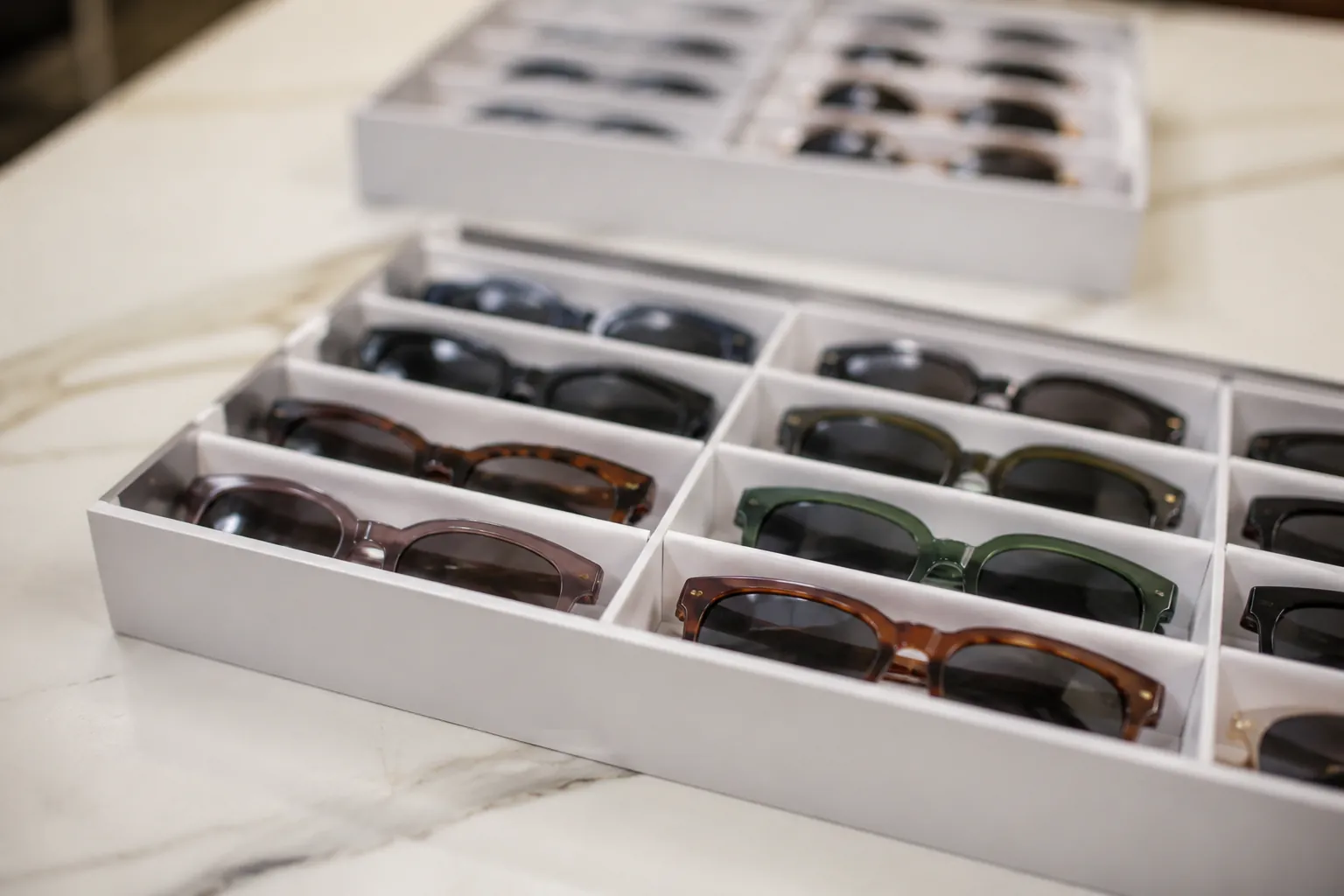
This guide is for brand owners, importers, distributors, and retail buyers choosing between ODM and OEM sunglasses. The point is simple: match the factory model to the commercial risk. ODM usually starts from an existing frame, so it cuts development work and shortens approval. OEM gives you more control over shape, materials, and branded details, but it also adds sample rounds, approvals, and failure points. The right choice depends on volume confidence, compliance demands, and how much repeat-order control your program needs.
Start with business risk, not design
Most buyers start with the design question. Wrong starting point. Start with risk. Are you testing demand with limited exposure, or building a repeatable program that needs tighter control over fit, appearance, and reorder consistency?
ODM usually means selecting an existing factory-developed frame platform and customizing the commercial layers around it. In sunglasses, that often means frame color, lens tint, polarization, mirror finish, logo application, temple print, and packaging. Because the base structure already exists, approval is usually simpler.
OEM usually means the product is built to your drawing, reference sample, or tech pack. That can involve new mold development for injected styles, new CNC programming for acetate parts, prototype review, dimensional correction, and pre-production approval before bulk output is stable. A low nominal MOQ does not change that. The real cost sits in tooling, samples, and revision time.
The key question is volume confidence. If you are unsure whether a silhouette, color story, or sales channel will work, ODM usually lowers first-order risk. If the product slot is proven and you need tighter control over shape, materials, or branded components, OEM is easier to justify.
One more check: ask which steps are done in-house and which are outsourced. A factory that controls molding, machining, lens processing, decoration, and inspection internally usually has fewer handoff failures and clearer accountability when something goes wrong.
Side-by-side: where ODM and OEM actually differ
| Factor | ODM | OEM |
|---|---|---|
| Development basis | Existing factory-developed frame platform | Buyer-developed or buyer-directed product specification |
| Upfront development cost | Usually lower; mostly samples, branding, packaging, and lens-option changes | Usually higher; may include tooling, prototype work, and more approval rounds |
| Sample timeline | Often shorter because the base construction already exists | Often longer because new geometry or materials must be validated |
| Bulk lead time | Usually more predictable after sample approval | First production run is often less predictable while the process stabilizes |
| Customization depth | Strong for colorways, lens options, logos, and packaging | Stronger for frame geometry, structural details, materials, and branded components |
| Compliance burden | Often lighter if based on a proven construction, though the exact product still needs verification | Often heavier on the first run because new combinations may need extra validation |
| Reorder control | Depends on platform continuity and recordkeeping | Usually stronger after specifications, tools, and approved samples are frozen |
| Commercial tradeoff | Faster market entry with less upfront risk, but weaker exclusivity | More ownership and defensibility, but more time and development exposure |
The table looks clean. Reality is not. ODM usually improves speed and lowers front-end uncertainty. OEM gets more attractive when the style is expected to repeat across seasons, channels, or markets and you need tighter control over what gets reproduced.
- Use ODM when speed, lower development exposure, and easier testing matter most.
- Use OEM when fit control, unique geometry, and longer-term differentiation matter more than launch speed.
- Use both when you want to test quickly now and formalize a custom program later.
Cost and margin: compare total program cost
Unit price is not the program cost. Buyers should compare total cost, including development work, sample revisions, compliance testing, packaging complexity, defect risk, and the cost of delay. A lower quoted unit price can still produce a worse landed margin if the program needs rework or misses the selling window.
Several cost drivers show up again and again in sunglasses programs. Polarized lenses usually cost more than standard tinted lenses. Mirror and other coated finishes add process sensitivity. Acetate construction usually costs more than basic injection because it requires cutting, machining, polishing, and more manual assembly. Decorative details such as metal logos, custom hinges, rigid boxes, or retail inserts also add cost and failure points.
Now compare how those costs behave under each model. ODM usually preserves cash because you are not funding a new frame platform from scratch. OEM can make more financial sense when the style is expected to reorder consistently and the buyer values exclusivity, repeatability, or tighter fit control enough to absorb the upfront burden.
Separate confirmed costs from estimated costs. Ask whether the quote includes sample charges, tooling, packaging setup, labeling changes, and any required testing. If those items are vague, the comparison is weak.
Small price gaps rarely do the most damage. Delays, inconsistent quality, and unplanned correction work usually hurt margin more.
Timeline: why ODM usually moves faster
ODM is usually faster because the factory is not solving the frame architecture from the beginning. The main work is confirming color, branding, lens options, packaging, and any destination-market labeling requirements.
- Select an existing frame platform that fits your target size, lens shape, material, and price position.
- Confirm the variables that affect the approved sample: color references, lens category, UV claim, logo method, packaging details, and labeling language.
- Review and approve a pre-production sample.
- Start bulk production only after sample details, packaging, and compliance requirements are aligned.
OEM adds front-end development before bulk production can start. A new frame may require drawing review, prototype construction, fit evaluation, hinge testing, and one or more corrective rounds. For injected styles, tooling adjustments may be needed if early samples do not match the intended shape or assembly performance. For acetate styles, problems may show up during machining and polishing that were not obvious in drawings or renderings.
In eyewear, small dimensional shifts matter. A minor change can affect fit, lens seating, temple alignment, or perceived quality. Good suppliers manage that with prototypes, production-equivalent samples, inspection criteria, and controlled approvals. Artwork is not enough.
If you have a fixed seasonal deadline, ask a blunt question: how many corrective rounds can this schedule absorb before the ship date breaks?
Customization: where OEM is worth the extra work
OEM is most useful when the product's value depends on details that a stock platform cannot fully control. That is not just decoration. It includes geometry and construction choices that affect comfort, durability, and brand recognition.
Two frames can look similar on paper and wear very differently. Bridge fit, temple opening angle, hinge placement, endpiece thickness, lens groove depth, and temple tip curvature all affect comfort and assembly behavior. Those are hard to truly own if you are only recoloring an existing frame.
That said, ODM can still support real differentiation. Many private-label sunglasses programs build distinction through logo placement, lens treatments, finish changes, contrast color application, pouches, cases, boxes, barcode labels, and retail-ready packaging. If the selling proposition is mostly commercial rather than structural, ODM may be enough.
OEM becomes the cleaner route when the brief requires a signature eye shape, a specific material look, a branded metal component, or dimensions tuned to a target consumer group. Match that extra complexity to the channel and price point. More customization is not automatically better. It only pays if the market will pay for it.
The strongest programs are not the most complicated ones. They are the ones where product complexity matches a realistic sales plan.
Compliance and QC: match documents to the product
In many cases, the sourcing model is shaped as much by compliance and quality-control complexity as by styling. If you are shipping into regulated markets, sample approval must confirm not only appearance but also the claims, labeling, and performance requirements tied to the finished sunglasses.
Buyers should separate product-level standards from factory-level credentials. CE EN ISO 12312-1, ANSI Z80.3, and AS/NZS 1067 are product references used in different markets. REACH covers chemical restrictions. FDA registration may appear in US sourcing discussions, but it does not replace product testing. ISO 9001 and BSCI speak to management systems, not the UV or optical performance of a specific style.
| Checkpoint | Why It Matters | ODM Impact | OEM Impact |
|---|---|---|---|
| Lens category and UV performance | Must support market claims and labeling | Often easier if using an established lens configuration, but still needs product-specific verification | May require more first-run validation if the lens and frame combination is new |
| Logo durability | Decoration can fail in transport or normal wear | Usually lower risk with standard print or engraving methods | Needs closer review when custom finishes or inserts are used |
| AQL and cosmetic standards | Defines acceptance for scratches, misalignment, finish defects, and assembly issues | Often easier to define on an existing platform | More important because new geometry can introduce new defect modes |
| Packaging and labeling accuracy | Errors can create retail, customs, or compliance problems | Simpler when artwork templates and claims are already settled | Higher coordination burden when product specifications are still changing |
- Ask for product-specific test reports and declarations that match the exact sunglasses configuration you plan to buy.
- Confirm lens category, UV claims, warning statements, and labeling language before packaging is printed.
- Define AQL and critical-to-quality points before production, especially alignment, lens fit, finish, and decoration durability.
- Check whether any change in lens, coating, material, or decoration could require renewed verification.
ODM can reduce some first-run risk because the base construction may already be familiar to the factory. OEM usually creates more validation work because new geometry, materials, or finishes can change both performance and defect patterns. In both models, check the documents against the final approved product, not a generic certificate pack.
Reorders and scale: this is where mistakes get expensive
Many buyers obsess over launch. Reorders are where weak controls show up. That is also where the money is.
ODM reorders can be efficient when the underlying frame platform stays unchanged and the factory keeps accurate records for color, lens specification, logo placement, packaging, and approved samples. The main risk is platform continuity. If the base frame is revised internally, a component source changes, or production records are loose, the reorder may drift from the original approval.
OEM reorders often become more stable after the first run because the product is tied to defined specifications, approved materials, and controlled tooling or machining files. That stability is not automatic. It depends on sample retention, revision control, and clear production records.
Ask how golden samples are stored, how artwork revisions are tracked, how packaging versions are controlled, and what the factory uses as the reorder reference: the original approved sample, the latest approved production sample, or a written specification set. Those answers often tell you more than the quote.
If you are planning chain retail, multi-country distribution, or an evergreen private-label line, reorder consistency may matter more than launch speed. The wrong model does not just slow you down. It also makes scale harder and quality drift more likely.
A practical decision framework
If you need a short rule set, use this.
- Choose ODM if you need to launch quickly, reduce development exposure, test a trend, or build a private-label program where color, logo, and packaging create most of the differentiation.
- Choose OEM if you need shape ownership, long-term exclusivity, repeat seasonal continuity, or tighter control over fit, geometry, materials, and branded components.
- Choose ODM first, then OEM later if the category is new to you and you want sales evidence before investing in custom development.
- Challenge any quote that hides assumptions about tooling, sample type, testing responsibility, revision rounds, packaging setup, or when lead time starts.
A staged strategy is often the most practical one. Use ODM to test commercial response with lower complexity. If the product proves itself, move the winning concept into a more controlled OEM program only when expected reorder volume and brand value justify the extra development work.
Short version: ODM buys speed and lowers first-order risk. OEM buys more control and stronger long-term ownership. Choose based on whether your next problem is market uncertainty or product definition.
Have a custom sunglasses project in mind?
Send us your styles, target market and quantities and we will return a detailed quote with MOQ, lead time and a sample plan.
Get a QuoteWhy source this from Wenzhou with LumiShades
Wenzhou in Zhejiang Province is widely regarded as China’s eyewear manufacturing capital, producing a large share of the world’s sunglasses. That concentration matters to buyers: a deep local supply chain for acetate sheet, hinges, lens blanks, plating and packaging means shorter component lead times, easier color and material matching, and a workforce with decades of eyewear-specific skill. LumiShades has manufactured in this ecosystem since 2009, and our vertical integration — in-house injection molding, acetate cutting, CNC milling, lens tinting, decoration and quality control — means no part of your order is quietly subcontracted to a workshop you cannot audit.
For international buyers, that vertical control translates into accountability. When a single factory owns every step, defects are traced and fixed at source rather than bounced between vendors, and your specifications survive intact from first sample to bulk. We back this with 15+ years of experience, shipments to 60+ countries, more than 5 million pairs produced per year and a 98.5% on-time delivery rate. Our certifications — CE EN ISO 12312-1, FDA registration, ANSI Z80.3, AS/NZS 1067, REACH, ISO 9001 and BSCI audit — mean the compliance documentation your market requires already exists. Explore our manufacturing capabilities and quality control process to see how this works in practice.
Frequently asked questions
Is ODM always cheaper than OEM for sunglasses? Not always, but ODM is usually cheaper at the start because the frame platform already exists and the buyer is not paying for the same level of development work. Compare total program cost, not just the per-pair quote. Ask each supplier to separate unit price from tooling, sample charges, packaging setup, testing, and revision costs.
Can I still add my logo and custom packaging with an ODM frame? Yes, often. Common ODM changes include logo printing or engraving, lens tint or polarization options, color changes, pouches, cases, boxes, barcode labels, and retail packaging. Before ordering, confirm exactly which elements are customizable on that platform, whether artwork approval is required, and whether decoration or packaging changes affect lead time or testing.
What should I ask before accepting an OEM quote? Ask for a full breakdown of what is included: tooling or mold charges, prototype rounds, production-equivalent samples, packaging setup, testing responsibility, revision limits, and the point at which bulk lead time starts. Also ask who owns the tooling, what records will control reorders, and what happens if the first prototype misses the approved specification.
How should I verify compliance documents for export sunglasses? Match the documents to the destination market and the exact product configuration you are buying. Request product-specific reports or declarations tied to the actual model, lens category, and claimed performance. Confirm whether CE EN ISO 12312-1, ANSI Z80.3, AS/NZS 1067, REACH, FDA registration, ISO 9001, or BSCI are relevant to your market and use case, and do not treat factory-level credentials as proof that a specific pair of sunglasses meets all product requirements.
What quality controls matter most before mass production starts? At minimum, confirm the approved sample reference, AQL standard, cosmetic defect limits, alignment requirements, lens fit, decoration durability, packaging accuracy, and labeling content. Ask the supplier to identify the critical-to-quality points for that model and explain how reorders will be checked against the approved standard. This matters even more when the product uses custom lenses, special coatings, or multiple packaging components.
Ready to start?
Explore our rimless sunglasses or request a quote — our sales team replies within 12 hours.
Request a Quote