
ODM vs Custom Tooling for First Sunglasses Orders
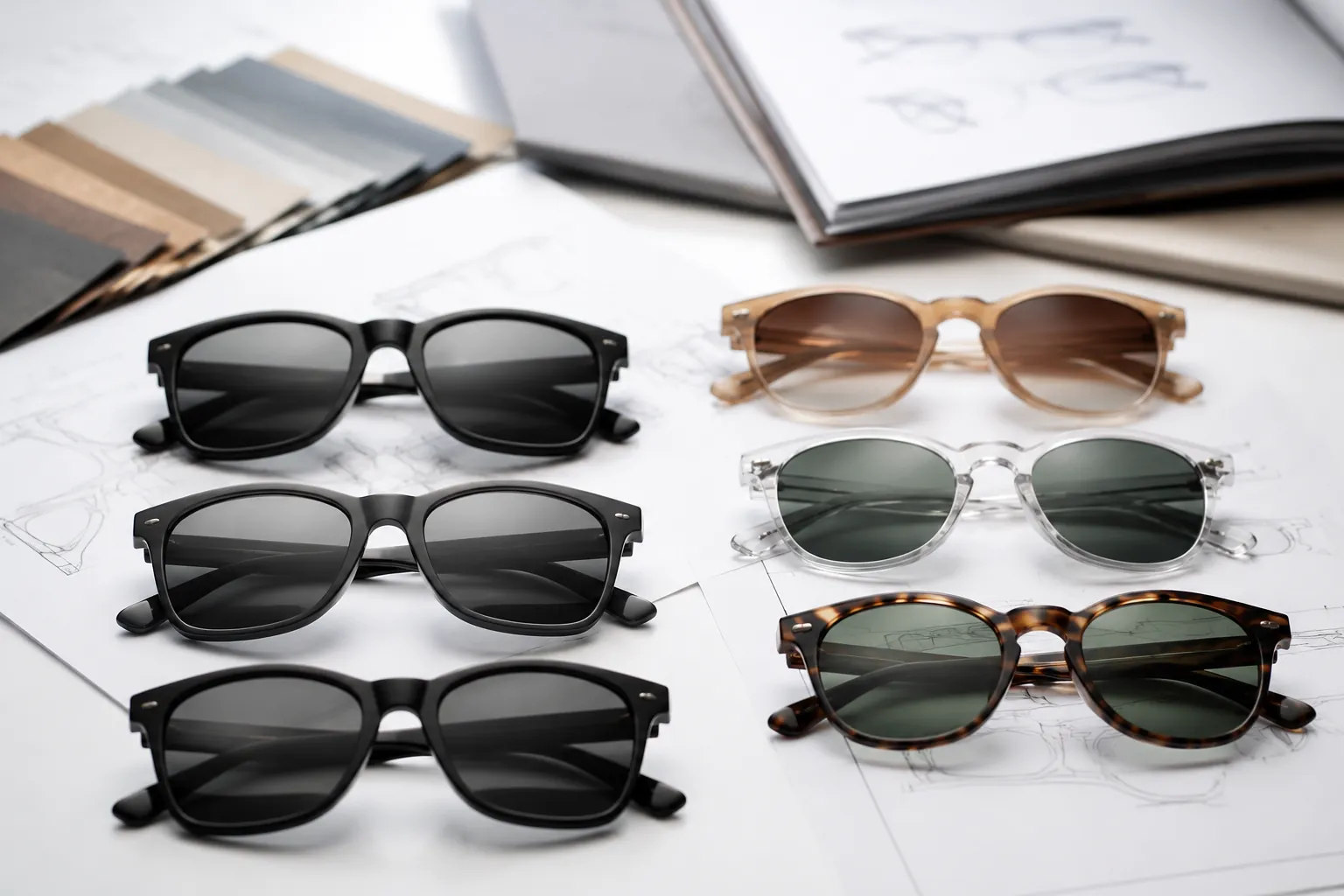
This guide is for brand owners, importers, distributors, and retailers placing a first custom sunglasses order with an overseas factory. Start with the business risk, not the sketch. On a first order, the biggest problems are often delays, unstable costing, and defects found too late. ODM and full custom tooling can both work. They solve different problems. Match the route to your order size, reorder outlook, and compliance needs, and the first shipment gets easier to control.
Start with the risk question, not the design question
Many first-time buyers start with style. That is the wrong first step. The real issue is operational risk. On a first order, the costly problems are often not visual. They are late samples, unstable pricing, and quality issues that show up after approval.
ODM means using an existing factory frame platform and changing the sellable details around it: color, lens tint, logo application, packaging, barcode labels, and sometimes minor trim details. Full custom tooling means creating new frame components from your own dimensions or structure, such as a new injection mold, a new acetate machining program, or a new metal-part setup.
That difference matters. An ODM shape already has production history. The factory usually knows how it behaves in molding or machining, where alignment problems appear, how the lenses fit, and which cosmetic defects need tighter control. That lowers first-order risk. Not to zero. But lower.
So ask the simple question: are you testing demand, or are you buying a signature shape? If the first goal is to launch, learn, and reorder from real sales, ODM usually gives you more room for error. If the shape itself is part of the brand and you can handle a longer development cycle, custom tooling may be worth it.
The fast comparison: where each route wins
| Decision factor | ODM existing shape | Full custom tooling |
|---|---|---|
| Upfront cash | Usually lower because there is no new mold or new structural development to fund | Usually higher because development and tooling costs are added before bulk production |
| Typical MOQ | Often more accessible for first orders, depending on the factory and the level of customization | Usually better suited to programs with stronger volume forecasts or planned reorders |
| Sample timeline | Often shorter because the frame geometry already exists and only sellable details need approval | Often longer because design review, engineering checks, and trial sampling come first |
| Bulk lead time | Usually more predictable once the approved sample is signed off | Usually less predictable until corrections are completed and the PP sample is approved |
| Unit economics | Often more efficient at low volume because there is no tooling amortization | Can improve over time if repeat orders spread development cost across more units |
| Dimensional control | Often more predictable because the base geometry has already been produced before | Higher early-stage uncertainty because new fronts or temples may need correction |
| Design uniqueness | Moderate; color, branding, and packaging can differ, but the base shape is shared | High; geometry, proportions, and structural features can follow your brief |
| Compliance path | Often simpler to evaluate when the base style has prior test history, though your final configuration still needs review | Usually requires fresh validation because geometry, lens behavior, or construction may change |
If your main goal is speed to market with lower cash exposure, ODM usually wins. If your main goal is shape ownership and you can absorb revision rounds, custom tooling can make sense. The common mistake is choosing custom too early and stacking market risk and development risk into the same first run.
Choose ODM if your first order is a market test
For many first-time buyers, ODM is the safer commercial choice. It cuts three common cost drivers at once: tooling spend, longer development loops, and engineering errors that only appear after the first trial sample.
- Lower upfront commitment: You are usually paying for sampling, materials, branding, and production rather than for new structural tooling.
- Faster approvals: Existing shapes can move straight into color, lens, logo, and packaging decisions instead of structural debugging.
- More predictable production behavior: The factory may already know hinge fit, lens retention, polishing steps, and the usual defect points for that frame.
- Better SKU testing: Lower minimums can let buyers test more than one style or colorway instead of tying budget to a single custom shape.
The cost logic is plain. On small orders, the quoted unit price is only part of the real decision. If a custom project needs separate development spending before bulk production, that cost has to be recovered somewhere, usually across a limited first run. With ODM, the cost model is easier to read. You are mainly comparing material choice, lens specification, decoration, packaging, and freight.
ODM is usually the better route for launch tests, retailer trials, event programs, seasonal capsules, and early market-entry orders. It still leaves room for brand expression through finishes, transparent or solid colors, lens tint, mirror coatings, temple printing, laser engraving, logo plates, pouches, rigid boxes, and retailer-specific labels.
Choose full custom tooling only for clear business reasons
Custom tooling can be the right call. But the reason should be commercial and technical, not just taste. A first order should not carry development cost simply because the buyer wants a slightly different silhouette and an ODM option is already close.
- Your design cannot be matched closely enough by an existing frame. This usually means critical geometry such as eye size, bridge width, front curve, temple profile, end-piece thickness, or a specific trim construction.
- You expect repeat volume. Tooling makes more sense when the style is likely to reorder and the development cost can be spread over time.
- The shape is part of brand identity. If your positioning depends on a recognizably ownable frame profile, ODM may not create enough separation.
- You need structural features that existing platforms do not support. Examples include unusual hinge placement, a specific wrap angle, or a construction detail that affects fit or coverage.
Buyers often underestimate the step between a drawing and a stable production part. In injection-molded plastic, the tool has to account for shrinkage, gate location, wall thickness, cooling balance, ejector marking, and finishing quality. In acetate, the machining path, bevel angle, lens groove depth, hinge routing, bending, and polishing sequence all have to work together. Small dimensional errors matter. A groove that is too tight can stress lenses during insertion. A hinge position that is slightly off can affect opening feel or symmetry. Uneven thickness can polish badly or react poorly to heat adjustment.
Correction rounds are normal in custom development. Factories may need to adjust hinge alignment, temple closing angle, pantoscopic tilt, lens retention pressure, or trim fit after the first sample round. That does not mean the project is failing. It means custom development takes time. Reserve it for styles with a clear business case.
What the timeline really looks like in production
Lead-time mistakes usually come from ignoring revision loops. Buyers compare the nominal sample date and stop there. That is not enough. The real question is not how quickly one sample can be made. It is how many approval stages stand between concept and stable bulk production.
With ODM, the path is shorter. You select a shape, confirm the frame material, define the finish, choose the lens tint or lens category, place logo artwork, and approve packaging. Because the geometry already exists, the factory can focus on visual and branding approvals rather than structural changes. After sample approval and deposit, bulk planning is usually more straightforward than on a new-tool project.
With full custom tooling, several stages are added before bulk scheduling becomes reliable.
- Design review: confirm eye size, bridge, temple length, front curvature, hinge type, logo zones, and target market requirements.
- Engineering check: review draft angle, wall thickness, groove dimensions, hardware fit, and whether the design can be produced without weak points or visible defects.
- Tool build or CNC setup: timing depends on whether the frame is injected plastic, acetate, metal, or mixed material.
- First trial sample: check cosmetic quality, fit, symmetry, opening force, and lens insertion behavior.
- Correction round: refine alignment, groove fit, trim assembly, or finishing quality if needed.
- PP approval: bulk timing becomes more dependable only after the pre-production sample is approved.
If you are trying to hit a fixed selling season, this gap matters. Missing the window can cost more than accepting an ODM shape that is close to ideal. When the calendar is tight, proven geometry is often the safer choice.
Material, process, and tolerance details that change the decision
Material choice changes both the commercial logic and the technical risk. Injection-molded plastic is often the most efficient ODM platform because the process can be repeatable once the mold and settings are stable. If the factory has already produced the style, it may already know the lens-fit window, hinge alignment, and finishing sequence that produce acceptable results.
Acetate follows a different path. It starts from sheet material, then moves through cutting, CNC milling, beveling, polishing, bending, hinge setting, and assembly. The visual depth and hand feel can be strong, but labor input is higher and variation is managed differently from injected frames. Do not assume the same speed, tolerance behavior, or consistency profile across these constructions.
Lens work needs equal attention. A frame can look right and still fail approval if the lens fit is wrong. If the groove is too loose, retention can be unreliable. If it is too tight, insertion stress can damage the lens or raise assembly losses. Lens specification also affects compliance. Lens material, darkness, filter category, and coverage all need to match the market and the intended use.
Decoration is often where buyers can get enough differentiation without paying for new tooling. Common options include pad printing, laser engraving, hot stamping on cases, and attached metal logo plates. Each method has tradeoffs. Pad printing is flexible but can wear in high-rub areas. Laser engraving is durable but depends on material response and contrast. Metal logo plates can raise perceived value but add assembly and alignment controls.
If the base geometry is not the core of the brand story, put the money into the parts customers notice first: finish quality, lens color, touch points, and packaging presentation.
Compliance is not automatic after a design change
One common sourcing mistake is assuming that if one version of a sunglass style was tested, every modified version is automatically covered. That is not safe.
For sunglasses, compliance can be affected by lens material, lens tint, filter category, frame coverage, retention, hinge stability, and how the lens sits in the rim. If you sell into markets requiring standards such as CE EN ISO 12312-1, ANSI Z80.3, or AS/NZS 1067, the tested sample should match the production configuration you plan to ship as closely as possible. Changing the lens material, changing lens darkness, or changing the front geometry can alter what needs to be reviewed or retested.
Material compliance needs separate attention. REACH may apply to frame materials, paints, coatings, nose pads, and decorative metal parts. Buyers serving the US market may also be asked about FDA registration in documentation flows, but FDA registration is not a substitute for product-performance testing. ISO 9001 and BSCI can help as factory-level indicators, but they do not prove a specific sunglass model meets optical or physical performance requirements.
Simple rule: the more you change geometry, lens specification, material, or trim, the less you should rely on old sample assumptions.
Ask the factory to tie compliance records to the exact build you are ordering. At minimum, confirm the bill of materials, lens specification, decoration method, and approved pre-production sample details in writing. That matters most on custom-tooling projects, where changes can continue through development and the approved sample can drift away from the final build if revisions are not controlled.
A practical first-order framework buyers can use
If you are deciding between ODM and full custom tooling for a first order, use a commercial filter rather than a creative one.
- Pick ODM if your first order is modest in size and your main goal is market feedback rather than long-term shape ownership.
- Pick ODM if your launch date is fixed and your brand can be expressed through color, lenses, logo treatment, and packaging rather than unique frame geometry.
- Pick custom tooling if the frame silhouette is central to your brand and you can absorb a longer development path with at least one correction loop.
- Pick custom tooling if your forecast supports repeat orders large enough to spread development cost over time.
- Delay custom tooling if dimensions, fit target, lens category, and market-specific compliance requirements are still changing.
For many buyers, the smarter path is staged. Start with a lower-risk ODM style, launch faster, and track what actually sells by eye size, lens tint, finish, and price point. If one concept proves itself, move that direction into more exclusive custom geometry with better information about reorder volume and customer preference. That sequence uses development budget more carefully and cuts the chance of paying for originality before demand is proven.
For a first order, lower risk usually beats higher originality. The better decision is the one that keeps cash flexible, lead times believable, and the first shipment out of avoidable tooling trouble.
Have a custom sunglasses project in mind?
Send us your styles, target market and quantities and we will return a detailed quote with MOQ, lead time and a sample plan.
Get a QuoteWhy source this from Wenzhou with LumiShades
Wenzhou in Zhejiang Province is widely regarded as China’s eyewear manufacturing capital, producing a large share of the world’s sunglasses. That concentration matters to buyers: a deep local supply chain for acetate sheet, hinges, lens blanks, plating and packaging means shorter component lead times, easier color and material matching, and a workforce with decades of eyewear-specific skill. LumiShades has manufactured in this ecosystem since 2009, and our vertical integration — in-house injection molding, acetate cutting, CNC milling, lens tinting, decoration and quality control — means no part of your order is quietly subcontracted to a workshop you cannot audit.
For international buyers, that vertical control translates into accountability. When a single factory owns every step, defects are traced and fixed at source rather than bounced between vendors, and your specifications survive intact from first sample to bulk. We back this with 15+ years of experience, shipments to 60+ countries, more than 5 million pairs produced per year and a 98.5% on-time delivery rate. Our certifications — CE EN ISO 12312-1, FDA registration, ANSI Z80.3, AS/NZS 1067, REACH, ISO 9001 and BSCI audit — mean the compliance documentation your market requires already exists. Explore our manufacturing capabilities and quality control process to see how this works in practice.
Frequently asked questions
At what order size does custom tooling start to make sense? There is no universal threshold. It depends on the factory, the material, the complexity of the frame, and how much exclusivity you need. Ask for two quotes: one based on an existing ODM platform and one based on custom development. Then calculate the total first-order cost, not just the unit price. Include sample charges, development or tooling cost, expected correction rounds, testing cost if needed, and the reorder volume needed to recover that spending. If you cannot justify it with a realistic reorder plan, ODM is usually the safer first step.
Can I make an ODM frame look like my brand without changing the mold? Yes, often enough for a first launch. Ask the factory which parts of the style can be customized without changing the structure: frame color, finish, lens tint, mirror coating, logo application, engraving, logo plates, packaging, care cards, and barcode labels. Then request a sample that matches the actual retail presentation. That tells you whether the brand difference is strong enough before you commit to a custom shape.
Does a new logo or color require new compliance testing? Not automatically, but do not assume prior testing still applies. List exactly what changed: logo method, paint or coating, frame material, lens material, lens darkness, filter category, geometry, or hardware. Cosmetic changes may matter less than lens or structural changes, but the safe approach is to review the final production configuration against your target market requirements. Ask the factory or test lab which changes affect CE EN ISO 12312-1, ANSI Z80.3, or AS/NZS 1067 for your product.
How much time should I add for full custom tooling versus ODM? Do not use a generic day count from a supplier without mapping the approval steps. Ask for a stage-by-stage timeline covering design review, engineering review, first sample, correction round, PP sample, and bulk production. For ODM, confirm how long branding, packaging approval, and material selection will take. For custom tooling, assume at least one correction round may be needed unless the construction is already very close to a proven design. Real lead time is the time to an approved PP sample, not the fastest date for the first sample.
What is the safest route if I need to launch before a fixed selling season? ODM is usually safer because the base geometry already exists and the factory can focus on branding and finish approvals rather than structural development. To reduce risk further, ask for a written critical path that includes sample approval, packaging approval, compliance review, production start, and shipment booking. Also confirm which materials or trims are stock-based and which ones could delay the order. If the selling window is fixed, choose the route with the fewest unknown engineering steps, even if the design is less exclusive.
Ready to start?
Explore our aviator sunglasses or request a quote — our sales team replies within 12 hours.
Request a Quote