
Nickel-Free Metal Eyewear Specs Before Sampling
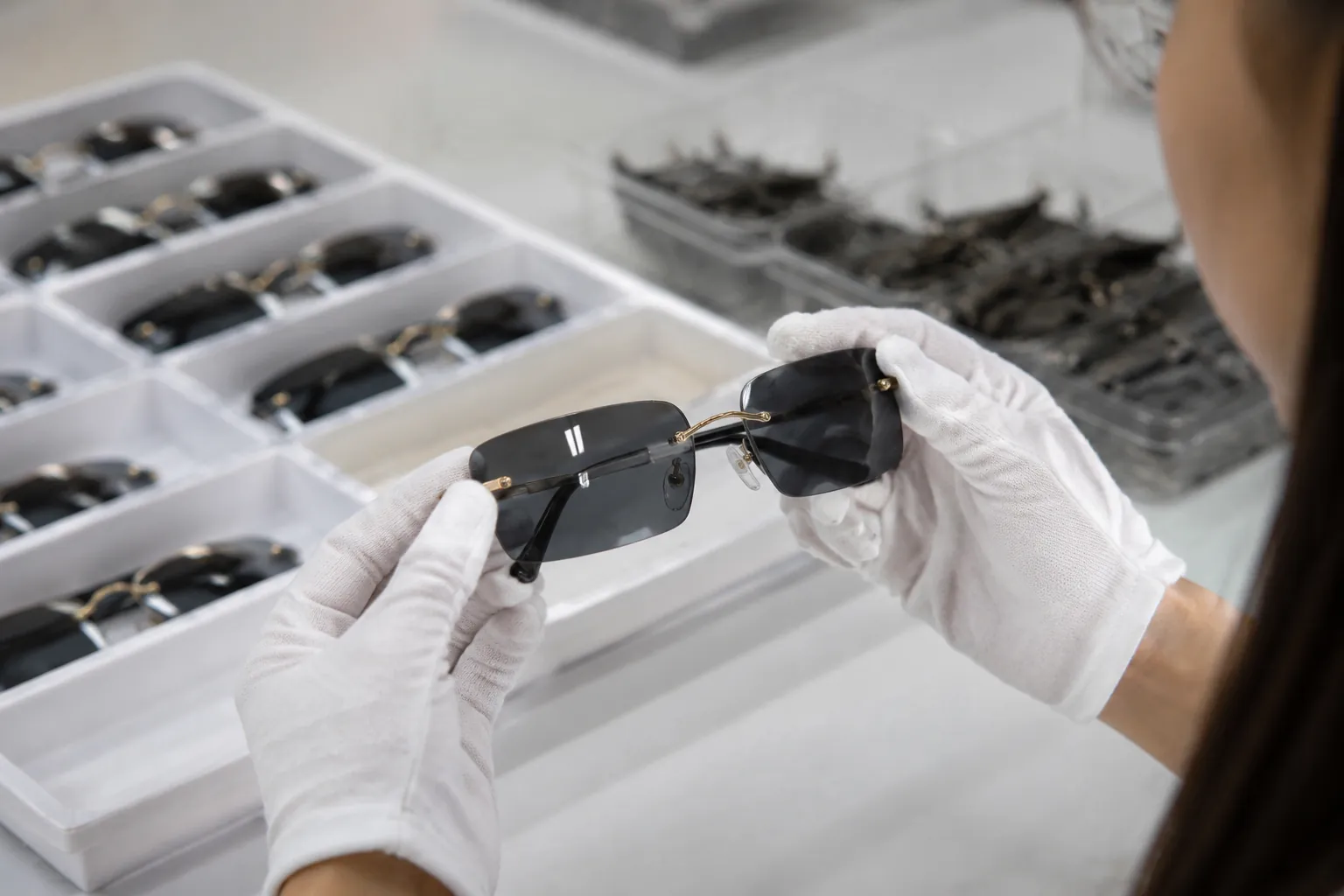
This guide is for import buyers, brand owners, distributors, and retailers sourcing metal sunglasses or optical frames for markets where skin-contact metal compliance matters. The goal is not a loose "nickel-free" claim. The goal is a frame specification a factory can build, inspect, document, and repeat in bulk. Nickel risk is controlled through the finished skin-contact parts: alloy, plating stack, screws, hinges, decoration sequence, lab testing, and approved samples. Fix those details before sampling. You reduce failed tests, plating disputes, color drift, and late changes.
Start With Skin Contact, Not Frame Color
Buyers often ask for "nickel-free gold metal frames" as if the visible color settles the issue. It does not. The real risk is nickel release from finished parts that touch skin during normal wear. Depending on the design, that can include the bridge, nose pad arms, rims, temples, hinge barrels, screws, decorative metal logos, brow bars, and exposed wire cores inside acetate temples.
For EU sales, buyers usually use REACH as the main framework for nickel-release risk on skin-contact parts. A practical rule is simple: if a metal part can have prolonged or repeated skin contact, treat it as test-relevant unless your compliance advisor or laboratory confirms otherwise. Sunglass lens compliance belongs in a separate file: CE EN ISO 12312-1 for Europe, ANSI Z80.3 for the United States, and AS/NZS 1067 for Australia and New Zealand. FDA registration may matter in the US regulatory and import context. It does not replace product testing.
The hard part is traceability. A supplier may show a compliant sample, then change screws, hinges, pad arms, logo plates, or trim sources before bulk production. Lock the bill of materials. Require the same material route for sample and bulk. Ask the supplier to identify any subcontracted plating, coating, or hardware source before approval.
Approve the Alloy Before Tooling
The base metal affects cost, forming, weight, welding or soldering, corrosion performance, and compliance risk. If the alloy contains nickel, a "nickel-free" sales claim may depend on plating integrity and finished-part test results. That is a fragile position on thin fashion frames, sharp bends, spring hinges, and low-cost plating programs where abrasion can expose underlayers.
| Material option | Typical use | Behavior and risk | Sampling requirement |
|---|---|---|---|
| Controlled stainless steel | Thin temples, aviators, mid-range sunglasses | Strong and dimensionally stable, but many grades contain nickel; finished-part nickel release still needs verification | Request the material grade, ask which small metal parts are paired with it, and test the finished frame instead of relying only on raw-material statements |
| Monel or copper-nickel alloy | Traditional low-cost metal eyewear | Easy to form and solder, but nickel content makes surface treatment and release control critical | Use only with a written plating specification, clear underlayer disclosure, and a test plan for finished skin-contact parts |
| Titanium or beta titanium | Premium lightweight and sensitive-skin positioning | Light and corrosion-resistant, usually positioned as a lower-allergy option, but cost and process demands are higher | Confirm the titanium grade where relevant, welding method, screw material, pad arm material, available finishes, MOQ, and lead time before approving the quotation |
| Aluminum alloy | Sport shapes and thicker fashion frames | Lightweight, but finish durability depends on anodizing or coating; hinge construction and color matching need close review | Check finish method, hinge fixing strength, and color tolerance between front and temples on actual samples |
| Metal trims on acetate or TR frames | Logo plates, brow bars, pins, small decorative parts | Small parts are often left out of compliance discussions and can still trigger test failure if they touch skin | List every trim in the BOM, identify whether it is skin-contact, and include it in the approval and testing plan |
For cost-sensitive programs, stainless steel or plated alloys may still work. Do not approve from photos. Put the base metal, skin-contact requirement, and finish target into the sample request. For fit consistency, define mechanical tolerances in the technical brief. Common buyer working tolerances for sunglasses include temple length within +/-1.0 mm, frame front width within +/-1.0 mm, lens size within +/-0.3 mm, and bridge width within +/-0.5 mm, unless the design needs tighter control.
Specify the Plating Stack
Many plating failures start with a vague purchase order: "gold plating, nickel-free." That is not a specification. A usable plating spec names the base material, cleaning and pre-treatment, barrier layer, visible color layer, top coat, and any thickness targets or performance checks the supplier can support. It also states whether nickel is prohibited in underlayers for skin-contact parts. If a nickel strike or nickel-bearing underlayer is used anywhere relevant, the buyer needs to know before testing and approval.
Control the finished surface system, not the color word. Depending on the project, checks may include coating thickness targets, adhesion, artificial sweat resistance, corrosion resistance, and visual acceptance criteria on high-contact areas. The plan should match the market, price point, and construction. It must be agreed before bulk production.
- Specify nickel-risk control for all skin-contact metal parts, including screws, hinge barrels, nose pad arms, bridge areas, brow bars, and logo plates where applicable.
- Ask directly whether any nickel strike, nickel underlayer, or mixed-metal pre-treatment is used beneath the visible finish.
- Define color by approved master sample, not only by words such as gold, gunmetal, silver, or rose gold.
- Set practical visual criteria: no exposed base metal, no blistering, no peeling, no rough plating at solder points, and no sharp burrs at hinge barrels.
- Require a plated first article for approval before the full batch is assembled.
Decoration sequence matters too. Laser engraving after plating can break the coating surface. Pad printing may need a compatible top coat. A metal logo plate needs the same material and surface-control review as the frame. Approve the construction sequence, not just the final appearance photo.
Write the Sample Brief Like a Technical File
A good sample brief can be short. It cannot be vague. Nickel-free metal sampling may take longer than a standard cosmetic sample if the project needs a special alloy, new plating color, or third-party test sample. Speed depends on whether the buyer gives a complete, consistent specification at the start.
- Confirm target markets: EU, US, Australia, New Zealand, or mixed distribution.
- Name the standards and files required: CE EN ISO 12312-1, ANSI Z80.3, AS/NZS 1067, REACH nickel-release related evidence, and FDA registration information where relevant.
- List every metal part: front, bridge, temple, hinge, screw, nose pad arm, trim, logo plate, wire core, and decorative rivet.
- State the preferred alloy or ask the factory to propose two options with price, MOQ, lead time, and compliance implications.
- Define plating color, finish, top coat, nickel-related requirement, and whether nickel is prohibited in underlayers for skin-contact parts.
- Specify lens category, tint color, UV400 requirement, polarization, mirror coating, gradient, and lens base material.
- Request BOM, process route, measurement sheet, pre-shipment sample photos, and packing method before shipment.
Include target dimensions and tolerances. For sunglasses, buyers commonly control lens width, bridge, temple length, frame width, pantoscopic angle, temple opening angle, and logo position. Measure logo placement from a fixed edge, for example 35 mm from the temple hinge and centered vertically within +/-0.5 mm. This prevents a common dispute: the sample looks right, but bulk logos, hinge tension, or lens fit move from batch to batch.
Separate MOQ, Price, and Lead Time
Nickel-risk control can add cost through material choice, surface treatment, and testing. The increase depends on construction. A simple stainless sunglass with standard hinges is easier to control than a mixed-material frame with several trims, spring hinges, nose pad arms, and plated logo plates.
Review quotation in four parts: sample cost, pilot MOQ, repeat MOQ, and testing cost responsibility. Also ask whether plating setup, color development, or third-party lab fees are charged separately. Unit price can change sharply with alloy, hinge construction, lens type, decoration method, packaging, and whether test samples are pulled from production.
| Order stage | Typical quantity | Control focus | Commercial logic |
|---|---|---|---|
| Prototype sample | 1 to 5 pairs | Alloy, plating color, lens tint, fit, decoration, comfort | Use this stage to find design and process issues; it is not a reliable basis for final unit-cost comparison |
| Pilot order | 50 to 300 pairs | Batch color, assembly repeatability, initial lab planning, packaging trial | Useful for market tests or buyer validation, but setup costs are spread over fewer units |
| Commercial run | 1000+ pairs | Incoming material control, plating batch records, AQL inspection, shade consistency | Pricing becomes more stable once parts, tooling, and processes are fixed |
| Volume program | 5000+ pairs | Capacity planning, repeated lab schedule, carton marking, replenishment management | Best cost efficiency, but late changes to alloy, plating, lens, or packaging become expensive |
Quote lead time as a calendar with milestones, not a single number. Separate sample making, sample approval, lab submission, report review, deposit receipt, bulk production, inspection, and freight booking. If testing is required before shipment, confirm whether the factory will hold cargo until final reports are issued.
Collect Product-Specific Documents
For regulated markets, the product file must match the actual goods. Generic factory certificates are not enough. Buyers need documents tied to the exact frame, lens, finish, and destination market.
Ask for a bill of materials naming the frame, temples, lenses, screws, hinges, nose pads, pad arms, plating or coating, decoration, pouch, cleaning cloth, and packaging. Where your company or retailer requires them, collect valid factory-level ISO 9001 and BSCI records. For product compliance, keep CE EN ISO 12312-1 reports for sunglasses sold in Europe, ANSI Z80.3 evidence for the US market, AS/NZS 1067 evidence for Australia and New Zealand, REACH-related evidence for restricted substances and nickel-release management, and FDA registration information where relevant to the US supply chain.
Match every report to the product. A report for a black TR frame does not support a gold metal aviator. A test on one plating color may not cover another if the chemistry or surface stack changes. If the lens category changes, or if a style moves from non-polarized to polarized, get written confirmation from the lab or retest. Keep the approved sample record, lab sample photos, PO number, and final packing photos in the same file so the shipment can be traced back to the approved configuration.
Control Bulk Production
A nickel-related specification can still fail in bulk if production control is weak. Common risks include mixed screws, wrong hinge stock, plating bath changes, polishing through the coating, undocumented supplier substitution, and decoration after coating without surface review.
Use practical controls: incoming material checks, separate identification for approved metal parts, plating batch records, first-article approval, in-process inspection after plating, assembly checks, and final AQL inspection. For sunglasses, QC should also cover lens fitting, temple alignment, opening tension, screw security, tint consistency, cosmetic defects, logo position, barcode accuracy, pouch quality, and carton marking.
Make checkpoints measurable. Temple opening should be balanced left to right. Screws should remain secure after repeated opening and closing. Lenses should sit without visible gaps. Hinge areas should show no exposed base metal after assembly. For branded projects, decoration should be checked against approved artwork at actual size, not only against a digital mockup.
Buyer rule: if a supplier changes a screw, hinge, logo plate, plating bath, coating supplier, or lens source, treat it as a compliance-impacting change until the supplier documents equivalence or new testing confirms it.
Check Everything Before Deposit Release
Before authorizing bulk production, check the sample against the documents. This is where buyers prevent avoidable recalls, retailer rejections, and disputes about what "nickel-free" was supposed to mean.
- Approved physical sample is signed, dated, photographed, measured, and kept as the control sample.
- Frame alloy and every metal component are listed in the BOM, including screws, hinges, pad arms, trims, and logo plates.
- Nickel-related requirement is written for all skin-contact metal parts, not only the visible frame front.
- Plating stack, color, finish, top coat, underlayer policy, and master color sample are confirmed.
- Lens material, category, tint, UV400 requirement, polarization, and mirror or gradient coating are confirmed.
- Decoration method is approved: laser engraving, pad printing, heat transfer, metal logo plate, or temple printing.
- Required standards are named: CE EN ISO 12312-1, ANSI Z80.3, AS/NZS 1067, REACH, and FDA registration where applicable.
- Lab testing plan, sample size, timing, pass criteria, and responsibility for fees are agreed before production.
- Lead time is tied to approval milestones and testing milestones, not only to deposit date.
- Inspection criteria include metal surface defects, corrosion-related checks, lens performance, alignment, screw security, logo position, and packaging accuracy.
Nickel-free metal eyewear is manageable. It does not tolerate vague buying language. Write the specification, test the actual product, and control every metal part that touches skin.
Have a custom sunglasses project in mind?
Send us your styles, target market and quantities and we will return a detailed quote with MOQ, lead time and a sample plan.
Get a QuoteWhy source this from Wenzhou with LumiShades
Wenzhou in Zhejiang Province is widely regarded as China’s eyewear manufacturing capital, producing a large share of the world’s sunglasses. That concentration matters to buyers: a deep local supply chain for acetate sheet, hinges, lens blanks, plating and packaging means shorter component lead times, easier color and material matching, and a workforce with decades of eyewear-specific skill. LumiShades has manufactured in this ecosystem since 2009, and our vertical integration — in-house injection molding, acetate cutting, CNC milling, lens tinting, decoration and quality control — means no part of your order is quietly subcontracted to a workshop you cannot audit.
For international buyers, that vertical control translates into accountability. When a single factory owns every step, defects are traced and fixed at source rather than bounced between vendors, and your specifications survive intact from first sample to bulk. We back this with 15+ years of experience, shipments to 60+ countries, more than 5 million pairs produced per year and a 98.5% on-time delivery rate. Our certifications — CE EN ISO 12312-1, FDA registration, ANSI Z80.3, AS/NZS 1067, REACH, ISO 9001 and BSCI audit — mean the compliance documentation your market requires already exists. Explore our manufacturing capabilities and quality control process to see how this works in practice.
Frequently asked questions
Can I claim nickel-free if only the outer plating is nickel-free? Not safely on that basis alone. Base the approval on the finished skin-contact part, not just the visible color coat. Ask the supplier to disclose the full plating stack, including any nickel-bearing underlayer, and submit the finished frame or relevant components for the required nickel-release or related compliance testing under your market plan. Verify screws, hinges, pad arms, logo plates, and other small metal parts separately in the BOM because these are often missed.
Which documents should I request for EU metal sunglasses? Request product-specific CE EN ISO 12312-1 evidence for sunglass performance, REACH-related evidence covering restricted substances and nickel-risk control for relevant skin-contact metal parts, and a BOM listing all metal components and finishes. Also collect the approved sample record, plating or coating description, measurement sheet, packaging specification, and any factory-level ISO 9001 or BSCI records your company requires. Check that all documents match the exact frame, lens, color, and finish being shipped.
Does FDA registration replace ANSI Z80.3 testing for the US? No. FDA registration and ANSI Z80.3 cover different issues. FDA registration may be relevant in the US regulatory and import context, but it is not a substitute for product performance evidence. For sunglasses sold into the US market, buyers should review ANSI Z80.3 requirements with the supplier and laboratory and keep product-specific supporting documents for the exact model being sold.
What MOQ should I use for a nickel-free metal frame trial? Use a quantity large enough to expose repeatability problems, not just appearance issues. A pilot of 50 to 300 pairs is often practical because it lets you review plating consistency, assembly quality, logo placement, packaging, and the documents tied to that batch. Before placing the pilot, confirm whether the supplier's MOQ applies per color, per lens option, or per total style. Decide in advance whether lab samples will be pulled from the same pilot batch.
How much extra lead time should I allow for compliance testing? Do not treat testing time as a fixed number without checking the scope and lab queue. Build in separate time for sample preparation, courier transit, lab booking, test execution, report issuance, and possible retesting if the alloy, plating stack, lens category, decoration method, or supplier changes. Keep testing as its own milestone in the purchase calendar so production, inspection, and freight booking are not scheduled on an assumption.
Are titanium frames always the best nickel-free choice? No. Titanium is often a strong option when the product needs low weight, corrosion resistance, and premium positioning, but it is not automatically the best commercial choice. Buyers still need to confirm the full construction, including screws, hinges, pad arms, nose pad hardware, finishes, and decoration. For some programs, controlled stainless steel or aluminum may meet the target more effectively on cost, lead time, and manufacturability, provided the finished product is properly specified and tested.
Ready to start?
Explore our wayfarer sunglasses or request a quote — our sales team replies within 12 hours.
Request a Quote