
PC Injection vs Acetate: When the Higher Cost Pays Off
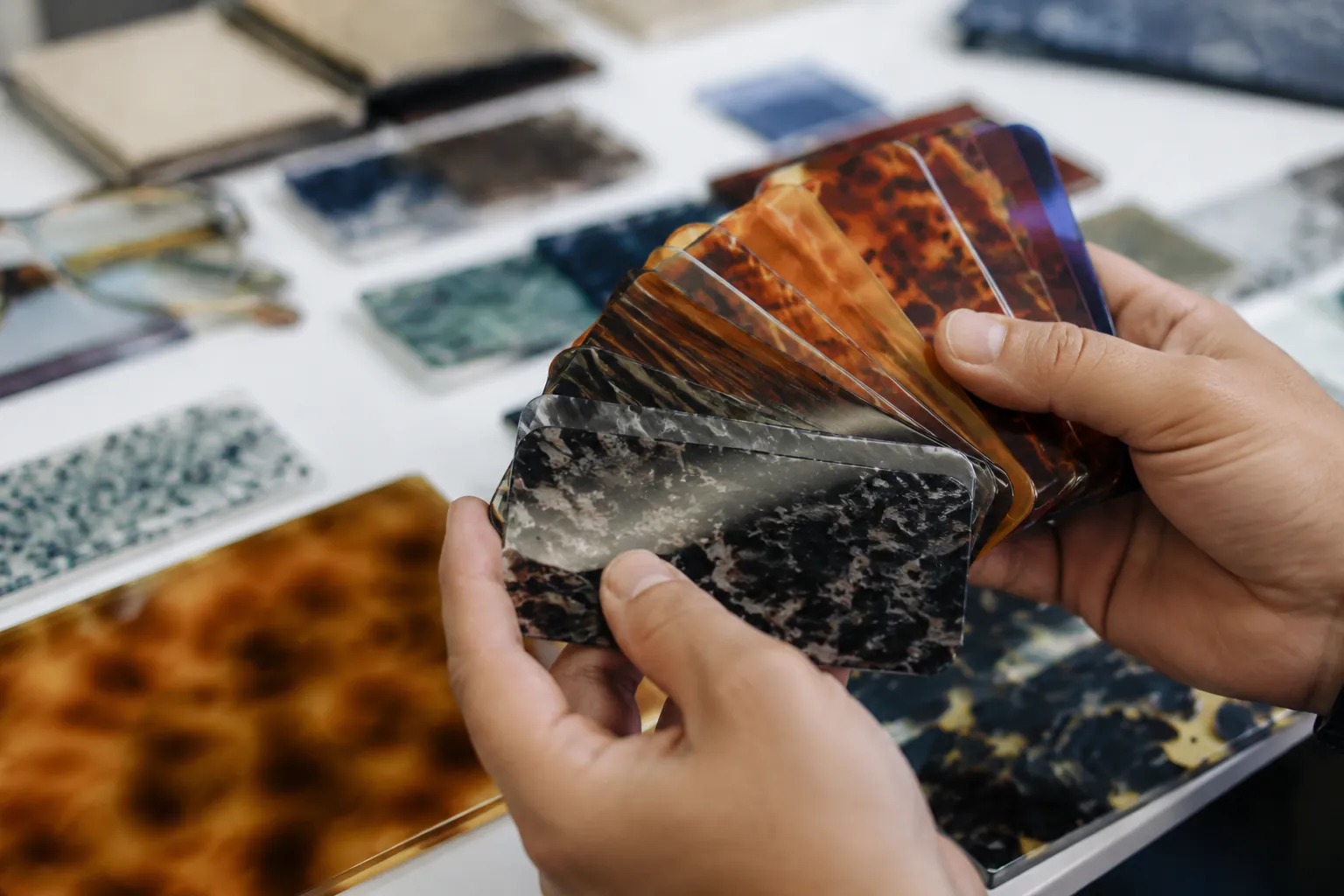
This guide is for brand owners, importers, distributors, and retail buyers deciding whether to stay with injected plastic or move into acetate. The real decision is not which material is better on paper. It is whether acetate creates enough extra retail value to cover the higher unit cost, tighter finishing control, longer approvals, and more cash tied up in stock. In price-driven channels, PC injection usually wins on speed, repeatability, and landed cost. In premium private-label programs, acetate can earn its keep if it supports a higher ticket, stronger perceived value, and better shelf presentation.
Start with the commercial question, not the material
Many sourcing teams compare PC injection and acetate as if the decision starts with a factory quote. It does not. Ask a harder question: Will this frame support a higher retail price, protect gross margin, and reorder cleanly after the added cost and development risk?
PC injection is built for efficiency and repeatability. A new shape usually needs tooling, which adds upfront cost and development time. After the mold, color, and process settings are approved, repeat production is often stable. That makes injected PC a practical choice for promotional programs, entry-price retail, replenishment lines, event merchandise, and seasonal color updates where price and lead time matter most.
Acetate runs on a different cost structure. It does not use an injection mold for the frame front, but it usually needs more machining, polishing, fitting, and visual inspection. It also carries more variation risk in sheet pattern, lamination appearance, bevel interpretation, and final polish. In return, acetate can deliver deeper color, more visible edge detail, and a denser hand feel that supports a more premium product story.
Use a simple filter. If changing materials is unlikely to move the retail position in a meaningful way, acetate often hurts the margin equation. If moving to acetate lets the style sit credibly in a higher retail bracket, the higher ex-factory cost may be worth it because gross margin dollars per pair improve.
Start with channel reality. If your customer buys mainly on price and speed, injected PC is usually the better fit. If your customer buys on touch, finish, color, and perceived quality, acetate deserves a serious review.
Head-to-head: where each frame type wins
| Factor | PC Injection Frames | Hand-Cut Acetate Frames |
|---|---|---|
| Typical use case | Promotional programs, entry-price retail, high-volume replenishment | Premium private label, fashion capsules, optical-style sun frames |
| Upfront development | New mold usually required for a new shape; development depends on tooling approval, color matching, and sample refinement | No injection mold for shape; development depends more on CAD, CNC programming, material selection, and finish approval |
| MOQ and cost logic | Usually more competitive as volume rises because tooling cost is spread across repeat production | Can work for smaller capsule runs, but unit cost usually stays higher because of labor and finishing time |
| Finish and hand feel | Consistent production feel, usually lighter weight, with less depth in color effects | Richer color layering, denser feel, and more visible polished edges, bevels, and surface detail |
| Design flexibility | Strong repeatability after tooling is fixed; post-tooling design changes are usually costly | Well suited to bevel variation, laminated effects, thicker fronts, and premium temple detailing |
| Common production risks | Warping, sink marks, parting line visibility, and lot-to-lot color variation | Polish inconsistency, lamination variation, hinge setting issues, alignment drift, and lens stress during fitting |
| Typical bulk lead time | Project timing depends heavily on mold approval and production scheduling | Project timing depends heavily on sample approval, finishing standards, and material confirmation |
| Best margin story | Lower landed cost, stable repeat production, broad price competitiveness | Higher ticket potential, stronger perceived value, and a stronger merchandising story |
For many buyers, the answer is not either-or. It is assortment architecture. Keep injected PC in core volume programs. Use acetate for hero styles, thicker fashion shapes, and premium capsules where customers will notice the material difference in hand.
What you are really paying for in acetate
Acetate usually costs more for one reason: more process. More machine time. More manual work. More finishing control.
A typical acetate sunglass front starts as sheet stock. The front outline is cut, then machined for the lens groove, bridge, and any bevel or facet detail. Temples are cut separately, often with metal core insertion or hardware fitting, then shaped, heated, bent, polished, and matched for symmetry.
A normal acetate process can include:
- Sheet selection and color confirmation: transparent, crystal, tortoise, laminated, striped, or layered acetate.
- CNC cutting: front profile, lens groove, bridge shaping, and temple profiling.
- Wire core or temple hardware fitting: especially on thicker or more structured temples.
- Tumbling and hand polishing: to reduce machining marks and develop surface gloss.
- Heat forming and alignment: front curve, temple opening angle, and fit balance.
- Hinge fitting: screw tension, pull resistance, and opening feel.
- Lens fitting and cosmetic QC: checking stress, gap, alignment, and finish consistency.
That extra work creates differences the customer can often see and feel. Acetate can show layered color effects that standard injected PC rarely reproduces convincingly. A polished bevel reflects light differently. A thicker front with a clean finish reads as more premium even before the buyer sees the logo.
Decoration quality matters more too when the frame is sold as premium. Common methods include laser engraving on temples, hot foil or pad print logos, inset metal logo plates, and visible core details in transparent temple colors. On injected PC, decoration is often simpler and more surface-led, such as pad print, screen print, or laser marking where geometry allows.
That does not mean acetate will always sell better. It means acetate gives you more premium signals. If your retail setting cannot turn those signals into a higher ticket or better sell-through, the extra production value stays in the factory and does not pay back.
The payback test: four numbers to model before switching
Before converting a style from injected PC to acetate, compare the full commercial outcome, not just the ex-factory quote.
- Retail price move: How much higher can this style really retail in your channel? The increase must be big enough to absorb the higher product cost and added development effort.
- Gross margin dollars per pair: Add the full cost stack: frame, lens, logo treatment, packaging, duty, freight, testing, and any quality-control cost. Then compare actual margin dollars per pair, not margin percentage alone.
- Sell-through confidence: Will shoppers notice the material difference? In fashion-oriented sunglass programs, often yes. In giveaway or low-ticket tourist product, often not.
- Inventory and cash-cycle risk: Can you absorb a slower approval cycle, a higher average unit value, and slower-moving premium inventory if the style underperforms?
Also model return and complaint risk. Acetate can improve perceived quality, but only if the supplier controls polish consistency, hinge fitting, alignment, and lens stress. Premium material without premium process control just creates higher-cost defects.
Because of that, buyers often reserve acetate for styles with one or more of these traits:
- Thicker front profiles where edge polish is visible.
- Classic silhouettes such as wayfarer-inspired, panto, square fashion, or optical-style sun frames.
- Collections where color layering or translucency is part of the brand story.
- SKUs likely to be sold through touch and try-on, not only through a thumbnail image.
Lead time, MOQ, and where projects usually stall
Suppliers may quote similar headline lead times across materials, but delays usually show up in different places.
With injected PC, delays tend to happen early in development around mold review, shape correction, texture confirmation, and color matching. Once the mold and process are approved, repeat output is usually more predictable.
With acetate, delays often appear later. Common pressure points include sheet color confirmation, bevel interpretation, polish standard disagreements, logo placement drift, temple alignment, hinge feel, and lens fitting stress. In short, acetate issues often surface during finishing and approval rather than at the first CAD stage.
Use MOQ strategically:
- Low MOQ runs: Best for limited drops, price testing, or capsule collections. Unit cost is usually highest, and sample approval needs to be especially precise.
- Mid-volume runs: Useful for comparing premium and entry-tier material options before a wider rollout.
- Higher-volume runs: Injected PC usually becomes more cost-efficient as volume rises because tooling cost is spread across more units. Acetate usually makes more sense when the style has already proved its retail position.
If you want an acetate project to run cleanly, define written tolerances and visual standards before bulk production. Useful examples include logo position tolerance, agreed reference dimensions, alignment acceptance criteria, and cosmetic grading for pits, swirl marks, edge asymmetry, and color variation. Comments such as "looks good" are not an approval standard. They cause disputes later.
Compliance and quality checks that matter by material
Frame material is only one part of the product. The finished sunglasses still need to meet the rules of the destination market, and the approved frame, lens, and decoration combination should match the tested construction.
References often requested in sunglasses sourcing include CE EN ISO 12312-1, ANSI Z80.3, AS/NZS 1067, REACH, FDA registration, ISO 9001, and BSCI. Buyers should confirm which standards actually apply to the target market, whether the documents are current, and whether they relate to the finished product configuration being ordered.
For both injected PC and acetate, confirm:
- Lens performance: visible light transmission category, UV protection, and any polarized, mirrored, or other lens specification on the final tint.
- Dimensions: eye size, bridge width, temple length, and lens seating against the approved sample.
- Mechanical function: hinge opening feel, screw retention, left-right balance, and frame alignment after lens fitting.
- Cosmetic AQL or inspection standard: criteria for scratches, sink marks, polish swirl, bubbles, flow lines, color variation, and logo position.
- Chemical compliance documentation: REACH-related declarations or other market-specific material documentation where required.
Each material has its own watch points. Acetate needs closer inspection on lamination appearance, polish uniformity, bevel symmetry, and heat-formed stability. Injected PC needs close control of parting line appearance, warpage, sink marks near thicker sections, and color consistency between production lots.
One practical point buyers often miss is lens fitting pressure. Over-tight fitting can stress both materials, but acetate is especially sensitive when groove depth, base curve, and lens edge finishing are not balanced correctly. Whitening at the rim, audible creak during fitting, or front distortion after lens insertion are warning signs. Treat them as process-control failures, not small cosmetic issues.
A practical decision framework for buyers
Use this framework before issuing a PO.
- Define the retail slot first. If the product must hit an entry retail, start by testing injected PC.
- Check the selling story. If your channel can explain material, finish, color depth, and logo treatment, acetate has a better chance of earning margin.
- Choose shapes that justify the material. Thicker classic silhouettes usually benefit more from acetate than thin commodity sport shapes.
- Estimate reorder probability. Extra development effort makes more sense on styles that are likely to repeat.
- Approve to a written finish standard. On acetate, specify front thickness, bevel style, polish level, hinge type, temple core detail, logo placement, and acceptable sheet variation.
- Pilot first. Use a smaller trial run when testing a new premium capsule, a higher retail band, or an unfamiliar channel.
- Keep a two-tier assortment. Use injection for volume and acetate for image-building hero SKUs instead of forcing one material across the full line.
The biggest buyer mistake is moving to acetate for the factory story while keeping the same retail strategy. If the consumer sees no difference, feels no difference, and pays no more, the added cost is unlikely to come back.
The opposite mistake is staying in injection for styles that depend on premium shelf presence. A strong silhouette with ordinary finish and low perceived substance can lose fast beside a better-finished acetate frame.
The best decision is usually selective, not ideological. Use each material where it fits the commercial role of the SKU.
Have a custom sunglasses project in mind?
Send us your styles, target market and quantities and we will return a detailed quote with MOQ, lead time and a sample plan.
Get a QuoteWhy source this from Wenzhou with LumiShades
Wenzhou in Zhejiang Province is widely regarded as China’s eyewear manufacturing capital, producing a large share of the world’s sunglasses. That concentration matters to buyers: a deep local supply chain for acetate sheet, hinges, lens blanks, plating and packaging means shorter component lead times, easier color and material matching, and a workforce with decades of eyewear-specific skill. LumiShades has manufactured in this ecosystem since 2009, and our vertical integration — in-house injection molding, acetate cutting, CNC milling, lens tinting, decoration and quality control — means no part of your order is quietly subcontracted to a workshop you cannot audit.
For international buyers, that vertical control translates into accountability. When a single factory owns every step, defects are traced and fixed at source rather than bounced between vendors, and your specifications survive intact from first sample to bulk. We back this with 15+ years of experience, shipments to 60+ countries, more than 5 million pairs produced per year and a 98.5% on-time delivery rate. Our certifications — CE EN ISO 12312-1, FDA registration, ANSI Z80.3, AS/NZS 1067, REACH, ISO 9001 and BSCI audit — mean the compliance documentation your market requires already exists. Explore our manufacturing capabilities and quality control process to see how this works in practice.
Frequently asked questions
At what retail level does acetate usually start to make sense? There is no fixed retail threshold because markup structure, brand strength, channel expectations, and the competitive set all vary. The practical test is whether acetate moves the frame into a clearly higher retail position and still leaves stronger gross margin dollars after all costs are included. Build a side-by-side model for one injected version and one acetate version of the same style, including ex-factory cost, freight, duty, packaging, testing, and expected markdown risk. If the retail increase is only marginal, acetate is usually hard to justify.
Can I launch acetate at only 50 pairs per design? Yes, if the supplier accepts that MOQ and you treat the project as a controlled trial rather than a fully optimized cost run. Before approving bulk, lock the sample against written standards for sheet color, lamination look, bevel shape, polish level, logo placement, hinge feel, and lens fit. Ask the supplier to confirm how replacement parts, remakes, and color consistency will be handled on a small run, because those issues are harder to control at low volume.
Is acetate always more durable than injected PC? No. Acetate often feels more substantial and may present as more premium, but durability depends on engineering and process control, not material alone. Buyers should check hinge installation, temple core design where applicable, screw retention, lens fitting stress, front alignment, and long-term shape stability. If durability is critical, request production samples for handling review and ask what mechanical checks the supplier performs before shipment.
What should I approve on an acetate sample before bulk production? Approve the sample as a full reference unit, not just by shape. At minimum, sign off on sheet color and pattern, lamination appearance, front and temple thickness, bevel style, polish level, hinge type, logo method and position, lens tint, lens fit, opening feel, and left-right alignment. Put the approval in writing with date-stamped photos and marked comments, and include measurable tolerances wherever possible. That record should be the benchmark for bulk inspection.
Which compliance documents should I ask for on sunglasses? Ask for documentation that matches both the destination market and the exact product configuration you are buying. Depending on market, that can include CE EN ISO 12312-1, ANSI Z80.3, or AS/NZS 1067 for sunglasses performance, plus REACH-related documentation where chemical compliance is required. You may also request evidence of factory systems such as ISO 9001 and BSCI, and supplier documentation such as FDA registration where relevant. Verify whether the documents are current, who issued them, and whether they apply to the finished product rather than only to a component or a previous style.
Ready to start?
Explore our wayfarer sunglasses or request a quote — our sales team replies within 12 hours.
Request a Quote