
Memory Metal vs Stainless Steel Sunglass Temples
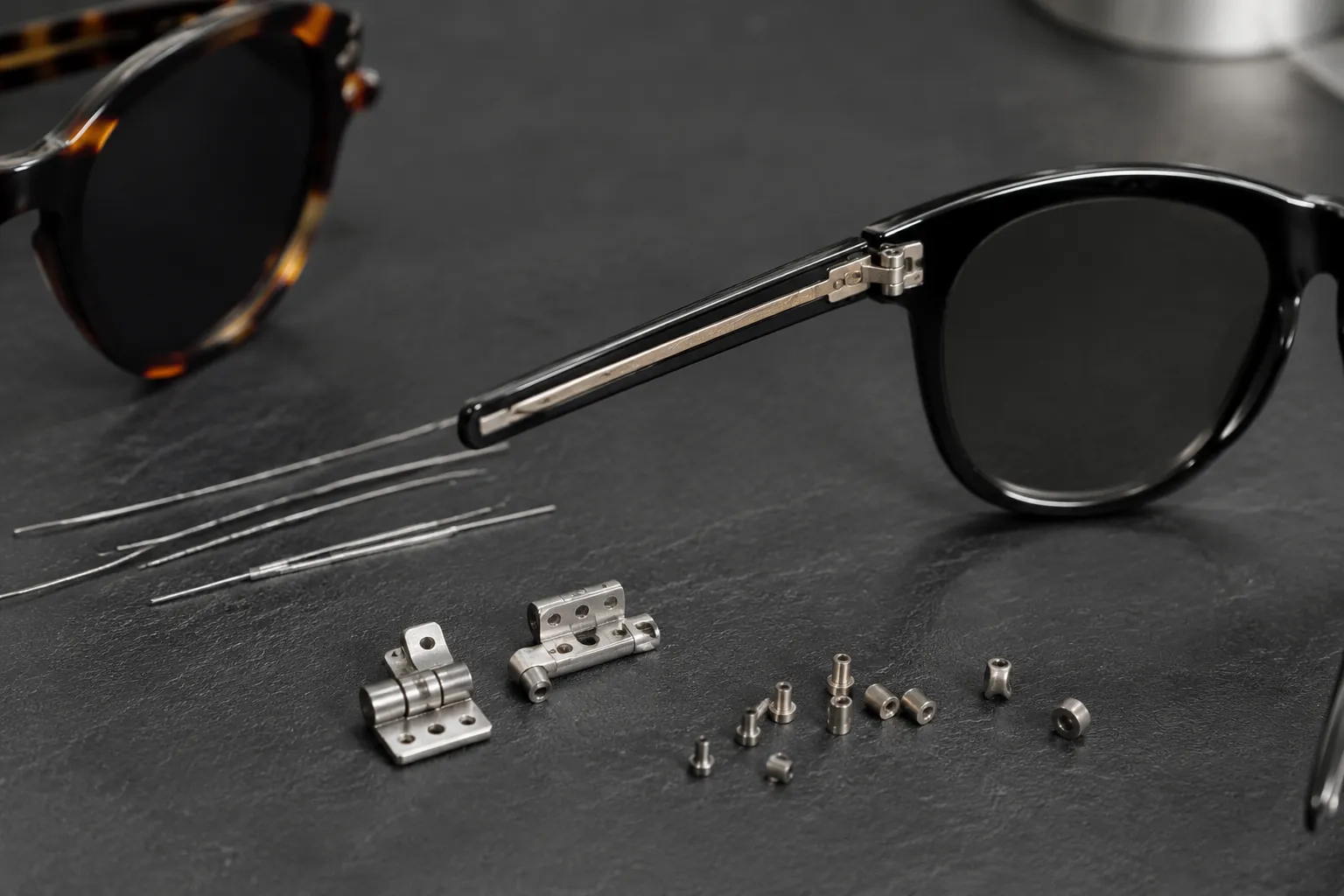
This guide is for brand owners, importers, distributors, and retail buyers selecting temple materials for a sunglasses program. The real question is not which metal sounds stronger on a spec sheet. It is which temple construction fits your target price, channel, fit needs, finish standard, and after-sales workload. Memory metal and stainless steel solve different problems. Compare them by flex behavior, comfort, repairability, finish options, MOQ economics, and reorder consistency, and the choice gets clearer fast.
Start with the buying decision, not the material name
Buyers often ask for memory metal because it sounds tougher, or stainless steel because it sounds more premium. That is not a sourcing standard. Temples usually fail in a few predictable ways: they bend out of alignment, twist, loosen at the hinge, wear at skin-contact points, or create fit complaints because the pressure feels too tight or uneven.
Memory metal temples are usually chosen for elastic recovery. In practice, that means they tend to return closer to their original shape after outward bending than conventional rigid metal temples. Stainless steel temples are usually chosen for appearance control: slim profiles, crisp lines, consistent brushing or polishing, and a firmer feel in hand.
For a serious B2B program, compare the two materials across five operational factors instead of one vague idea of durability:
- Flex behavior: how the temple responds to repeated opening, outward bending, and normal handling.
- Comfort window: clamp feel, spring response, end-tip contact, and fit tolerance across different head widths.
- Repair pattern: whether stores are more likely to re-level, re-bend, replace screws, or reject finish defects.
- Visual positioning: utility, travel, sport-lifestyle, minimalist fashion, or entry premium.
- Reorder stability: whether the same finish, logo process, hinge parts, and assembly result can be repeated on later orders.
That framework works better than asking which metal is "best." The right answer depends on how the frame will be sold, handled, and serviced after sale.
Head-to-head: what changes in actual use
| Factor | Memory Metal Temples | Stainless Steel Temples |
|---|---|---|
| Flex recovery | Generally higher elastic recovery after outward bending, depending on alloy, section design, and construction | Lower elastic recovery once overstressed; visible bend set is more likely to remain |
| Shape precision | Good, but visual lines may appear softer depending on section and covering parts | Very good; supports slim, crisp profiles and consistent visual definition |
| Comfort feel | Springy, more forgiving across varied head widths when designed well | Stable, firmer, often preferred for structured premium silhouettes |
| Common failure mode | Problems more often occur at hinge seats, welds, transition parts, sleeves, or coatings than in the flexing section itself | Permanent bend, hinge fatigue, or visible asymmetry after misuse or repeated adjustment |
| Retail adjustability | Can be less intuitive to reshape precisely after severe damage; handling depends on specific construction | Usually easier for trained technicians to adjust in small increments |
| Finish options | Usually coated, painted, sleeved, or combined with molded tips; decorative options on the flexing section are more limited | Well suited to brushing, polishing, plating, laser marking, pad printing, and attached logo details |
| Cost tendency | Often higher than basic stainless builds because of material choice and assembly structure | Broad cost range; often efficient on repeat programs with straightforward finishing |
In daily use, memory metal often makes sense where rough handling is common and post-sale fitting service is limited. Stainless steel often makes sense where shelf presentation, slim metal styling, and finish quality sit at the center of the product concept.
Do not isolate temple material from frame architecture. A stainless steel temple on a full-metal frame behaves differently from a stainless steel temple attached to an injected or acetate front. Hinge design, screw quality, weld quality, insertion method, and end-tip construction can affect field performance as much as the alloy name.
Durability: where each option actually fails
Memory metal is not unbreakable. Its main advantage is elastic recovery. In commercial eyewear, that usually means it is better at resisting a permanent spread after outward bending than more rigid temple metals. That helps in broad-fit lifestyle programs, travel-oriented products, and channels where consumers handle frames less carefully.
But most failures do not happen in the middle of the temple shaft. They happen at connection points. Hinge attachment areas, welded transitions, decorative sleeve interfaces, fitted end sections, screws, and coatings are the usual trouble spots. If those details are weak, misaligned, or inconsistently assembled, the frame can still fail even if the memory section itself performs well.
Stainless steel behaves differently. It gives good structural consistency and supports a wide range of cosmetic finishes. It is widely used for brushed, polished, plated, engraved, or logo-applied temple designs. The trade-off is simple: once a stainless steel temple is bent beyond its working range, it is more likely to hold visible deformation. A technician may adjust it back, but repeated or severe misuse can leave asymmetry.
For factory control, ask for measurable checks, not broad durability claims. Useful controls include hinge opening and closing cycle testing, pull or retention checks at temple connection points, left-right symmetry checks, finish adhesion or corrosion testing where relevant, and final assembly alignment checks. The exact method and acceptance standard should be written into the supplier's QC specification or the buyer-approved inspection standard.
Decoration flow matters too. If engraving, pad printing, logo fitting, and assembly are split across too many subcontract steps, the risk of cosmetic mismatch, scratching, or left-right inconsistency goes up. Ask who controls each step and how master samples are referenced during production.
Comfort and fit retention over long wear
Comfort drives returns fast. A frame can look good in a sample set and still fail at retail if clamp pressure is too strong, the temple profile is too sharp, or the balance shifts during wear. Memory metal can widen the fit window because the temple response is often more forgiving across different head widths.
Stainless steel temples can also be very comfortable, but they rely more on geometry than on elastic forgiveness. Temple width, curvature, end-tip material, front weight, lens weight, and hinge tension all matter. A well-designed stainless steel temple feels controlled and balanced. A poor one feels narrow, hard, or unstable over time.
Before approving a sample, ask the supplier for comfort-related build detail instead of general reassurance:
- Temple thickness and width: very slim profiles may look refined but can increase pressure if edge shaping is too sharp.
- End-tip construction: injected tips, overmolded soft-touch parts, or acetate sleeves can reduce direct metal pressure behind the ear.
- Opening force: the frame should be checked for clamp balance across more than one wearer or fit gauge.
- Front-to-temple balance: heavier lenses or larger fronts need enough temple stability to prevent slipping.
- Symmetry and leveling: small left-right errors are often felt quickly, even on lightweight frames.
A practical review method is simple. Compare both temple options on the same front design, wear each sample long enough to find pressure points, open and close them repeatedly, and then check whether the frame remains level and stable on the face. That gives a better buying signal than judging the material by description alone.
Repair rates, after-sales work, and channel fit
Temple material affects more than product behavior. It affects service workload too. If you sell through optical stores, department concessions, or distributors with adjustment capability, stainless steel is often easier to manage because trained staff can usually make controlled fit corrections with standard tools. That can keep more units sellable after repeated try-on or minor misuse.
If you sell through online DTC, travel retail, gift channels, or general merchandise accounts with limited adjustment service, fewer post-sale fit issues matter more. In those channels, memory metal can offer a practical edge because it is generally more tolerant of random handling and consumer over-opening.
The channel logic is usually straightforward:
- Online DTC and mass retail: memory metal is often worth testing first when fit forgiveness and lower shape-related complaints matter more than decorative finish complexity.
- Fashion boutiques and premium department channels: stainless steel is often worth testing first when slim metal styling, finish detail, and premium presentation are central to the assortment.
- Distributor programs across mixed markets: split the range by user, price tier, and service environment instead of forcing one temple material across all SKUs.
Repair rate is also tied to spare-parts discipline. If a style is expected to repeat, ask whether the supplier can keep the same hinge parts, screws, logo hardware, tip color references, and finish standards on reorders. Small changes create problems later. Approved master samples and signed color or finish references should be retained against the production order.
Cost, MOQ, and lead-time trade-offs in production
Temple material affects cost, but not on its own. Tooling, hinge construction, decoration method, finish yield, labor intensity, and order volume can matter just as much. Sometimes more. Buyers should compare cost by order stage because prototype pricing often exaggerates the material difference.
| Order Stage | What Matters Most | Typical Buyer Decision Impact |
|---|---|---|
| 50-299 pairs | Sample setup, material sourcing efficiency, manual fitting time, decoration approval | Unit cost can appear inflated; avoid drawing long-term conclusions from first-sample pricing alone |
| 300-999 pairs | Stable sourcing, decoration yield, assembly consistency | Good stage to compare the two materials against actual channel needs and acceptable QC level |
| 1000-4999 pairs | Line efficiency, scrap control, repeatability | Cost structure usually becomes clearer; finishing and assembly design often drive the final gap |
| 5000+ pairs | Process balance, finish consistency, packing efficiency | Well-controlled programs usually benefit most from simplified construction and stable finishing standards |
Do not judge memory metal versus stainless steel from the first quotation alone. At low quantities, setup loss, manual assembly, and logo or finish approvals can account for a large share of unit cost. At higher quantities, the gap may narrow or widen depending on temple complexity and finish demands.
Lead time also depends on more than the base metal. Sampling and bulk timing often hinge on artwork approval, color confirmation, fit revisions, packaging decisions, and material availability. Memory metal builds may need tighter control at transition parts and assembly points. Stainless steel builds may need stricter cosmetic inspection when brushed, polished, plated, or engraved finishes are part of the spec.
For procurement, request like-for-like quotations: same front design, same lens specification, same packaging assumptions, same finish standard, and clear notes on what is included in sampling, tooling, and QC. That is the only fair commercial comparison.
Compliance and spec points buyers should not skip
Temple material is only one part of compliance. For sunglasses, the finished product must match the destination market's product-performance and chemical requirements. Request test relevance by SKU, lens category, and market. Do not assume one document covers every variation.
The certifications, registrations, and management standards commonly referenced in sunglass sourcing include CE EN ISO 12312-1, ANSI Z80.3, AS/NZS 1067, REACH, FDA registration, ISO 9001, and BSCI. They do not mean the same thing. CE EN ISO 12312-1, ANSI Z80.3, and AS/NZS 1067 relate to sunglass performance in their market contexts. REACH addresses restricted substances. FDA registration may matter to U.S. documentation or facility records, but it does not replace product-performance testing. ISO 9001 and BSCI relate to management systems and social compliance, not sunglass lens performance.
On the temple side, ask for a specification sheet that covers the actual build:
- Base metal declaration: identify the temple material used in production and any combined components.
- Surface finish system: define whether the part is painted, plated, polished, brushed, coated, or covered by sleeves or tips.
- Corrosion or perspiration resistance requirement: set the expected test or inspection standard for the intended market and use environment.
- Hinge construction: confirm hinge type, screw specification, attachment method, and replaceable parts where relevant.
- Chemical compliance file: request support documents for REACH and any buyer-specific restricted substance list.
Short version: do not approve temple material by appearance alone. Tie it to the target market, lens specification, use environment, and the exact compliance file behind the final SKU.
A practical sourcing rule for choosing between the two
If the collection targets utility, travel, family retail, entry-to-mid price bands, or online channels where fit forgiveness matters, start by testing memory metal temples on the core volume styles. If the collection targets fashion presentation, slimmer metal styling, premium shelf appeal, or store environments where fit adjustments are available, start by testing stainless steel.
A disciplined sourcing process usually looks like this:
- Define the retail channel: online, wholesale distributor, boutique, sporting goods, or department store.
- List likely consumer handling conditions: heavy try-on, travel packing, bag storage, low service support, or frequent adjustment.
- Set target margin and reorder size: decide whether the real program is a small launch, a repeat core style, or a scaled volume item.
- Sample both temple types on one front: keep lens specification, front geometry, and size constant so the comparison is valid.
- Review the most likely return reasons: crooked fit, bent temple, hinge issue, finish wear, or comfort complaint.
- Approve the option that addresses the main failure mode: choose by real-use risk, not by marketing language.
For many buyers, the best answer is not one material across the full collection. It is a split strategy. Use one material for utility-driven volume styles and the other for image-driven or finish-led styles. That keeps product design aligned with channel behavior and helps protect margin on repeat orders.
Have a custom sunglasses project in mind?
Send us your styles, target market and quantities and we will return a detailed quote with MOQ, lead time and a sample plan.
Get a QuoteWhy source this from Wenzhou with LumiShades
Wenzhou in Zhejiang Province is widely regarded as China’s eyewear manufacturing capital, producing a large share of the world’s sunglasses. That concentration matters to buyers: a deep local supply chain for acetate sheet, hinges, lens blanks, plating and packaging means shorter component lead times, easier color and material matching, and a workforce with decades of eyewear-specific skill. LumiShades has manufactured in this ecosystem since 2009, and our vertical integration — in-house injection molding, acetate cutting, CNC milling, lens tinting, decoration and quality control — means no part of your order is quietly subcontracted to a workshop you cannot audit.
For international buyers, that vertical control translates into accountability. When a single factory owns every step, defects are traced and fixed at source rather than bounced between vendors, and your specifications survive intact from first sample to bulk. We back this with 15+ years of experience, shipments to 60+ countries, more than 5 million pairs produced per year and a 98.5% on-time delivery rate. Our certifications — CE EN ISO 12312-1, FDA registration, ANSI Z80.3, AS/NZS 1067, REACH, ISO 9001 and BSCI audit — mean the compliance documentation your market requires already exists. Explore our manufacturing capabilities and quality control process to see how this works in practice.
Frequently asked questions
Is memory metal always more durable than stainless steel for sunglasses temples? No. Memory metal is usually better at recovering from outward bending, but that does not make the whole temple assembly immune to failure. Hinge attachments, welds, transition parts, screws, sleeves, and coatings can still fail. Ask suppliers to show the full construction, explain likely weak points, and provide QC checks for hinge durability, alignment, and finish performance. If your main concern is shape recovery after rough handling, memory metal is often the better starting point. If your main concern is precision, finish quality, and easier in-store adjustment, stainless steel may be the better choice.
Which temple material usually creates fewer retail returns? It depends on the selling channel and service model. In online, travel, gifting, and other low-service channels, memory metal often deserves first consideration because it is generally more forgiving when consumers over-open or mishandle frames. In optical or premium retail environments with trained staff, stainless steel can perform very well because minor fit issues can often be corrected quickly. Make the decision with your own return data by reason code: bent shape, comfort complaint, hinge issue, finish wear, or adjustment problem. Then sample both materials on the same front and compare them against those specific risks.
Does stainless steel look more premium to consumers? Often yes, especially on slim metal styles with brushed, polished, plated, or engraved details. But the premium impression comes from execution, not from the metal name alone. Consumers usually notice profile sharpness, finish consistency, logo detail, fit stability, and overall balance more than alloy terminology. If premium presentation is the goal, ask suppliers for side-by-side samples with the same front design and compare cosmetic consistency under the lighting used in your retail channel.
How should I sample these two options before placing a bulk order? Use one front design, one lens specification, and one size. Make two versions: one with memory metal temples and one with stainless steel temples. Then compare them with the same checklist: opening feel, recovery after controlled outward bending, left-right alignment after repeated opening and closing, finish quality, comfort during wear, and stability on the face. Record the likely return risks for each version. Also ask the supplier to state the temple construction, hinge type, finish process, and any outsourced decoration step so you can see whether performance differences come from the base metal or the assembly design.
Will either option affect MOQ and lead time? Yes, but usually through construction and finishing complexity rather than through the metal name alone. MOQ and timing can change if one option needs more fitted parts, more cosmetic inspection, more difficult finishing, or longer approval on logos and color references. Do not compare only headline MOQ or prototype timing. Ask for a like-for-like quotation that separates sample cost, tooling if any, unit price assumptions, finish process, and estimated production lead time after approval. That gives you a usable sourcing comparison instead of a rough quote that hides process differences.
Ready to start?
Explore our wayfarer sunglasses or request a quote — our sales team replies within 12 hours.
Request a Quote