
Sunglasses Mold Costs: Stock Tool vs New Tooling
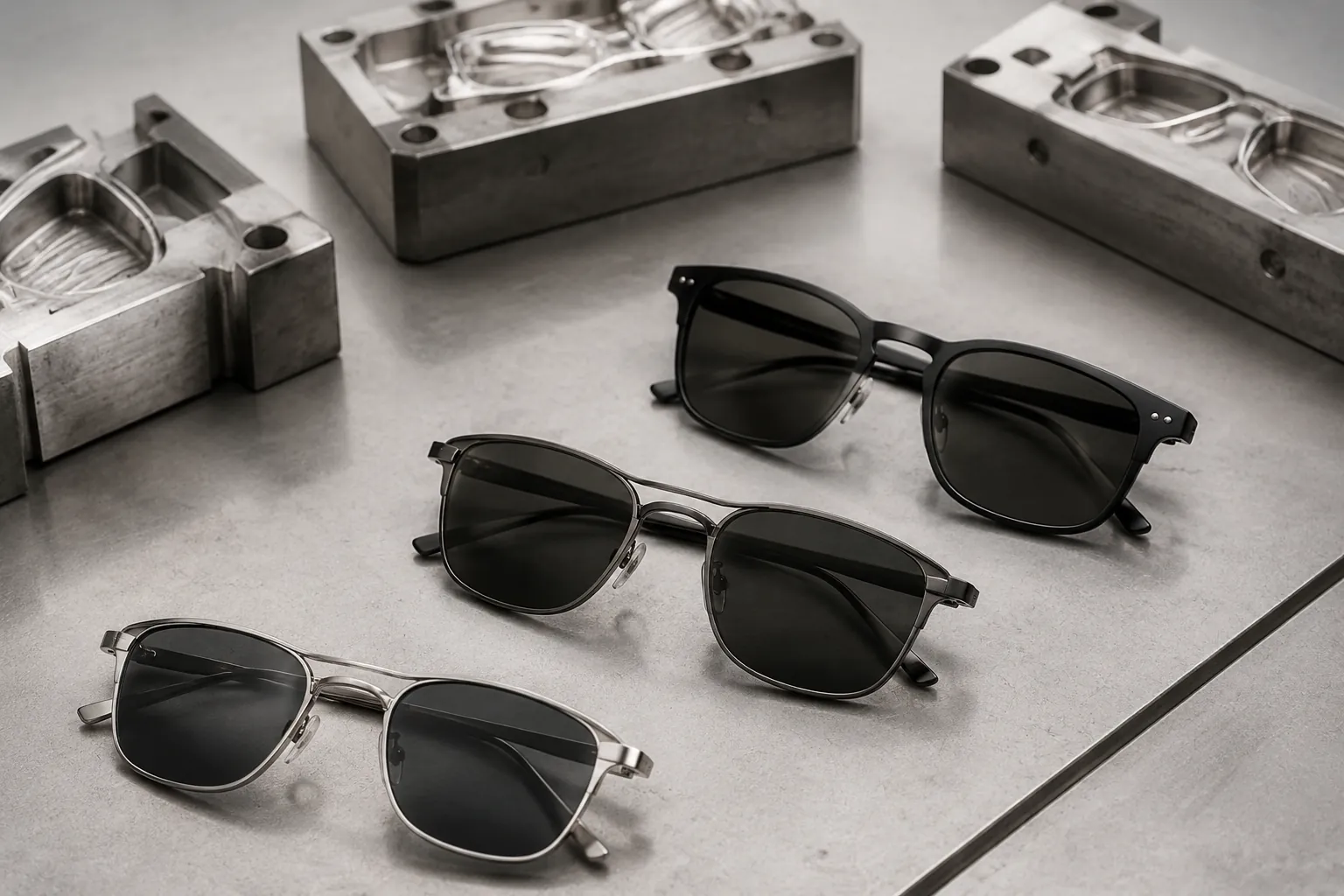
This guide is for brand owners, importers, distributors, and retail buyers sourcing injection-molded sunglasses at production scale. The main decision is not simply whether to pay for a mold. It is whether an existing production mold, a controlled mold edit, or a fully new tool makes the most commercial sense once you account for MOQ, target landed cost, lead time, fit consistency, decoration, and compliance impact. Tooling is where many eyewear programs either gain discipline or absorb avoidable cost. The right route depends on repeat volume, how much visible differentiation the market will reward, and how much engineering change the frame can take without creating quality or approval risk.
Start With the Business Case
Many buyers ask about a new mold too early. Wrong starting point. Before discussing steel grade, cavity count, or surface finish, define the business case: expected annual volume, target landed cost, launch window, fit requirements, and how much design differentiation the end market will actually notice and pay for.
For injection-molded sunglasses, there are usually three sourcing paths:
- Use an existing production mold and change color, lens tint, logo, or packaging.
- Modify an existing mold within a limited range, such as a logo recess, surface texture, or selected cosmetic details.
- Open a fully new mold for the front, temples, or both.
If your opening order is close to a factory's MOQ, a new mold often does not make financial sense. At low volume, too much of the spend sits in development, setup, and approval instead of unit efficiency. If the style is likely to repeat across several orders, the tooling cost can be spread across more units and becomes easier to justify.
In practice, many private-label buyers start with a proven stock platform. It cuts lead time, limits upfront cash exposure, and lets the market test the concept before the buyer commits to tooling. A buyer with a protected design language, a fixed retail concept, or a repeat program may justify custom tooling earlier because the frame shape itself carries product value.
Ask one blunt question: what truly needs to be unique, and what can stay standard without hurting the offer?
What a Tooling Charge Usually Covers
Buyers often treat a mold fee as payment for a machined block of steel. That is incomplete. In most cases, the tooling charge covers a wider set of engineering and production steps: drawing review, 2D and 3D adjustment, mold design, CNC machining, EDM where finer geometry is needed, polishing or texturing, fitting of inserts or sliders, initial trial shots, inspection, correction work, and sample confirmation.
On a typical injection-molded sunglass frame, the tooling split often includes one mold for the front and separate tooling for the left and right temples. Complexity rises fast when the design includes deeper wrap, undercuts, badge recesses, overmolded areas, or hinge structures that need tighter positional control. Two frames can look similar in photos and still carry very different tooling burdens.
Important variables in eyewear tooling include:
- parting line location and how visible it will be on cosmetic surfaces
- surface finish target, such as polish or texture
- draft angle needed for release without damaging sharp edges
- wall-thickness balance to help manage sink, cooling, and distortion
- insert areas for logos, hinge hardware, or mixed-material assemblies
Buyers should ask what the quote includes and what it excludes. Some factories include one correction round after the first trial. Others charge separately for every revision after opening. That matters because first-shot parts often expose issues that are hard to see in CAD: sink near thicker hinge zones, temple twist after cooling, lens groove inconsistency, or cosmetic marks in visible areas.
Material choice also changes the development load. Polycarbonate can produce crisp geometry and defined surfaces. TR90-type nylon materials are often chosen for lower weight and flexibility. Different resins behave differently in shrinkage, flow, and warpage control, which affects tuning time during development. That cost may appear as a tooling charge, a sampling fee, or simply a longer approval cycle.
Three Routes Compared
| Route | Typical upfront cost | Sample timing | What can change | Main limitation |
|---|---|---|---|---|
| Existing production mold | Usually no new tooling fee or only a setup charge | Fastest route; timing depends on material, decoration, and sample queue | Frame color, lens tint, logo print, laser marking, hot stamping, metal logo plate, packaging | Core shape, fit architecture, lens opening, and hinge geometry stay fixed |
| Existing mold with minor modification | Lower than full new tooling, but depends on the area and extent of rework | Longer than stock sampling because the tool must be reworked and retested | Selected logo recesses, surface texture, limited cosmetic edge changes, some decoration zones | Geometry can move only within limited process and structural constraints |
| Fully new mold | Highest upfront cost because it includes engineering, machining, trials, and corrections | Longest route because tooling, trial sampling, correction, and approval all happen before bulk | New front shape, new temple profile, custom lens opening, custom wrap, custom fit architecture | Highest development risk, longest approval cycle, and more compliance review points |
This is the real trade-off. If the frame must look proprietary from a distance, a stock mold may be too generic. If the commercial value sits mainly in branding, colorway, lens tint, or packaging, custom tooling may never pay back its cost. For many importers and distributors, a controlled mold edit is the practical middle ground because it improves differentiation without taking on the full cost and delay of a new tool.
A simple rule helps: judge uniqueness by what the customer sees before reading the logo. If the silhouette itself must signal exclusivity, you are likely looking at new tooling. If differentiation comes mainly from finishing and branding, a proven production mold is often the lower-risk option.
Where Mold Changes Work and Where They Fail
Not every design request suits a mold modification. Buyers need to separate cosmetic changes from changes that alter function, fit, or process stability.
- Usually feasible: logo recess areas, outer temple decoration zones, selected surface texture changes, and small cosmetic refinements on non-critical edges.
- Needs engineering review: bridge width, lens groove geometry, hinge seat location, front curvature, temple thickness, and base-curve-related geometry.
- Usually requires new tooling: major silhouette changes, large lens-shape changes, wrap changes, front-size changes, or structural revisions around hinge-load zones.
The reason is process control. Injection molds are built around shrinkage, material flow, cooling balance, ejection, and part strength. Move one feature too far and another problem can appear somewhere else. A thinner temple may look cleaner but become less stable after demolding. A larger lens opening may weaken retention or reduce fitting consistency. A narrower bridge may help one face shape and create pressure complaints for another.
In eyewear production, the expensive failures are often subtle. Hinge alignment, left-right opening feel, lens seating consistency, and cosmetic surface quality can all shift after what looks like a small geometry edit. Buyers should describe requested changes in production terms as well as design terms. Ask whether the edit changes wall thickness, cooling balance, steel strength, ejection direction, assembly tolerance, or lens retention. Those answers matter more than a vague statement that a change is possible.
When New Tooling Makes Financial Sense
Tooling should be judged against realistic lifetime volume, not only the first purchase order. The basic buyer-side calculation is simple: divide total tooling spend by the number of units you reasonably expect to buy over the life of the design, then compare that added cost per pair with expected margin, reorder confidence, and the commercial value of shape exclusivity.
Use a straightforward framework:
- Estimate likely repeat volume from actual sell-through or comparable programs, not optimistic forecasts.
- Calculate tooling cost per pair at several volume levels, such as first order only, first year, and total expected life.
- Compare that added cost with the gross margin benefit of a more proprietary frame.
- Include the cost of extra sampling, possible correction rounds, and the value of any launch delay.
Timing belongs in the same calculation. If an existing mold lets the program launch earlier and test demand sooner, that lower commercial risk may be worth more than custom shape ownership. For many first-time private-label programs, a proven platform is the stronger financial starting point because the buyer can collect reorder data before funding a fully custom frame.
New tooling usually makes sense only when three conditions are present: the design difference matters commercially, the reorder outlook is credible, and the buyer can absorb the longer development path without missing the selling season.
Lead Time From Drawing Approval to Bulk
Lead times are useful only when the factory defines what is included. Standard sample and bulk windows may apply to proven production molds, but new tooling adds engineering, machining, trial, correction, and approval steps before normal production timing begins.
A typical sequence looks like this:
- Buyer confirms target shape, material, lens requirement, decoration method, and packaging.
- Factory reviews whether a stock mold, a mold edit, or a new tool is the right route.
- If new tooling is needed, engineering finalizes drawings and toolmaking begins.
- T1 trial shots are produced and reviewed for dimensions, assembly fit, cosmetics, and hinge function.
- Corrections are made if required, then updated samples are submitted for approval.
- Bulk production starts: molding, trimming, hinge assembly, lens fitting, decoration, cleaning, final QC, and packing.
In practice, the most variable stage is the period between the first trial and final approval. That is where cooling behavior, hinge alignment, bridge feel, and lens seating issues usually show up. Consolidated buyer feedback helps. Fragmented comments from multiple internal stakeholders often extend the schedule without improving the final result.
Decoration also affects timing. Pad printing requires adhesion validation on the chosen finish. Laser marking depends on material and color contrast. Hot stamping adds its own setup controls. Metal logo plates introduce extra assembly steps and fit checks. Buyers who need calendar discipline should ask for lead time in separate blocks: tooling lead time, sample lead time after trial, and bulk production lead time after final approval.
Materials, QC, and Early Compliance Checks
Material and decoration choices affect cost, fit consistency, and defect risk. Standard injection-molded sunglasses commonly use polycarbonate or TR90-type nylon materials depending on target price, weight, flexibility, finish, and end use. Polycarbonate is often chosen for defined geometry and glossy finishes. TR90-type materials are often chosen when flexibility and lower weight matter more. The trade-off is process control. Different materials can require different molding settings and post-mold handling.
Decoration should be selected for durability as well as appearance:
- Pad printing: suitable for logos and simple graphics, but adhesion should be checked on the selected finish.
- Laser engraving: durable on suitable surfaces, but the visual effect depends on contrast and material response.
- Hot stamping: useful for metallic or foil effects, with durability dependent on process control and substrate compatibility.
- Metal logo plates: can create a premium look, but they add assembly steps and tighter fit requirements for the recess area.
QC for molded sunglasses should cover cosmetics and function. Typical checkpoints include front width, temple length, lens groove fit, hinge function, opening and closing feel, left-right symmetry, surface marks, tint consistency where applicable, and logo position. Buyers should also ask how the factory handles first-article approval, in-process checks, and final inspection.
When supplier qualification matters, request documented quality and social compliance status where relevant, such as ISO 9001 for quality management systems and BSCI for social compliance. Do not assume those certifications are in place. Ask for current evidence if they are part of your sourcing requirement.
Tooling decisions can also affect regulatory work. For sunglasses sold into different markets, relevant product standards may include CE EN ISO 12312-1, ANSI Z80.3, or AS/NZS 1067 depending on destination and product category. Material and chemical expectations may also involve REACH. FDA registration may be relevant in some U.S. documentation or channel-specific workflows, but buyers should confirm the exact requirement for the product and route to market rather than assuming it always applies.
A frame that passed previous testing is not automatically equivalent after a mold change. Revisions to lens retention, wearing position, coverage, front curve, or structural load areas can affect test-relevant performance. Check that early. It is cheaper than finding out after production samples are approved.
A Practical Approval Framework
Design approval should stay tied to commercial reality, quality control, and compliance review. Treat tooling approval as a gated decision, not a design preference exercise.
Use this sourcing framework before approving tooling spend:
- Estimate repeat volume honestly. Support the number with sales history, forecast logic, or retailer commitments.
- Define what must be unique. Keep the standard platform if color, branding, and packaging are enough.
- Map non-negotiable fit points. Bridge feel, temple length, lens coverage, and front curve usually matter more than minor styling details.
- Ask which changes are safe inside an existing tool. Request an engineering explanation with clear limits.
- Separate costs clearly. Tooling, sampling, unit price, revision charges, testing, and packaging should be itemized.
- Check compliance impact early. Confirm whether any design change affects testing or documentation needs.
- Protect the calendar. A launch window can be worth more than a marginal design change.
For many B2B buyers, the strongest program is not the most customized one. It is the one with a clear commercial case, stable quality, credible compliance planning, and a reorder path that can scale without repeated surprises.
Have a custom sunglasses project in mind?
Send us your styles, target market and quantities and we will return a detailed quote with MOQ, lead time and a sample plan.
Get a QuoteWhy source this from Wenzhou with LumiShades
Wenzhou in Zhejiang Province is widely regarded as China’s eyewear manufacturing capital, producing a large share of the world’s sunglasses. That concentration matters to buyers: a deep local supply chain for acetate sheet, hinges, lens blanks, plating and packaging means shorter component lead times, easier color and material matching, and a workforce with decades of eyewear-specific skill. LumiShades has manufactured in this ecosystem since 2009, and our vertical integration — in-house injection molding, acetate cutting, CNC milling, lens tinting, decoration and quality control — means no part of your order is quietly subcontracted to a workshop you cannot audit.
For international buyers, that vertical control translates into accountability. When a single factory owns every step, defects are traced and fixed at source rather than bounced between vendors, and your specifications survive intact from first sample to bulk. We back this with 15+ years of experience, shipments to 60+ countries, more than 5 million pairs produced per year and a 98.5% on-time delivery rate. Our certifications — CE EN ISO 12312-1, FDA registration, ANSI Z80.3, AS/NZS 1067, REACH, ISO 9001 and BSCI audit — mean the compliance documentation your market requires already exists. Explore our manufacturing capabilities and quality control process to see how this works in practice.
Frequently asked questions
At what order volume does a new sunglasses mold usually make sense? There is no universal volume threshold because tooling cost, frame complexity, target margin, and reorder probability all vary by project. Calculate tooling cost per pair across the realistic lifetime volume of the style, not only the first order. As a practical step, ask the supplier for three quotes: existing mold, modified mold, and fully new mold. Then compare the added tooling burden per pair, the expected launch delay, and whether the shape difference is important enough commercially to justify both.
Can I change the lens shape on an existing injection mold? Sometimes, but only within clear engineering limits. Small adjustments may be possible if they do not compromise the front cavity, lens groove geometry, lens retention, or structural stability. If the lens opening needs to look obviously different to the customer, assume a new front mold may be required unless the supplier's engineering team confirms otherwise in writing. Ask specifically whether the change affects groove depth, retention, front strength, or any prior test basis.
How many sample rounds should I expect on a new mold? Expect at least one trial round, and a second round is common when corrections are needed. The better question is what the tooling quote includes. Confirm before payment whether the quote covers T1 sampling, dimensional review, one correction round, and updated samples after correction. Also ask how approval comments should be consolidated, because slow or fragmented feedback often extends the timeline more than the tool work itself.
Does a new frame mold mean I need to review compliance again? Often yes, or at minimum you need to assess whether the change affects any test-relevant feature. If the new mold changes lens retention, coverage, wearing position, front curve, or structural behavior, prior results should not be treated as automatically transferable. Review the change against the target market requirements, which may include CE EN ISO 12312-1, ANSI Z80.3, or AS/NZS 1067, and confirm whether updated testing or documentation is needed before shipment.
What is the fastest route to launch a private-label sunglasses line? Use an existing production mold and limit customization to color, lens tint, logo application, and packaging. That removes toolmaking and correction from the critical path. To keep the launch moving, finalize decoration artwork early, confirm material and lens specifications in one approval package, and ask the supplier to separate sample timing from bulk timing in writing. A single headline lead time is not enough.
Ready to start?
Explore our shield & oversized sunglasses or request a quote — our sales team replies within 12 hours.
Request a Quote