
Private Label Injection Sunglasses: When They Fit, When They Fail
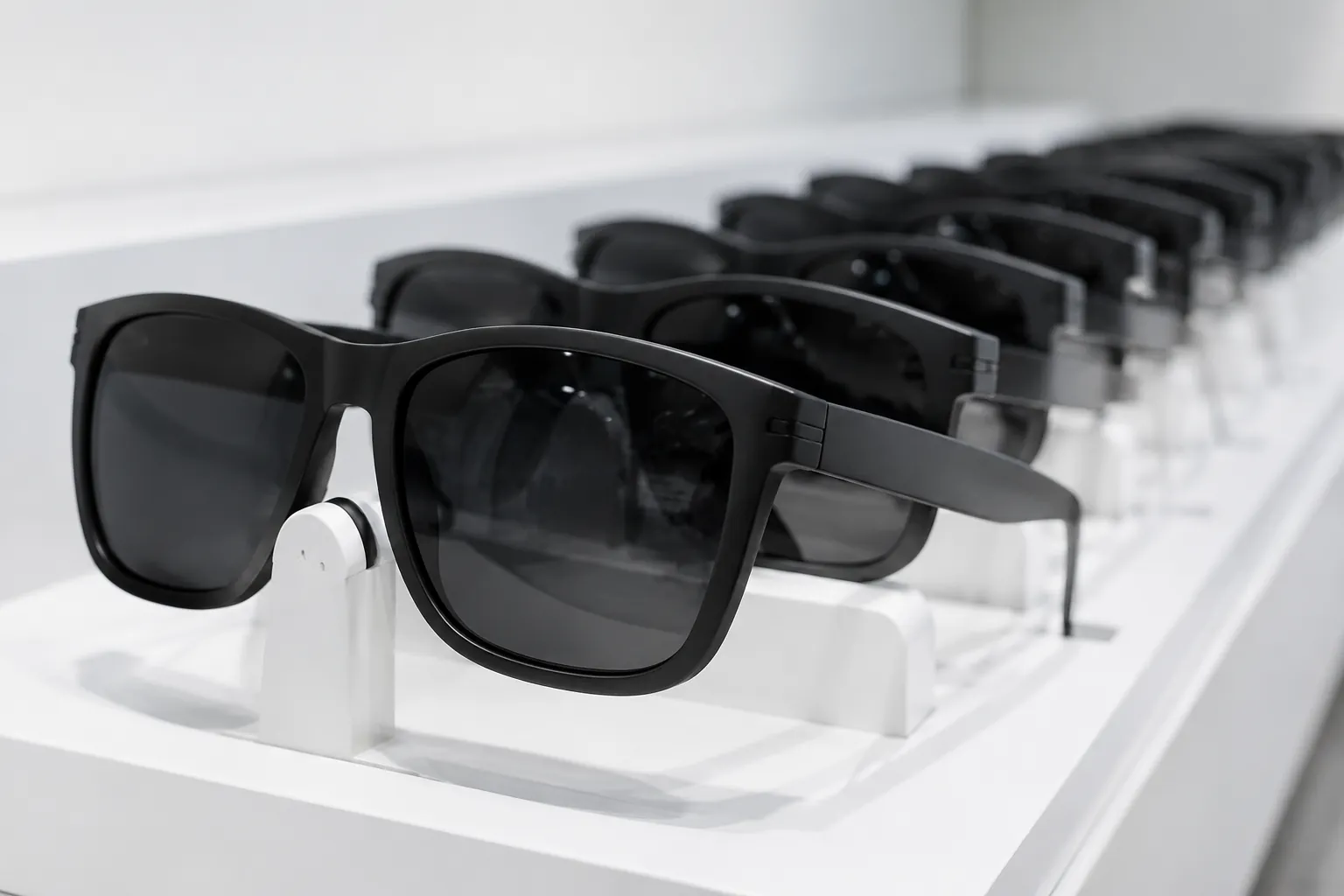
This guide is for buyers sourcing private label sunglasses in volume: brands, importers, distributors, and retail chains. If you are choosing between injection-molded frames and acetate or metal constructions, do not start with material buzzwords. Start with target ex-factory cost, order volume by color, repeat-order speed, finish expectations, and compliance risk. Injection-molded sunglasses can be a strong route for commercial programs, but only when the design brief matches the process. The point here is to help you judge that fit quickly, ask better factory questions, and avoid paying for the wrong build.
Start With the Four Buying Questions
Injection-molded sunglasses are often the right answer when a buyer needs repeatable production, controlled unit cost, and a straightforward reorder process. They are less attractive when the product depends on a heavy hand feel, visible material layering, hand-polished depth, or frequent low-volume color experiments with different trims and lens combinations.
Before you request samples, use four questions to narrow the sourcing path.
- What is your target ex-factory cost? Injection is commonly used when the cost brief is tight and the frame specification is controlled. The lower the target cost, the more important it is to simplify the shape, finish, decoration, and packaging.
- How many pairs per color will you actually buy? Injection becomes easier to justify as volume per color increases because setup, color matching, assembly, and packaging are spread across more units. Very small runs can work on an existing mold, but too many color splits can quickly weaken the commercial case.
- How fast do you need repeat orders? Once the mold, color standard, logo position, lens specification, and packaging are fixed, repeat injection runs are usually easier to plan than more hand-worked constructions. Buyers should still confirm realistic factory capacity and approval timing instead of assuming every reorder will be fast.
- What finish does your customer expect in hand? If the product needs to feel dense, deeply polished, or visibly premium on first touch, injection may not be the best fit. If it needs to look clean, consistent, and commercially sharp at a controlled price point, injection is often a strong option.
For promotional retail, travel channels, chain-store assortments, entry-price online ranges, licensed merchandise, and replenishment styles, injection is frequently chosen for practical reasons: process repeatability, simpler scaling, and easier cost control. Those factors matter more than material story when the order must be repeatable and commercially disciplined.
Where Injection Construction Clearly Wins
Injection-molded frames are used because the process is built for repeatability. Resin is prepared, injected into a mold cavity, cooled, ejected, trimmed, assembled, and inspected against an approved standard. When the factory controls mold condition, cooling balance, color consistency, hinge fit, and finishing quality, the same shape can usually be reproduced with less variation than a construction that depends more heavily on manual shaping and polishing.
- Repeat production: Once a frame has an approved mold, approved color target, approved lens specification, and stable assembly method, repeat runs are usually easier to standardize.
- Cost discipline: Injection is often commercially attractive for programs that need a price-conscious frame build with controlled decoration and packaging. The simpler the specification, the easier it is to protect the ex-factory price.
- Color consistency: Solid colors, translucent tones, and matte textures are usually easier to standardize than finishes that depend on manual polishing or layered sheet variation. Buyers should still approve a physical color standard because small shifts in raw material or color dosing can affect the result.
- Scalability: When molding, lens processing, decoration, assembly, and QC are closely coordinated, the factory can usually reduce handoff delays and correct problems faster during bulk production.
- Assembly consistency: Once trimming points, hinge hardware, and lens fit are stable, injection frames often provide more consistent lens seating, temple alignment, and left-right symmetry than builds with more manual finishing steps.
This is why injection is common in price-sensitive collections, event programs, retailer launches, replenishment lines, school or resort channels, and multipack sunwear. It is a process selected to reduce variation and support commercial scale, not to imitate every premium material characteristic.
Where Injection Is the Wrong Choice
Injection is not the answer to every brief. Buyers usually get into trouble when they force it into a premium positioning the process does not naturally support.
First, the hand feel can be lighter and less substantial than a thick acetate frame. That is not automatically a problem. For many consumers it is acceptable and sometimes preferable for comfort. But if your brand promise depends on density, visible lamination, high polish depth, or a luxury optical-store feel, customers may notice the difference immediately.
Second, shape flexibility is real but not unlimited. Very thick-to-thin transitions, deep sculpting, aggressive undercuts, and decorative surface relief can increase tooling complexity and defect risk. In those cases, buyers should watch for:
- Sink marks near thick sections where cooling is uneven
- Warping at temples or rims when the part does not cool uniformly
- Parting-line visibility on highly polished surfaces
- Ejection marks in poorly placed pin areas
- Flash or rough trimming around bridge, endpiece, or gate areas
Third, small-volume color experiments can become inefficient quickly. Multiple low-volume colors, mixed lens tints, and several logo placements create repeated setup changes, more approvals, slower packing decisions, and more chances for mismatch. A buyer may still proceed, but should not expect the economics or simplicity of a focused volume program.
Fourth, a high-gloss premium finish is possible on injection frames, but it will not automatically match a well-finished acetate product. If your reference sample comes from acetate or metal, compare samples side by side under direct light before approving the build.
Practical rule: if the product sells because it is affordable, consistent, and easy to reorder, injection is usually a strong fit. If it sells because it feels expensive the moment it is picked up, review acetate or metal before you lock the program.
Cost, MOQ, and Lead Time by Order Scenario
Private label buyers should not judge injection by unit price alone. The real buying logic includes whether the project uses an existing mold or new tooling, how many colors are involved, the lens specification, the logo method, the packaging standard, and the expected reorder pattern. The same sunglass shape can move from commercially efficient to unnecessarily expensive if the first order is over-customized.
| Order scenario | Typical fit for injection | MOQ and price logic | Lead time logic |
|---|---|---|---|
| Small test order | Useful for market testing or retailer review when the shape already exists | Unit cost is usually highest at this stage; keep to one frame color, one lens tint, one logo method, and standard packaging | Best suited to existing molds and light customization; lead time depends heavily on sample approval and factory scheduling |
| Focused launch order | Strong entry point for a disciplined private label program | Setup cost spreads more reasonably; decoration and packaging become easier to control when the SKU count stays tight | Practical for a limited number of colors and standard accessories once artwork and specifications are confirmed |
| Core volume order | Good fit for chains, distributors, and importers building a repeatable style | Material planning, assembly flow, and packaging cost typically improve when the model and color plan are stable | Repeatability becomes a major advantage if mold condition, color standard, and QC criteria are already proven |
| Large replenishment order | Best case for injection economics and process consistency | Highest leverage on process efficiency when the specification is stable and the production line can run with fewer interruptions | Production planning is generally easier when molding, decoration, assembly, and QC are well coordinated |
The practical lesson is simple: do not ask for premium complexity on a low-volume first order and expect efficient pricing. Keep early-stage projects tight. Use a standard shape, standard lens color, one decoration method, and standard packaging. Add variants only after the factory has proven the base model in production.
What the Factory Process Means for Buyers
Serious buyers should understand the production sequence because many defects start there, not at final carton inspection. A clean-looking finished sample can still hide weak process control if the factory cannot explain how key steps are managed.
- Mold setup and material prep: Resin type, drying condition, and color-control method affect dimensional stability, surface appearance, and shade consistency. Poor material handling can contribute to brittleness, splay, or cosmetic defects.
- Injection molding: Process settings such as fill speed, holding pressure, and cooling time affect flash, short shots, sink, and warpage. Uneven cooling between cavities can create symmetry problems.
- Deflashing and trimming: Poor trimming leaves gate marks, rough edges, or visible seam cleanup around the bridge and temple areas. This is one of the fastest ways for a low-cost product to look poorly made.
- Secondary machining if needed: Some designs need additional machining for hinge pockets, logo recesses, or detail cleanup. Buyers should confirm whether those steps are controlled in-house or subcontracted.
- Lens production and tinting: Lens tint, transmittance category, coating, and left-right visual match must stay within the approved standard. Buyers should confirm whether lenses are made in-house or sourced from a specialist supplier.
- Decoration: Pad printing is widely used for logos but requires good adhesion control. Laser marking is more durable in many applications but often subtler in appearance. Applied metal logos can increase perceived value but add assembly complexity and placement risk.
- Assembly and fit check: Temple opening resistance, hinge screw security, lens seating, front curvature balance, and frame symmetry should be checked before packing.
- QC and compliance verification: Cosmetic inspection alone is not enough. The finished product must also match the approved compliance documentation for the target market.
Ask where these steps happen. When molding, lens handling, decoration, and QC are managed under tighter coordination, correction loops are usually shorter. When the process is fragmented across several outside parties, approvals and corrective action often take longer.
Materials, Finish Limits, and Decoration Choices
Not all injection programs are equal because material choice and finish specification change both performance and appearance. Buyers should ask what frame material is being used, what lens material is paired with it, and which decoration method is planned. They should also ask for a production-relevant sample, not just a rendering or a polished concept sample.
| Specification area | Commercial upside | Common limit or risk | Buyer checkpoint |
|---|---|---|---|
| Standard injected plastic frame | Supports repeatable output and controlled cost on commercial programs | May feel lighter or less premium than acetate depending on design and wall thickness | Approve hand feel against the intended retail position, not against a luxury benchmark from another material |
| Matte or textured finish | Can hide minor handling marks better than a high-gloss surface | Texture variation can show if mold maintenance or finishing control is weak | Approve an exact physical finish sample rather than relying on photos or CAD images |
| High-gloss surface | Can improve shelf appeal and perceived value | Shows parting lines, polishing defects, and scratches more easily | Review samples under direct light from multiple angles before approval |
| Pad-printed logo | Common and cost-effective for private label branding | Can wear if ink adhesion or curing control is poor | Request an agreed rub-resistance check and confirm exact artwork position on the approved sample |
| Laser marking or metal logo | Can provide more durable branding or a stronger premium signal | Higher cost, tighter tolerance needs, and more assembly complexity | Use only when the retail price and brand position justify the added process risk and cost |
For first orders, simplicity usually wins. A controlled frame color, a standard lens tint, and one well-placed logo often perform better commercially than an over-designed low-volume concept. Every extra variable adds an approval point, and every approval point adds time and risk.
Compliance and Testing: What Actually Matters
For sunglasses, appearance is only half the job. The product still has to meet target-market requirements, and buyers should ask for documentation tied to the actual lens and frame configuration they are buying, not a generic statement or an unrelated old report.
- CE EN ISO 12312-1: Relevant in markets where this sunglass standard is used. Buyers should verify that the report applies to the lens category, tint, and construction being supplied.
- ANSI Z80.3: A recognized US reference for non-prescription sunglasses. Buyers should confirm whether their customer or importer requires testing to this standard for the specific product.
- AS/NZS 1067: Important for Australia and New Zealand programs where this standard applies.
- REACH: Relevant to chemical substance compliance in applicable markets, especially for frame materials, coatings, inks, and decoration inputs.
- FDA registration: Frequently raised in US discussions. Buyers should confirm exactly what registration or listing, if any, is appropriate for the product category and import route involved.
- ISO 9001 and BSCI: Useful as indicators of management-system structure and social compliance practices, but they do not replace model-specific product testing.
Do not mix these categories. A factory may hold ISO 9001 certification or pass a BSCI audit, yet still need product-level confirmation for a specific sunglass model with a specific lens. Buyers should verify:
- the report matches the lens category and tint being ordered
- the report is current enough for the buyer's compliance process
- the frame and lens configuration matches the approved production sample
- shipment labeling and packaging claims align with the verified test status
That is the difference between a factory that talks about compliance and a buyer program that is actually protected.
A Simple Decision Framework for Buyers
If you need a fast yes-or-no tool, use this matrix before you sample multiple constructions.
| Buyer priority | Injection is usually a good fit | Check another construction first |
|---|---|---|
| Low target ex-factory cost | Yes, especially when the specification is simplified and volume is concentrated | No, unless material story matters more than cost discipline |
| Fast repeat production | Yes, once mold, color standard, lens specification, and QC criteria are stable | No clear advantage if every reorder changes shape, finish, or decoration |
| Very premium hand feel | Sometimes, but sample carefully and compare blind against other materials | Yes, review acetate or metal options first if tactile premium value is central to the sell-through |
| Many small color splits | Only if the program is tightly simplified and the buyer accepts weaker efficiency | Often better to reduce variants or reconsider the construction strategy |
| Large replenishment volumes | Yes, this is where injection is typically strongest | Switch only if brand positioning clearly requires a different material story |
One final practical point: buyers often overcomplicate the first order. Do the opposite. Use an existing mold if the shape is close. Keep the lens color standard. Choose one logo method. Confirm fit, coverage, finish, and compliance. Then add variants only after the first shipment proves that the program is stable. That approach reduces reject risk, shortens approvals, and gives you a stronger basis for future cost negotiation.
Have a custom sunglasses project in mind?
Send us your styles, target market and quantities and we will return a detailed quote with MOQ, lead time and a sample plan.
Get a QuoteWhy source this from Wenzhou with LumiShades
Wenzhou in Zhejiang Province is widely regarded as China’s eyewear manufacturing capital, producing a large share of the world’s sunglasses. That concentration matters to buyers: a deep local supply chain for acetate sheet, hinges, lens blanks, plating and packaging means shorter component lead times, easier color and material matching, and a workforce with decades of eyewear-specific skill. LumiShades has manufactured in this ecosystem since 2009, and our vertical integration — in-house injection molding, acetate cutting, CNC milling, lens tinting, decoration and quality control — means no part of your order is quietly subcontracted to a workshop you cannot audit.
For international buyers, that vertical control translates into accountability. When a single factory owns every step, defects are traced and fixed at source rather than bounced between vendors, and your specifications survive intact from first sample to bulk. We back this with 15+ years of experience, shipments to 60+ countries, more than 5 million pairs produced per year and a 98.5% on-time delivery rate. Our certifications — CE EN ISO 12312-1, FDA registration, ANSI Z80.3, AS/NZS 1067, REACH, ISO 9001 and BSCI audit — mean the compliance documentation your market requires already exists. Explore our manufacturing capabilities and quality control process to see how this works in practice.
Frequently asked questions
At what order size does injection-molded eyewear usually make the most sense? It usually makes the most sense when the order is large enough to keep the specification focused and spread setup effort across meaningful volume. In practical buying terms, injection becomes easier to justify when you are not splitting the order into many low-volume colors or trim variations. Ask the factory for a quotation in at least three volume tiers using the same specification: one low-volume test quantity, one mid-volume launch quantity, and one repeat-order quantity. Then compare not only unit price, but also what changes in lead time, color options, packaging, and decoration at each tier.
Can injection-molded sunglasses still look premium enough for a brand launch? Yes, if the design is clean and the brief fits the process. A controlled gloss or matte finish, accurate assembly, good lens matching, and disciplined logo placement can create a strong retail result. The key is to judge the product against its intended price position, not against a luxury acetate reference. Ask for a production-like sample in the exact finish, logo method, and lens color you plan to buy, and review it under direct light and in hand beside any acetate or metal alternative you are considering.
What defects should I watch for on injection frames during sample approval? Check parting-line visibility, sink marks near thick sections, temple alignment, hinge fit, gate-area trimming, rough edges, lens seating, left-right lens color match, gloss consistency, and logo placement accuracy. Inspect the sample under direct light from several angles, open and close both temples repeatedly, and compare multiple sample pieces if possible rather than approving a single best-looking piece. Also ask the factory to identify which areas are most sensitive in production so you can focus your QC standard on the highest-risk points.
How should I structure a first order to reduce risk? Use one proven shape, keep to one or two frame colors, choose a standard lens tint, limit decoration to one method, and avoid complicated packaging on the first run. Ask the factory to confirm the exact approved sample standard, color reference, logo position artwork, and packing method before bulk starts. If you need variants, launch the base model first and add the extra colors or trims only after the initial production has been inspected and shipped successfully. This makes it much easier to identify the cause of any issue and protects both timeline and margin.
Do certifications on the factory profile automatically cover every sunglass model? No. ISO 9001, BSCI, factory registrations, and general claims do not replace model-specific product compliance. For each program, ask for documentation relevant to the exact frame and lens combination you are buying for the destination market, whether that involves CE EN ISO 12312-1, ANSI Z80.3, AS/NZS 1067, REACH-related material control, or confirmed FDA-related documentation where applicable. Check that the report or declaration matches the ordered configuration, that it is current enough for your compliance process, and that your labeling and packaging claims do not go beyond what has actually been verified.
Ready to start?
Explore our square sunglasses or request a quote — our sales team replies within 12 hours.
Request a Quote