
PC Injection vs Acetate Frames: Best Fit by Brand
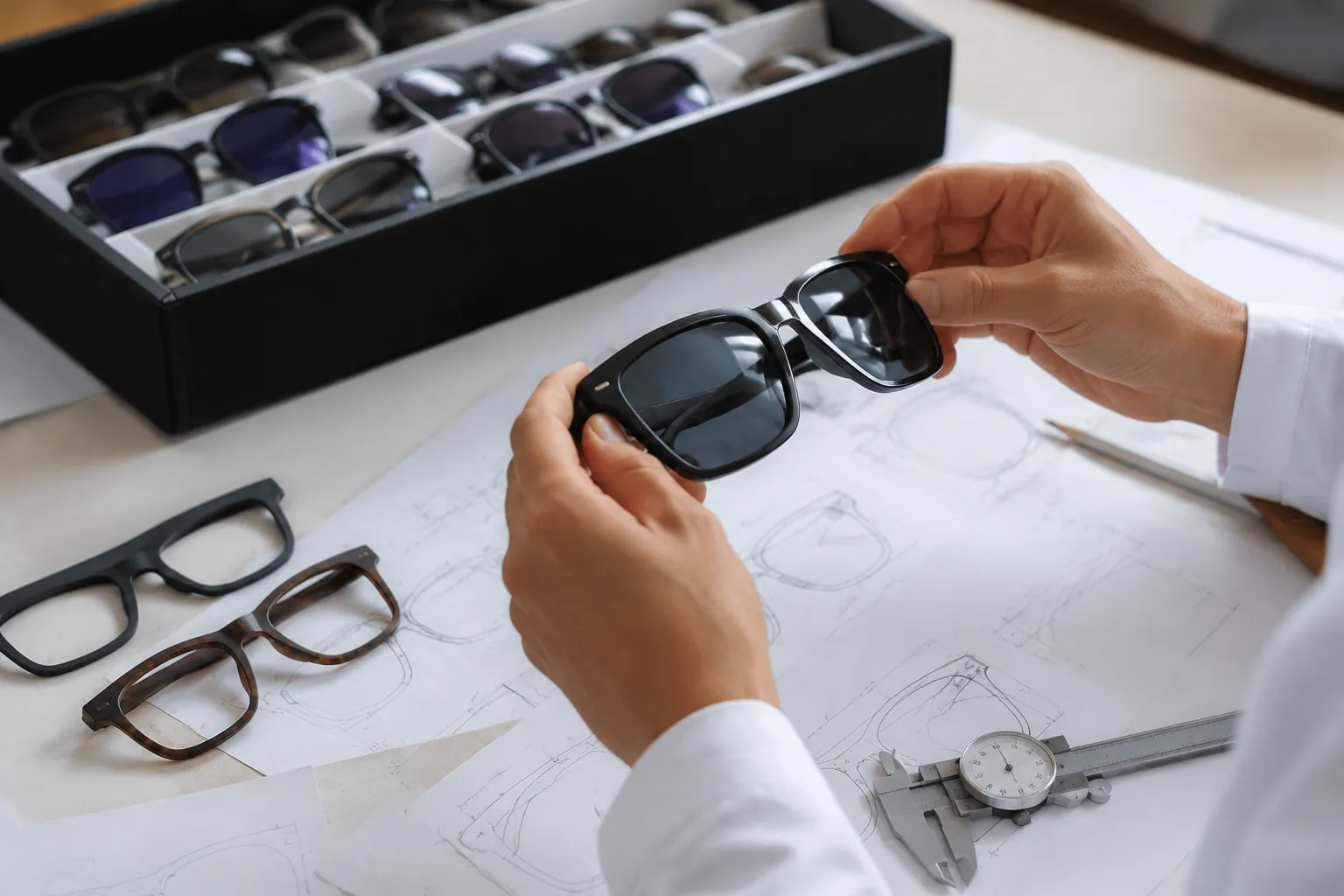
This guide is for brand owners, importers, distributors, and retail buyers choosing between polycarbonate (PC) injection and hand-cut acetate for a new sunglasses line. The choice affects more than material cost. It shapes tooling spend, finish, weight, reorder control, complaint risk, and how easily you can scale a winning shape. In broad terms, PC injection suits price-sensitive programs that need stable output and easier volume growth. Hand-cut acetate suits design-led collections that rely on visible material depth, polished edges, thicker profiles, and a more premium hand feel. Forget the sales pitch. The real question is which construction method fits your target retail price, order pattern, margin structure, and tolerance requirements before development starts.
Start with brand position, not material hype
Buyers often ask which frame material is better. Wrong starting point. Ask which process supports your selling price, customer expectation, and reorder pattern without adding avoidable production risk.
PC injection is common in promotional programs, chain retail, travel retail, event merchandise, kids' ranges, and fast-turn fashion styles. It works best where retail targets are tight, design is fairly clean, and the business depends on replenishment. Once a mold is approved and production settings are stable, the factory can usually repeat the same geometry across batches with less variation than a more manual frame process. That matters if one core shape is expected to reorder for months or years.
Hand-cut acetate serves a different job. Buyers choose it less for throughput and more for visible material character. Cellulose acetate can show layered transparencies, tortoise patterns, crystal effects, laminated color combinations, deeper bevels, and a heavier hand feel that many consumers read as higher value. If your line sells on touch, shelf presence, and design detail rather than opening price, acetate usually fits better.
The choice also depends on how you build the range. Many brands should not force everything into one material. Use injection for opening-price basics. Use acetate for hero styles or premium capsules. That split can protect margin at entry level while giving the top of the line more visual weight.
- Use injection when: retail price is sensitive, reorder demand is predictable, and style continuity matters more than material character.
- Use acetate when: the product needs visible depth, thicker rims, polished edges, and a hand feel that can support a higher ticket.
- Split the line when: you need a low opening price but still want standout styles that lift perceived brand value.
How the two processes differ on the factory floor
PC injection starts with tooling. The exact route can vary by design and production plan, but the basic sequence is simple: dried polycarbonate resin is heated, injected into a mold cavity under pressure, cooled, ejected, trimmed, and sent to downstream steps such as hinge fitting, lens assembly, decoration, and final inspection. The main advantage is repeatability. If shrinkage, cooling time, and mold condition are controlled, lens groove dimensions, bridge geometry, and temple alignment usually stay more stable across lots.
Hand-cut acetate involves more machining and more manual finishing. The factory starts with cellulose acetate sheet, then cuts fronts and temples from sheet stock, mills the parts by CNC or copying machine, routes the lens groove, bevels edges, tumbles, hand-finishes, heat-forms where needed, assembles hinges, polishes, and fits lenses. There are more touch points. That creates room for better finish, but also more room for variation. Process discipline matters as much as material choice.
The two routes also build shape differently. Injection forms the frame in near-final geometry inside the mold. Acetate creates geometry through cutting, milling, heating, and polishing. That affects dimensional control, edge detail, and how much sculpting the design can show. Injection is efficient. Acetate is slower. Each has its place.
- Injection checkpoints: mold condition, gate marks, sink marks, flash, lens groove consistency, hinge retention, and left-right temple symmetry.
- Acetate checkpoints: sheet thickness consistency, lamination alignment, bevel symmetry, polishing quality, hinge positioning, and front warpage after heating.
- Shared checkpoints: lens fit, opening and closing force, logo placement, cosmetic defect rate, and packing accuracy.
One more point: ask how the development sample was made. A prototype with extra hand finishing can look better than what the actual production method will hold at scale.
Perceived value: what customers notice first
Most consumers do not know the frame process. They still notice the result. Weight, surface finish, color depth, edge quality, and feel in hand all shape perceived value before the logo gets any credit.
Hand-cut acetate often feels denser and more substantial than injected PC. It can show layered color, transparent depth, polished bevels, and thicker profiles in a way that reads premium at first touch. On square, oversized, or vintage-inspired shapes, that material character often becomes part of the product story.
PC injection can still look good, especially for sporty wraps, low-profile fashion shapes, bright opaque colors, and lightweight commercial frames. It works when the design goal is clean, practical, and modern. But be realistic. Most injected PC frames sit better in scalable commercial programs than in highly crafted luxury positioning. If the concept depends on deep polish, layered translucency, or a sculpted edge, acetate usually gives you more room.
Decoration also behaves differently by substrate. On injection, common options include pad printing, laser marking, hot stamping, and some embedded trim details depending on construction. On acetate, buyers often use pad printing, laser engraving, foil stamping, metal logo plates, or pinned decorative elements. Match the decoration method to the finish target and the budget. A premium acetate frame with weak logo execution still looks cheap. A clean injected frame with accurate print and controlled finish can sell well at its intended price point.
Short rule: if customers buy with their fingers as much as their eyes, acetate usually has the edge. If they buy on trend, price, and replenishment speed, injection is often the safer commercial choice.
Cost, MOQ, and lead time: where economics change
This is where many sourcing decisions are made or missed. The lower unit price is not always the lower-risk program once tooling, reorders, and development complexity are included.
Injection often gives a lower repeat cost after tooling is in place because cycle time is faster and unit consistency is easier to hold. The trade-off is upfront tooling cost for a new shape, and that spend has to be judged against expected reorder volume. Acetate can reduce dependence on injection molds for some developments, but unit cost stays more labor-sensitive because material yield, CNC time, tumbling, polishing, and assembly all still matter.
In practice, if a core style is likely to reorder regularly, injection often becomes more economical over the life of the program. If runs are shorter, colors change often, or the assortment turns seasonally, acetate can still make commercial sense even with a higher per-unit cost.
Lead time also needs a clearer breakdown. Sampling time depends on whether the factory is working from a new drawing, modifying an existing shape, waiting on acetate sheet availability, or building new tooling. Bulk lead time depends on approval timing, material readiness, finishing capacity, and packaging requirements. Ask for timing by stage. Not one vague estimate.
| Factor | PC Injection | Hand-Cut Acetate |
|---|---|---|
| Best use case | Volume programs, aggressive retail, repeat replenishment | Design-led collections, premium positioning, lower-volume style runs |
| MOQ logic | Often improves as volume rises because tooling and setup are spread across more units | Can work for shorter runs, but labor keeps the cost curve less aggressive |
| Development cost | May include mold or tooling cost depending on shape and production route | Usually driven more by machining and finishing labor than injection tooling |
| Sampling time | Depends on tooling status, sample route, and design complexity | Depends on sheet availability, machining requirements, and finish detail |
| Bulk lead time | Depends on approved tooling, production capacity, and finishing plan | Depends on cutting, polishing, assembly load, and material readiness |
| Cost trend at volume | Usually falls faster at higher quantities on stable repeat programs | Usually improves with volume too, but labor and material content limit cost-down speed |
Finish detail and tolerance: where complaints start
Many buyers only see the real difference after bulk production. The sample was fine. The repeat order was not. Usually that points to tolerance control, not just material choice.
Injection frames can be highly consistent if the mold, machine settings, resin handling, and cooling process are under control. Lens groove width, temple symmetry, bridge geometry, and hinge position can stay close from batch to batch. The main risks are molding defects such as flow lines, gate blush, flash, sink marks, short shots, or uneven surface texture. These issues are usually visible and can often be traced back to tooling condition or process setup.
Acetate frames can look more premium, but consistency takes more work. Common issues include uneven bevel depth, polishing that rounds one side more than the other, hinge misalignment caused by heating and bending, and visible color mismatch when fronts and temples are cut from different visual zones of sheet stock. Small asymmetries show up fast on thicker premium frames because customers expect cleaner lines and tighter finish.
Push suppliers to define acceptance limits in writing. Typical controls include cosmetic inspection for scratches and print defects, hinge torque checks, lens seating checks, left-right alignment review, and dimensional checks on front width, bridge, and temple length. The exact tolerance standard depends on the product, market, and buyer-supplier agreement, but it should be set before production starts.
Operational control matters here. A lot. If molding, acetate machining, decoration, lens fitting, and final QC are not coordinated well, small errors move downstream and come back as finished-goods complaints. Ask where each key process happens, who signs off each stage, and how nonconforming units are isolated before packing.
Compliance and test planning by market
Frame construction is only part of the buying decision. The finished sunglasses still need to meet the standards required by the destination market, and compliance planning should be built into the sourcing brief early. This matters even more when lens category, mirror coating, polarization, or frame color changes by SKU.
The standards and documents most often discussed here include CE EN ISO 12312-1, ANSI Z80.3, AS/NZS 1067, REACH, FDA registration, ISO 9001, and BSCI. Use these terms carefully. CE EN ISO 12312-1, ANSI Z80.3, and AS/NZS 1067 relate to sunglasses product requirements by market. REACH covers chemical compliance for relevant materials and substances. FDA registration is often mentioned in the US market context. ISO 9001 and BSCI refer to management-system or social-compliance status; they do not replace product performance testing.
A common mistake is testing one bill of materials and then changing a key input before mass production. Different lens treatments, acetate sheet sources, resin grades, or mirror coatings can affect whether shipped goods still match the tested configuration.
- Define the destination market first. The EU, US, and Australia or New Zealand do not follow the same requirements or documentation path.
- Lock the lens specification before testing. Tint category, UV performance, mirror coating, and polarization can affect compliance results.
- Match the tested bill of materials to bulk. Do not change frame material source, lens treatment, or coating without reviewing compliance impact.
- Keep records by SKU. One approved style does not automatically cover every lens and frame-color combination.
Do not treat compliance documents as paperwork to collect after production starts. They belong in planning, especially if you sell into regulated retail channels or multiple export markets.
A practical decision framework for buyers
If you need to decide fast, score the program instead of arguing over preference. Rate it on target retail price, expected annual volume, reorder predictability, finish-detail requirement, compliance path, and landed-cost tolerance. That usually gets you to the right answer faster than debating which material sounds more premium.
Choose PC injection if most of the following are true: retail price must stay sharp, you expect replenishment on proven shapes, the design is clean rather than heavily sculpted, and later production runs need to match earlier ones closely. Choose acetate if most of these are true: the sales story depends on visible material character, the customer expects a heavier feel, the frame benefits from thicker rims or polished bevels, and your margin model can support a higher per-unit cost.
For many brands, the best answer is a split architecture. Keep volume basics in injection to protect opening-price competitiveness. Use acetate for statement pieces that strengthen the rest of the line. That usually produces a better assortment than forcing every SKU into one construction route.
- Choose injection for: chain retail programs, promotions, school or event orders, kids' lines, and trend shapes with high reorder probability.
- Choose acetate for: boutique optical-adjacent ranges, premium fashion capsules, thicker silhouettes, and styles sold on color depth and tactile finish.
- Split the line when: entry-level margin matters, but hero styles need stronger shelf impact and perceived value.
Before approving production, ask direct operational questions: Was the sample made by the same process planned for mass production? Will a new mold be required? Which decoration steps are done in-house and which are outsourced? How will reorders be matched on resin, sheet source, and lens tint? What inspection standard applies to cosmetic defects and alignment? Clear answers here prevent expensive surprises later.
Have a custom sunglasses project in mind?
Send us your styles, target market and quantities and we will return a detailed quote with MOQ, lead time and a sample plan.
Get a QuoteWhy source this from Wenzhou with LumiShades
Wenzhou in Zhejiang Province is widely regarded as China’s eyewear manufacturing capital, producing a large share of the world’s sunglasses. That concentration matters to buyers: a deep local supply chain for acetate sheet, hinges, lens blanks, plating and packaging means shorter component lead times, easier color and material matching, and a workforce with decades of eyewear-specific skill. LumiShades has manufactured in this ecosystem since 2009, and our vertical integration — in-house injection molding, acetate cutting, CNC milling, lens tinting, decoration and quality control — means no part of your order is quietly subcontracted to a workshop you cannot audit.
For international buyers, that vertical control translates into accountability. When a single factory owns every step, defects are traced and fixed at source rather than bounced between vendors, and your specifications survive intact from first sample to bulk. We back this with 15+ years of experience, shipments to 60+ countries, more than 5 million pairs produced per year and a 98.5% on-time delivery rate. Our certifications — CE EN ISO 12312-1, FDA registration, ANSI Z80.3, AS/NZS 1067, REACH, ISO 9001 and BSCI audit — mean the compliance documentation your market requires already exists. Explore our manufacturing capabilities and quality control process to see how this works in practice.
Frequently asked questions
Which frame process gives better reorder consistency? PC injection usually gives tighter reorder consistency because the mold defines the geometry and production settings can be repeated when the process is well controlled. Acetate can also be consistent, but it depends more on sheet consistency, CNC control, polishing discipline, heat-forming, and assembly skill. Ask the supplier how they control lens groove dimensions, hinge position, front alignment, and color matching across repeat orders, and request a written tolerance standard before placing the PO.
Is acetate always more premium than injection? No. Acetate often supports a more premium look and hand feel because it can show deeper color, polished bevels, and thicker profiles, but premium positioning is not automatic. A well-made injected frame with clean molding, accurate decoration, and stable lens fit can outperform a poorly finished acetate frame. When comparing samples, check symmetry, polishing quality, hinge action, lens seating, decoration accuracy, and overall cosmetic consistency instead of relying on material alone.
How should I split my first order if I am testing a new market? Start with the commercial objective, not just the lowest opening cost. If you are testing broad price sensitivity, use injection for core basics that may need quick replenishment. If you also need a small number of image-building styles, reserve acetate for a limited hero selection. In practice, ask the supplier for MOQ by style, color, and logo method, compare development cost separately from unit cost, and avoid launching too many constructions at once if the forecast is still uncertain.
Do PC injection and acetate both support custom decoration? Yes. Both can support common decoration methods such as pad printing, laser marking or engraving, foil or hot stamping, and selected metal logo details, depending on frame design and budget. The key question is not only whether the decoration is possible, but whether it is durable and repeatable on that substrate. Ask for decoration options by frame material, request an adhesion or wear-resistance check where relevant, and approve logo position against a production-ready sample rather than artwork alone.
What documents should I confirm before shipping to my market? Confirm the product standard that applies to the destination market and the exact lens specification being shipped. Depending on the market, that may include CE EN ISO 12312-1, ANSI Z80.3, or AS/NZS 1067, together with any relevant REACH-related material information. If the supplier mentions FDA registration, ISO 9001, or BSCI, verify what those documents do and do not cover. Also confirm that the tested bill of materials matches bulk production, including frame material source, lens treatment, coating, and tint category, and keep records by SKU for future reorders.
Ready to start?
Explore our sport wrap sunglasses or request a quote — our sales team replies within 12 hours.
Request a Quote