
How to Vet a Sunglasses Factory's Capacity
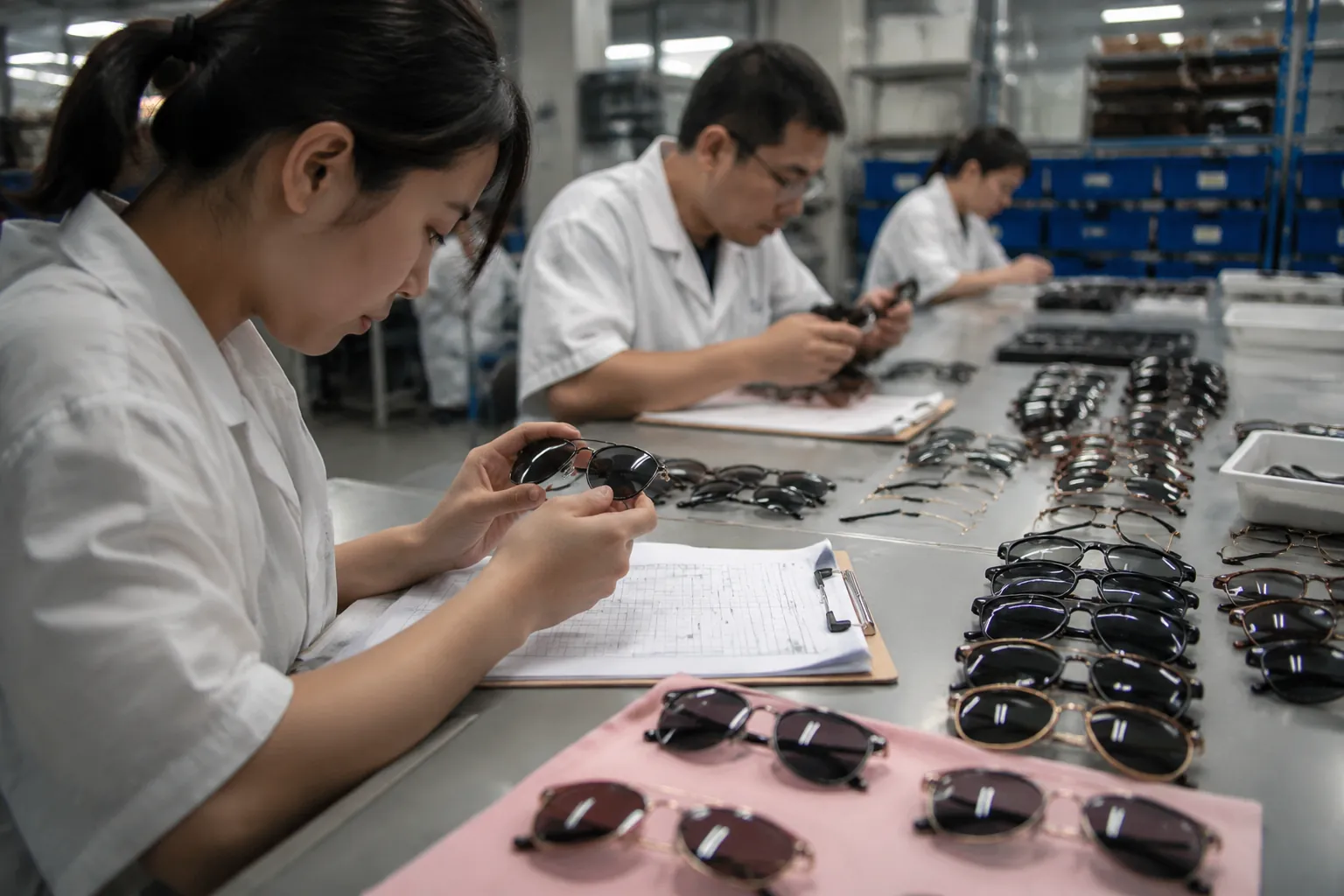
If you buy custom sunglasses in volume, factory capacity matters more than a polished sales deck. A supplier can accept a low MOQ, quote a good unit price, and still fail once repeat orders start to stack up. Real capacity is not one headline number. It is the factory's ability to keep frames, lenses, decoration, inspection, packing, and shipping moving at the same pace, month after month. This guide shows brands, importers, distributors, and retail buyers how to check true monthly output, spot bottlenecks, test process control, and judge whether a sunglasses factory can support repeat business without quality drift or delivery surprises.
1) Start with capacity by process, not one annual number
Do not accept a single claim like "5 million pairs per year" as proof of capacity. That number may include stock models, outsourced work, seasonal peaks, or production assumptions that do not apply to your order. Useful capacity is measured by process, product type, shift structure, and the actual bottleneck step.
A typical sunglasses flow includes frame molding or cutting, trimming, CNC milling, polishing, hinge or temple installation, lens cutting or tinting, logo decoration, assembly, inspection, packing, and carton loading. Each step moves at a different speed. Injection frames may come off a mold quickly. Acetate polishing, metal logo fitting, polarized lens sourcing, or pad-print alignment may slow the order down.
Ask the factory to break output into practical units: pairs per day per line, active lines per shift, average changeover time, and maximum weekly output for your product type. A plant may mold a large number of plastic fronts each day but only polish a much smaller number of acetate frames. Decoration or lens handling may be the real limit. If your order needs two-color temple printing and mirrored polarized lenses, that is where capacity will break first.
Use direct questions:
- Daily output by frame type: injection plastic, acetate, TR90, metal, or mixed-material.
- Daily lens handling capacity: standard tint, gradient tint, polarized, mirrored, or coated lenses.
- Decoration capacity by method: pad printing, laser engraving, hot stamping, metal logo plate, or embossing.
- Changeover time between colors, molds, lens tints, and logo setups.
- Number of active operators per process, not only total factory headcount.
- In-house versus outsourced steps, especially lens tinting, polishing, plating, and packaging.
Ask which step constrains production for your product type and how that step is scheduled when two orders overlap. A supplier that can describe the line by process, not just by headcount, is usually easier to judge. It knows its own limits.
2) Test capacity against your actual SKU mix
Capacity changes sharply with design complexity. A basic injection-molded PC or recycled plastic frame with one-color pad print is not the same job as an acetate front with hand-polished edges, metal hinges, temple plaques, and custom tinted lenses. A supplier may be fast on catalog styles and slower on custom builds. Test the same materials, lenses, logo placement, packaging, and compliance requirements you plan to order.
Send three reference SKUs: one simple style, one medium-complexity style, and one difficult style. Ask the factory to quote sample lead time, bulk lead time, MOQ, price breaks, and the bottleneck process for each. If the factory gives the same timing for all three, treat that as a warning. Real production teams know what takes time.
For custom sunglasses, sample timing of 7-10 days can be realistic when existing molds, available materials, and standard lenses are used. New mold development adds time because tooling, first samples, and approval rounds are involved. Bulk production of 25-35 days is common when specs are clear and materials are available, but acetate polishing, mirror coating, custom packaging, or third-party testing can stretch the schedule to 40-55 days or more.
Be precise about the specification:
- Frame material: PC, TR90, acetate, stainless steel, aluminum-magnesium, or mixed construction.
- Dimensional targets: lens width, bridge, temple length, hinge alignment, front curve, and pantoscopic angle where relevant.
- Lens details: UV400 target, category 2 or 3 darkness, polarization, gradient tint, mirror coating, base curve, and thickness.
- Logo method: pad print, laser engraving, hot stamping, metal logo plate, molded logo, or temple embossing.
- Packaging: microfiber pouch, EVA case, paper box, insert card, barcode label, master carton, and drop-test expectations.
- Compliance: CE EN ISO 12312-1, ANSI Z80.3, AS/NZS 1067, REACH, FDA registration where relevant, plus retailer-specific requirements.
The key question is not "Can you make sunglasses?" It is "Can you make this exact SKU mix at this volume, on this timeline, with this repeatability?" That is the question that matters.
3) Understand MOQ, price, and lead-time logic
MOQ is often misunderstood. A low MOQ of 50 pairs per design can help with market testing, influencer seeding, or small retail drops. It does not prove strong monthly capacity. It only means the supplier is willing to absorb setup inefficiency or combine your order with existing production. Real capacity appears when you move from 300 pairs to 1,000 pairs to 5,000+ pairs and the factory keeps quality, documentation, and timing under control.
Price should move logically too. At very small quantities, unit price is higher because setup time, decoration preparation, color matching, packaging setup, and QC paperwork are spread across fewer units. At 300 pairs, setup cost begins to dilute. At 1,000 pairs, material purchasing and line planning improve. At 5,000+ pairs, the main question becomes whether the factory has enough controlled process capacity, not whether labor cost is low.
| Order level | Typical production meaning | What should improve | Capacity risk to verify |
|---|---|---|---|
| 50 pairs/design | Pilot run, sample sale, or small private-label test | Speed of sampling, communication, basic finishing | May be hand-managed and not representative of bulk output |
| 300 pairs | Small commercial run with real setup requirements | More stable unit cost, repeatable decoration setup | Color, print position, and packaging consistency may drift |
| 1,000 pairs | Standard wholesale order for one or several SKUs | Better material planning, line balance, and QC sampling | Lens sourcing, polishing, and inspection can become bottlenecks |
| 5,000+ pairs | Capacity test for repeat import or retail programs | Lower unit cost, stronger scheduling discipline | Factory may need extra shifts, subcontracting, or longer lead time |
If a supplier quotes around $2.10 per pair only at meaningful volume, that can be normal pricing logic for simple plastic sunglasses with standard lenses and packaging. It is not automatically good or bad. Check what is included: UV400 lenses, hinge quality, logo method, pouch or box, inspection level, export carton strength, and defect allowance. A cheap quote with unclear specs is usually a future dispute, not a capacity win.
4) Look for real process control: tolerances, fit, and material behavior
Capacity without process control creates large batches of inconsistent product. Sunglasses are small items, but small variation is visible: crooked temples, tight hinges, uneven lens gaps, wavy acetate polish, weak logo edges, or lens tint mismatch. A serious factory should be able to discuss tolerances and inspection criteria in measurable terms.
Ask what tolerances they control during production. For many commercial sunglasses, buyers commonly watch lens size tolerance around +/-0.2 mm to +/-0.5 mm, temple opening symmetry within a few millimeters, hinge screw tightness, bridge fit, lens retention, and logo placement accuracy. Requirements vary by design, but a factory that cannot describe any tolerance probably relies too much on final visual sorting.
Material behavior matters too. PC injection frames are efficient and low cost, but they can show gate marks, shrinkage, or stress whitening if tooling and cooling are poorly controlled. TR90 is flexible and lightweight, but color matching and bonding with decorative parts need attention. Acetate looks premium and polishes well, but it requires cutting, tumbling, hand polishing, and shape control; it can warp if stored or heated incorrectly. Metal frames need plating control, solder joint strength, and anti-corrosion checks.
For lenses, verify UV protection and optical quality instead of assuming all lenses are equal. Polarized lenses need axis control. Mirror coating can scratch or vary in shade if handling is weak. Gradient tinting must be consistent from pair to pair, especially for retail displays where customers compare units side by side.
A useful audit question is: "At which steps do you measure, and what do you reject?" The answer should include incoming material inspection, first-article approval, in-process checks after decoration or lens fitting, final AQL inspection, and packing verification. If QC only happens after packing, the factory is finding defects too late.
5) Check the bottlenecks that damage repeat orders
Many factories can push through a first order because managers give it special attention. Repeat orders reveal the real operating system. The second and third purchase orders show whether the factory can reserve capacity, replenish materials, keep color consistent, and protect your schedule while serving other customers.
The most common bottlenecks are predictable. Lenses can slow production when polarization film, mirror coating, or tint color must be sourced in batches. Decoration can delay shipment when print plates, fixtures, or metal logo molds are not ready. Acetate frames may queue at polishing because hand finishing is labor-intensive. Packaging can become a hidden blocker when microfiber pouches, insert cards, barcodes, or retail boxes are ordered from outside suppliers.
Ask blunt operational questions:
- What is the longest lead-time component in my SKU?
- Which parts are purchased externally, and what are their supplier lead times?
- How many SKUs can run in one week before setup time affects delivery?
- What is the rework rate by process: frame, lens, decoration, assembly, and packing?
- What happens if a mold, print plate, hinge batch, or lens lot fails mid-order?
- How much raw material stock is held for repeat SKUs?
- Can the factory reserve monthly capacity for recurring orders?
Repeat-order reliability is usually less about raw labor and more about coordination. A factory with in-house lens tinting, decoration, assembly, and QC removes several common delay points. That does not make the supplier risk-free, but it gives you more visibility. The factory should be able to show a production calendar, WIP status, inspection reports, and shipment cutoffs instead of answering every schedule question with "we will check with production."
6) Audit the line remotely if you cannot visit
Not every buyer can travel to the factory. That is workable, but you need structured evidence. Ask for a live video walk-through, not only showroom photos or edited clips. The camera should move through molding or cutting, polishing, lens handling, decoration, assembly, QC, packing, warehouse storage, and finished-goods staging. Ask questions during the call and request current work-in-progress labels.
Look for visible control, not cosmetic neatness. A real production floor should have batch cards, SKU labels, separated rejected parts, inspection points, tooling storage, and organized packing materials. Finished goods should not be mixed with semi-finished parts. Rejects should be isolated and marked. Cartons should show item number, quantity, color, PO number, and destination where appropriate.
Request one recent order file with sensitive customer information removed. The file should include production schedule, material issue record, in-process inspection sheet, final inspection report, packing list, carton marks, and shipment date. You are checking whether the factory manages orders in a way that supports repeatability.
If a supplier claims strong on-time delivery performance or broad export coverage, treat that as a starting point, not proof. Ask how on-time delivery is calculated. Is it based on ex-factory date, vessel departure, courier pickup, or customer receipt? Does it exclude buyer-caused artwork delays? Does it count partial shipments as on time? Definitions matter because weak metrics hide weak planning.
7) Match certifications to the market and exact product
Compliance paperwork matters, but it does not replace capacity control. For export sunglasses, the relevant standard depends on the destination market, lens category, material, and sales channel. A long certificate list is less useful than proof that the exact frame and lens combination can pass the required tests.
For EU sales, CE EN ISO 12312-1 is the common reference for sunglasses performance. For the United States, buyers often ask for ANSI Z80.3 alignment and FDA registration where relevant in the trading context. Australia and New Zealand commonly reference AS/NZS 1067. REACH matters for restricted substances in materials, coatings, pigments, and packaging entering the EU supply chain. ISO 9001 and BSCI are not product-performance certificates, but they can support quality management and social compliance expectations.
Check whether reports match your product. A certificate for one black PC frame with smoke lenses does not automatically cover a new acetate style with mirrored polarized lenses and metal logo plates. Changes in lens tint, material, coating, or construction can change test relevance. Ask for report number, model number, test date, lab name, tested lens category, and whether the report covers your exact SKU or only a similar model.
Also connect compliance to lead time. Third-party testing can add time after samples are ready, and retesting can add more if the first result fails. A factory that understands export work will build that timing into the schedule instead of treating testing as an afterthought.
8) Decide whether the factory can grow with your reorder plan
Your first order should be judged against the next three. A factory that can make 50 pairs once is easy to find. A factory that can repeat 1,000 or 5,000 pairs every month with stable fit, lens color, logo quality, packaging, and documentation is much more valuable.
Before issuing a larger PO, ask the supplier to map a reorder plan. For example: 300 pairs for a market test, 1,000 pairs after sell-through, then 3,000-5,000 pairs monthly for peak season. Ask what capacity can be reserved, which materials need advance purchase, and which components should be standardized to protect lead time. If the factory cannot explain how it would scale, it may be surviving order by order.
Use this final buyer checklist before committing:
- Request monthly output by frame type and process, not one headline capacity number.
- Confirm the bottleneck step for your exact SKU mix.
- Check sample lead time, bulk lead time, mold timing, testing timing, and changeover time.
- Verify in-house control of molding, cutting, milling, tinting, decoration, assembly, QC, and packing.
- Review tolerances for fit, lens retention, logo placement, hinge function, and color consistency.
- Ask for one recent production record, inspection report, packing list, and shipment record.
- Confirm export-relevant compliance for the exact frame, lens, and destination market.
- Place a controlled repeat order before scaling to seasonal volume.
The strongest suppliers talk in process terms: output per shift, setup time, tooling condition, lens lead time, QC checkpoints, defect rate, and shipment cutoff. That is the language of a plant that knows its own limits. For overseas buyers, real capacity is not the brochure or the sample box. It is the ability to repeat production at the same quality, on the same timeline, while the factory is also running the rest of its business.
Have a custom sunglasses project in mind?
Send us your styles, target market and quantities and we will return a detailed quote with MOQ, lead time and a sample plan.
Get a QuoteWhy source this from Wenzhou with LumiShades
Wenzhou in Zhejiang Province is widely regarded as China’s eyewear manufacturing capital, producing a large share of the world’s sunglasses. That concentration matters to buyers: a deep local supply chain for acetate sheet, hinges, lens blanks, plating and packaging means shorter component lead times, easier color and material matching, and a workforce with decades of eyewear-specific skill. LumiShades has manufactured in this ecosystem since 2009, and our vertical integration — in-house injection molding, acetate cutting, CNC milling, lens tinting, decoration and quality control — means no part of your order is quietly subcontracted to a workshop you cannot audit.
For international buyers, that vertical control translates into accountability. When a single factory owns every step, defects are traced and fixed at source rather than bounced between vendors, and your specifications survive intact from first sample to bulk. We back this with 15+ years of experience, shipments to 60+ countries, more than 5 million pairs produced per year and a 98.5% on-time delivery rate. Our certifications — CE EN ISO 12312-1, FDA registration, ANSI Z80.3, AS/NZS 1067, REACH, ISO 9001 and BSCI audit — mean the compliance documentation your market requires already exists. Explore our manufacturing capabilities and quality control process to see how this works in practice.
Frequently asked questions
What is the first capacity number I should ask a sunglasses factory for? Ask for monthly output by product type and process, not one factory-wide number. Injection frames, acetate polishing, lens tinting, decoration, assembly, and QC usually have different limits. Then ask which step becomes the bottleneck for your specific SKU.
Is a low MOQ a sign of strong factory capacity? No. MOQ only shows the smallest order the supplier is willing to accept. Real capacity shows up in repeat orders, stable lead times, controlled defects, and consistent quality at 1,000 pairs and above. A low MOQ can simply mean the factory is willing to take small, less efficient jobs.
What lead times are realistic for custom sunglasses? For simple custom styles with existing molds and available materials, samples in 7-10 days and bulk production in 25-35 days can be realistic. New molds, acetate polishing, mirror coating, custom packaging, or third-party testing can extend the schedule. Ask the factory to separate tooling time, sample time, production time, and testing time.
Which process bottlenecks most often delay sunglass orders? Common bottlenecks include acetate polishing, polarized or mirrored lens sourcing, logo decoration setup, hinge or metal part availability, custom packaging, and final inspection capacity. The practical way to verify this is to ask the factory which step has the longest lead time and whether that step is in-house or externally sourced.
What tolerances should I discuss with a sunglasses factory? Ask about lens fit tolerance, hinge alignment, temple symmetry, logo placement, lens retention, screw tightness, color consistency, and acceptable cosmetic defects. The exact tolerance depends on the design, but the factory should be able to tell you what it measures, what it rejects, and when the check happens.
Which certifications matter for export sunglasses? Use the market-specific set: CE EN ISO 12312-1 for applicable EU contexts, ANSI Z80.3 for U.S. performance expectations, AS/NZS 1067 for Australia and New Zealand, REACH for EU restricted substances, FDA registration where relevant, plus ISO 9001 and BSCI as management references. Confirm that the report or registration matches the exact frame, lens, and market you plan to sell into.
Ready to start?
Explore our square sunglasses or request a quote — our sales team replies within 12 hours.
Request a Quote